You have probably spent a fortune mapping your ideal customer. Avatar workshops, persona decks, JTBD canvases pinned in Notion. And yet the people who quietly grew your store last quarter are the ones you have never interviewed: the customers who switched to you from a named competitor.
What’s in This Article
Most Aussie Shopify founders interview happy repeat buyers. That feels safe, but it is the lowest signal cohort in your entire database. Repeat buyers love you because of inertia. They tell you what you want to hear. Switchers, by contrast, ran a live A vs B test with their own credit card. They left a brand they used to trust and chose you instead. That decision is gold, and most of it is sitting unmined in your Klaviyo list right now.
Australian shoppers now buy from 16 different online stores a year, up from 9 in 2018, and 62% have actively switched brands in the last 12 months to save money or get a sharper experience. That is the most fluid retail environment we have seen since the original DTC boom. If you are not running structured switcher research at least once a quarter, you are letting your sharpest positioning insight walk out the door.
Why Switcher Research Beats Generic Customer Interviews
A generic customer interview asks “Why did you buy?” and lets the customer reconstruct a tidy story. That story is almost always wrong. People are dreadful narrators of their own decisions. They give you the post-rationalised version because it is the easiest one to tell.
Switcher research forces a different conversation. You are not asking “Why did you buy?” You are asking “Walk me through the day you decided your old brand was not enough.” That reframe pulls out a narrative arc with a specific trigger, a specific frustration, and a specific moment of consideration. You hear product names, prices, timing, and emotional language you can lift straight into ads.
This is the same logic behind our Win/Loss Research Playbook, but pointed in the opposite direction. Win/Loss interviews the 75% of shoppers who almost bought and walked away. Switcher research interviews the 5 to 10% of buyers who actively replaced a competitor. Together they form a stereo view of the category. Most founders only run one side.
The payoff is not abstract. Brands that get switcher research right typically rewrite their entire homepage hook, three top-of-funnel ad angles, and the first two emails of their welcome flow within 30 days of the project. That is a positioning lift you cannot get from another avatar workshop.
The Four Forces You Are Actually Mapping
Every switch decision is the output of four forces. This is Bob Moesta’s Jobs To Be Done lens applied to a real purchase event. If you do not consciously map all four, your interview turns into a marketing focus group and you walk away with quotes you cannot use.
- Push. The frustration with the old brand that built up before the switch. Usually a slow burn, occasionally a single bad event. “My old protein started giving me reflux.” “Their dispatch went from 2 days to 9.”
- Pull. What pulled them toward you. The promise, the proof, the angle that solved the push. “Yours had the gut health blend my naturopath actually recommended.”
- Anxiety. The hesitation that almost stopped them. Price, fit, ingredient unfamiliarity, the cost of being wrong. “I was worried about wasting $89 if it tasted like dirt.”
- Habit. The inertia of the old brand. Auto-renew subscriptions, saved payment details, the friendly chemist who always asks how the dog is. “It felt like dumping someone.”
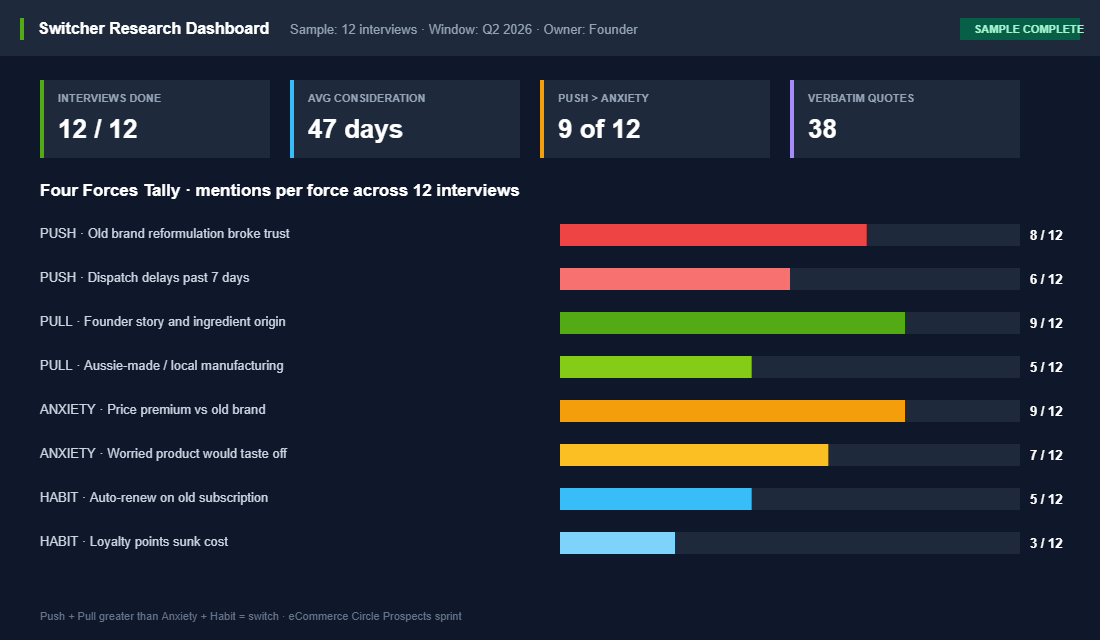
A switch only happens when Push + Pull is greater than Anxiety + Habit. Map this for 12 customers and the pattern is almost always loud: the same Push shows up six times, the same Anxiety shows up nine times. That repetition is the real research output. It tells you what to say in the next paid ad, the next PDP rewrite, and the next welcome email subject line.
How to Build a Switcher List in Klaviyo (The Filter Most Brands Miss)
You cannot interview switchers if you cannot find them. Most Shopify stacks are not configured to tag the cohort at all. Fix this once and you have an evergreen recruitment pool.
The easiest entry point is a post-purchase survey. Tools like Fairing (formerly Enquirelabs) sit on the order confirmation page and consistently see 40 to 80% response rates, against the 5 to 15% average that generic email surveys deliver. The single highest-value question for switcher research is not “How did you hear about us?” It is “What brand were you using before this purchase?” Free text, optional, no dropdown bias.
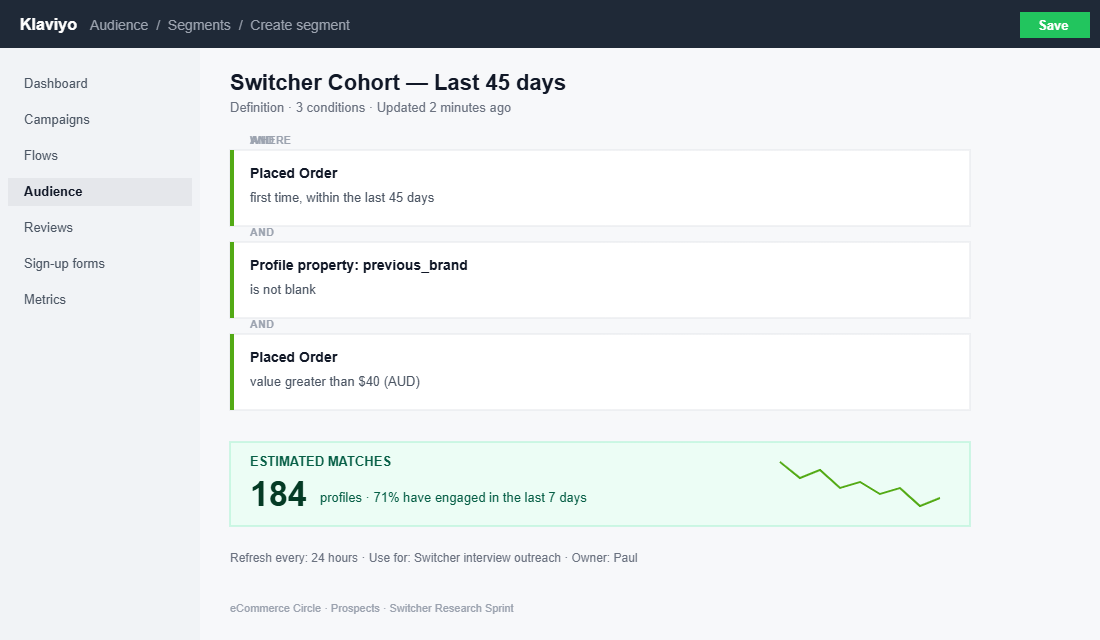
Pipe the response into a Klaviyo customer property called previous_brand. Now you can build a segment with three conditions:
- First purchase placed. Within the last 45 days. You want the switch decision fresh.
- Previous brand is not blank. They told you they were buying somewhere else before you.
- Order value greater than $40. Filters the free-shipping abusers and one-off gifters who do not have a real switch story.
On a $1.5m run-rate store, that segment usually lands between 80 and 250 contacts a month. That is plenty to recruit 12 interviews per quarter, which is the minimum sample to see repeating Push and Anxiety patterns. If your post-purchase survey is not live yet, that is the first thing to fix this week. It is a 30 minute install and it backfills your switcher list every single day from now on.
Bonus filter for sophisticated brands: cross-reference with your Voice of Customer feeds from Gorgias, Loop Returns, and review replies. Any contact who has mentioned a competitor by name in a chat or review qualifies for switcher outreach, even if they ignored the post-purchase survey.
The Outreach Sequence That Hits 30 to 40% Response
Cold “can we hop on a call” emails get ignored. Founders who actually fill the interview calendar use a three-touch sequence with a specific incentive, sent from a real person on a real domain. Here is the version that works.
Touch 1, day 0. Subject line: “Quick favour, Sarah.” Body is four sentences. You loved that they recently joined the brand. You are running a 20 minute research call to make the product sharper for people like them. There is a $50 store credit or charity donation for their time. Reply yes and you will send a Calendly link. No HTML, no logo, no marketing footer.
Touch 2, day 3. A one-sentence bump from the same thread. “Just bumping this in case it got buried.”
Touch 3, day 7. Subject line: “Last try, promise.” One sentence and a specific date. “We are closing recruitment Friday, would Wednesday at 11am AEST work?”
That sequence will sit around 30 to 40% positive reply rate for switchers, which is roughly 3 to 4x the rate of generic customer interview outreach. The incentive matters, but the bigger lever is sending from the founder’s real Gmail rather than the brand’s marketing domain. People reply to humans, not to hello@.
Track the funnel in a single Airtable or Google Sheet: invited, replied yes, booked, attended, transcribed. Aim for a 70% attendance rate from booked, which means you need to invite roughly 50 contacts to reliably get 12 completed interviews.
The 7-Question Switcher Interview Script
Print this. Use it on every call. The order matters because you are walking the switcher backwards through their own timeline, not forwards through their decision. Forwards invites rationalisation. Backwards forces specific recall.
- 1. “Take me to the day your first order arrived. Where were you and what did you do with it?” Anchors the customer in a real moment. You are looking for sensory detail: the kitchen bench, the bathroom shelf, the gym bag. This warms them up and gives you a real scene to use in creative.
- 2. “Before you bought from us, what brand were you using and how long had you been with them?” Establishes Habit. The longer the prior relationship, the heavier the inertia they overcame.
- 3. “Cast your mind back. What was the first moment you remember thinking your old brand was not quite right?” This is your Push question. Listen for a specific event, not a vague feeling. “The reflux.” “The dispatch delay.” “The reformulation.”
- 4. “Between that first thought and actually switching, how long did it take and what else happened?” Reveals the gap between awareness and action. Most switches take 30 to 90 days. This question maps the consideration window so you can time retargeting and email cadence to match.
- 5. “When you started looking, which brands were on the shortlist and how did you compare them?” Maps the competitive set the way the customer actually sees it, not the way you imagine it. You will get brand names you did not know you competed with.
- 6. “What almost stopped you from ordering from us specifically?” This is the Anxiety question. The most important single question in the script. Whatever they say here is the objection your PDP, ads, and welcome email need to defuse in the first frame.
- 7. “If a friend was using your old brand and complaining the same way you were, what would you tell them?” This is the verbatim quote you put in the next set of ads. People describe products to friends in language that is 10x sharper than anything a copywriter would write.
The whole interview should run 20 to 25 minutes. Record with permission via Zoom or Loom. Use a transcription tool like Otter or Fireflies. Do not skip transcription. The matrix step in the next section is impossible without it.
If you have never run founder-led interviews before, the warm-up details in our Founder-Led Customer Interview Playbook will save you the first three awkward calls.
The Switcher Insights Matrix: Turning 12 Interviews Into Positioning Gold
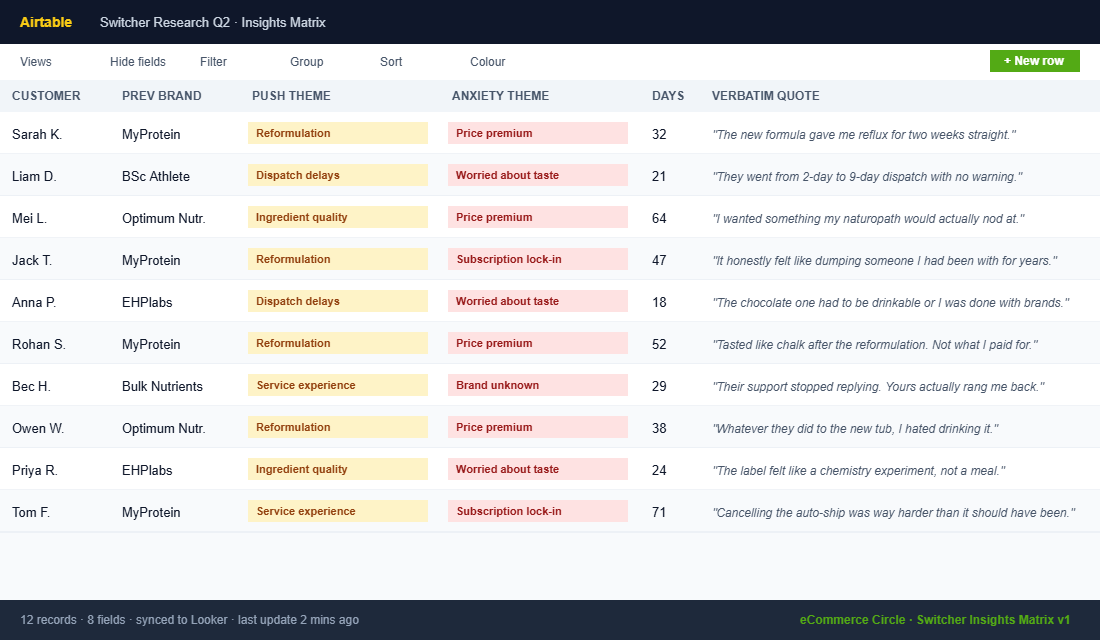
Twelve interviews give you about three hours of raw audio. Without a structure, you will drown in it. The Switcher Insights Matrix is a single Airtable or Google Sheet with one row per interview and these columns:
- Previous brand. The competitor they left.
- Time with previous brand. Months or years. Anchors the Habit force.
- Push trigger. The specific event or pattern that started the switch. Tagged into 5 to 7 themes (price, dispatch, formulation, service, ethics, range, format).
- Consideration window. Days from first doubt to first order.
- Shortlist. Other brands they evaluated alongside you.
- Pull factor. The single attribute they credit for choosing you.
- Anxiety. What almost stopped them. Tagged into 4 to 6 themes (price, fit, ingredient, brand trust, delivery).
- Verbatim quote. One direct quote per interview, copy paste ready.
Once the matrix is populated, pivot on the Push and Anxiety columns. You will almost always see two or three themes dominate. If “reformulation” shows up 6 of 12 times as a Push, that is your next paid ad angle. If “worried about the price” shows up 9 of 12 times as Anxiety, that is the headline of your welcome email two and the bullet point above your PDP add-to-cart button.
The matrix is not a strategy document. It is a content engine. Every row becomes either an ad hook, a PDP bullet, an email subject line, or a piece of social copy. A single round of 12 interviews typically produces 30 to 40 reusable assets if you mine it properly.
How to Wire Switcher Findings Into Ads, PDPs and Welcome Flows
Research that sits in a Notion doc is a vanity exercise. The whole point of switcher work is that within 30 days of the last interview, three things in your funnel should be visibly different.
Ads. Take the top three Push themes and write a paid creative for each. The hook is always a callout of the old brand experience without naming the competitor directly. “If your protein left you bloated by 11am, that is not the protein you are meant to drink.” This sort of negative-mirror hook converts cold Meta traffic at 1.5 to 2x the rate of feature-led creative, because the viewer recognises themselves in the first line.
PDPs. Take the top two Anxiety themes and answer them in the first scroll. If “I was worried it would taste chalky” is the dominant anxiety, you need a tasting note, a creator video, and a 30-day taste guarantee badge above the fold. Most Shopify PDPs answer features first and objections last. The data says the opposite is correct.
Welcome flow. Rewrite email one and two of your Klaviyo welcome to mirror the Push and the Anxiety. Email one acknowledges the frustration with the old way (Push). Email two defuses the objection that almost stopped the switcher from ordering (Anxiety). This single change typically lifts welcome flow placed-order conversion from 5% to 12% within a fortnight.
Aussie brands have proven this loop publicly. Who Gives A Crap built its entire homepage and ad system on the Push of “supermarket toilet paper feels like buying into a category I do not care about” and the Pull of “the same product, but you are funding toilets in developing nations.” That is a switcher insight industrialised. Frank Body turned the Push of “my skincare routine feels boring and clinical” into the cheeky, UGC-led brand voice that built a $20m business. Both are switcher economies dressed up as brand stories.
The Compound Effect: Why This Becomes an Unfair Advantage in 90 Days
One round of switcher research is useful. A quarterly cadence becomes unfair. Here is the compounding logic.
Round one teaches you what your switchers were running from. Round two, 90 days later, tells you whether your competitive set has shifted. Round three reveals which of your own product or service decisions have started to push your switchers away from you. You stop being surprised by churn because you have the same instrument pointed at both your acquisition and retention edges.
The financial impact is concrete. Aussie operators we work with typically see three things happen inside the first 90 days of running this loop properly:
- Meta cost-per-acquisition drops 18 to 32% as switcher-led creative replaces feature-led creative.
- Welcome flow placed-order rate lifts from 5 to 12% as the first two emails finally mirror the real buying conversation.
- PDP add-to-cart rate lifts 15 to 25% as the dominant anxiety gets defused above the fold instead of buried in the FAQ.
On a $2m run-rate store, those three lifts combine to roughly $300k to $500k in incremental annual contribution. That is a payback period measured in days for what is really 12 interviews and a spreadsheet. The reason most brands skip it is not effort. It is fear of hearing the truth from people who used to pay someone else.
If you want a stronger grounding in the broader research methodology, our deep dive on Jobs To Be Done for Shopify pairs perfectly with this switcher work.
Your Switcher Research Sprint: The 30-Day Checklist
Print this and pin it above your desk. Thirty days from today, the work below will have happened.
- Week 1. Install or audit Fairing (or equivalent post-purchase survey). Add “What brand were you using before this purchase?” as a question. Pipe the response into a Klaviyo property.
- Week 1. Build the switcher segment in Klaviyo with the three filters from earlier. Export the contact list.
- Week 2. Send the three-touch outreach sequence to the first 50 contacts. Book 12 interviews into your Calendly.
- Week 3. Run the interviews. 7 questions, 20 to 25 minutes each. Record and transcribe.
- Week 3. Build the Switcher Insights Matrix. Pivot on Push and Anxiety. Identify the top three of each.
- Week 4. Ship three new Meta ad concepts mirroring the top Push themes. Rewrite welcome emails one and two. Rewrite the first scroll of your top three PDPs to defuse the top Anxiety. Schedule the next round for 90 days from now.
Stick this on the wall. Do it once. Then never stop.
Cannot Get 12 Calls? The Async Switcher Survey That Still Works
Some founders read the interview script above and stall, because they run a $40k-a-month store solo and cannot find twelve 30-minute slots in a fortnight. Do not let that kill the project. An async version of switcher research gets you 70% of the insight for about 10% of the time, and it is a good enough starting point to fix your homepage headline next week.
Here is the cut-down build:
- Use the same Klaviyo switcher segment, but send a Typeform or Fillout survey instead of a call invite. Keep it to five open-text questions lifted straight from the script: what they used before, what pushed them to look, what nearly stopped them switching, what tipped it, and what would send them back. Open text only. Multiple choice hands them your assumptions.
- Incentivise properly. A $20 store credit lifts response from the usual 3 to 5% to somewhere between 12 and 18% on a warm segment. Send to 150 to 200 switchers and you will land 25 to 30 usable responses, which is more than enough to see patterns. Store credit also costs you far less than $20 in real margin and brings a chunk of them back for another order.
- Follow up the gold. Of those 25 responses, five will be unusually detailed. Reply to those five personally and ask for a 15-minute call. Those calls are your interviews, and they are far better than cold-booked ones because the customer has already shown they care.
- Code the answers the same way. Drop every response into the Switcher Insights Matrix exactly as you would with call notes. The words customers use in a text box are, if anything, closer to ad copy than what they say on a call, because they had time to phrase it.
Run the reverse version too. Pull a segment of customers who bought two or more times and then went silent for 120 days, and send the same five questions flipped: what did you switch to, and why. Response rates are lower, around 6 to 8% with the same credit, but the answers are the most valuable research you will ever read, because they tell you which of the four forces your competitors are winning on right now. Brands that do this often discover the “push” was something fixable and boring, like a delivery estimate that was two days too long, not a rival’s product.
Once you have a repeatable switcher pipeline, two things get easier. Positioning against cheap marketplace competition stops being guesswork, because you know exactly which moat the switchers name, which is the whole premise of the Temu-proof playbook. And the five people who gave you the best answers are your first candidates for a customer advisory board, so the research becomes an ongoing conversation instead of a project you run once and forget.
Inside eCommerce Circle, switcher research is one of the core projects we run with members during the Prospects sprint of the More Orders Operating System. If you want a second opinion on yours, let’s talk. If you want to see which of the 10 P’s is capping your orders right now, take the free More Orders Scorecard. It takes two minutes and tells you exactly where to start.