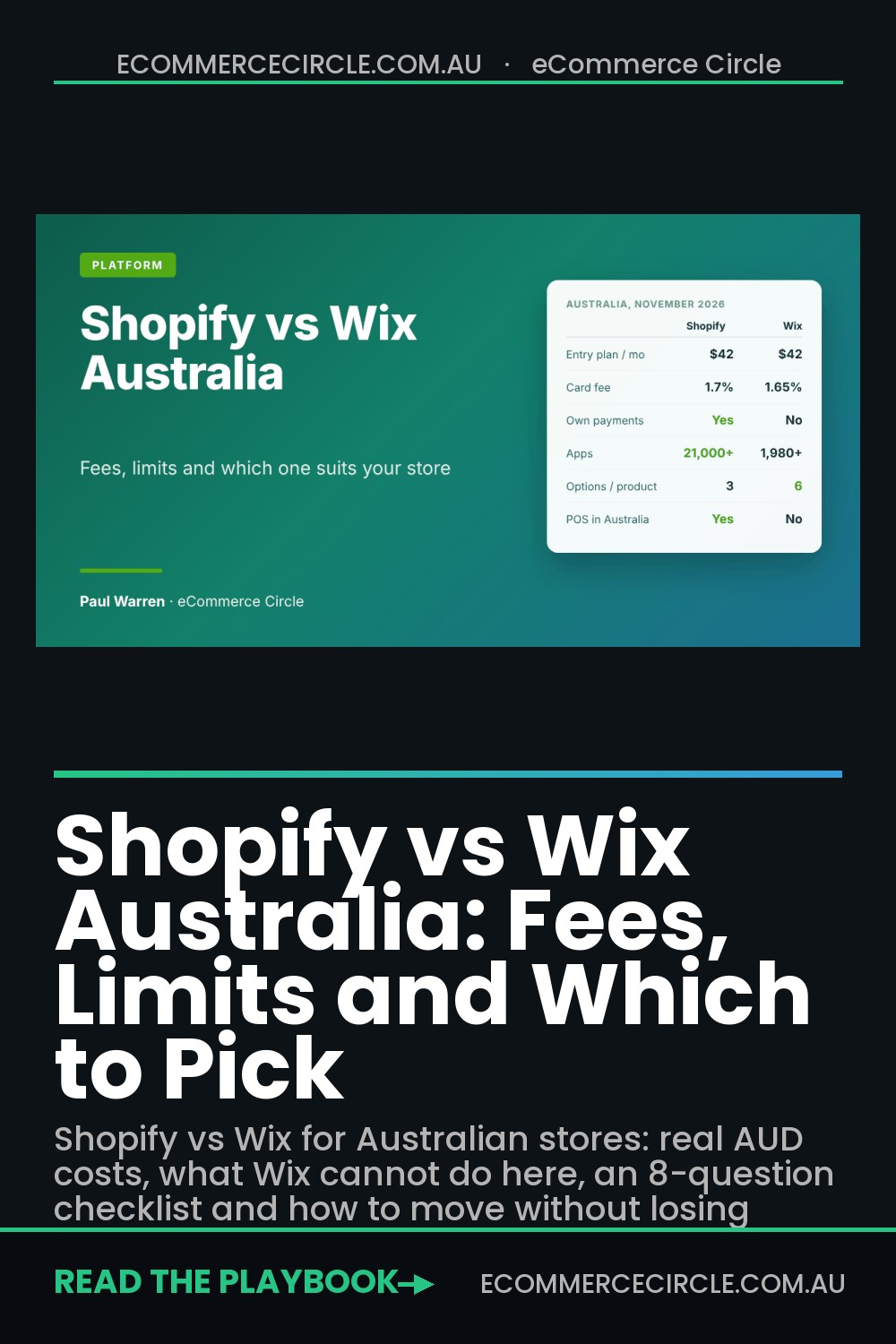
Shopify is the better pick for an Australian store whose main job is selling products, and Wix is the better pick when the website comes first and the shop is a side feature. Running costs are close to identical. On $10,000 a month in sales the two land within about $5 of each other, so fees should not make the call.
Most founders pick between these two the wrong way. They compare the monthly plan price, see that Wix looks a few dollars cheaper, and sign up. Twelve months later they are trying to add Afterpay, a loyalty app, a stocktake tool and a market stall card reader, and finding out which of those the platform can and cannot do in Australia.
The founders who get it right ask a different question: what will this store need to do in two years, and which platform does that without a rebuild? This guide runs the real Australian numbers, lists the limits on each side, and gives you an eight-question checklist so you can decide in ten minutes.
Shopify vs Wix in Australia: The Quick Answer
Here is the short version before the detail. Every figure was checked on 16 November 2026.
| Shopify | Wix | |
|---|---|---|
| What it is | Ecommerce platform built for selling products | Website builder with a store added on |
| Entry plan that can sell | Basic: $42 a month on yearly billing, $56 month to month (AUD) | Core: about $42 a month on yearly billing, GST included (AUD) |
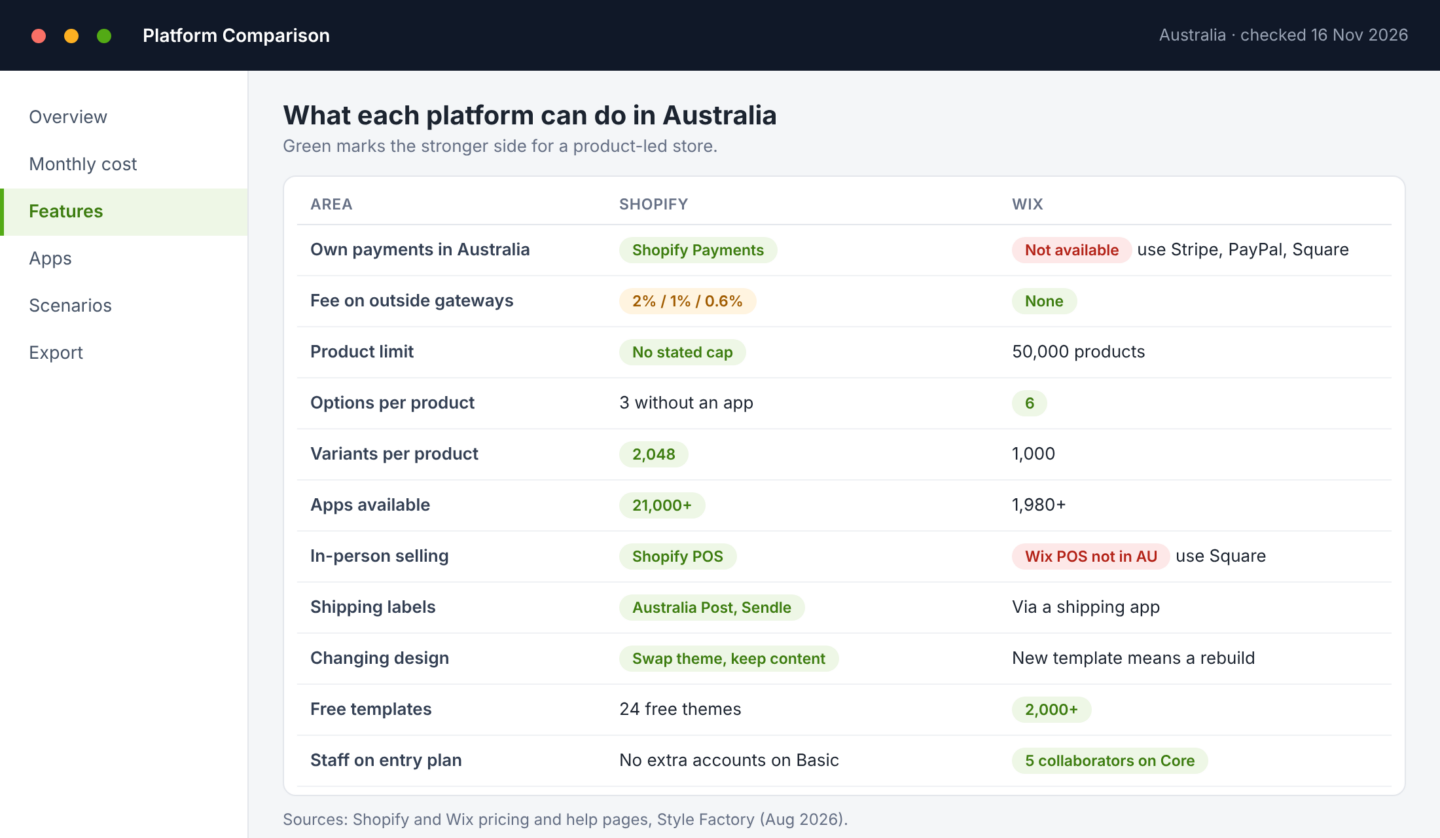
| Own payment system in Australia | Yes. Shopify Payments, 1.7% + 30c on Basic | No. Wix Payments is not offered here, so you connect Stripe, PayPal, Square or similar |
| Fee for using another gateway | 2% on Basic, 1% on Grow, 0.6% on Advanced | None from Wix |
| Product limit | No stated cap | 50,000 products |
| Options and variants per product | 3 options, 2,048 variants | 6 options, 1,000 variants |
| Apps | 21,000+ | 1,980+ |
| In-person selling in Australia | Shopify POS | Wix POS is US, Canada and UK only. Use Square |
| Change your design later | Swap themes and keep your content | Changing template means rebuilding the site |
| Best for | Product brands that plan to grow | Service, content and booking sites that sell a few products |
Sources: Shopify’s Australian pricing page, Wix’s plans page, Wix’s own Wix Payments country list, Wix Stores limits, and Style Factory’s August 2026 Wix vs Shopify review for the app counts and Shopify variant limits.
One note on the Wix price. Wix shows US visitors US$29 a month for Core, before tax. The $42 Australian figure, GST included, comes from Aspire’s October 2026 platform comparison. Confirm the number on Wix’s checkout page before you commit, and check whether GST is added on either platform.
How Many Australian Stores Use Each One
Both are big here, which is why the choice is hard. BuiltWith’s tracker, updated 13 November 2026, counts 173,698 Australian sites running Shopify and 113,778 running Wix Stores, out of 582,674 ecommerce detections. That puts Shopify at about 30% and Wix Stores at about 20%.
Read those numbers with care. BuiltWith counts websites where it detects the technology. It does not count sales. A hobby store with three orders a year counts the same as a brand turning over millions.
The gap shows up when you look at who is using each one. Shopify Plus, the enterprise tier, has another 6,581 Australian sites on the same tracker. Wix’s base leans toward tradies, studios, consultants and makers with a short product list. Neither is a mark against the platform. It tells you what each was designed to do well.
What Each Platform Costs an Australian Store
Plan prices first, then the fees that sit on top.
| Monthly billing | Yearly billing (per month) | Notes | |
|---|---|---|---|
| Shopify Basic | $56 | $42 | 1.7% + 30c domestic cards |
| Shopify Grow | $149 | $114 | 1.55% + 30c, 5 extra staff accounts |
| Shopify Advanced | $575 | $431 | 1.35% + 30c, 15 extra staff accounts |
| Wix Core | Check at checkout | About $42 | Basic ecommerce, 50 GB storage, 5 collaborators |
| Wix Business | Check at checkout | About $55 | Standard ecommerce, 100 GB, 10 collaborators, multiple currencies |
| Wix Business Elite | Check at checkout | About $199 | Advanced ecommerce, unlimited storage, 100 collaborators |
Shopify also runs a starter offer. On 16 November 2026 its pricing page showed three days free, then $1 a month for the first three months. Wix lets you build for free and gives a 14-day money-back guarantee once you pay. The Wix Light plan, the cheapest paid one, cannot take payments, so ignore it for a store.
The payment fee is where people get confused
Shopify has its own processor in Australia. Turn on Shopify Payments and you pay 1.7% + 30c on domestic cards on Basic, 2.9% + 30c on Amex and 3.5% + 30c on international cards. Our Shopify Payments fees breakdown walks through every line.
Wix does have its own processor, but not here. Wix’s help centre lists 15 countries for Wix Payments and Australia is not one of them. So an Australian Wix store connects an outside gateway. Wix lists Stripe, PayPal, Square, eWAY, Fat Zebra and Afterpay among the providers that work in Australia.
The good news for Wix sellers is that Wix adds no fee of its own on top. You pay the gateway’s rate and nothing more. Stripe’s Australian pricing is 1.65% + 30c on domestic cards and 3.5% + 30c on international cards.
Shopify does the opposite. If you skip Shopify Payments and use an outside gateway as your card processor, Shopify charges 2% of the sale on Basic on top of the gateway’s own fee. On $10,000 a month that is $200 you did not need to spend. Use Shopify Payments unless your product category is not eligible for it.
Worked example: two store sizes
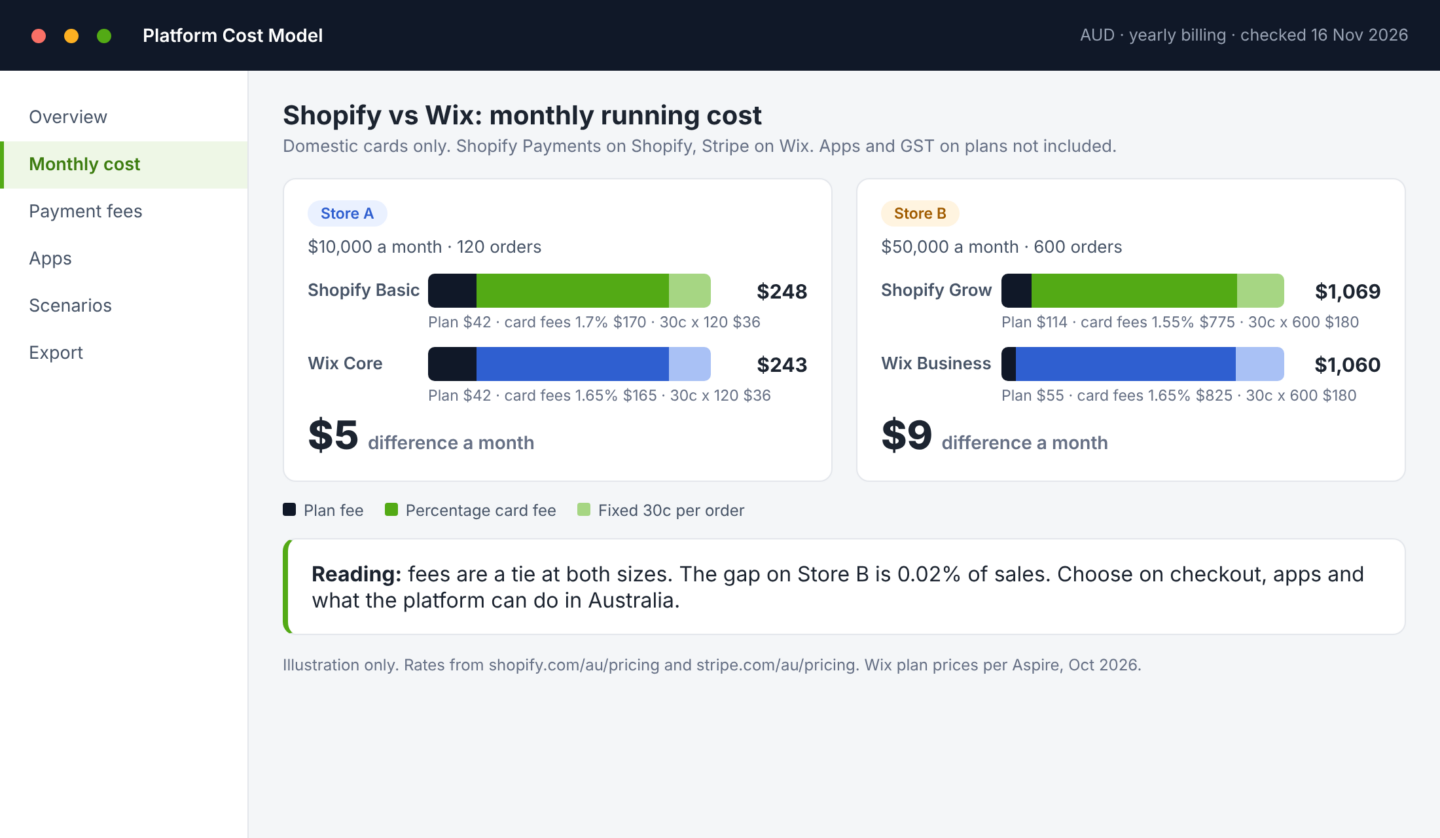
This is an illustration, not a quote. It assumes every order is paid with a domestic Visa or Mastercard, yearly billing, Shopify Payments on Shopify and Stripe on Wix. It leaves out apps, Amex, PayPal, Afterpay, international cards and GST on the plan.
| Shopify | Wix | |
|---|---|---|
| Store A: $10,000 a month, 120 orders | Basic plan 42 + card fees 170 + fixed fees 36 = $248 | Core plan 42 + card fees 165 + fixed fees 36 = $243 |
| Store B: $50,000 a month, 600 orders | Grow plan 114 + card fees 775 + fixed fees 180 = $1,069 | Business plan 55 + card fees 825 + fixed fees 180 = $1,060 |
Five dollars apart at the small end. Nine dollars apart at the larger end. On Store B that gap is 0.02% of sales.
So stop comparing fees. They are a wash. The real cost difference comes from apps, from time lost to workarounds, and from the sales a weaker checkout or a missing feature costs you. Those are the things to compare.
Where Wix Is the Better Choice
Wix gets written off by ecommerce people far too quickly. For the right business it is the smarter pick.
- You are a service or content business first. A yoga studio that takes bookings and sells a few mats. A photographer selling prints. A consultant with one paid course. Wix puts bookings, a blog and a small shop on one site without bolting on apps.
- You want full control of the layout without a developer. Wix’s editor lets you drag any element anywhere, and it ships with more than 2,000 templates, all free. Shopify’s theme editor is more structured, and Style Factory counts 24 free Shopify themes, with premium ones priced from US$100 to US$500.
- Your products have lots of options. Wix allows 6 options per product. Shopify allows 3 without an app. If you sell a custom item with size, colour, material, finish, engraving and gift wrap, Wix handles that natively.
- You need more people logged in on a small plan. Wix Core includes 5 site collaborators. Shopify Basic does not include extra staff accounts at all.
- You like a phone number to call. Style Factory’s review notes Wix offers phone support, while Shopify’s regular plans are chat only.
- You already use a gateway you like. Wix charges nothing extra for it.
If you sell fewer than about 20 products, do not plan to run paid ads at scale, and your website has to do other jobs as well, Wix will serve you well. Build it, launch it, and get on with the business.
Where Shopify Pulls Ahead
Once selling products is the main game, the list tips the other way.
The checkout
Checkout is where the money is made or lost, and Shopify has spent nearly two decades on its one. Shopify’s own research, run by a major consulting firm, found its checkout converts 15% better on average than competing platforms, and up to 36% better. Treat that as a vendor claim. Shopify paid for the study and does not name the competitors. But even a fraction of that lift is worth more than any plan saving.
Do the sums on your own store. If you turn over $20,000 a month and a better checkout lifts conversion by 5%, that is $1,000 a month in extra sales. The entire difference between the two platforms’ fees was nine dollars.
Payments in one place
With Shopify Payments, your orders, payouts, refunds and chargebacks sit in one dashboard, and customers can pay with Shop Pay. On Wix in Australia you manage the gateway in a separate account and reconcile the two. That is a small annoyance at 30 orders a month and a weekly job at 600.
Apps
Shopify’s app store has more than 21,000 apps. Wix’s has about 1,980. The raw count matters less than what it means in practice: whatever problem you hit, somebody has already built the Shopify fix. Subscriptions, bundles, pre-orders, returns portals, reviews and wholesale pricing all have several mature options.
A warning from the other side. Apps are also how Shopify gets expensive. As a rule of thumb, budget $50 to $150 a month for apps on a small store and audit them every quarter. Our Shopify review for Australian stores covers the true running cost.
Selling in person
If you do markets, pop-ups or have a shopfront, this one decides it. Wix’s help centre says Wix POS Register is available in the US, Canada and UK, and it needs Wix Payments, which Australia does not have. Australian Wix sellers use Square for in-person sales. Shopify POS works here and shares stock and customer records with your online store.
Shipping
Shopify Shipping lists Australia Post and Sendle among its carriers, so you can buy and print labels inside the order screen. On Wix you will add a shipping app for the same job.
Design changes and reporting
Two quieter points. On Shopify you can swap themes and keep your products, pages and content. On Wix, changing template means rebuilding the site. And Style Factory counts more than 200 report types on Shopify against 16 ecommerce reports on Wix. When you start asking which products bring customers back, you will want the deeper reports.
The Eight-Question Checklist
Answer these honestly. Count your Shopify answers.
- Is selling products more than half of what the site is for? Yes points to Shopify. No points to Wix.
- Will you have more than 50 products within two years? Yes points to Shopify.
- Do you sell in person, or plan to? Yes points to Shopify.
- Will you spend more than $1,000 a month on ads? Yes points to Shopify. Paid traffic makes checkout conversion matter more.
- Do you need subscriptions, bundles, pre-orders or wholesale pricing? Yes points to Shopify.
- Do you plan to sell to New Zealand, the US or the UK? Yes points to Shopify, where multi-currency selling is on every plan. On Wix it starts on Business.
- Do you need bookings, events or a large content site alongside the shop? Yes points to Wix.
- Do your products need more than 3 options each? Yes points to Wix, or to a Shopify app.
Five or more Shopify answers: go Shopify and do not look back. Three or fewer: Wix will do the job and cost you less time. Four is the grey zone. In the grey zone, pick the one that matches where you want the business to be in two years, because moving later costs more than choosing well now.
Platform is one of the 10 P’s we score, and this checklist is a cut-down version of what the Platform section of the Scorecard asks.
Real Australian Brands and What Replatforming Did
We could not find a published Australian case study of a Wix to Shopify move with audited numbers, so here are two local brands that moved to Shopify from other platforms. They show the size of the prize when a store outgrows its setup. Both come from Shopify’s own case study library, so they are the wins Shopify chose to publish.
Mocka. The furniture and homewares retailer sells across Australia and New Zealand. It moved from BigCommerce to Shopify in 2024. Before the move, a product upload or promotion rollout could take up to six hours across several team members. Per Shopify’s case study, Australian sales rose 31% year on year in FY25 and quarterly average order value rose 13%.
Abode Living. The Melbourne bed linen maker, founded in 1991, moved from WooCommerce to Shopify Plus. Shopify reports a 25% lift in average order value since the migration and a 53% year-on-year rise in peak sales. It then used Shopify Markets to open New Zealand.
Notice what both stories have in common. Neither brand moved to save on fees. They moved because the old setup made every change slow. Speed of change is the thing to watch in your own store. If adding a promotion, a product or a new payment method takes you days, you have outgrown your platform. Our Shopify vs WooCommerce comparison covers the same trade-off for self-hosted stores.
Six Signs You Have Outgrown Wix
Already on Wix? You do not need to move just because someone on a podcast said so. Move when at least two of these are true.
- You are reconciling payouts by hand across Wix orders and a separate gateway every week.
- You want to sell in person and are running Square beside your store with stock in two places.
- You have hit a ceiling. A product needs more than 1,000 variants, or the catalogue is heading toward 50,000 products.
- You need a feature and the Wix app does not exist or has a handful of reviews.
- You want a redesign and have learned that a new template means rebuilding every page.
- Ads are now your main traffic source and each 0.1% of conversion rate is worth real money.
If you sell on a marketplace as well, the same thinking applies. Our Etsy vs Shopify guide has the signals for that move.
How to Move From Wix to Shopify Without Losing Rankings
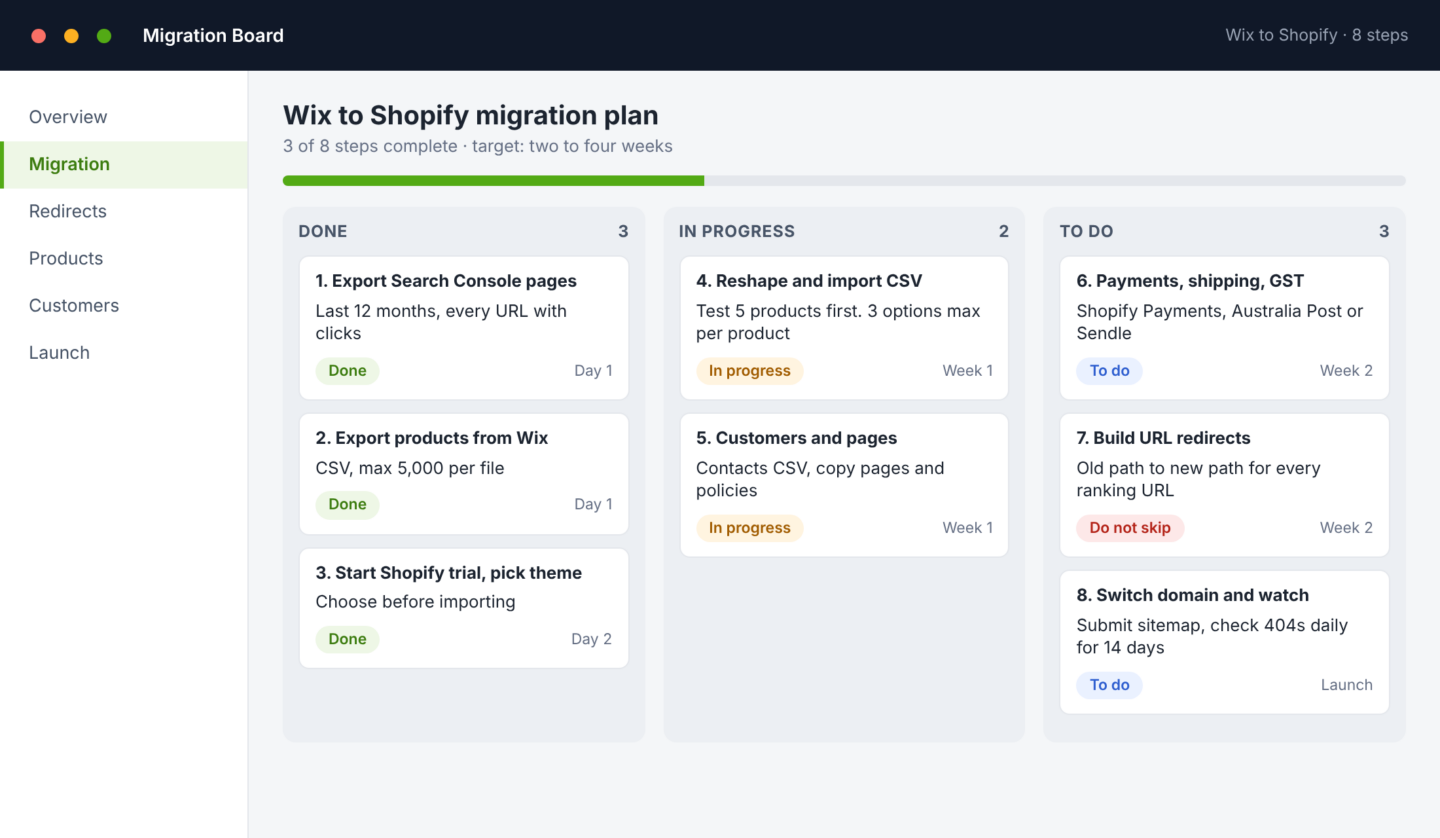
A small catalogue can move in a weekend. Allow two to four weeks to do it properly. The step most people skip is redirects, and it is the one that protects your Google traffic.
- Record what you have. Open Google Search Console, go to Performance, then Pages, and export the last 12 months. That gives you every URL that earns clicks. Keep the file.
- Export products from Wix. In the Wix dashboard, open Store Products and use the export option to download a CSV. Style Factory notes exports are capped at 5,000 products per file and digital products cannot be exported, so plan for a manual step if you sell downloads.
- Start the Shopify trial and pick a theme before you import anything.
- Reshape and import the CSV. Download Shopify’s sample product CSV, match your Wix columns to it, then in Shopify admin go to Products, then Import. Test with five products first. Remember Shopify allows 3 options per product, so anything with 4 to 6 options on Wix needs restructuring or an options app.
- Export customers and re-create pages. Customer contacts export from Wix as a CSV. Pages, blog posts and policies need copying across by hand or with a paid migration tool such as LitExtension.
- Set up payments, shipping and tax. Turn on Shopify Payments, connect Australia Post or Sendle, and set GST to be included in prices.
- Build your redirects. Wix and Shopify use different URL structures. For every URL in your Search Console export, add a redirect in Shopify. Search for “URL redirects” in the Shopify admin search bar, or bulk-upload them with a two-column CSV of old path and new path.
- Switch the domain and watch. Point your domain at Shopify, submit the new sitemap in Search Console, and check for 404 errors daily for two weeks.
Customer passwords do not transfer between platforms. Email your customers the week you switch, tell them why the site looks different, and ask them to reset their password. Add a small offer and it doubles as a relaunch campaign.
Common Questions
Is Wix or Shopify cheaper in Australia?
They cost about the same. The entry ecommerce plans are both around $42 a month on yearly billing, and domestic card fees are 1.7% + 30c on Shopify Payments against 1.65% + 30c through Stripe on Wix. On $10,000 a month in sales the gap is about $5.
Can I use Wix Payments in Australia?
No. On 16 November 2026, Wix’s help centre listed 15 countries for Wix Payments and Australia was not among them. Australian Wix stores connect a third-party provider such as Stripe, PayPal or Square.
Does Wix support Afterpay in Australia?
Yes. Wix lists Afterpay as a payment provider for Australia, Canada, New Zealand and the United States. Shopify supports Afterpay in Australia too.
Is Wix good enough for a small online store?
Yes, if the store is small and likely to stay that way, or if the website has other jobs such as bookings and content. It allows up to 50,000 products, so product count is rarely the thing that stops you. Checkout, apps and in-person selling are.
Will I lose my Google rankings if I move from Wix to Shopify?
Not if you redirect every old URL to its new one before you switch the domain. Expect some movement for a few weeks either way. Stores that skip redirects are the ones that lose traffic.
Which is better for dropshipping in Australia?
Shopify. Style Factory counted 934 dropshipping apps in Shopify’s store against 48 in Wix’s, and Wix caps dropshipped products through its Modalyst integration at 25 on the Core plan.
How the Pieces Fit Together
Line it all up and the decision gets simple. Price is a tie. Wix wins on design freedom, product options and doing several jobs on one site. Shopify wins on checkout, local payments, apps, in-person selling, shipping and reporting.
Every one of Shopify’s wins gets bigger as you grow. A 5% lift from a better checkout is worth $50 a month at $1,000 in sales and $2,500 a month at $50,000. A missing app is a shrug at ten orders a week and a staff member’s whole Friday at a hundred. That is why the right answer depends on where you are heading more than where you are today.
So run the eight questions today. If you score five or more for Shopify and you are on Wix, export your Search Console pages this week and book a migration weekend within the next 30 days, before you add more products that will need moving. If you score three or fewer, stay put and spend the time on traffic.
Inside eCommerce Circle, Platform is one of the 10 P’s we work through with every member, and the question is always the same: is your platform helping you sell, or making you work around it? If you want to see exactly where your store is being held back, take the free More Orders Scorecard. It takes two minutes and shows you which of the 10 P’s to fix first. Or if you would like help planning the move, start in Connect.