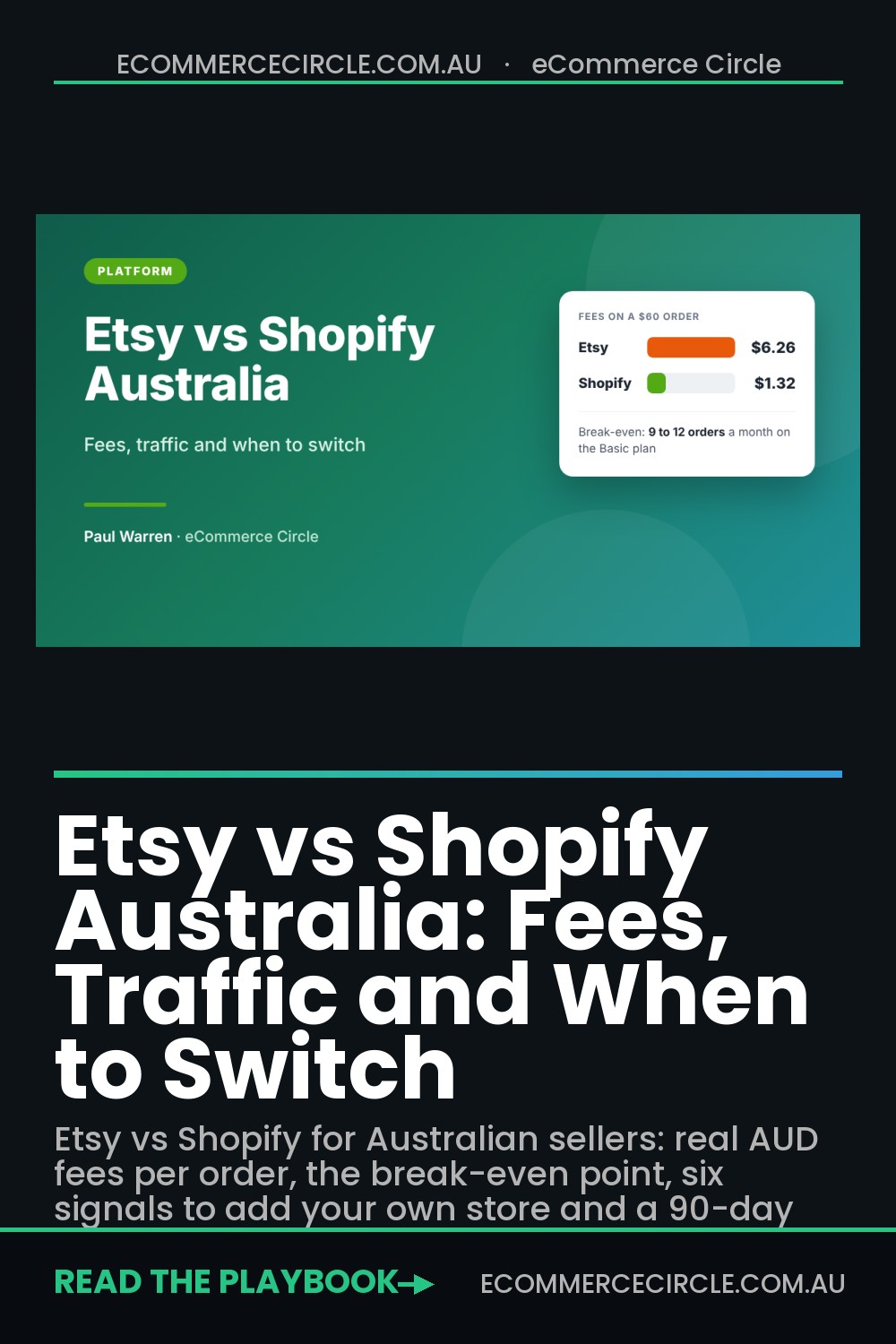
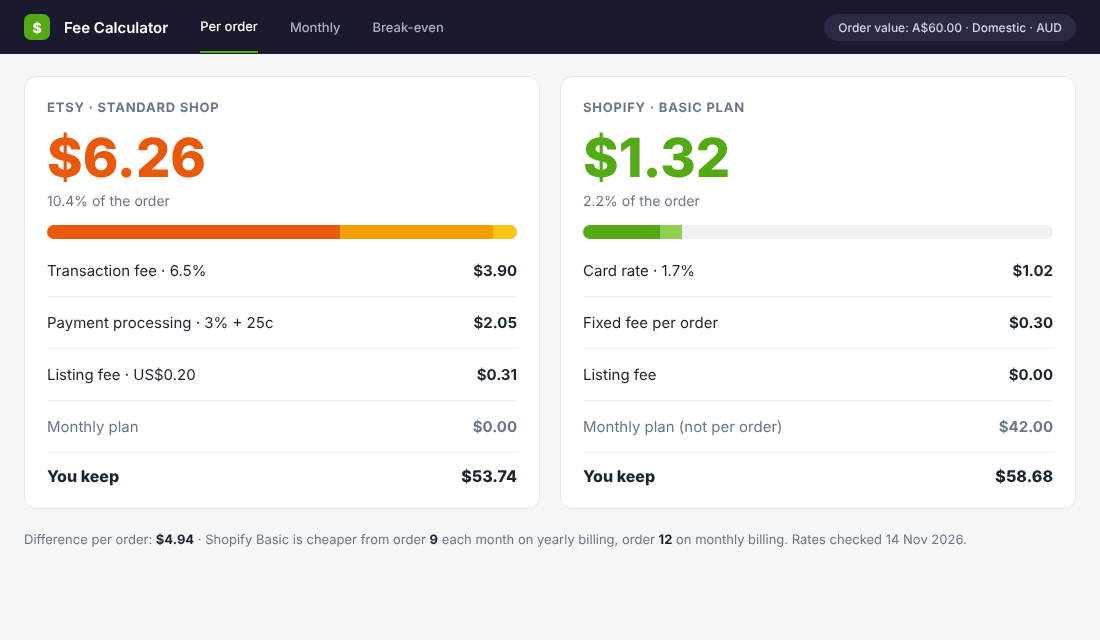
Etsy is the better place to start and Shopify is the better place to grow. On a $60 order an Australian seller pays Etsy about $6.26 in fees against roughly $1.32 on Shopify Basic, so once you sell more than about 9 to 12 orders a month, your own store is the cheaper one to run.
Most makers get this decision wrong in one of two ways. Some stay on Etsy for years because the sales keep trickling in, and never notice they are handing over more than 10% of every order to a business that owns their customers. Others rage-quit Etsy after a fee rise, launch a Shopify store on a Sunday night, and then wonder why nobody turns up.
The sellers who get it right treat the two as different tools. Etsy is a marketplace that lends you buyers. Shopify is a store you own that you have to fill yourself. This guide puts real Australian numbers on both, shows you the six signals that say it is time to add your own store, and gives you a 90-day plan for running the two side by side.
Etsy vs Shopify in Australia: The Quick Answer
Here is the short version before the detail.
| Etsy | Shopify | |
|---|---|---|
| What it is | Marketplace. Your shop sits inside Etsy next to millions of others | Your own store on your own domain |
| Monthly cost | $0 on the standard plan | Basic is $42 a month on yearly billing, $56 month to month (AUD) |
| Fee on a domestic sale | 6.5% transaction fee, plus 3% + 25c payment processing, plus a US$0.20 listing fee | 1.7% + 30c with Shopify Payments on Basic |
| Fees on a $60 order | About $6.26 (10.4%) | About $1.32 (2.2%), plus the plan fee |
| Where buyers come from | Etsy search, the Etsy app and Etsy ads | You bring them: ads, Google, email, social |
| Who owns the customer | Etsy | You |
| Best for | Testing a product and making your first sales | Building a brand with repeat customers |
Etsy fees are from Etsy’s Fees and Payments Policy and its payment processing fee table. Shopify prices are from Shopify’s Australian pricing page. All were checked on 14 November 2026. Fees change, so confirm them in your own accounts before you decide.
Look at the two rows in the middle. Etsy costs you roughly five times as much per order. Shopify costs you nothing per order that Etsy would not also charge, but it sends you zero buyers. Every other difference between the two flows from that trade.
What Etsy Really Costs an Australian Seller
Etsy looks free because there is no monthly bill. The cost is in the stack of small fees that come out of each sale before the money reaches your bank account.
These are the fees that apply to a standard Australian shop:
- Listing fee: US$0.20 per item. Charged when you list, again every four months when the listing auto-renews, and again each time a multi-quantity listing sells. Wise’s guide for Australian Etsy sellers puts it at about 31 cents in Australian dollars.
- Transaction fee: 6.5%. Charged on the item price plus whatever you charge for shipping and gift wrapping. This catches people out. If you charge $12 postage, Etsy takes 6.5% of that too.
- Payment processing: 3% + 25c. That is the rate for Australian sellers on domestic orders. Orders from overseas buyers cost 4% + 25c.
- Offsite Ads: 15% or 12%. When Etsy advertises your item on Google or social media and that click leads to a sale, you pay 15% of the order. More on this below, because it is the one that hurts.
- Currency conversion: 2.5%. Only if you list in one currency and get paid in another. List in AUD with an Australian bank account and you avoid it.
Add the first three together on a $60 domestic order and you get $3.90 in transaction fee, $2.05 in payment processing and about 31 cents for the listing. That is $6.26, or 10.4% of the sale.
On a $40 order the same maths gives you $4.36, which is 10.9%. The fixed fees bite harder on small orders, so low-ticket shops pay the highest effective rate.
The Offsite Ads fee you cannot switch off
Offsite Ads is where a growing shop gets a nasty surprise. Etsy’s policy says the standard fee is 15% of any order that came from one of its off-platform ads. While your shop has made less than US$10,000 in the past 365 days, you can opt out.
Once you pass US$10,000 in a year, somewhere around A$15,000 depending on the exchange rate, you are enrolled for good. The rate drops to 12%, the fee is capped at US$100 per order, and the policy says it stays that way for the life of the shop even if your sales fall back under the threshold.
So the reward for building a successful Etsy shop is a compulsory ad fee. On a $60 order that came through an Offsite Ad, you pay the usual $6.26 plus another $7.20. That is 22% of the sale gone before you have bought materials or postage.
What about GST?
Etsy’s policy says tax is collected on seller fees in countries where it applies, so check your monthly Etsy statement to see whether GST is being added to yours. If you are registered for GST you can normally claim it back, and you need to register once your turnover reaches $75,000 a year. Our GST guide for online stores covers the rest, and your accountant should confirm your own position.
What Shopify Costs for the Same Sales
Shopify flips the model. You pay a fixed monthly fee, and the cost per order is small.
The Basic plan is $42 a month if you pay yearly, or $56 month to month. With Shopify Payments the card rate on Basic is 1.7% plus 30 cents for a standard Australian card. There is no listing fee and no commission on the sale. Our breakdown of Shopify Payments fees in Australia goes through every plan and the premium card rates.
On that same $60 order, Shopify takes $1.02 plus 30 cents. That is $1.32, or 2.2%.
The gap between the two is $4.94 an order. Divide the plan fee by that gap and you get your break-even:
- $42 a month (yearly billing): Shopify is cheaper from the 9th order each month.
- $56 a month (monthly billing): Shopify is cheaper from the 12th order each month.
- At a $40 average order: break-even moves out to 13 to 17 orders a month.
- At a $100 average order: it drops to 6 or 7 orders.
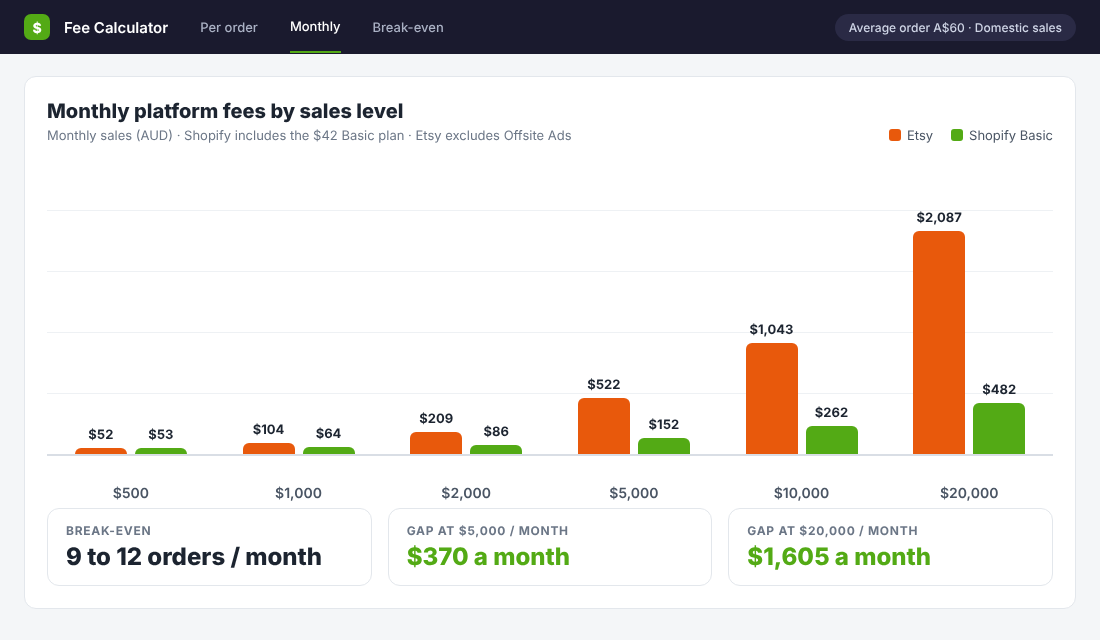
Here is how that plays out as a shop grows, using a $60 average order and domestic sales only.
| Monthly sales | Orders | Etsy fees | Shopify Basic (fees + plan) | Difference |
|---|---|---|---|---|
| $500 | 8 | $52 | $53 | Even |
| $1,000 | 17 | $104 | $64 | $40 |
| $2,000 | 33 | $209 | $86 | $123 |
| $5,000 | 83 | $522 | $152 | $370 |
| $10,000 | 167 | $1,043 | $262 | $781 |
| $20,000 | 333 | $2,087 | $482 | $1,605 |
These are my own calculations from the published rates, before GST. The Etsy column assumes one listing fee per order and no Offsite Ads sales. If one order in ten comes through Offsite Ads at 12%, add $240 a month to the Etsy column at $20,000.
The costs that table leaves out
It would be dishonest to stop there, because Shopify has costs Etsy does not.
- A domain. Budget $20 to $30 a year for a .com.au.
- Apps. Reviews, email and shipping tools can add $0 to $150 a month. Start with the free tiers.
- Traffic. This is the big one. Etsy’s 10% is partly a marketing fee. On Shopify you fund your own.
So read the “Difference” column as a marketing budget. At $5,000 a month, moving those sales to your own store frees up $370 a month. The question is whether you can use $370 to bring in the same buyers Etsy was sending you. Early on, usually not. Once people search for your brand by name, easily.
The Traffic Question: Borrowed Buyers vs Customers You Own
Fees are the easy part to compare. Traffic is what decides whether a move works.
Etsy had 86.6 million active buyers and 5.6 million active sellers in the first quarter of 2026, according to its Q1 2026 earnings call. On the same call, management said about 47% of sales now happen in the Etsy app. Those buyers open Etsy with a card ready and a gift in mind. A brand new shop with good photos and sensible titles can get a sale in its first week without spending a cent on ads.
A brand new Shopify store gets nothing. No search bar full of shoppers, no app, no “you might also like”. You have to earn every visit.
Now look at the other side of that deal. There are roughly 15 buyers for every seller on Etsy, and your listing sits on a page with dozens of lookalikes. Etsy decides which ones show first. It also decides what happens after the sale.
- You do not get a marketing list. Etsy handles the relationship. Its rules restrict you from adding buyers to your own email list without their consent, so your 400 past customers are not an audience you can reach when you launch something new.
- Your shop looks like Etsy. Same layout, same checkout, same orange. Ask a customer where they bought it and most will say “on Etsy”, not your brand name.
- Competitors sit beside you. Every product page shows similar items from other shops. You pay for the visit and Etsy shows your buyer someone cheaper.
- The rules change without you. The transaction fee went from 5% to 6.5% in 2022. Search ranking, ad programs and policies shift, and you find out afterwards.
On your own store, every buyer goes into your email list, sees only your products and remembers your name. That is what makes repeat sales cheap. A welcome flow, an abandoned cart flow and a post-purchase flow will do more for a small store than any ad, and none of them are possible on Etsy. Our guide to the 9 Klaviyo flows every Shopify store needs lists the ones to build first.
Shopify also has a checkout advantage once the buyer arrives. Shopify says Shop Pay has more than 150 million users and that its checkout lifts conversion by 15% on average. That is Shopify’s own figure, so treat it as a vendor claim, but it matches what I see in member stores: returning Shop Pay buyers check out in a couple of taps.
Who Should Stay on Etsy (For Now)
I am a Shopify coach and I will still tell some people to stay put. Etsy is the right home if most of these are true:
- You sell fewer than 10 orders a month. The plan fee would cost more than you save.
- You are still testing the product. Etsy is the cheapest market research in ecommerce. List six variations, see which one sells, and you have spent under $2.
- It is a side income and you want it to stay that way. No marketing, no email list, no site to maintain. That is a fair choice.
- Your buyers search for a thing, not a brand. “Personalised dog tag” and “printable wedding sign” are Etsy searches. People are not looking for a maker by name.
- You have no time to market. A Shopify store with no traffic plan is a $42 a month hobby.
If that is you, stay, and put your effort into photos, titles and reviews. If you are still working out what to sell at all, start with our guide on what to sell online in Australia.
Six Signals It Is Time to Add Shopify
Notice the word “add”. Almost nobody should switch off a working Etsy shop. The move is to open your own store next to it and shift the weight over time.
Score yourself on these six. Each one is a yes or a no.
- You sell more than 12 orders a month, three months running. You are past break-even on any Shopify billing option.
- You are near or past US$10,000 a year on Etsy. Compulsory Offsite Ads is about to lift your effective fee, or already has.
- More than 20% of your orders are repeat buyers. Those people would buy from you anywhere. You are paying Etsy 10% to process orders it did not find.
- People search for your shop by name. Check your Etsy stats for searches containing your shop name, and look at your Instagram messages. Brand searches belong on a site you own.
- You have an audience outside Etsy. 1,000 or more engaged Instagram or TikTok followers, a market stall crowd, or wholesale accounts.
- You want to do something Etsy will not let you. Bundles, subscriptions, a loyalty program, wholesale pricing, pre-orders or email marketing.
How to read your score. Zero to two: stay on Etsy and keep building. Three or four: open a Shopify store and run both. Five or six: you are overdue, and every month you wait costs you the “Difference” column in the table above.
Real Brands That Made the Move
This is not theory. The pattern of “start on Etsy, graduate to your own store” is one of the most common brand stories in ecommerce.
Simone Walsh Jewellery (South Australia)
Simone Walsh listed a few pieces on Etsy in 2006, sure that nobody would buy jewellery they could not see in person. On her own site she writes that the first one sold thirty minutes later. By mid-2007 she had launched her own online store, and an Onya Magazine profile notes she was among Shopify’s first 1,000 merchants and now sells only through her own store.
Her reason is the cleanest summary of the trade-off I have read: “Stores are dominated by Etsy’s branding and rules.” Etsy proved the demand in half an hour. Her own store built two decades of business.
Old World Kitchen (USA)
The Polder family started selling hand-carved wooden spoons on Etsy and made their first sale three days after launching. When they opened a Shopify store, business manager Loran Polder told Shopify: “We were just absolutely blown away, because our conversion rate went up so much.” Her explanation: “There’s a huge amount of distraction on Etsy.” Their own store now makes most of the brand’s sales, and it let them add email marketing and products from partner brands.
Brooklyn Candle Studio (USA)
Founder Tamara Mayne opened an Etsy shop to test whether candles would sell online where nobody could smell them. About six months in she landed a $4,000 order. Her advice on the Shopify Masters podcast was to “always do a Shopify in tandem with an Etsy store”, because “you have so much more control with your own ecommerce store”.
Three different products, the same sequence. Etsy for proof, your own store for growth, and a period in the middle where you run both.
How to Run Both: The 90-Day Plan
Here is the sequence I would follow. It keeps your Etsy income safe while your own store finds its feet.
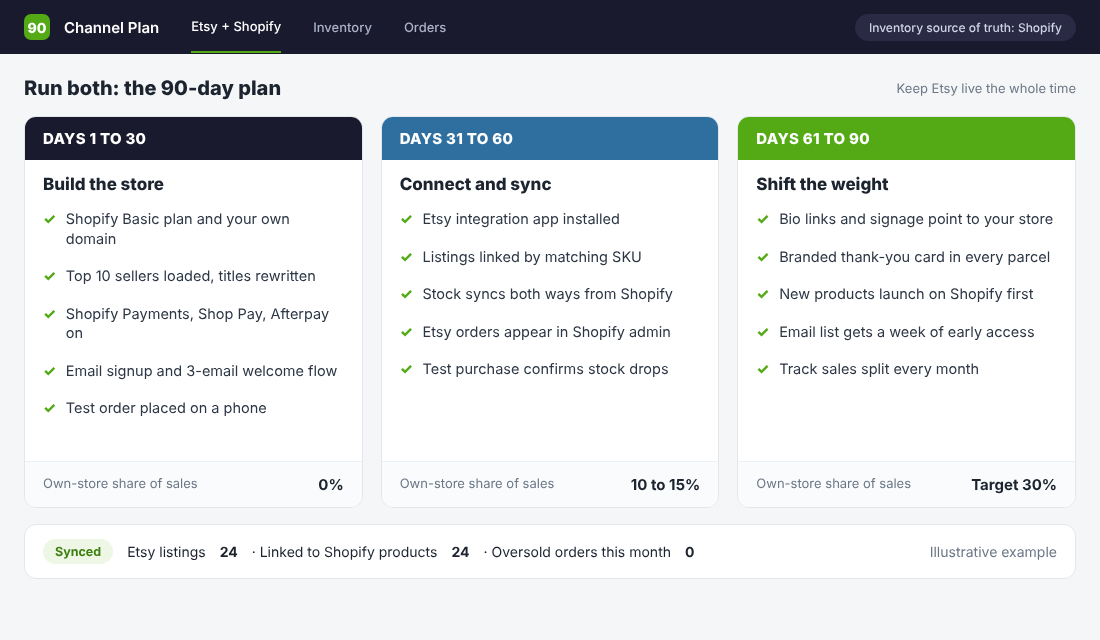
Days 1 to 30: build the store
- Start a Shopify trial and choose the Basic plan. You do not need more yet. Our 9-step guide to starting an online store in Australia covers the ABN, domain and payments setup.
- Load your top 10 sellers first. Not the whole catalogue. Rewrite the titles and descriptions for your own store. Etsy titles are stuffed with keywords for Etsy search and read badly on a product page.
- Turn on Shopify Payments, Shop Pay and Afterpay. Then place a real test order on your phone.
- Add an email signup with a first-order offer and build a three-email welcome flow.
Days 31 to 60: connect and sync
Once you sell the same stock in two places, overselling becomes the risk. Sync your inventory before you send any traffic.
A note on tools. Shopify’s own blog points sellers to its Marketplace Connect app for Etsy, but when I checked the app listing on 14 November 2026 it named Amazon, eBay, Target Plus and Walmart, not Etsy. The dedicated option is CedCommerce Etsy Integration, rated 4.5 from more than 1,200 reviews. Its Beginner plan is US$9 a month for up to 10 products, and Growth is US$59 a month for up to 1,000 products and 500 orders.
Setup takes about an hour:
- Install the app from the Shopify App Store and start the 7-day trial.
- Connect your Etsy account and approve the permissions.
- Let it import your Etsy listings, then link each one to the matching Shopify product. Matching SKUs on both sides makes this automatic.
- Set Shopify as the source of truth for inventory, so a sale on either channel reduces stock on both.
- Turn on order sync so Etsy orders appear in your Shopify admin and you pack from one list.
- Run one test: buy an item on Etsy and confirm the stock drops in Shopify within a few minutes.
Days 61 to 90: shift the weight
- Point everything you control at your own store. Instagram bio, TikTok, market stall signage, business cards, wholesale line sheets.
- Brand your packaging. A thank-you card with your logo and Instagram handle goes in every parcel. Read Etsy’s fee avoidance rules before you add anything that sends Etsy buyers elsewhere for the same purchase.
- Launch new products on Shopify first. Give your email list a week of early access before the item goes on Etsy.
- Measure the split. Track what share of monthly sales comes through your own store. A good first target is 30% by day 90 and 50% by the end of the year.
Keep Etsy running the whole time. Think of it as a paid acquisition channel that costs 10% a sale. That is a reasonable price for a new customer. It is a terrible price for a repeat one.
Common Questions
Is Etsy or Shopify cheaper in Australia?
Etsy is cheaper below roughly 9 to 12 orders a month because there is no monthly fee. Above that, Shopify Basic is cheaper, and the gap widens with every order. At $5,000 a month in sales the difference is about $370 a month before marketing costs.
Can I sell on Etsy and Shopify at the same time?
Yes, and it is what most growing makers do. Use an integration app to sync stock and orders so you do not oversell.
Do I lose my Etsy reviews if I open a Shopify store?
Your reviews stay on Etsy. They do not carry across automatically. Start collecting reviews on your own store from the first order with a free review app, and check Etsy’s terms and your app’s import rules before you copy any existing reviews over.
Do I need an ABN to sell on Etsy or Shopify?
If you are running it as a business, you should have an ABN on either platform. The platform does not change your tax position. Ask your accountant if you are unsure whether you are a hobby or a business.
Is Etsy worth it for Australian sellers in 2026?
For testing a product and getting first sales, yes. For building a brand with repeat customers, it works best as one channel next to your own store, not as the whole business.
How long does it take to set up a Shopify store from an Etsy shop?
A basic store with your top 10 products can be live in a weekend. Allow 30 days to do it properly, including rewritten product pages, payments, shipping rates and a welcome email flow.
How the Pieces Fit Together
Put fees, traffic and ownership side by side and the decision stops being Etsy or Shopify.
Etsy wins on traffic you did not have to find. Shopify wins on fees, on brand and on owning the customer. Early on, traffic matters most, so Etsy is the right call. As repeat buyers and brand searches grow, the 10% you pay Etsy buys you less and less, and the store you own becomes worth more each month.
The sellers who do best use each for what it is good at. Etsy finds the stranger. Your packaging and product win them over. Your own store, your email list and your checkout keep them. If you are also weighing up other platforms, our Shopify vs WooCommerce comparison runs the same numbers for a self-hosted store.
So score yourself on the six signals today. If you land on three or more, start the 90-day plan this week and aim to have 30% of your sales coming through your own store by the end of it.
Inside eCommerce Circle, Platform is one of the 10 P’s we work through with every member, and the question is always the same: is your platform helping you own the customer, or renting them to you? If you want to see exactly where your store is being held back, take the free More Orders Scorecard. It takes two minutes and shows you which of the 10 P’s to fix first. Or if you would like help planning the move, start in Connect.