Most Shopify brands launch their affiliate program the same lazy way. They install an app, set a flat 10% commission, paste a link in their footer, and then wonder six months later why nothing’s happening. Or worse, why they’re losing money on every “affiliate” sale that was actually their existing customers stacking codes at checkout.
What’s in This Article
That’s not an affiliate program. That’s a discount leak with extra steps.
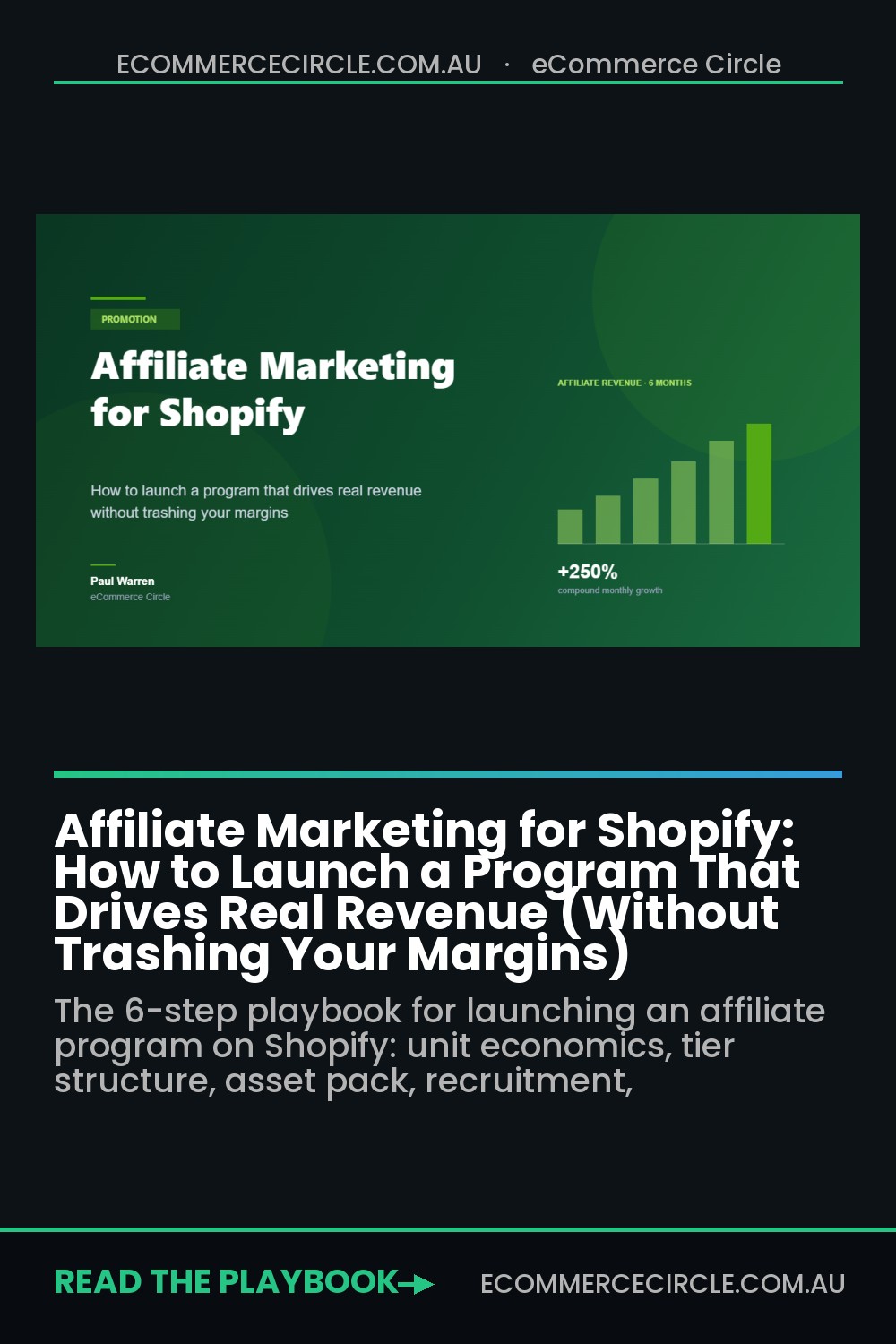
The brands that build affiliate programs into a real channel — driving 15-25% of total revenue at a 12:1 ROI — treat it like any other paid acquisition channel. They run the unit economics first. They build a published commission tier so partners have a reason to push. They recruit specific affiliates by hand instead of waiting for sign-ups. And they have fraud rules baked in from day one, because affiliate fraud will eat your margin if you don’t.
This article is the playbook for doing it properly. By the end you’ll have the exact commission structure, tracking stack, recruitment system, and fraud rules to launch (or fix) an affiliate program on Shopify in the next 30 days.
Why Affiliate Marketing Works So Well in 2026
Three things have made affiliate marketing one of the highest-ROI channels in ecommerce right now.
First, the cost dynamics. Affiliate marketing pays only when a sale happens. There’s no $80 CPM you eat whether or not someone converts. Industry data shows affiliate marketing returns roughly $12 for every $1 spent, compared with around $3.31 for Google Ads. That’s not because affiliates are magic. It’s because the cost is a percentage of revenue, capped, and only triggered by a transaction.
Second, attribution is getting harder everywhere except affiliate. iOS privacy changes, third-party cookie deprecation, and the slow death of pixel-based attribution have wrecked Meta and Google reporting for most stores. Affiliate links and unique codes still attribute cleanly. You always know which partner drove the sale.
Third, the audience match. A creator on Instagram, a niche blog, or a deal site has spent years building trust with a specific audience. When they recommend your product, you’re not buying impressions — you’re borrowing trust. That’s why nearly 65% of affiliate programs report generating at least 20% of total company revenue once they’re properly built.
The catch is that almost none of that happens by accident. The brands cashing in on those numbers built their programs on purpose.
The Foundation: Run the Unit Economics Before You Launch
This is the step most brands skip, and it’s the reason most affiliate programs lose money for six months before quietly dying.
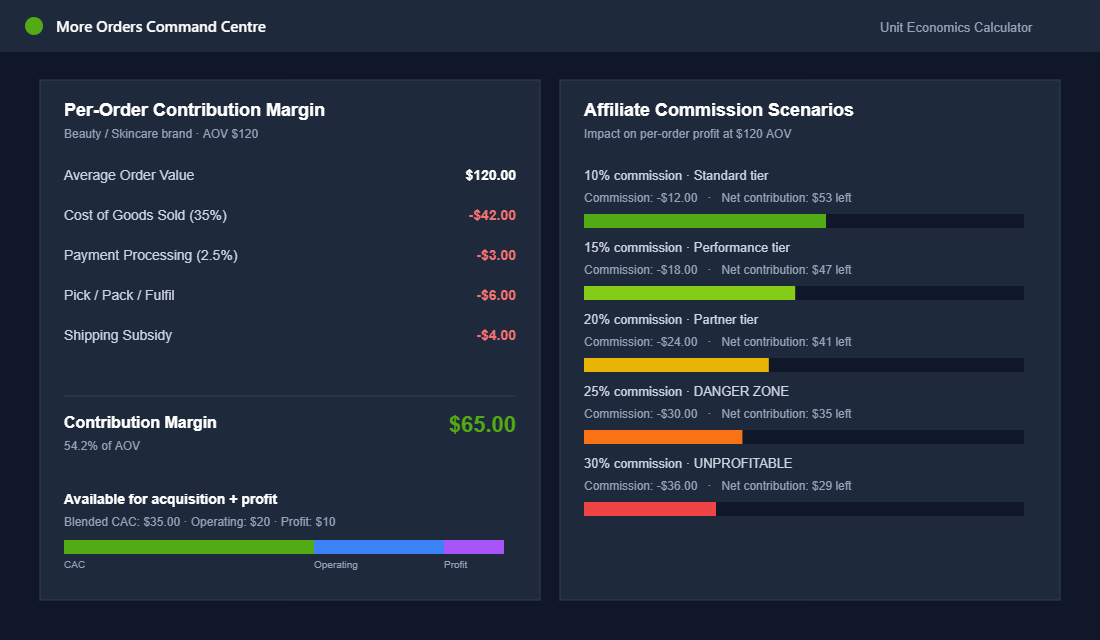
Before you decide on a single commission rate, you need to know exactly what you can afford to pay an affiliate without going backwards. The number you care about is contribution margin per order — the dollars left after COGS, payment processing, fulfilment, and shipping subsidies.
Here’s the calculation:
- Average Order Value (AOV): $120
- Cost of Goods Sold (35%): -$42
- Payment processing (2.5%): -$3
- Pick, pack, fulfil: -$6
- Shipping subsidy (avg): -$4
- Contribution margin per order: $65 (54%)
That $65 has to cover three things: your customer acquisition cost, your operating overhead, and your profit. If your blended CAC across paid channels is currently $35, you have $30 of contribution left per order. A 10% affiliate commission on a $120 order is $12. That fits comfortably. A 25% commission would be $30 — leaving you with zero. That’s not a program; that’s a charity.
Run this calculation for your own store before you go any further. If you’re not clear on your contribution margin, fix that first. We’ve covered that workflow in detail in Contribution Margin for Shopify Stores.
The other number you need is customer lifetime value (CLV). If your CLV is $360 — meaning the average customer comes back twice — you can afford a higher first-order commission because you’re paying for a long-term customer, not a single transaction. CLV is the lever that lets you outspend competitors on acquisition, and affiliates are no exception.
Step 1: Pick the Right Tracking Platform
The Shopify affiliate app market has consolidated around three serious players. Pick wrong and you’ll spend the next two years exporting CSVs and chasing payments manually.
UpPromote is the simplest to set up and where most Aussie brands under $5M should start. The free plan handles 200 referral orders per month with unlimited affiliates, paid tiers begin at $29.99/month, and the dashboard is genuinely usable for non-technical founders. It rates 4.9 stars across 2,900+ Shopify reviews, which is rare in this category.
GoAffPro is the other strong starter option. The free plan is uniquely generous (unlimited affiliates and revenue), and the $49/month premium tier adds branded affiliate dashboards and automated payouts. If you want a white-label experience for partners without paying enterprise pricing, this is the play.
Refersion is the upgrade for brands doing serious volume — typically $5M+ in revenue with influencer-heavy programs. It starts at $99/month and the value sits in the reporting depth, the offers engine, and the integrations with Klaviyo, Postscript, and Shopify Plus. Around 1,000 Shopify reviews, mostly from larger brands.
The decision rule: if you’re under $2M and just getting started, install UpPromote or GoAffPro free this week. If you’re already running creator partnerships through DMs and spreadsheets, jump to Refersion. The cost of staying in spreadsheet hell is higher than $99/month every time.
Step 2: Design a Commission Structure That Scales
This is where most brands either undercommit (10% flat for everyone, no incentive to push) or overcommit (30% to a handful of mates, no path for the rest of the program to grow). Neither builds a real channel.
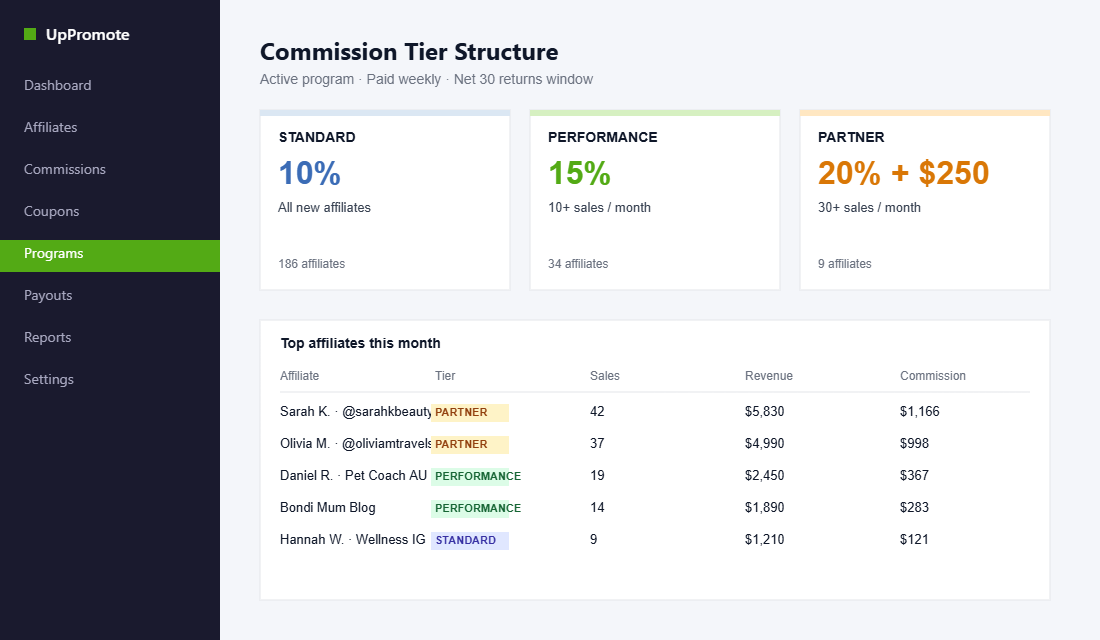
Use a three-tier structure with a published path:
- Standard tier — 10% commission. Default for every new affiliate. Covers your unit economics comfortably and screens out anyone who isn’t willing to start small.
- Performance tier — 15% commission. Unlocks once an affiliate drives 10 paid sales in a calendar month. Stays active for the next 60 days regardless of volume, then resets.
- Partner tier — 20% commission + monthly bonus. Reserved for affiliates driving 30+ sales per month. Includes a $250 monthly performance bonus, exclusive product drops, and direct access to your team.
This structure works because the economics protect you at the bottom (10% is always profitable on a 50%+ margin product) and the incentive to push is built into the public ladder. Every affiliate can see exactly what they need to do to earn more, and your top performers feel rewarded instead of being lumped in with the people who shared their link once on Facebook.
A note on flat fees vs percentages. For brands with low AOV ($40-60) where 10% is too small to motivate, switch to a flat $10-15 per new customer order. Affiliates respond better to “$15 per sale” than “12.5% on a $120 order” — the math is easier and the number is bigger. For higher-ticket brands ($150+ AOV), stick with percentages.
Always exclude returns, refunds, and orders flagged for fraud from commission calculations. Pay 30 days after the order ships to allow returns to clear. State this clearly in your terms — affiliates respect transparency more than they resent the delay.
Step 3: Build the Affiliate Asset Pack
The single biggest predictor of whether an affiliate actually posts about your brand is whether you made it easy. Most brands send a sign-up link and a welcome email and leave it there. Then they wonder why their dashboard shows 200 affiliates and 4 sales.
You need a pre-built pack that lives on a Notion page or in your affiliate dashboard. The minimum viable version includes:
- 10-15 product photos in lifestyle, flat-lay, and on-model formats. Include both portrait (4:5 for Instagram and TikTok) and landscape (16:9 for YouTube and blog use). Royalty-free for affiliate use only.
- 5 short-form video clips (15-30 seconds) showing the product in use. Caption-ready, vertical 9:16. These outperform photos by roughly 3x on social.
- 3 caption templates per product — one educational, one storytelling, one direct CTA. Affiliates with no copywriting skill will use these verbatim.
- 5 hook options for video first lines. “I’ve been using this for 90 days and here’s what changed” performs better than “Check out this brand I love”.
- Approved talking points and ingredient/benefit lists. What they can say. What they cannot say (especially around health claims if you’re in beauty, supplements, or wellness — there are real ACCC rules in Australia).
- FAQ: shipping, returns, sizing, ingredients. Affiliates will get DMs from their audience asking these questions — give them the answers upfront.
This pack is the leverage. Spend a week building it once, and every affiliate you onboard for the next two years gets the same head start.
Step 4: Recruit Affiliates Like You Recruit Customers
Sitting back and waiting for sign-ups is the slowest path to a working program. The fastest path is direct outreach to people who already have your audience.
There are five sources every Aussie Shopify brand should be working through in the first 60 days:
- Existing customers. Pull a list of customers with 3+ orders or who’ve spent over $500. Email them an invitation with the commission structure spelled out. Conversion to active affiliate is typically 8-12% — these people already love you and only need permission and a link.
- Micro-influencers (5K-50K followers) in your category. Search Instagram and TikTok hashtags relevant to your product. Send a personalised DM offering a free product plus the partner-tier commission. Smaller creators convert at 5-10x the rate of mega-influencers because they need the income.
- Niche bloggers and review sites. Search “best [your category] Australia” on Google. The first 20 results are warm prospects. Send a personalised pitch with a unique tracking link and an EPC projection.
- Industry-adjacent newsletters and podcasters. A pet food brand should be partnering with dog training newsletters, not other pet food brands. Adjacent audiences are cheaper to win and convert better.
- Coupon and loyalty sites. Use sparingly and ONLY with the dual-attribution rule below. Sites like Honey, Cashrewards, and ShopBack drive volume but cannibalise organic conversions if you’re not careful.
The pitch that works. Don’t lead with your commission rate. Lead with EPC — earnings per click. “We pay 15% commission on a $145 AOV product converting at 4.2%, so our top affiliates are averaging $9.10 EPC.” That’s the language affiliates speak, and most brands miss it.
This recruitment work is the same kind of partnership building we covered in our influencer marketing playbook — and the two channels overlap heavily. Treat affiliates and influencers as the same recruitment funnel with two different commercial models.
Step 5: Onboarding That Actually Activates
Roughly 70-80% of new affiliates never make a single sale. Most of those who fail aren’t lazy — they signed up, didn’t know what to do next, and dropped off. Your onboarding sequence is the difference between a program with 50 active partners and a program with 500 dormant accounts.
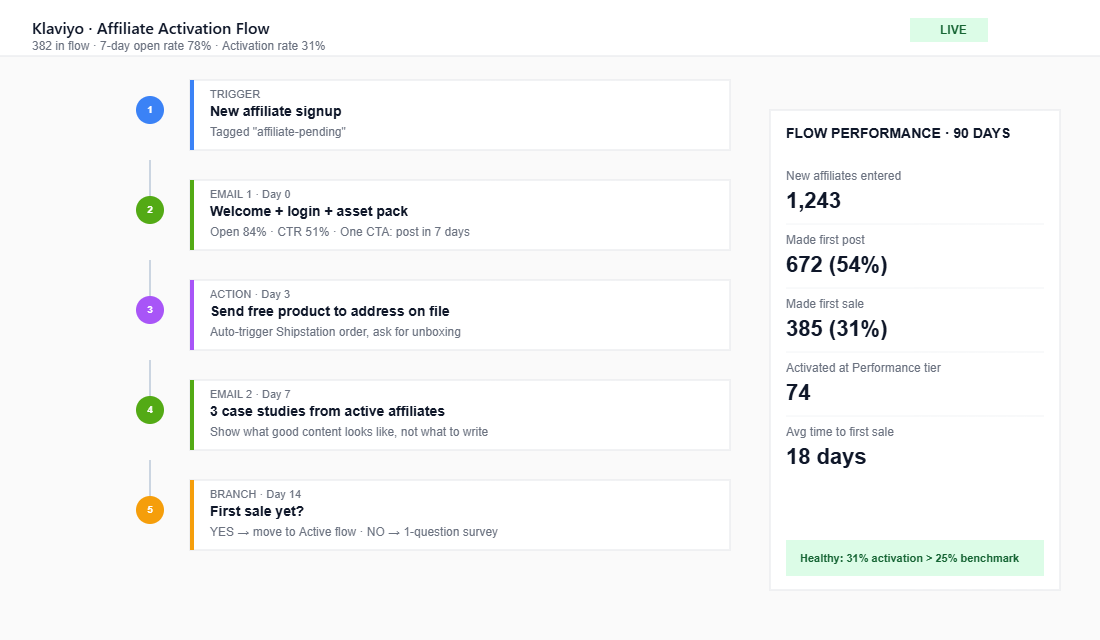
Build a four-email activation sequence inside your email tool:
- Email 1 (immediate): Welcome + login link + their unique code and tracking link + link to the asset pack. One CTA: “Make your first post in the next 7 days and reply to this email so we can amplify it.”
- Email 2 (Day 3): Send a free product to their nominated address. Include a personal note and ask them to film an unboxing.
- Email 3 (Day 7): Share three pieces of content from existing affiliates that drove sales. Show, don’t tell, what good looks like.
- Email 4 (Day 14): If no first sale, send a one-question survey: “What’s stopping you from posting?” The answers will reveal where your asset pack or program structure needs to improve.
Once an affiliate makes their first sale, move them into a separate “active” sequence: monthly performance updates, top-performer leaderboard, new product previews, and the path to the next commission tier. Activation isn’t a one-off event — it’s a relationship you maintain.
Step 6: The Fraud Rules Every Program Needs
Affiliate fraud isn’t a fringe issue. It’s the line item that quietly kills the ROI on most programs. Coupon code leaks alone can cost a $5M brand $50K+ a year if you don’t have rules in place from day one.
Build these six rules into your program terms before you onboard a single affiliate:
- One discount per order. No stacking. An affiliate code does not combine with a sitewide promo, a welcome series discount, or a free shipping threshold. Configure this in Shopify Discounts settings — it’s a one-click toggle.
- Unique codes per affiliate. Never reuse codes. Every partner gets their own. This makes leak-tracing trivial: if “SARAH15” shows up on RetailMeNot, you know exactly who shared it.
- Dual attribution for coupon-led sales. The customer must both click the affiliate link and apply the code at checkout for the affiliate to earn commission. This single rule removes 80% of aggregator-site fraud, where someone pastes your code on Honey without ever sending traffic.
- Monthly leak audits. Once a month, run a search of your brand name plus “discount code” on Google, RetailMeNot, Honey, and Cashrewards. If a code appears that wasn’t approved for that channel, deactivate it immediately and warn the affiliate.
- Self-referral block. Affiliates cannot use their own code on their own orders. Most platforms have a toggle for this; turn it on.
- Anomaly review threshold. Any affiliate doing 5+ sales in a 24-hour period from cold gets manually reviewed before commission is approved. Real spikes look different from bot spikes — review the order data before paying.
State all of these in plain English in your affiliate terms. Good affiliates appreciate clear rules. Bad affiliates self-select out, which is exactly what you want.
Measuring Whether the Program Is Actually Working
Most brands measure their affiliate program by two numbers — total revenue and total commissions paid — and miss the four metrics that actually tell you whether it’s healthy.
The dashboard you want, reviewed monthly:
- Active affiliate ratio. Affiliates who drove at least one sale this month divided by total program signups. Healthy programs sit at 15-25%. Below 10% means your onboarding is broken.
- Top 20 contribution. What percentage of program revenue comes from your top 20 affiliates? Concentration over 70% means you’re vulnerable to losing a single partner — diversify recruitment. Concentration under 40% means you’re not investing enough in your best people.
- New customer rate by affiliate. Of the orders attributed to affiliates, what percentage are first-time customers? Below 60% means you’re paying commissions on customers who would have bought anyway through email or direct.
- Effective commission rate. Total commissions paid divided by total affiliate-attributed revenue. Should track within 1-2 points of your published commission. Drift above means tier abuse or fraud.
Track these four numbers in a simple spreadsheet or Notion database. Review them on the first Monday of every month. Any metric that moves more than 20% in a month is worth a 30-minute investigation. This is exactly the kind of data review we cover inside the eCommerce Circle weekly rhythm — small reviews catch problems before they compound.
The Compound Effect: Why This Channel Snowballs
Affiliate programs feel slow for the first 90 days and then unrecognisable a year in. The reason is that every component you build compounds with every other component.
Your asset pack, built once, makes onboarding faster — which means more affiliates make their first sale — which means more case studies for your recruitment outreach — which means better-quality affiliates respond to your DMs — which means a higher activation rate on the next cohort. Your fraud rules protect your margin so you can afford to keep investing in the program. Your tier structure means your top performers stay engaged because there’s always a new level to push for.
Most importantly, affiliate programs build owned demand. Unlike Meta or Google, the relationships you build with creators and content partners are yours. Algorithm changes, ad cost spikes, and pixel deprecation don’t touch them. Once a partner is doing $10K a month for your brand, they have just as much incentive to keep that channel healthy as you do.
That’s the prize. Not “a 10% commission flat program in your footer”, but a real channel that generates 15-25% of revenue, attributes cleanly, scales with your unit economics, and grows compoundingly through the people who already love your product.
Where to Start This Week
If you’re starting from scratch, do these five things in this order over the next 14 days:
- Calculate your contribution margin per order. Confirm what commission rate is actually affordable.
- Install UpPromote or GoAffPro free. Configure your tiered commission structure.
- Build the affiliate asset pack in Notion. Photos, video, captions, hooks, talking points, FAQ.
- Email your top 50 customers (3+ orders or $500+ spent) with the affiliate invitation.
- Spend one hour a day for the next two weeks DM’ing 20 micro-influencers in your category with the EPC pitch.
If you already have a program but it’s underperforming, the first thing to audit is your fraud rules and your onboarding sequence. Eight times out of ten that’s where the leak is.
Inside the eCommerce Circle, building affiliate programs is one of the channel-discipline workstreams we coach members through, alongside customer referral programs and the broader Promotion playbook. The goal isn’t to add another channel for the sake of it — it’s to build channels that compound and protect your margin while they grow.
If you want to talk through whether an affiliate program is the right next move for your store, or you want a second pair of eyes on the unit economics before you launch, let’s have a chat. We’ll walk through your numbers and tell you straight whether to build it now or fix something more important first.