Most Shopify founders set their prices once, in week one, based on a quick competitor scan and a gut feel for what “looks right”. Then they spend the next three years pouring money into Meta ads, hiring agencies, and obsessing over conversion rate, while the highest-impact lever in the entire business sits untouched.
What’s in This Article
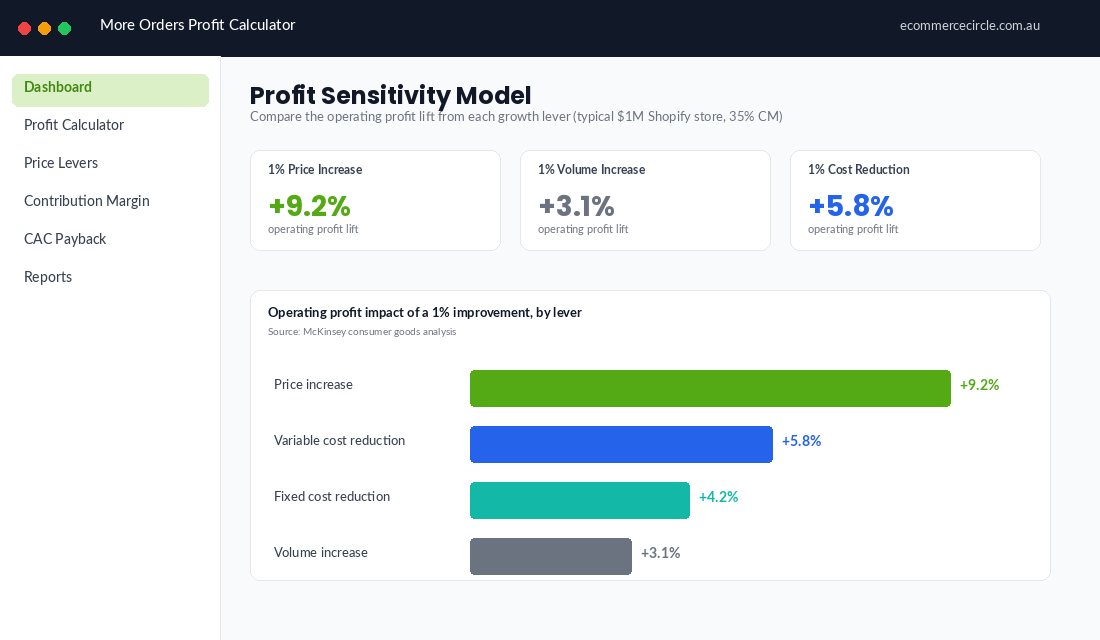
The math here is brutal. A 1% lift in price, with no change in volume, drops almost entirely to the bottom line. A 1% lift in volume, by contrast, has to fight its way through ad cost, COGS, fulfillment, and returns before any of it reaches profit. Research from McKinsey has shown that a 1% price increase can lift operating profit by 8 to 11% for a typical consumer goods business. Yet pricing is the part of the marketing mix Aussie operators touch the least.
Inside eCommerce Circle we work with hundreds of Aussie Shopify founders, and pricing is the conversation that consistently produces the fastest results. Not because pricing is magical, but because it has been so badly neglected. Most stores leave 15 to 25% of revenue on the table because they have never built a real pricing architecture. They have a price list, not a pricing strategy.
This article walks you through the 5-Layer Pricing Architecture we use to fix that. It is the same framework Harvard Business Review and Cornell research point to, applied specifically to Shopify and tuned for Australian operators heading into EOFY and BFCM. Read it once, then run the audit at the bottom on your own store this weekend.
Why Pricing Is the Most Underused Profit Lever in Ecommerce
Before we get into the layers, sit with the maths for a second. The Harvard Business Review reported in 2025 that psychology-based pricing strategies alone can increase ecommerce revenue by 10 to 25%. That is the floor, not the ceiling, of what is possible when you stop treating price as a one-time decision.
Compare that to the realistic lift from your other levers. A new Klaviyo flow might add 3 to 5% to revenue. A successful Meta ads creative refresh might lift ROAS 15 to 20% on a single campaign. A site speed project might add 2 to 4% to conversion rate. All of those are worth doing, and we have written full playbooks on each. But none of them touch the structural lever of price itself.
The reason most Aussie founders avoid pricing is fear. Fear that putting prices up will tank conversion. Fear that competitors will undercut. Fear that customers will revolt on Instagram. In our experience, almost none of those fears are validated by the data. When we run pricing tests with members, the typical pattern is a 5 to 12% revenue lift with conversion staying flat or, in many cases, improving because the new price signals higher quality.
Pricing is not a vibe. It is an architecture. Here are the five layers.
Layer 1: The Cost-Plus Floor (Know Your Real Number)
Every pricing decision starts with one number: your contribution margin per unit. If you do not know it cold, you are not pricing, you are guessing. We cover the full calculation in our contribution margin guide for Shopify stores, but the short version is this.
Contribution margin equals selling price minus all variable costs. Not just COGS. The variable cost stack on a typical Aussie Shopify product looks like this:
- COGS landed. Product cost plus inbound freight plus customs and GST on imports.
- Pick, pack, and ship. Whether in-house or 3PL, a real per-unit cost.
- Payment processing. Roughly 1.7 to 2.5% on Shopify Payments depending on plan and card mix.
- Returns reserve. Apparel sits at 20 to 30% returns, beauty at 5 to 8%, food and drink near zero. Build it into the unit economics.
- Discount slippage. Average discount applied across all orders, not just promo orders.
- Transaction-level apps. Subscription apps, loyalty point liabilities, BNPL fees on Afterpay and Zip.
Once you have the variable stack, your floor is the price at which contribution margin per unit equals zero. Sell below that and every order destroys cash. The Cost-Plus Floor is not your selling price, it is the line you cannot cross. Most Aussie founders are shocked to discover their floor is 15 to 30% higher than they thought once BNPL fees and returns are properly loaded.
The mistake to avoid: setting your selling price as a fixed multiple of COGS only (“3x markup is fine”). Multiples worked when retail had clean margins. In 2026, with Meta CPMs up, fulfillment costs up, and returns up, a 3x markup on COGS often produces a 25% contribution margin, and that is not enough to fund acquisition, retention, and a profit line all at once. Calculate the floor properly. Then build up from there.
Layer 2: The Anchor (Why Your Hero Product Should Never Be the Cheapest)
The most famous pricing case study in retail history is the Williams-Sonoma bread maker. In 1990, Williams-Sonoma launched a premium bread maker at $429. It barely sold. Then they introduced a second bread maker at $279, sat it next to the $429 model, and sales of the cheaper unit doubled overnight. The $429 model was never meant to sell. It existed to make the $279 model look like a bargain.
That is anchoring, and it is the second layer of your pricing architecture. The first price a shopper sees becomes the reference point for every price after it. If your hero product is the cheapest thing on the page, every other product feels expensive. If your hero is the most expensive, every other product feels reasonable.
For Shopify operators, anchoring shows up in three places:
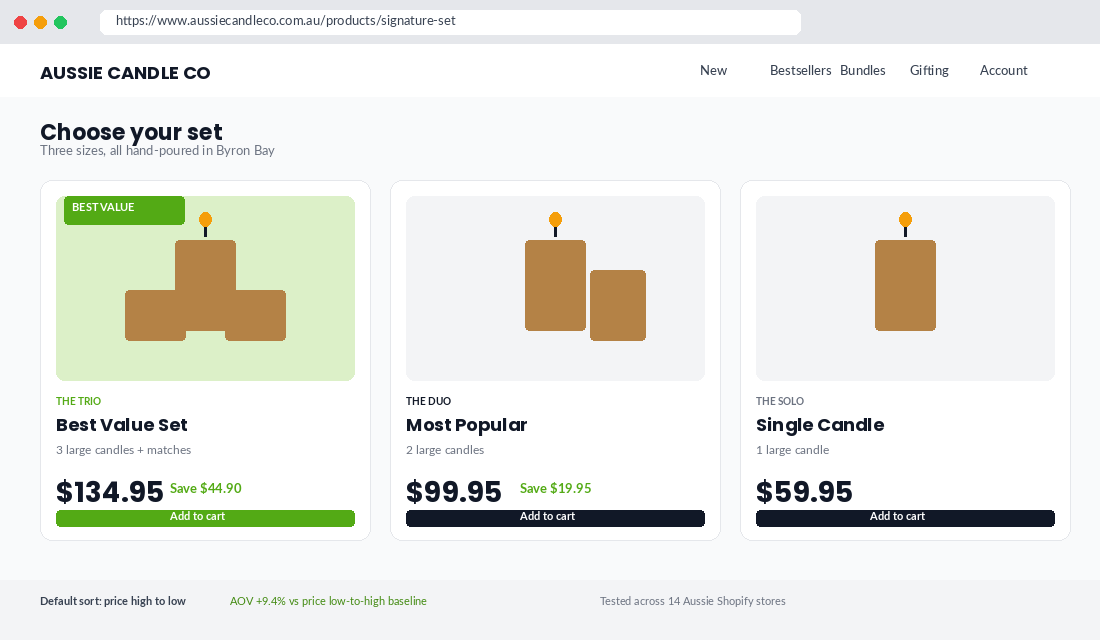
- Collection page order. Sort highest-priced first, not lowest. The eye anchors on the top-left product. If that product is your $159 premium SKU, the $89 mid-tier feels like a steal.
- Product page upsells. Show the bigger size or premium variant first, with the standard underneath. Beauty brands have used this for years and it routinely lifts AOV 8 to 15%.
- Bundle decoys. Build a 3-pack at a price point that mathematically nobody should pick, so the 2-pack looks like the obvious value. Who Gives A Crap does this beautifully on their bundles page.
The principle is older than ecommerce, but the application is specific to Shopify. Most Aussie store collection pages default to “best selling” or “price low to high”. Both kill your anchoring. Switch your default sort to “price high to low” on your hero collection and watch the AOV move within a week. We have seen 6 to 11% AOV lifts from this single change inside Circle members’ stores.
Layer 3: The Charm Layer (When .99 Beats Round Pricing, and When It Doesn’t)
Charm pricing is the most well-documented pricing trick in retail. Cornell University research found that prices ending in .99 can increase sales by up to 24% versus rounded equivalents. A 2025 University of Chicago study put the lift at 8 to 12% for everyday items under $100. The mechanism is the left-digit effect: shoppers read prices left to right and anchor on the first digit. $9.99 reads as “nine dollars something”, not “ten dollars”.
But charm pricing is not universal. The Journal of Consumer Research published a study in 2024 showing that for premium and luxury brands, round pricing ($100 instead of $99.99) actually performs better. The reason is signal value. Round prices feel intentional, considered, premium. Charm prices feel discounted, transactional, mass-market. Aesop, Le Labo, and Bondi Sands at the premium end all use round pricing for a reason.
The rule we teach inside Circle is simple. Use charm pricing when the buying decision is rational and price-led. Use round pricing when the buying decision is emotional and brand-led.
- Charm pricing wins for: consumables, accessories, sub-$50 SKUs, value-positioned brands, sale and clearance items, and any product where the customer is comparing across stores.
- Round pricing wins for: luxury, gifting, premium positioning, hero SKUs above $100, candles, fashion, and brands where the customer is buying into a story rather than a spec sheet.
- Hybrid approach: Run round pricing on full-price hero SKUs ($120) and charm pricing on bundles and sale items ($99.95). The contrast itself signals value.
One Aussie pattern worth flagging: GST. Australian shoppers see prices inclusive of GST, but the .99 trick still works the same way at the inclusive price point. Set your price at $49.99 inc GST, not at $45.45 ex GST. The customer never sees the ex-GST number, and the .99 ending is what does the conversion work.
Layer 4: Good-Better-Best Tier Architecture
Layers 1, 2 and 3 set the prices for individual SKUs. Layer 4 is about how those SKUs sit together as a portfolio. The Good-Better-Best framework, popularised by Harvard Business Review in 2018, is the simplest and most powerful tier structure in retail. It works because of two psychological forces: choice architecture and the compromise effect.
The data is decisive. Harvard Business Review found that adopting a three-tier structure typically lifts conversion by 17 to 25%. ProfitWell’s research shows 60 to 70% of customers select the middle tier when presented with three options. Studies from Price Intelligently put the average revenue lift from a three-tier structure at 30% versus single-price offerings.
Here is how the three tiers work in a Shopify context:
- Good (entry). Stripped-down version of your hero product. Solo SKU, smaller size, or the basic variant. Designed to convert price-sensitive new customers and lower the barrier to first purchase.
- Better (target). The version you actually want most customers to buy. This is your margin engine. Priced to feel like clear value next to Good but not a stretch from it. Most commerce theory points to a 1.5x to 2x multiple of Good.
- Best (premium). The fully loaded version. Bundle, larger size, gift set, premium variant. Priced 2.5x to 4x of Good. Designed less to sell in volume and more to make Better look like the obvious choice. The Williams-Sonoma decoy.
If you sell a single SKU at one price point, you are leaving the entire compromise effect on the table. Your job is not to find the one perfect price. It is to design a portfolio where the customer self-selects into the tier that maximises both conversion and contribution margin.
For variable products (size, scent, colour) this is straightforward, you build the tiers as variants. For single SKUs, you build the tiers as bundles: 1-pack, 2-pack, 3-pack. Make sure the 3-pack is priced to be a clear “no-brainer” maths decision (e.g. 1-pack $29.99, 2-pack $54.99, 3-pack $74.99 saves $14.98). The maths does the selling.
Layer 5: Test, Don’t Guess (How to Run Real Pricing Experiments)
The four layers above will get you 80% of the way there. The remaining 20% comes from testing. Most Aussie founders never test prices because they think it requires a data team. It does not. Three tools handle this on Shopify out of the box.
- Intelligems ($75/month from the Shopify App Store). Lets you A/B test prices, shipping thresholds, and discount levels in true split tests with statistical significance reporting. The cleanest tool for live price testing on Shopify.
- Prisync AI ($49/month for the Shopify plan). Tracks unlimited competitor prices and feeds them into dynamic pricing rules. Useful if you sell SKUs that are also stocked by major retailers.
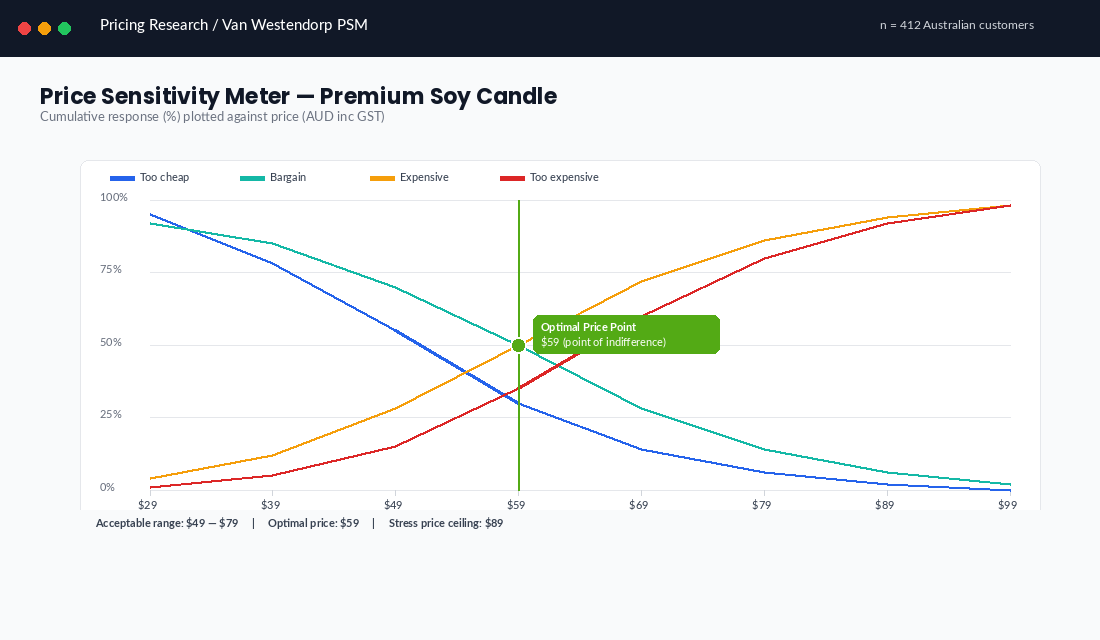
- Van Westendorp Price Sensitivity Meter. A four-question survey, sent to your existing email list via Klaviyo or Typeform, that maps customer willingness to pay. Free if you build it yourself, and the gold standard for pre-launch pricing on a new product.
The four Van Westendorp questions are:
- At what price would you consider this product so cheap that you’d question its quality?
- At what price would you consider this a bargain, a great buy for the money?
- At what price would you start to consider it expensive, but still worth buying?
- At what price would you consider it too expensive to buy?
Plot the four lines, find the intersection points, and you get a defensible price range backed by your actual customers’ words. We had a Circle member in homewares run this exact survey on a new candle line, and the data showed customers were comfortable paying 22% more than the founder had planned. They launched at the higher price and hit revenue target in 11 days.
Two Aussie Brands Doing This Right
Who Gives A Crap built their entire pricing architecture around tiered bundles. Their Lil’ Bundle starts at $68.80 versus $86 if you bought the products separately, a 20% saving. The bigger bundles save more. They have effectively designed a Good-Better-Best portfolio out of toilet paper, tissues, and paper towels, and the bundles drive a meaningful share of orders. Notice how the maths is always crystal clear: customers can see the saving in dollars, not just percentages.
Frank Body uses a hybrid approach. Their hero scrubs sit at round price points ($16.95, $19.95) to signal premium positioning. Their bundle “Body Duos” sit at charm prices ($29.99, $39.99) to drive value perception on multi-buys. The contrast does the work. New customers anchor on the round-priced single SKU, then see the duo at “only $10 more for two” and self-select into the better tier. Classic Layer 4 in action.
Both brands also keep their pricing remarkably stable across the year. They run promotions, but the everyday list price moves rarely. That stability is itself a pricing strategy. Customers who feel the everyday price is “fair” are far more likely to buy on the first visit instead of waiting for a sale. We have written about this in our discount strategy guide.
The Compound Effect: What This Looks Like at M ARR
Let’s make the maths real. Take a Shopify store doing $1M ARR with a 35% contribution margin. They have a single hero product priced at $59 with no tiers, no anchoring, no charm logic, no testing. Their default Shopify collection is sorted “price low to high”.
Run the 5-layer audit. Three things change. First, the collection sort flips to “price high to low” and the hero price moves to $59.95 with charm pricing applied to every other SKU. AOV lifts 4% from anchoring alone. Second, a Good-Better-Best tier launches: solo at $59.95, duo at $99.95, trio at $134.95. Mix shifts and AOV lifts another 9%. Third, a Van Westendorp survey reveals customers are happy to pay $64.95 on the solo. They lift the price. Conversion holds. Revenue per visitor rises a further 6%.
Compound effect at the same traffic: roughly 19 to 22% revenue lift. On a $1M base, that is $190K to $220K of new revenue. At a 35% contribution margin, that is $66K to $77K of new profit, with no extra ad spend, no new product, no new hire. This is what we mean when we say pricing is the highest-impact lever in the business. The investment is two weeks of focus.
And it compounds with everything else. A 19% revenue lift improves your CAC payback period, which improves your ad budget, which improves your traffic, which improves your revenue again. Pricing is not a one-off project. It is the floor that every other growth lever sits on.
The 5-Layer Pricing Audit (Run This on Your Store This Weekend)
Print this out and walk through it on your top 10 SKUs by revenue. Score each layer 1-5. Anything below a 3 is your priority for this quarter.
- Layer 1: Cost-Plus Floor. Do you know the contribution margin on this SKU to the cent, including BNPL fees, returns reserve, and discount slippage? If not, score 1.
- Layer 2: Anchor. Is the highest-priced SKU shown first on your hero collection page? Are premium variants shown above standard on the product page? If no to either, score 2 or below.
- Layer 3: Charm. Is your charm vs round pricing logic intentional? Are sale and value SKUs ending in .99 or .95, and hero/premium SKUs in round numbers? If you have not thought about this, score 1.
- Layer 4: Tier Architecture. Do you have a Good-Better-Best portfolio for your hero SKU? Is there a clear maths case for the middle tier? If you only sell at one price point, score 1.
- Layer 5: Test, Don’t Guess. Have you run a real price A/B test in the last 90 days, or surveyed customers on willingness to pay? If not, score 2 or below.
Add the scores. Anything under 15/25 across your top SKUs means there is meaningful revenue sitting on the table right now. Most stores we audit score 8 to 12 on first pass, which is exactly why a focused pricing project routinely produces 15 to 25% revenue lifts inside a quarter.
Pricing is not a vibe. It is the highest-impact architecture in the business, and it is also the most neglected. Build the five layers properly and the rest of your growth motion gets easier, because every dollar of traffic, every email send, every new customer is now flowing through a pricing engine designed to maximise both conversion and contribution.
The Price Increase Playbook: How to Lift Prices Without Losing the Customers You Have
Most founders know they are underpriced. What stops them is the fear of a customer revolt that, in practice, almost never arrives. Freight, packaging and Australian wages have all moved since you set those prices. Your prices have not.
Here is the sequence that works on a Shopify store without torching goodwill.
Start with a 7 to 9% lift on your mid-tier, not your hero. Your hero product carries brand memory. Customers know what it costs. Your mid-tier SKUs are where price memory is weakest and where the elasticity is most forgiving. A 7 to 9% increase on a product carrying a 55% gross margin lifts contribution per order by roughly 15% with no change in traffic, ad spend or conversion work.
Hold the increase for a full 30 days before you judge it. The first fortnight after a price change is noisy. Returning customers who saved a product months ago react first, and they are the loudest, not the most representative. Watch units sold and total contribution across a 30-day window against the prior 30 days, adjusted for any promotion that ran in either period.
Give the price a reason to exist. A silent increase invites suspicion. A stated one invites acceptance. Improved packaging, a longer warranty, local manufacturing, a bigger size, better materials: pick the true one and say it on the product page. Brands that pair a price rise with a visible upgrade typically see conversion hold flat rather than dip.
Protect your best customers explicitly. Email your top 20% by lifetime value a fortnight before the change and give them a window at the old price, or a one-off credit. It costs you a small amount of margin on a handful of orders and it converts your most valuable segment from potential complainers into people who feel looked after. Klaviyo segments on historic spend in about two minutes.
Watch three numbers, not one. Conversion rate on the changed products, average order value across the store, and refund or return rate. A price increase that holds conversion but spikes returns has not worked, it has just delayed the loss. If returns move more than 2 percentage points, the price is now ahead of the perceived value and you have a product page problem, not a pricing problem.
Run this once a year as a standing habit rather than an emergency response to a bad month. Brands that review pricing annually rarely need a dramatic correction. Brands that avoid it for three years end up needing a 20% jump, which is the one customers actually notice. For the deeper version of this thinking, the pricing power playbook covers how to build the permission to charge more in the first place.
Inside eCommerce Circle, pricing is one of the core P’s we work on with every member. If you want a second opinion on yours, let’s talk.