Most Shopify founders run their entire business on guesses. They write product copy based on what sounds good. They build avatars on a whiteboard stitched together from Instagram screenshots and stock photos. They launch ads aimed at a customer who exists more in their imagination than in their database.
What’s in This Article
The brands quietly compounding past one million a year do something different. They run a Voice of Customer (VoC) system that pulls real language, real objections, and real reasons-to-buy out of five live channels every single week.
According to Sprinklr’s 2026 maturity research, companies with mature VoC programs spend 25% less to retain customers and see 15 to 20% higher cross-sell and upsell success. And brands that build messaging from real customer language (not internal brainstorms) see revenue increases between 23 and 33% versus their inconsistent peers. The data is there. The question is whether you are actually listening.
Why most “customer research” is fake
The avatar-on-a-whiteboard exercise is not research. It is a brainstorm in costume. You sat in a workshop, your team made up a persona called Sarah who is 32, loves yoga, and “values authenticity”. Three months later Sarah is forgotten and your ads still convert at 0.8%.
Real VoC research is operational, not strategic. It runs every week. It feeds into your ad copy, your product page headlines, your email subject lines, and your homepage hero before the next BFCM. It is the difference between a brand that guesses and a brand that compounds.
The five channels we work through with every Aussie Shopify founder inside the eCommerce Circle workshop are: post-purchase surveys, product reviews, chat and DM transcripts, returns reason data, and welcome-flow zero-party data. Each one captures a different slice of the customer journey. Run together, they form the most reliable insight engine in your stack.
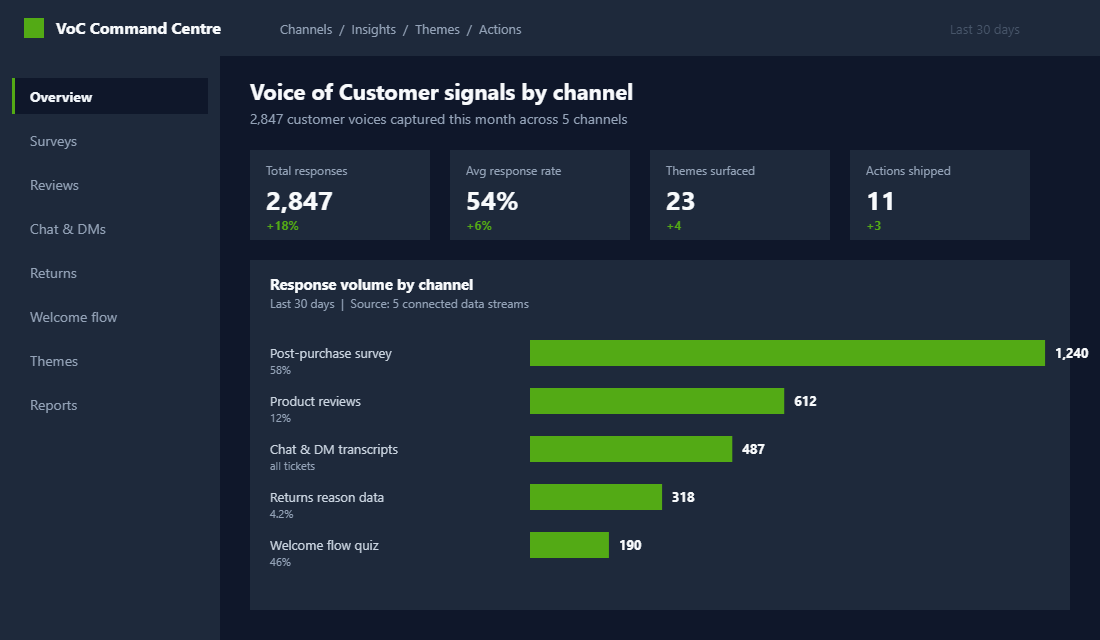
Channel 1: Post-purchase surveys (the highest-signal data source)
Post-purchase surveys sit on your Shopify thank-you page or order status page. The customer has just bought. They are warm, they are paying attention, and they are willing to answer a question or two before they navigate away.
This placement is the entire game. Email-based post-purchase surveys average a 3.24% response rate. Thank-you-page surveys hit 50% or higher routinely, with top brands above 75%. Fairing reports the average for stores with 1,000+ survey views sits between 54 and 58%. You are looking at a 15 to 20x lift on signal volume just by changing where the survey lives.
The three questions that matter on a thank-you page survey:
- How did you hear about us? (HDYHAU) The single highest-ROI attribution question in ecommerce. Fairing’s own data shows this one question delivers a 20%+ gain in attribution insight and reveals which channels are actually driving high-LTV customers, not just clicks.
- What almost stopped you from buying? This surfaces objections you can rewrite directly into your product page copy and ad creative.
- What were you using before this? Tells you who your real competitor is. Often it is not who you think.
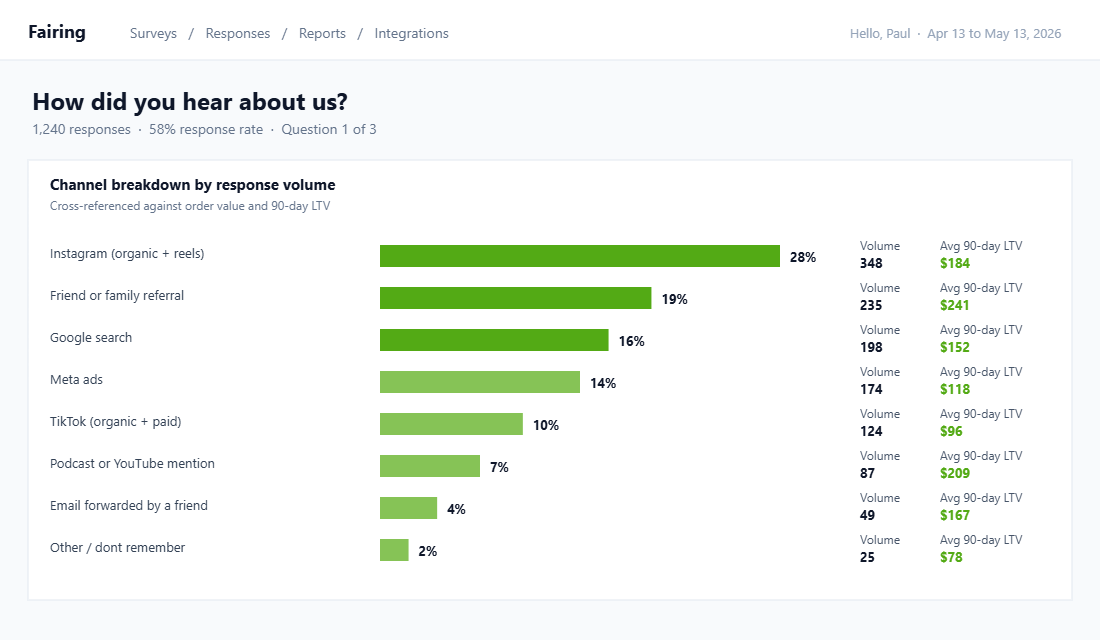
Setup is fast. Install Fairing from the Shopify App Store, build a 3-question survey, set the trigger to fire on order confirmation, and connect Klaviyo so responses sync to customer profiles. From there, slice every response by order value and 90-day LTV. The cheapest channel often is not the highest LTV channel, and that single insight has rewritten ad budgets for half the brands we work with.
Channel 2: Product reviews (the goldmine you are not mining)
Every Aussie Shopify founder collects reviews. Almost none of them mine reviews for insight. They use the star rating on the PDP for social proof and that is it. The text of the review (the actual customer language, the actual emotion, the actual purchase trigger) sits unused in a database.
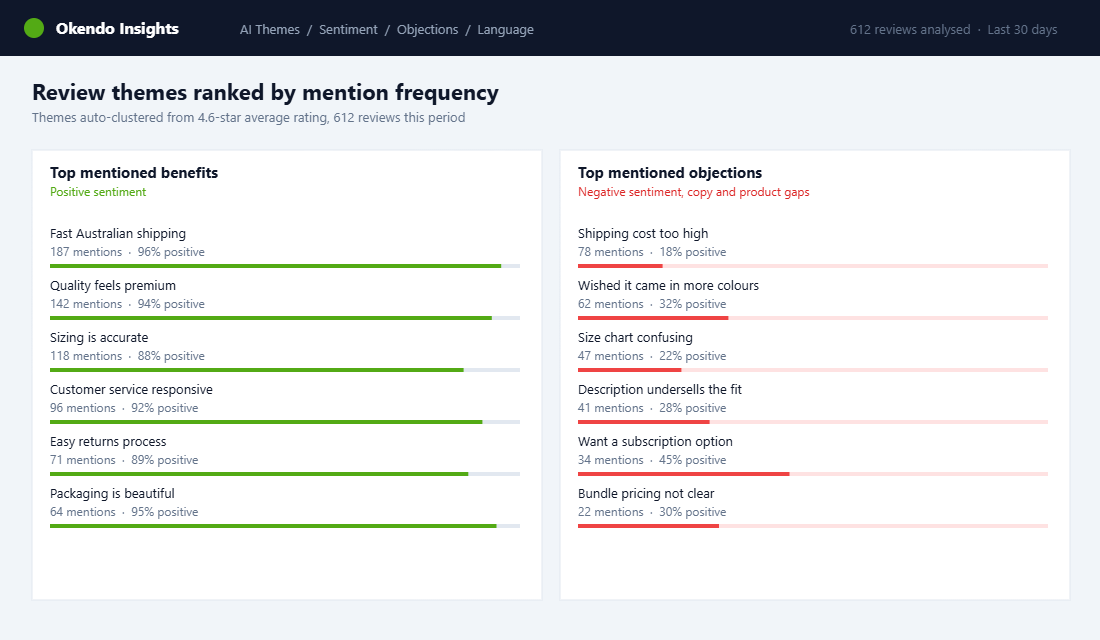
The 4-phase review mining framework: cluster the themes, capture the objections, extract the benefits, and steal the exact phrases. Tools like Okendo and Junip now ship AI-powered theme summarisation, so you do not have to do this in a spreadsheet. Okendo’s review summaries cluster mentions into themes automatically. Junip’s AI agent is trained on your review data and surfaces the same.
Run this every fortnight:
- Top 5 benefits mentioned. These become the bullet points on your product page above the fold.
- Top 5 objections. These become the FAQ section, the headline copy on your checkout upsells, and the answer to “What almost stopped you from buying?”.
- Top 10 exact phrases. The actual sentences customers wrote. Lift them word for word into Meta ad creative and product page H1s. Customer language outperforms agency copy every time.
- Comparison mentions. Whenever a reviewer mentions a competitor or a previous brand, log it. This is your real competitive set.
If you have not built a review collection system yet, that is step zero. We covered the exact 5-stage system in our piece on the Shopify Reviews Engine. Start there, then come back to mine the database.
Channel 3: Chat and DM transcripts (the pre-purchase objection layer)
This is the channel almost no one mines. Every question your support team answers in Gorgias, Re:amaze, or Zendesk is a customer telling you what your website failed to explain. Every Instagram DM your community manager handles is a buyer signal you are not capturing.
The brutal truth: if 30 customers asked about your sizing this month, your size guide is broken. If 18 customers asked about shipping to WA, your shipping page is buried. Each ticket is a tax on conversion. Mine the tax, fix the cause.
The weekly workflow:
- Tag every ticket and DM with a category: sizing, shipping, returns, product info, payment, other. Most helpdesks have built-in tagging.
- Pull a weekly count. Sort by category, descending.
- Fix the top 3 every fortnight. Rewrite the page, add an FAQ entry, update the email auto-responder, or change the product copy to address the question before it gets asked.
- Track ticket volume month over month. A healthy VoC loop reduces support tickets by 20 to 40% within 90 days because the website is doing the work the team used to do.
Channel 4: Returns reason data (the truth filter)
Returns are the most honest feedback channel in ecommerce. The customer voted with their wallet. They paid, they received, they sent it back. Whatever they tell you in the returns form is gospel because the cost of lying is high (returns cost them shipping fees, return labels, time).
If you are running Loop Returns, Returnly, or ReturnGO, you already have a returns reason picker. The question is whether you actually read it. Pull the report monthly. Cluster by SKU. The top three return reasons per SKU tell you exactly which product copy is overselling, which photography is misleading, and which size charts need a rebuild.
A practical example. One Aussie apparel brand we worked with had a 14% return rate on their top SKU. The returns data showed 62% of returns cited “smaller than expected”. The product page said “true to size”. The reviews said “size up”. Fixing the size chart and updating the PDP copy dropped the return rate to 8.4% in one quarter. That is real revenue, dropping straight to the bottom line.
Channel 5: Welcome flow zero-party data
Your Klaviyo welcome flow is the most underused research tool in your stack. Most Aussie brands run a 3-email welcome, push the discount, and call it done. What they miss: the welcome flow is the only moment a new subscriber is genuinely curious about you. They will answer a thoughtful question.
Add a one-question survey to email two of the welcome flow. Rotate the question quarterly. Some examples that consistently get 40%+ response rates:
- “What are you hoping {product category} will help you with?”
- “What is the biggest frustration you have had with {category} brands before?”
- “What almost stopped you from clicking ‘subscribe’?”
- “If you could change one thing about your current {category} routine, what would it be?”
Pipe the responses into a Klaviyo custom property. Now you have segmentation gold. You can run a re-engagement campaign to subscribers who never clicked, segmented by the exact frustration they typed in. If you have not yet built proper customer segments, our guide to Klaviyo segmentation is where to start.
For brands running a quiz funnel as the entry point instead of a standard pop-up, the same logic applies. The Shopify quiz funnel framework we walked through previously generates the richest zero-party data you can collect, because every answer maps directly to a product recommendation.
The compound effect: how the channels stack
A single channel gives you data. Five channels give you triangulation. When the post-purchase survey, the reviews, the DMs, the returns, and the welcome flow all surface the same theme, you have ground truth. That is the moment you stop guessing and start moving.
Real example from a brand inside our Connect program. The post-purchase survey said “I almost did not buy because I could not tell if it would fit my space”. The reviews said “looks bigger than expected”. The DMs were dominated by sizing questions. The returns data showed 41% of returns cited size mismatch. Five channels, one theme. They redesigned the PDP with a scale photograph, added a measurement video, and rewrote the product description. PDP conversion went from 1.9% to 3.4% in six weeks. Returns dropped 28%. The signal was always there. They just had to listen to it five times before they trusted it.
The weekly VoC ritual (90 minutes, every Monday morning)
The reason VoC programs fail is not the data. It is the lack of a ritual. Without a fixed weekly slot in the calendar, the channels collect data that nobody reads. Build the habit. Block 90 minutes every Monday morning. Run this checklist:
- Minutes 0 to 15: Pull the data. Fairing weekly export, Okendo theme summary, helpdesk tag report, returns reason export, Klaviyo survey responses.
- Minutes 15 to 45: Extract the themes. What changed this week? What appeared in more than one channel? What new exact phrase is worth stealing?
- Minutes 45 to 75: Action. Write the new ad copy, update the PDP bullet, draft the new FAQ entry, brief the designer on the new homepage hero.
- Minutes 75 to 90: Ship one thing. A single change goes live by end of day. One per week, 50 per year. That is how brands compound.
Turning VoC Gold Into Copy That Converts
Collecting customer language is half the job. The other half is putting it to work, and this is where most founders stall. The reviews sit in a spreadsheet, the survey answers get skimmed once, and the product page keeps the copy the founder wrote at 11pm two years ago.
Here is the working rule: your customers write better copy than you do. They describe the problem in the words other buyers actually search for and recognise. Your job is editorial, not creative.
- Headlines from five-star reviews. Find the phrase that repeats across your best reviews and test it word for word as your product page H1. Imagine you run a sleepwear brand and 14 reviews say some version of “first time I have slept through an Australian summer”. That is your headline. Not “Premium Bamboo Sleepwear”.
- Objection handling from pre-purchase questions. Every question that hits your chat widget before checkout is a conversion leak. The top three belong on the product page as an FAQ block, answered in the customer’s own words.
- Ad angles from returns and complaints. The reasons people return products tell you which expectations your marketing is setting wrongly. Fixing one mismatched expectation often does more for contribution margin than a new creative batch.
Then measure it like any other test. Run the VoC-led page against your current page and watch conversion rate and revenue per visitor, not opinions. Brands that rebuild key pages around mined customer language regularly see double-digit conversion lifts, and you will see the movement inside a fortnight on a page with decent traffic. If you are not sure which numbers to watch weekly, our weekly metrics dashboard covers the eight that matter.
And remember the compounding loop: better-matched expectations create happier customers, and happier customers come back. VoC is as much a retention tool as an acquisition one. We unpack that side in why your second sale matters more than your first.
The 4-step action plan to launch your VoC system this week
- Install Fairing today. Launch the 3-question post-purchase survey. HDYHAU, “what almost stopped you”, “what were you using before”.
- Open your review platform. Run the AI theme summary report. Save the top 5 benefits, top 5 objections, top 10 exact phrases to a shared doc.
- Tag your last 30 days of helpdesk tickets and DMs. Pull the count. Identify the top 3 categories. Schedule one fix per fortnight.
- Add a single survey question to email 2 of your Klaviyo welcome flow. Pipe answers into a custom property. Review responses weekly.
Block 90 minutes in your calendar every Monday morning. Label it “VoC ritual”. Defend the slot like you would a meeting with your accountant. This is the meeting that funds the rest of the year.
Inside eCommerce Circle, Voice of Customer is one of the core pillars we work on with every member. It sits at the heart of the Prospects P in our 10-P Operating System, because if you do not know who you are selling to, every other dollar you spend is friction. If you want a second opinion on yours, let’s talk.