Most Aussie Shopify brands launch TikTok Ads the same way they launched Meta Ads in 2019. Pick a couple of polished product videos, point them at a broad audience, set a $50 daily budget, and wait for the orders to land. Then four weeks later they shut the account down because the ROAS came in at 0.8x and they have written off TikTok as “not working for our brand.”
What’s in This Article
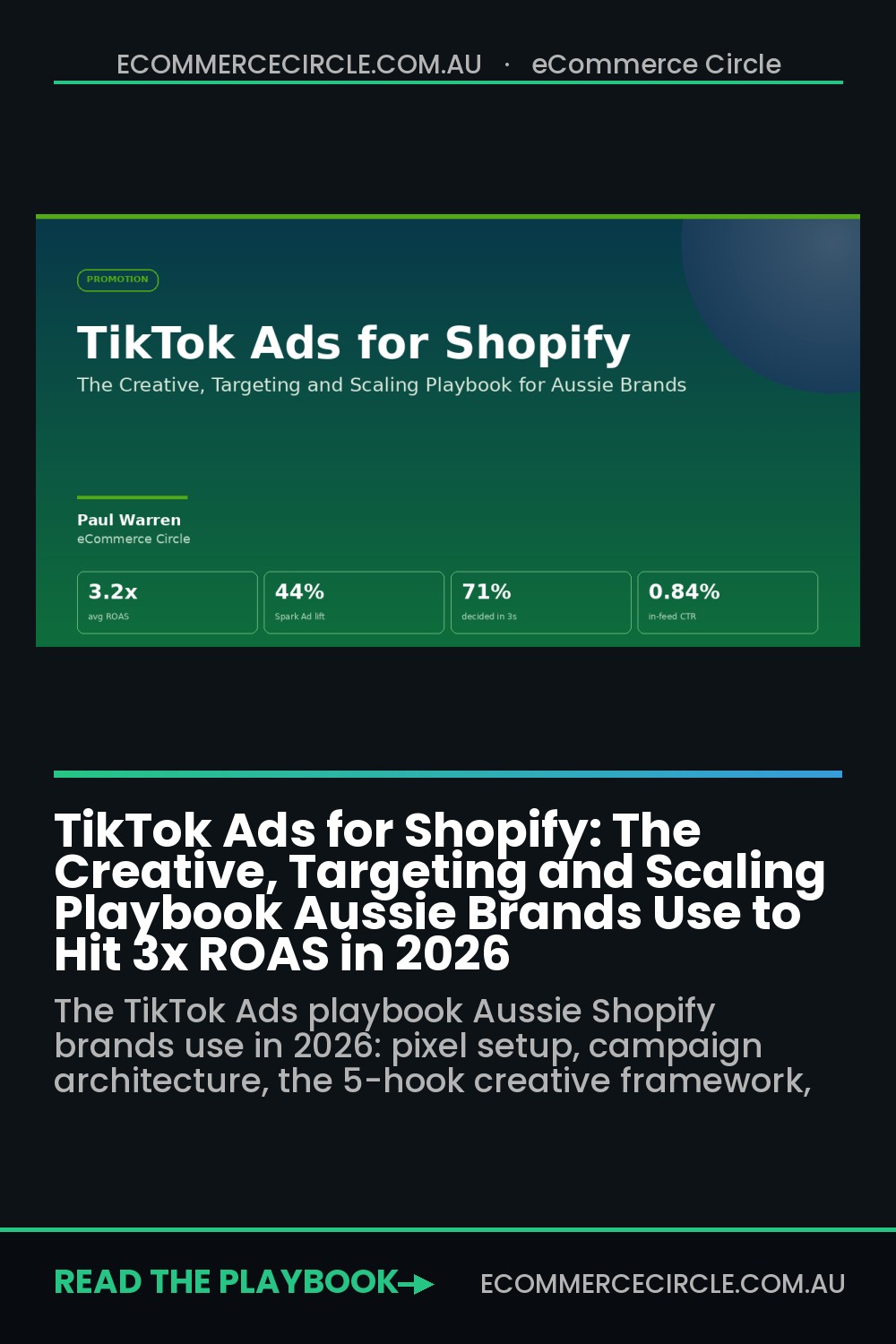
TikTok is not Meta. The auction works differently, the creative bar is different, the audiences behave differently, and the conversion path is shorter than anything you have ever run before. Brands that crack it are pulling 3x to 4.5x blended ROAS in 2026 with creative budgets that would have been laughable on Meta two years ago. TikTok Shop GMV grew 300% year over year, and the average TikTok ad ROAS for Shopify stores now sits around 3.2x according to platform data.
The difference is not budget. It is not even targeting. It is the operating model you wrap around the channel: how you set up tracking, how you structure campaigns, how you produce creative, and how often you refresh it. This is the same playbook we use with hundreds of Aussie Shopify founders inside eCommerce Circle. It works for $40k a month stores. It works for $500k a month stores. The only thing that changes is the volume of creative you ship.
The 2026 TikTok Ads Benchmarks: What “Good” Actually Looks Like
Before you touch a campaign, calibrate your expectations. Most Aussie founders are still benchmarking TikTok against their Meta numbers, which guarantees disappointment. The numbers are different because the channel is different.
- CPM: $6 to $13 AUD for most ecommerce verticals. Apparel and beauty tend to sit higher, homewares lower. Triple Whale’s 2026 data has e-commerce CPMs averaging $13.26 globally, up 16% year over year.
- CTR: 0.84% is the e-commerce average for in-feed ads. Spark Ads hit 2.4% on average. If you are under 1% on Spark, your hook is broken.
- Conversion rate (on-site): 1.92% for conversion-optimised campaigns. TikTok Shop campaigns running native checkout hit 10%+ because the path is shorter.
- ROAS: 2.5x to 3.5x is healthy. Above 4x means you have not scaled yet. Below 1.5x means your tracking, creative, or product are off.
- Cost per click: $0.40 to $1.20 AUD. Higher than Meta on the front end, but conversion paths are often shorter.
The single most important rule: measure blended performance, not in-platform ROAS. TikTok under-reports attribution by 20 to 40% because so much of its impact happens through view-through and organic discovery. If you have not already moved to the Marketing Efficiency Ratio framework, you will misread TikTok every single time.

Step 1: Fix the Foundation (Pixel, Events API, Catalog)
This is the part every brand skips and every brand regrets. TikTok’s algorithm learns from event quality. If your tracking is broken or partially implemented, you are training the algorithm on noise. No creative strategy in the world will save a campaign whose optimisation signal is wrong.
Use the official TikTok sales channel inside Shopify. Install the app, connect your TikTok Ads Manager account, and let it provision the pixel automatically. Then verify five events are firing cleanly in Events Manager:
- PageView on every page load.
- ViewContent on product pages.
- AddToCart on every cart add (including cart drawer adds, which break in many themes).
- InitiateCheckout on checkout entry.
- CompletePayment with order value, currency (AUD), and product SKUs.
Then turn on the Events API alongside the pixel. The Pixel runs in the browser, the Events API runs server-side, and TikTok deduplicates between them. The combo lifts event match rate from around 50% to 85%+, which directly improves attribution and lowers CPA. Most Shopify themes do not enable Events API by default. You either run it through the TikTok sales channel (the easy path) or via a server-side tracking layer like Stape or Elevar (the better path for scaling brands).
Last foundation piece: connect your product catalog. TikTok needs a clean feed to run Catalog Sales, dynamic retargeting, and TikTok Shop campaigns. The Shopify integration handles this, but you must verify the product feed is approved and product images meet TikTok’s specs (1080 by 1920 portrait, no excessive text overlay, no claims that trigger rejection).
Step 2: Campaign Architecture (The 3-Tier Structure That Scales)
Once tracking is clean, architect your account before you spend a dollar on creative. The biggest mistake we see is brands running 17 ad groups under one campaign, each with a different objective and audience. TikTok’s algorithm cannot learn from chaos. Give it structure.
Run three campaigns. That is it.
- Campaign 1 – Prospecting (broad). Objective: Conversions, optimised for CompletePayment. Audience: broad targeting, age 18 to 55, all genders unless your product is gender-specific. No interests, no behaviours. Let the algorithm find buyers. Budget: 60 to 70% of total spend.
- Campaign 2 – Creative Testing (ABO). Objective: Conversions, optimised for AddToCart or CompletePayment depending on volume. One ad group per creative concept, $20 to $50 a day per ad group, identical audience to Campaign 1. Budget: 15 to 20% of total spend. This is where every new creative starts its life before it earns a place in Campaign 1.
- Campaign 3 – Retargeting (warm and Shop visitors). Objective: Conversions, optimised for CompletePayment. Audience: 14-day or 30-day video viewers, AddToCart, and InitiateCheckout. Creative: offer-led, social proof heavy, urgency where genuine. Budget: 10 to 20% of total spend.
For prospecting, use Campaign Budget Optimisation (CBO) with 3 to 5 active ad groups. CBO needs spend history and volume to allocate well, which is exactly what prospecting gives it. For testing, use Ad Group Budget Optimisation (ABO) so each creative gets a fair shot before the algorithm picks favourites. The minimum daily budgets in 2026 are $50 at campaign level and $20 at ad group level, so plan accordingly.
Naming convention matters. Use a structure like [Funnel]_[Audience]_[Date]_[Objective]. Example: PROSP_Broad_2026-05_Purchase. You will thank yourself in three months when you are trying to find which ad group hit 4x ROAS in March.
Step 3: Creative Strategy (The 5-Hook Framework That Stops the Scroll)
This is where every TikTok campaign lives or dies. The first three seconds determine 71% of whether a user keeps watching or scrolls past. That is not a creative preference, it is a platform reality. If your ad opens with your logo or a slow brand-lift shot, you have already lost.
Every ad your brand ships should hook from one of these five archetypes. Test all five, find the two or three that work for your category, then iterate within those.

- Hook 1: The Problem Reveal. Show the painful moment your product solves in the first second. “POV: you just spilled coffee on your white couch for the third time this week.” Now demo the solution. Works for utility-driven categories: cleaning, organisation, beauty, kitchenware.
- Hook 2: The Curiosity Gap. Open with a statement that demands an answer. “I haven’t washed my hair in 11 days and it’s never looked better.” The viewer keeps watching to find out why. Best for products with a counterintuitive benefit.
- Hook 3: The Before and After. Cut hard between the “before” state and the result. Three seconds in, the viewer already sees the transformation. Best for skincare, home renovation, organisation, fitness.
- Hook 4: The Native Reaction. Creator opens with their honest first reaction to your product. “Okay this just arrived and I don’t know how to feel about it.” Mimics organic content perfectly. Best for unboxing-worthy products at $30 to $150.
- Hook 5: The Pattern Interrupt. Unexpected visual: reverse footage, slow motion at speed zero, a frame of bright colour against muted footage, a sound effect, anything that breaks the TikTok feed visually. Best for categories where the product itself is not visually distinctive.
After the hook, the rest of the ad follows the Hook, Value, Proof, CTA structure. Hook in 3 seconds. Value (what it does, why it matters) in 5 to 10 seconds. Proof (review snippet, transformation, social validation) in 5 to 10 seconds. CTA in the final 3 seconds: “Shop now,” “Get yours,” “Link in bio.” Action-oriented overlays lift conversion 18%+.
Length: 15 to 30 seconds for most. 15 seconds is the sweet spot for prospecting. Retargeting can run 30 to 45 seconds because the audience already knows the brand and tolerates more depth.
Step 4: Spark Ads (Why Your Best Ad Is Already on a Creator’s Account)
The single highest-leverage move on TikTok in 2026 is running Spark Ads. These are ads that boost an existing organic post from your brand account or, more powerfully, from a creator who has tagged your product or partnered with you. They look organic because they are organic. The platform treats them differently because they originate from a real account with a real feed history.
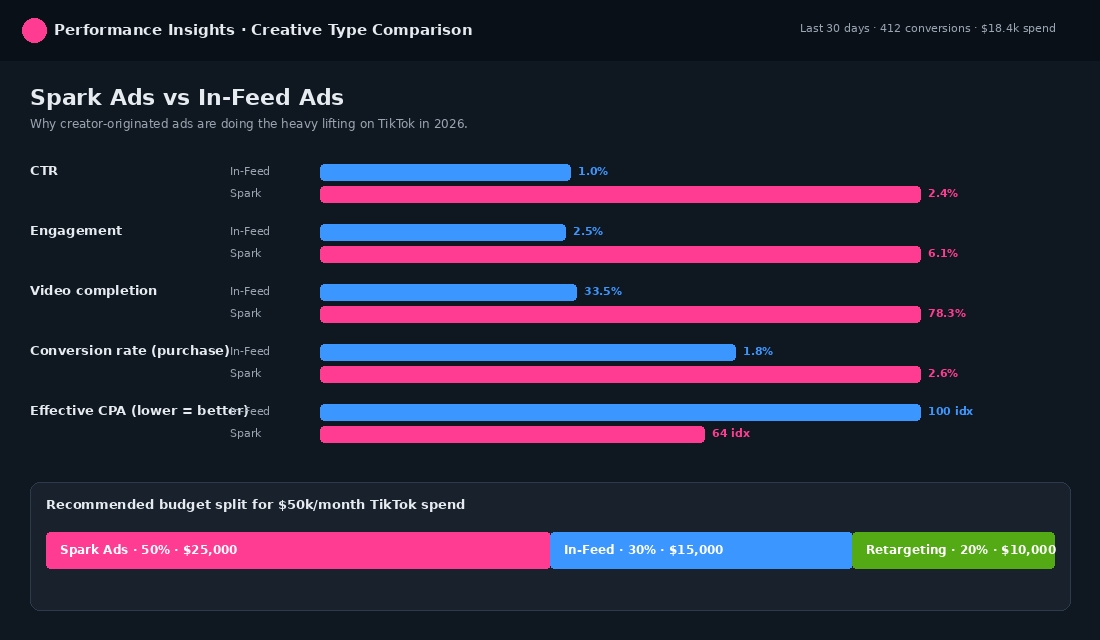
The performance gap is not subtle. Spark Ads produce a 2.6% conversion rate versus 1.8% for studio-built in-feed ads, a 44% lift. Engagement rate runs 6.1% on Spark Ads versus 2.5% on in-feed. Video completion rate hits 78.3% versus 33.5%. CTR averages 2.4% on Spark versus 1.0% on in-feed. UGC-based ads see engagement jump 28% and web conversions rise 29% on average.
The way you source Spark Ads at scale:
- Brief 5 to 10 micro-creators a month ($300 to $1,500 AUD per creator depending on follower count and niche). Send the product, give them a creative brief built around the 5-hook framework, and ask for 2 to 3 video variants each.
- Request a Spark code on every video you intend to run as an ad. Without the code, you cannot promote their post.
- Test as native organic first for 24 to 48 hours on the creator’s account. If a video starts hitting outsized engagement organically, that is your green light to put paid behind it.
- Run Spark Ads in Campaign 1 (Prospecting) with the same broad audience. The Spark Ad creative does the targeting work for you.
For most brands, 40 to 60% of paid budget should sit behind Spark Ads. The CPC premium is real (about 38% higher than in-feed), but the conversion lift and engagement gap make the effective CPA materially lower.
Step 5: Testing Cadence (The Weekly Rhythm That Compounds)
Creative fatigue on TikTok is faster than any channel you have run before. A winning ad burns through its audience in 7 to 14 days at scale. If your refresh cadence is monthly, you are too slow.
The cadence we run inside eCommerce Circle for clients spending $5k to $50k a month on TikTok:
- Weekly: ship 5 to 10 new creative concepts. Mix of in-house, creator briefs, and Spark Ads. Top brands ship 20 to 50 new variations a month, so build your production engine accordingly.
- Weekly: test 2 to 3 new hooks on existing winning creative. Same body, different first 3 seconds. Same hook, different background music. Same script, different creator.
- Weekly: kill bottom 30% of ads by CPA. Do not wait for ROAS to crater. If an ad has spent 3x your target CPA without converting, it is done.
- Weekly: promote winners to scale. Once an ad in the testing campaign produces 3 to 5 conversions at or below target CPA, duplicate it into the prospecting CBO campaign.
- Monthly: full account audit. What categories of creative are winning? What hooks? What creators? What price points? Codify the patterns. Build the next month’s brief off the learnings.
This rhythm is the difference between brands that get TikTok and brands that quit. If you cannot ship that volume in-house, hire a creator agency or build a UGC pipeline. The platform rewards velocity. Brands that ship 1 to 2 ads a month will always lose to brands shipping 10 to 20.
Step 6: Audience Strategy (Why Broad Wins in 2026)
This will feel wrong if you are coming from Meta. On TikTok, interest targeting and behavioural targeting consistently lose to broad. Why? Because TikTok’s interest signals are softer than Meta’s, and the algorithm is much better at finding buyers from creative signals than from input targeting. Your creative is your targeting.
For Aussie Shopify brands, the formula for 90% of prospecting:
- Location: Australia. Drop New Zealand into a separate ad group if you ship to NZ, do not blend.
- Age: 18 to 55 (or wider). Narrow only if your product is genuinely age-bound, like maternity or aged-care.
- Gender: All, unless gender-specific product. Even then, test both. You may be surprised.
- Interests and behaviours: Empty. Let the algorithm work.
- Custom audiences: Reserve for retargeting only.
For retargeting, build three custom audiences: 14-day video viewers (50%+ watched), 30-day AddToCart, and 30-day InitiateCheckout. Stack them into one retargeting ad group with offer-led creative. Excluded audiences should include 30-day purchasers, unless you have a subscription or replenishment product, in which case rotate them back in at 60 days.
Step 7: Scaling (When and How to Increase Spend Without Breaking Performance)
TikTok is more sensitive to budget changes than Meta. A 50% overnight budget increase will often blow up your CPA for 3 to 5 days while the algorithm re-learns. The safe path:
- Scale by 20% every 2 to 3 days on campaigns hitting target CPA. This gives the algorithm time to absorb the new budget without resetting learning.
- Duplicate winners instead of scaling once you hit $500 a day per ad group. Run two ad groups at $500 each rather than one at $1,000. The auction dynamics get easier and the algorithm has more independent reps.
- Add cold creative weekly as you scale. A scaling campaign needs constant new fuel, otherwise audience saturation will kill ROAS within two weeks.
- Watch frequency. If your in-platform frequency goes above 2.5 in a 7-day window, you are hitting audience saturation and need more creative, not more budget.
Pair this with a strong retention engine on the back end. TikTok brings volume, but the LTV math only works if you have a post-purchase email sequence and a healthy customer base. Acquiring volume without retention is the fastest way to bankrupt yourself with paid ads.
The Compound Effect: Why TikTok Becomes a Pipeline, Not a Channel
Here is what makes TikTok different from every other paid channel an Aussie Shopify brand will run. It is not a closed loop. The ads you run also fuel your organic account, your creator partnerships, your UGC library, and your email and SMS list growth. Treat the channel like a pipeline, not a single funnel.
The brands compounding fastest on TikTok in 2026 are running this loop:
- Spend on Spark Ads with creators. Each Spark Ad doubles as paid distribution for the creator and an organic asset for the brand account.
- Organic engagement compounds. Spark Ads view-throughs and follows feed your organic account. Your brand handle picks up 200 to 500 followers a week as a free byproduct of paid spend.
- UGC library grows automatically. Every creator brief is also a UGC asset for your email, your PDPs, your Meta Ads, and your landing pages.
- Email and SMS list grows on the back end. TikTok-driven traffic captured by a quiz funnel or welcome popup drives 15 to 25% list growth from the same paid spend.
- Retention engine monetises the back end. First-time TikTok customers move into your email and SMS flows, which is where margin actually lives.
This is why the brands hitting 4x and 5x blended ROAS on TikTok are not just buying ads. They are running a pipeline that converts paid spend into multiple owned assets at once. The blended math works because the channel is doing four jobs.
The 30-Day TikTok Ads Implementation Plan
If you are starting from zero or restarting after a failed attempt, run this 30-day plan before judging the channel.
- Week 1: Install the TikTok sales channel. Verify all 5 events firing. Enable Events API. Connect product catalog. Brief 5 micro-creators on the 5-hook framework. Budget: $0 to $500 in ads.
- Week 2: Receive first creator content. Set up 3 campaigns (Prospecting CBO, Creative Testing ABO, Retargeting). Launch with 5 to 8 in-feed ads, $50 a day per testing ad group. Budget: $1,500 to $3,000.
- Week 3: First Spark Ads go live. Kill bottom 30% of testing ads. Promote winners into prospecting CBO. Ship 5 to 10 new creatives based on Week 2 learnings. Budget: $3,000 to $6,000.
- Week 4: Scale winning prospecting ad groups by 20% every 2 to 3 days. Add retargeting offer-led creative. Audit which hooks, creators, and formats are winning. Build Month 2 brief. Budget: $6,000 to $12,000.
By end of Week 4 you should have hit at least 2x in-platform ROAS and 2.5x blended. If you have not, the failure is almost always in one of four places: tracking is broken, creative volume is too low, you are still using interest targeting, or your product margin cannot support paid acquisition. None of those is a TikTok problem. All of them are fixable.
Inside eCommerce Circle, TikTok is one of the paid channels we work on with every member running a Shopify store above $40k a month. If you want a second opinion on your TikTok setup, your creative, or your tracking before you spend another dollar, let’s talk.
Related reading: the TikTok Shop Australia playbook.
Related reading: our Meta ads creative testing framework.