Walk into any Aussie Shopify store and ask the founder how much revenue gift cards drove last year. You will get one of three answers. A shrug. A guess in the low single digits. Or, occasionally, a real number from a founder who has been paying attention.
What’s in This Article
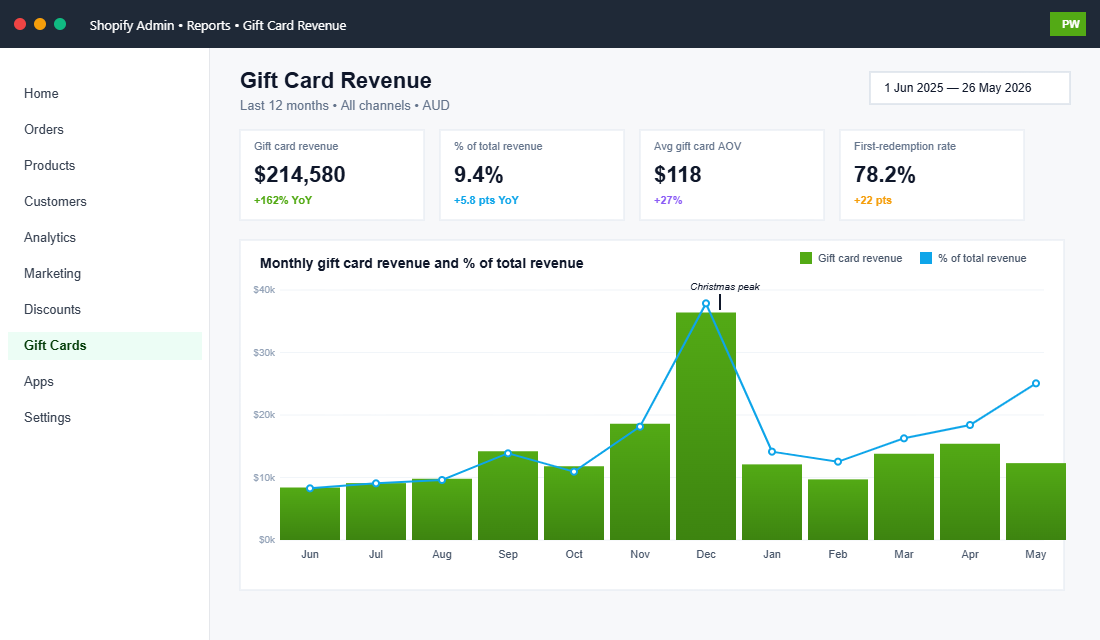
The shruggers are missing the easiest 8 to 12% of revenue sitting inside their store. Gift cards are the only product in your catalogue that ships in 0 seconds, carries 0 COGS until the moment of redemption, and arrives in the hands of a brand-new customer who did not pay to acquire themselves. The Australian gift card market sits at roughly $2.5 billion in annual spend, with 69% of Aussie adults purchasing a gift card in the last 12 months and an average load value of $57. That demand exists whether you build a system to capture it or not.
Most brands treat gift cards as a checkbox feature buried two clicks deep in the footer. The brands quietly winning treat them as a strategic revenue line with its own merchandising, its own email flow, its own seasonal calendar, and its own P&L. This is the 5-lever system we coach Circle members through. Pull all five and gift cards stop being a rounding error and start funding your next inventory order.
Why Gift Cards Quietly Outperform Every Other Product On Your Store
Before we get into the levers, the unit economics. A gift card sale is structurally different from a product sale and that difference is where the margin lives.
- Zero COGS at point of sale. You collect cash, you ship nothing. Your COGS line stays at 0 until the recipient redeems against real product.
- Zero pick, pack, and freight on the gift card itself. A $100 digital gift card has the same fulfilment cost as a thank-you email. Compared with a physical product carrying 15 to 25% in pick, pack, and AusPost freight, this is a $15 to $25 swing on every $100 of revenue.
- Breakage is real margin. Industry data puts gift card breakage (the share of cards never redeemed) at 5 to 10% for digital programs and up to 15 to 20% for physical and corporate cards. That breakage is recognised as pure revenue with no offsetting cost. On $200,000 of annual gift card sales, even a conservative 8% breakage is $16,000 of margin you bank without lifting a finger.
- The buyer is not the customer. Every gift card sold introduces a brand-new buyer to your store at $0 CAC. If 60% of recipients have never bought from you before, your gift card line is also your cheapest acquisition channel.
- Redemption is almost always topped up. Research from loyalty platforms shows that 65 to 75% of gift card redemptions exceed the value of the card. A $50 card typically lands a $75 to $90 order. Your AOV on gift-card-driven orders runs 40 to 60% above your store average.
Stack those five effects together and a healthy gift card line delivers a blended contribution margin north of 70%. That is roughly double what a well-run apparel or beauty brand makes on a typical product order. Once you internalise that math, treating gift cards as a footer link starts to feel like leaving cash on the floor on purpose.
Lever 1: Promote The Gift Card Like A Hero Product (Not A Footer Link)
The first lever is the cheapest and most ignored. If your gift card lives at /products/gift-card with one stock-standard image and no copy, you are telling buyers it is an afterthought. Aussie shoppers searching for “gift” or “voucher” will bounce to a competitor who has built a real gift card experience.
The Mecca Beauty Loop benchmark in Australia shows what good looks like. Mecca treats gift cards as a category landing page, not a single SKU. The destination has hero imagery, denomination options, a gift message field, a delivery scheduler, and the same care given to a new product launch.
Your version of that, on a $40k to $500k a month Shopify store, looks like this:
- A dedicated /pages/gifts landing page. Not the product page. A curated gifting destination with sections for “Gift cards”, “Gifts under $50”, “Gifts for her”, and “Last-minute gifts”. Internally link to it from your main navigation under “Gifts” or “Gifting”.
- 4 to 6 denominations as visible options. $25, $50, $100, $150, $250, $500. Default to the middle value. Brands that bury the denomination behind a free-text field lose buyers who do not want to think about it.
- Custom card designs. A birthday card. A thank-you card. A “just because” card. A seasonal card swapped quarterly. Buyers pick a design the way they would pick a Hallmark card. Tools like Govalo and GiftKart handle the designs natively inside Shopify.
- A gift message field, a recipient email field, and a scheduled send date. The buyer wants to send the card to land on a specific morning. If your store cannot do that, you have already lost the corporate gifter and the procrastinator.
- Social proof on the PDP. A reviews block scoped to gift cards. Pull verbatim quotes from past gift card buyers about how well it landed.
One more merchandising lever most brands miss. Add a “Buy a gift card” prompt to the cart drawer and post-purchase thank-you page. A shopper not ready to commit to a $150 product is often happy to buy a $50 gift card for someone else. We have seen Aussie brands lift gift card revenue 30 to 45% in 90 days from PDP and cart drawer placement alone.
Lever 2: Build The Recipient Activation Flow (The Moment A Gift Card Becomes A New Customer)
This is the lever almost every founder misses. The gift card sale is only half the transaction. The other half is the recipient opening the email, clicking through, and turning into a paying customer.
By default, Shopify sends the recipient a basic transactional email with a code and a redemption link. That email gets opened. Then nothing happens. The recipient sits on the card for weeks, browses once, leaves, forgets. Conservatively, 30 to 40% of gift cards still have a balance 90 days after issue. Most of that balance never gets redeemed because the brand never built a flow to bring the recipient back.
Build a 5-email recipient activation flow in Klaviyo, triggered by the gift card delivery event:
- Email 1 (Day 0). The arrival. Branded gift card delivery. Includes the sender’s gift message, the redemption code, a clear CTA to “Start shopping”, and a soft brand introduction. This is not a transactional receipt. It is a brand moment.
- Email 2 (Day 3). The welcome. If they have not redeemed, send a “welcome to the brand” email with your hero product, your founder story, and 3 collections to explore. Treat them like a high-intent prospect, because they are.
- Email 3 (Day 14). The shortlist. Curate 6 to 9 products at or below the gift card value. Solve the “I do not know what to spend it on” problem. Include shipping cost transparency so they know the card covers the full purchase.
- Email 4 (Day 30). The nudge. A reminder of the card balance. A real photo of the product the sender’s previous orders contained (“Your friend Alex bought this. Want to try the same?”). Subtle, not creepy.
- Email 5 (Day 60 to 75). The expiry pressure. If your card has an expiry (Aussie cards now have a 3-year minimum under ACCC rules), remind them. If not, use a soft “we’d love to see what you pick” message tied to a top-trending product.
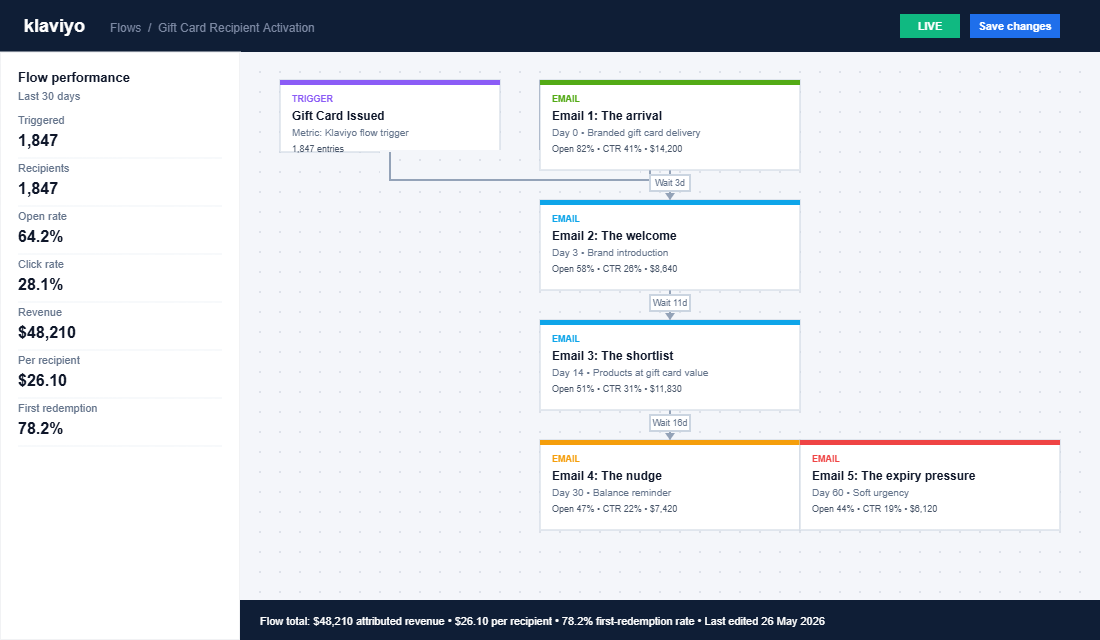
Brands that build this flow lift first-redemption rate from a default of 50 to 60% up to 75 to 85% inside 90 days. That is direct revenue, and more importantly, it is a new customer entering your retention flows at AOV well above your store average. The recipient activation flow is the single biggest email project most Aussie DTC brands have never built.
Lever 3: Engineer Breakage Without Being A Jerk (The Hidden Margin Every CFO Loves)
Breakage is the share of gift card value that is sold but never redeemed. Under ASC 606 and Australian accounting standards, breakage is recognised as revenue once it is reasonably certain the card will not be used. For an Aussie brand running clean books, breakage is real, bankable margin. The trick is to engineer the right amount.
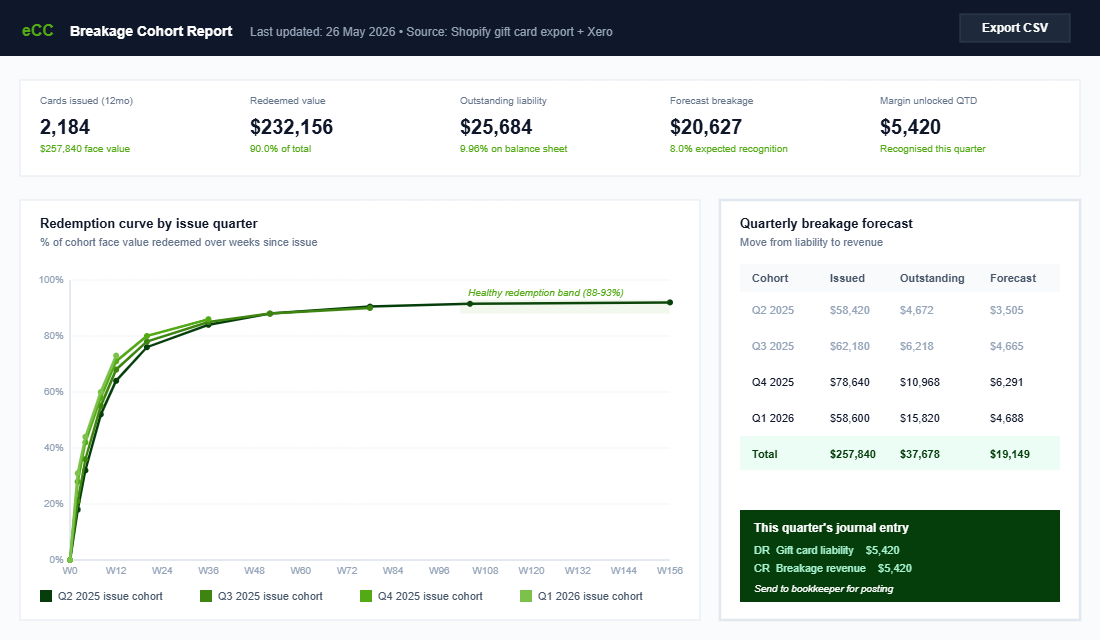
Too little breakage (under 5%) means your activation flow is doing its job but you are leaving accounting margin on the table. Too much breakage (over 15%) is a sign your recipients hate the brand experience and you are sitting on a customer complaint timebomb. The healthy band for a well-run DTC brand sits between 7 and 12%.
Three things to do this quarter to get breakage in the right zone:
- Comply with the ACCC 3-year minimum. Since 2018, gift cards sold in Australia must have a minimum 3-year expiry from the date of supply, and the expiry must be clearly displayed on the card or receipt. Anything shorter is illegal and a brand-damaging fight you do not want. Use the full 3 years and let the activation flow do the heavy lifting.
- Track redemption curves by cohort. Pull a quarterly report by quarter-of-issue showing what percentage of that quarter’s gift card value has been redeemed, what is still outstanding, and what your forecast breakage looks like. Most Shopify-native gift card analytics will not show you this. Build it in a Google Sheet using your Shopify gift card export.
- Recognise breakage in your accounts. Talk to your bookkeeper or fractional CFO about moving expected breakage from “gift card liability” to “breakage revenue” on a quarterly cadence. For a brand doing $200k a year in gift card sales with 8% breakage, that is $16,000 of revenue that should be hitting your P&L, not sitting on the balance sheet indefinitely. Tying this back to your working capital framework shows how a healthy gift card line quietly improves your cash conversion cycle.
One nuance worth flagging. Breakage is not a target you optimise for at the expense of customer experience. Brands that try to manufacture breakage through hidden expiry dates, dormancy fees, or hard-to-find redemption flows lose the long game. The ACCC has actively fined retailers for non-compliant gift card terms, and consumer media in Australia has zero tolerance for it. Build a clean program, run the activation flow, and let breakage sit naturally in the 7 to 12% band.
Lever 4: Map Occasion Campaigns To The Aussie Gifting Calendar
Gift cards are not a year-round flat line. They spike sharply on calendar moments. The brands capturing the spike are the ones who pre-plan campaigns 60 to 90 days out. Everyone else reacts in the week of and wonders why they missed it.
The Aussie gifting calendar that matters for Shopify brands:
- Mother’s Day (second Sunday in May). Australians spent around $1 billion on Mother’s Day in recent years, with gift cards consistently ranking in the top 5 gift categories. Start your campaign on 1 April. Peak send window is the Wednesday before.
- Father’s Day (first Sunday in September). Smaller spend than Mother’s Day but heavily skewed to digital gift cards for hardware, tech, and lifestyle brands. Roy Morgan data shows fewer Aussies are buying for Dad but those who do are spending more per gift.
- Christmas (mid-November to 24 December). The peak. ARA research shows 20% of Aussies say the bulk of their Christmas spend goes on gift cards. This is the single most important 6-week window in your year for gift cards. Run a 6-week ramp from early November.
- Valentine’s Day (14 February). Small in retail terms but high-margin if you sell beauty, jewellery, lingerie, or experience-style products. Run a 2-week campaign.
- Birthdays (year-round). Birthdays do not show up on a calendar but they make up 35 to 40% of all gift card purchases in the ARA dataset. Capture them with an “always-on” birthday gift campaign in your Klaviyo flows.
- EOFY corporate gifting (May to June). Often missed by DTC brands. Aussie businesses use gift cards as staff and client gifts pre-30 June. A simple “bulk gift cards” page with a 5 to 10% discount on orders over $1,000 captures this market.
For each occasion, run the same 5-stage campaign:
- Pre-launch (60 days out). Build the campaign landing page, finalise the card designs, brief the email and social calendar.
- Awareness (30 to 14 days out). Drop “gift inspiration” content. Soft mention of gift cards as the fallback option.
- Decision (14 to 5 days out). Push the gift card hard. Lean into “still not sure what to get?” messaging.
- Last-chance (5 days to 24 hours out). Hammer the digital gift card. This is your highest revenue window because procrastinators convert at extraordinary rates.
- Post-occasion (the week after). Recipient activation flow does the heavy lifting. Add a “still time to use your card” promo for the procrastinator recipients.
This is where being Australian gives you an asymmetric edge. The US-centric Shopify gift card content treats Christmas as the only event. The Aussie calendar has 5 to 6 distinct moments. Each one is a chance to rebuild the same campaign with a different angle. Across 12 months, the cumulative lift is what takes gift cards from 2% of revenue to 8 to 12%.
Lever 5: Use Gift Cards As Retention Insurance (Returns, Win-Back, And VIP Recovery)
The fifth lever is the most strategic and the most underused. Gift cards are not just a product to sell. They are a retention tool you can deploy in three high-value moments.
- Returns rescue. When a customer requests a refund, offer a store credit gift card at 110% of the refund value. A $80 refund becomes an $88 gift card with no shipping cost. Brands running this in apparel and beauty recover 25 to 40% of refund value as future revenue at near-100% margin. The customer feels heard, the cash stays in the store, and the LTV graph keeps climbing.
- Win-back for lapsed customers. Segment customers who have not purchased in 120 days. Send a small ($15 to $25) “we miss you” gift card with a 30-day expiry. Conversion on these campaigns typically lands in the 8 to 15% range, an order of magnitude better than a flat percentage discount because the framing is generous rather than desperate.
- VIP appreciation. For your top 10% by spend, send an unprompted $50 to $100 gift card on a meaningful date (their first-purchase anniversary or their birthday). This is where the gift card stops being a sales tool and starts being a relationship investment. The downstream LTV impact is hard to measure on a single touch but compounds across cohorts. This pairs cleanly with the loyalty program structure you should already have running.
The math on retention insurance is brutal in your favour. Acquiring a new customer in 2026 costs an Aussie DTC brand $40 to $150 depending on category. A $20 gift card to a lapsed customer who reactivates costs you maybe $8 in marginal product cost. Even at a 10% reactivation rate, the blended CAC equivalent is under $80, competitive with paid acquisition, and the activated customer comes back with full brand context.
The Compound Effect: What 5 Levers Look Like Together
One lever in isolation is a nice-to-have. Five levers running as a system is a revenue line. Here is the order of operations and the realistic numbers we have seen Circle members hit at the $1 to $5m Shopify revenue band.
- Month 0 baseline. Gift cards at 1.5 to 3% of revenue. Default Shopify email. No activation flow. Breakage uncounted.
- Month 1 to 2. Merchandising live. Gift cards lift to 3 to 5% of revenue from PDP and cart placement alone.
- Month 2 to 3. Recipient activation live. First-redemption rate moves from 55% to 75%+. New customer adds climb 80 to 120%.
- Month 3 to 4. Breakage accounting clean. $10k to $25k of margin recognised in the quarter that was sitting on the balance sheet.
- Month 4 to 12. Occasion campaigns running across the 5 to 6 Aussie calendar moments. Cumulative effect lifts gift cards to 6 to 9% of revenue.
- Month 6 onward. Retention insurance live. Returns rescue recovers 25 to 40% of refund cash. Win-back gift cards become a top-3 reactivation channel.
The brands we work with land at 8 to 12% of total revenue from gift cards within 12 months. At a $2m revenue brand that is $160k to $240k of gift card revenue at a blended contribution margin north of 70%. That is $110k to $170k of margin dollars sitting inside a workstream that, before this system, was a footer link.
The Tool Stack And The 30-Day Implementation Plan
You do not need a complex tech stack to run this. You need 3 tools and 30 days of focused work.
- Gift card platform. Shopify’s native gift cards work for the basics. For real merchandising (custom designs, scheduled sends, corporate orders, store credit returns), graduate to Govalo or GiftKart. Both integrate natively with Shopify and Klaviyo. Govalo starts at around USD $25/month and is built specifically for DTC brands. GiftKart sits in a similar bracket with stronger cashback features.
- Email platform. Klaviyo is the standard for the recipient activation flow. The flow is built once and runs forever. Most Klaviyo agencies will build the 5-email sequence for $1,500 to $3,500 if you do not want to do it in-house.
- Accounting and analytics. Xero or QuickBooks plus a monthly Shopify gift card export. Build the breakage cohort report in a Google Sheet. Your bookkeeper handles the journal entries. Cost: zero new tools.
The 30-day plan:
- Week 1. Build the /pages/gifts landing page. Add the gift card to main navigation. Install Govalo or GiftKart. Brief 4 to 6 card designs with your designer.
- Week 2. Build the 5-email recipient activation flow in Klaviyo. Add the cart drawer gift card prompt. Update product pages with a “Or send this as a gift card” CTA.
- Week 3. Set up the breakage cohort report. Talk to your bookkeeper about quarterly breakage recognition. Map the next 3 occasion campaigns on your calendar.
- Week 4. Soft launch the first occasion campaign. Add returns rescue gift cards to your customer service macros. Brief the team on the new program.
One month of focused work and you have a gift card system that compounds for years. Two months in, the merchandising and activation flow are running on autopilot. Six months in, the occasion campaigns are landing and you are seeing the breakage line in your monthly P&L. Twelve months in, gift cards are quietly funding a meaningful slice of your inventory orders. The same focus we bring to BFCM inventory planning deserves to sit on your gift card line as well.
The Mistake That Kills Most Gift Card Programs Before They Start
Before we wrap, one last warning. The biggest mistake Aussie founders make with gift cards is treating them as a discounting tool. They run a “20% off gift cards” promo at Christmas, the margin evaporates, and the program never recovers because the brand has trained buyers to wait for the discount.
Gift cards should not be discounted, ever. Discounting a gift card is discounting your own currency. If you want to incentivise buyers, do it on the product side. Offer a free gift wrap, throw in a sample pack with every gift card purchase over $100, or give a bonus $10 card on a $100 purchase (which costs you only the marginal COGS if and when the bonus is redeemed). All of these preserve the card’s full value while still rewarding the buyer.
The brands winning the gift card game in Australia are not running flashy promos. They run a clean program with strong merchandising, a tight activation flow, sensible breakage, calendar-mapped campaigns, and the discipline to use gift cards as retention insurance when it matters. None of it is glamorous. All of it compounds.
Your 5-Lever Gift Card Audit (Take 15 Minutes)
If you want to know where your store sits today, run this audit. For each lever, score yourself out of 2 (0 = not done, 1 = partially done, 2 = fully done). Total possible: 10.
- Lever 1 (Merchandising): Dedicated gifting landing page, navigation entry, custom card designs, scheduled send, social proof on the PDP.
- Lever 2 (Recipient activation): A 5-email Klaviyo flow triggered on gift card delivery, with first-redemption rate tracked monthly.
- Lever 3 (Breakage): ACCC-compliant 3-year expiry, quarterly cohort report, breakage recognised in the P&L.
- Lever 4 (Occasion campaigns): Pre-planned campaigns for Mother’s Day, Father’s Day, Christmas, Valentine’s Day, EOFY corporate, plus an always-on birthday flow.
- Lever 5 (Retention insurance): Returns rescue gift cards in your customer service macros, win-back gift cards for 120-day lapsed customers, and VIP appreciation cards for your top 10%.
Most Aussie DTC brands we audit score between 1 and 3 out of 10 on their first run. The ones doing real revenue from gift cards score 7 to 9. The gap between those two numbers is roughly $100k to $250k a year in additional contribution margin at a $2m revenue store. That is the prize on the table.
Inside eCommerce Circle, the gift card revenue playbook is one of the Profit pillars we work on with every member. If you want a second opinion on yours, let’s talk.