Your loyalty program has 4,000 members. Most of them have no idea they joined. They earned points at checkout, never read the email, and they will churn at exactly the same rate as customers who never signed up. That is the dirty secret of free points programs: enrolment is not engagement.
What’s in This Article
Now look at the brands that charge for loyalty. Costco closed fiscal 2025 with a 92.2% renewal rate in the US and Canada. Amazon Prime members spend roughly $1,170 USD a year on Amazon against $570 for non-members, a 2-to-1 gap that has held for five straight years. And McKinsey’s research on paid loyalty found that members of paid programs are 60% more likely to increase their spend with the brand after joining. Free programs manage half that lift.
The mechanism is not complicated. When a customer pays to belong, they shop to justify the fee. The fee creates the habit, and the habit creates the revenue. This playbook walks you through the 5-part system for building a paid membership on your Shopify store: when it works, how to design the value stack, how to price it, how to build and launch it, and how to run the renewal engine that keeps it compounding. It is the same model Wesfarmers runs with OnePass, scaled down to a DTC brand doing $50k to $500k a month.
Why Paid Memberships Beat Points Programs (The Psychology of the Fee)
A free points program asks nothing of the customer, so it gets nothing back. A paid membership asks for $40 to $100 upfront, and that single transaction rewires the relationship in three ways.
- The sunk cost flips the default. A member who paid $59 for free shipping and member pricing now has a reason to check your store first. Every order they place elsewhere feels like wasted membership. Amazon built one of the largest subscription businesses on earth on exactly this instinct.
- The fee filters for your best customers. Only people who already like your brand pay to get more of it. You are not bribing strangers with points. You are deepening share of wallet with customers who were already going to spend, which is why McKinsey found paying members can be worth several times more than non-paying members even before you count the fee revenue.
- The fee itself is high-margin recurring revenue. Thrive Market, the US grocery DTC built entirely on a $59.95 USD annual membership, generates roughly 20 to 25% of total revenue from membership fees alone. That is revenue with no product cost, no pick-and-pack, and no shipping attached.
Closer to home, Wesfarmers has rolled OnePass across Bunnings, Kmart, Target, Officeworks, Catch and Priceline at $4 a month or $40 a year, bundling free delivery, express click and collect, and 365-day change-of-mind returns. In April 2026 they went harder again, giving shoppers six months of free delivery to push trial. When the most disciplined retailer in the country keeps doubling down on a paid membership, that tells you what the unit economics look like from the inside.
One distinction before we build: a membership is not a subscription. A subscription ships product on a schedule (we covered that engine in the $30K MRR subscription playbook). A membership sells access: better prices, free shipping, early drops, perks. Customers still order whenever they want. For most Aussie DTC brands, membership is the easier sell because it asks for commitment to the brand, not commitment to a delivery schedule.
The Readiness Test: 4 Numbers That Tell You If a Membership Will Work
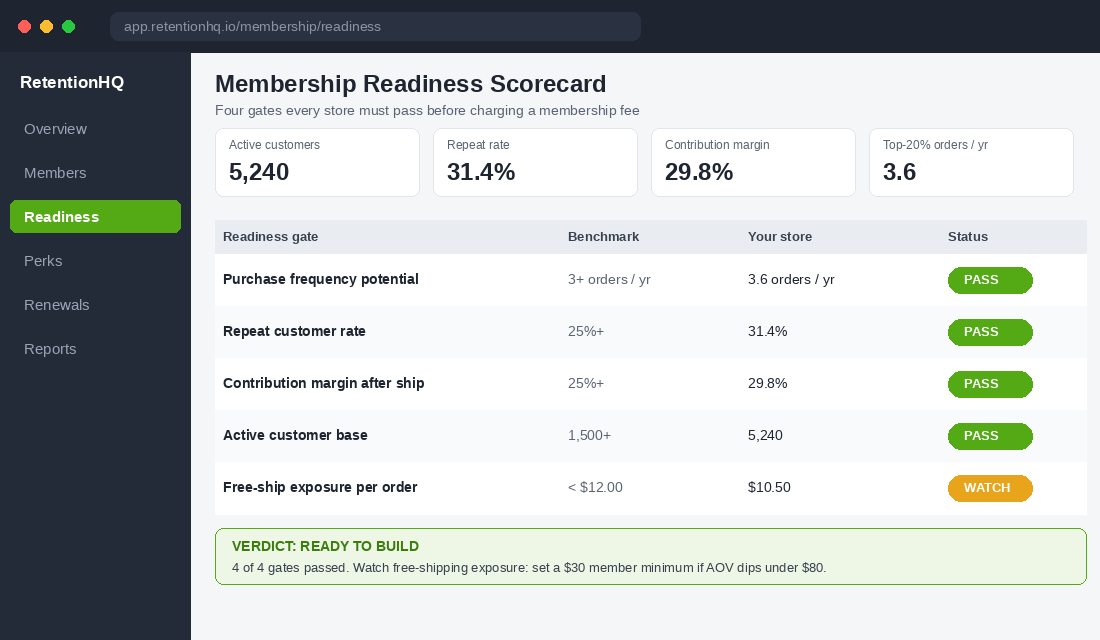
Paid memberships fail when they get bolted onto stores without the underlying behaviour to support them. Before you design anything, pull these four numbers from Shopify Analytics and Klaviyo.
- Purchase frequency potential of 3+ orders a year. Your top 20% of customers need to be ordering at least 3 times a year already, or plausibly could (consumables, replenishables, broad ranges). If your product is a one-off purchase like a mattress, a membership has nothing to feed on.
- A repeat rate above 25%. If fewer than a quarter of customers ever come back, fix retention basics first. Start with your loyalty foundations and post-purchase flows before charging for a club.
- Contribution margin of 25%+ after shipping. Free shipping is the anchor perk of almost every membership. If your margin cannot absorb $9 to $12 of shipping on a typical member order, the perk bankrupts you. Run the maths from your contribution margin audit first.
- At least 1,500 to 2,000 active customers. Conversion to paid membership typically lands between 3 and 8% of active customers in year one. Below 1,500 actives you are building infrastructure for 50 members. Wait until the base is there.
Pass all four and a membership is one of the highest-impact retention plays available to you. Pass three and you can usually proceed with a tighter perk stack. Pass two or fewer, park this playbook for two quarters and work the fundamentals.
Part 1: Design the Value Stack (The 3-5x Rule)
The membership has to feel like an unfair deal in the member’s favour. The benchmark that works: the perceived annual value of the perks should be 3 to 5 times the fee. Thrive Market’s members typically earn back their membership fee in savings within their first two orders. That is the bar. If a member has to squint to see the value, they will not renew, and renewal is where all the profit lives.
Build the stack from four layers, in this order.
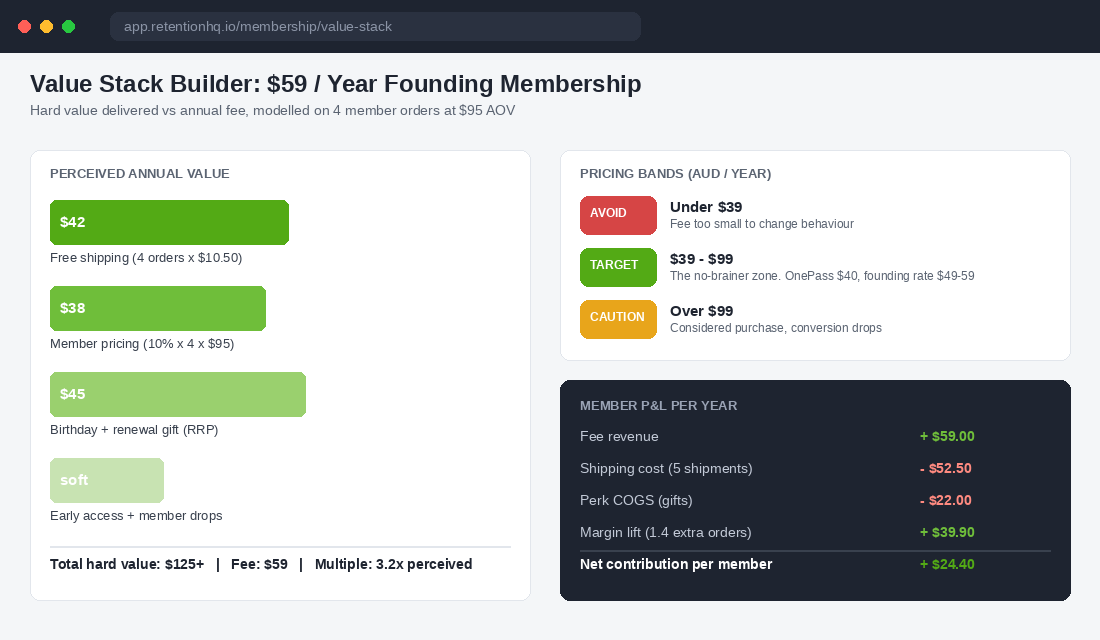
- Layer 1: Free shipping, always. This is the anchor and the single biggest reason people join OnePass and Prime. For a member who orders 4 times a year at $10.50 average shipping, this alone is $42 of visible value. Price your fee with this cost modelled in.
- Layer 2: Member pricing. A flat 10% member price (not a coupon, an automatic price) on every order. On 4 orders at a $95 AOV that is another $38 of value, and it quietly discourages members from waiting for sitewide sales.
- Layer 3: Access. 48-hour early access to new drops and restocks, plus members-only colourways or bundle sizes. Costs you nothing, and for hyped ranges it is often the perk members talk about most.
- Layer 4: Surprise and delight. A birthday gift, an annual free product around renewal time, double points months if you run points alongside. Budget $15 to $25 of COGS per member per year. This layer drives the renewal decision more than its dollar value suggests.
Worked example for a $79 AUD membership: free shipping ($42) + member pricing ($38) + early access (soft value) + birthday gift and renewal gift ($45 RRP) = roughly $125 of hard value plus access perks. That is a 1.6x hard-value multiple and a 3x+ perceived multiple once access and status are counted. Strong enough to sell, cheap enough to fund from the spend lift.
Part 2: Price It Like a No-Brainer (Annual First, $39 to $99 AUD)
Almost every successful DTC membership lands between $39 and $99 AUD a year. OnePass charges $40. Thrive Market charges $59.95 USD. Below $39 the fee does not trigger the justify-the-fee psychology. Above $99 you are asking for a considered decision, and considered decisions kill conversion.
- Lead with annual, offer monthly reluctantly. Annual members renew as a single decision once a year, usually on a saved card. Monthly members re-decide 12 times a year. If you offer monthly at all, price it so annual is the obvious deal ($8/mo vs $59/yr).
- Set the fee against your shipping exposure. Estimate member order frequency (typically 1.5 to 2x your current best-quartile frequency), multiply by your true cost per shipment, and make sure fee + spend lift comfortably covers it. A $59 fee against 5 shipments at $10.50 leaves $6.50 plus the entire margin lift as profit.
- Price the first year like a test. Launch as a founding member rate ($49 instead of $69, locked for life while membership stays active). Urgency without discounting your product range.
One rule from the brands that run this well: never discount the fee in a panic. The fee is the product. If joins are slow, add a perk or improve the onboarding, do not cut the price. Costco has raised its fee repeatedly and renewal barely moved, because the value stack stayed obvious.
Part 3: Build It on Shopify in an Afternoon (Appstle Memberships Setup)
You do not need a developer for v1. Appstle Memberships is the most complete dedicated membership app on the Shopify App Store: free to install, no transaction fees on any plan, with tiered plans, automatic member perks and recurring billing built in. Here is the build sequence.
- Step 1: Install Appstle Memberships from the Shopify App Store and create one plan: your annual founding membership. Resist tiers at launch. One plan, one price, one decision.
- Step 2: Attach the perks. Configure automatic free shipping for active members (Appstle tags members, and a shipping profile or discount rule keyed to the member tag handles the rest) and set member pricing as an automatic discount tied to the same tag.
- Step 3: Build the member page. A single landing page that does the value maths for the shopper: the perks, the 3-5x value calculation, an FAQ, and one join button. Mirror the layout OnePass uses: perks as tiles, savings example, cancel-anytime reassurance.
- Step 4: Wire the data into Klaviyo. Appstle pushes membership status to customer profiles. Build three segments: active members, members at 30 days to renewal, and high-fit non-members (2+ orders, $150+ spend, 90 days recency).
- Step 5: Gate the early access. Tag-based access on launch collections, or simply send members the link 48 hours before the public email. Low-tech works fine at this stage.
Budget half a day for the build and a week of QA where your team places test orders as members and non-members. The thing to verify ruthlessly: a member should never see a worse price than a sale shopper. Stack member pricing on top of promos or exclude members from promo emails entirely.
Part 4: Launch to Your Top 10% First (The Founding Member Cohort)
Do not launch a membership to your whole list. Launch it to the customers who already behave like members. Your top 10% customers drive the majority of your revenue, order most frequently, and will convert at multiples of the list average. They also give you honest feedback before the public sees anything.
- Week 1: Private invite to the top 10%. A founder-signed email: you are one of our best customers, we built this for you, founding rate locked for life, 200 spots. Expect 8 to 15% of this segment to join inside a fortnight.
- Week 2 to 3: High-fit segment. Open it to the 2+ orders / $150+ spend segment with the same founding rate and a real cap. Scarcity must be true. If you say 500 founding spots, close at 500.
- Week 4: Public launch. Membership page in the nav, a banner on the cart drawer showing the shipping saving a member would have made on this exact order, and a post-purchase upsell on the thank-you page where the fee can be added in one click.
- Always-on: the basket prompt. The single best evergreen placement is the cart: “Members get free shipping on this order. Join for $59/year.” It converts because the saving is concrete at the exact moment shipping cost appears.
A realistic year-one target for a store with 5,000 active customers is 250 to 400 members: 3 to 8% conversion of actives. Treat anything above 10% as a signal you priced too low.
Part 5: Run the Renewal Engine (Where All the Profit Lives)
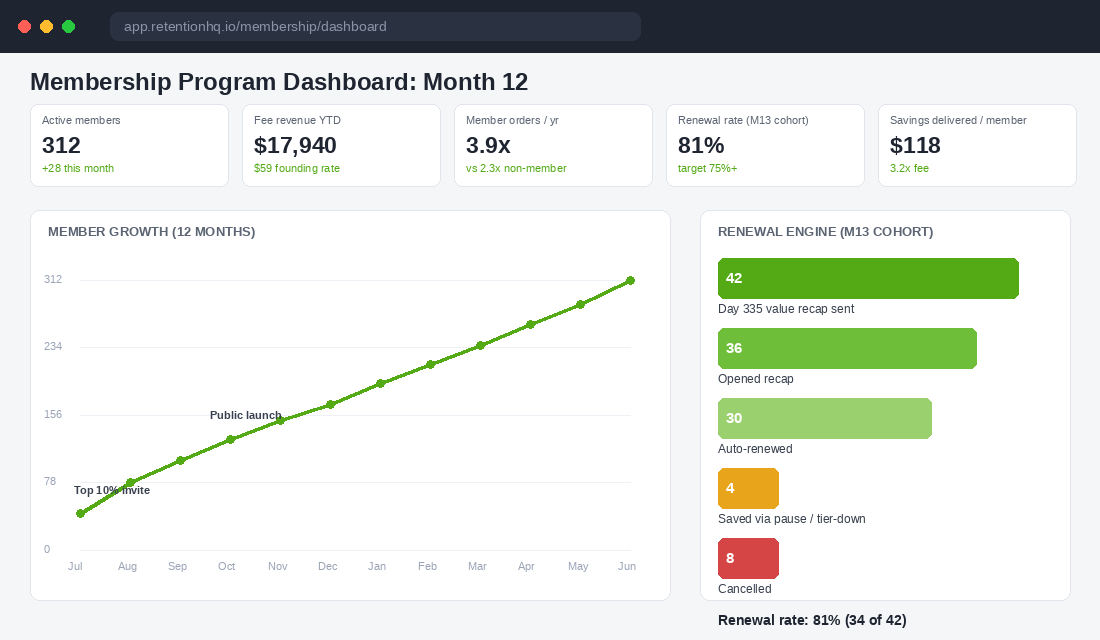
Year-one membership revenue is nice. The business is renewal. Costco’s worldwide renewal sits near 90%, and Thrive Market’s early cohorts renewed at over 70% after year one. Those numbers are engineered, not lucky. Four mechanisms do the work.
- Drive usage in the first 30 days. A member who places an order in their first month renews at far higher rates than one who joins and goes quiet. Onboard with a member-pricing nudge on their wishlist or replenishment SKU within week one.
- Show the running savings total. Quarterly “your membership has saved you $87 so far” emails. This is the renewal argument being made 9 months early, and it is the exact play Prime runs with its order-history value recaps.
- Pre-renewal value recap at day 335. Thirty days before renewal, send the full year: orders placed, shipping saved, member pricing saved, gifts received. If the number beats the fee, renewal is rational. If it does not, offer a pause or a tier-down instead of letting a silent cancel happen. Borrow the interception mechanics from the churn prediction playbook.
- Watch the one metric that predicts everything: member order frequency. If members are not ordering at least 1.5x your non-member rate by month three, the value stack is not changing behaviour. Fix that before chasing new joins.
The 3 Ways Memberships Fail
- The perks are just discounts in a trench coat. If the whole stack is “10% off”, a member is a customer who pre-paid for a coupon. The stack needs at least one perk money cannot buy at checkout: early access, members-only product, real service upgrades.
- The shipping promise outruns the margin. Brands with $25 AOVs and $11 shipping costs sign members up to lose money on every order. Set a member free-shipping minimum ($30 to $40) if your AOV is thin, or fix AOV first.
- It launches and nobody runs it. A membership is a product. It needs an owner, a monthly scorecard (joins, member frequency, savings delivered, renewal rate), and a quarterly perk review. Set-and-forget memberships decay into refund requests at renewal time.
The Compound Effect: What 300 Members Does to a $2M Brand
Run the maths on a $2M AUD brand with 5,000 active customers, $95 AOV and a 30% contribution margin. Year one: 300 members at a $59 founding rate is $17,700 in fee revenue at nearly full margin. The behaviour change is the bigger number. If those 300 customers lift from 2.4 to 3.8 orders a year (the kind of lift the Prime spend gap implies), that is 420 incremental orders, roughly $40,000 in extra revenue and $12,000 in contribution, on top of the fees. Net of shipping costs and perk COGS (about $14,500 all-in), the program clears $15,000 to $18,000 in year one while concentrating your best customers inside a fence your competitors cannot see over.
Year two is where it compounds: renewals arrive with zero acquisition cost, the member base grows to 500+, and fee revenue alone approaches $30,000 while member spend quietly becomes 25 to 30% of total revenue. That cohort also lifts your customer lifetime value in a way that lets you outbid competitors on ads with a straight face.
Your Membership Launch Checklist
- Readiness: 3+ orders/year potential, 25%+ repeat rate, 25%+ contribution margin after shipping, 1,500+ active customers.
- Value stack: free shipping + member pricing + early access + surprise gift, at 3 to 5x perceived value of the fee.
- Price: annual-first between $39 and $99 AUD, founding rate for the first cohort, never discount the fee.
- Build: Appstle Memberships, one plan, member tag driving shipping and pricing, Klaviyo segments wired.
- Launch: top 10% private invite, high-fit segment, then public with a cart-drawer prompt.
- Renewal engine: 30-day usage push, quarterly savings emails, day-335 value recap, member frequency on the monthly scorecard.
Print this, pin it above your desk, and give the program an owner before you write a line of perk copy.
Inside eCommerce Circle, retention architecture like this is one of the core pillars we work on with every member, and we have helped hundreds of Aussie Shopify founders decide whether points, subscriptions or a paid membership is the right next move. If you want a second opinion on yours, let’s talk.