Ask a room of Shopify founders what their best seller costs them and most will quote the supplier invoice. Six twenty US a unit, ex factory. Easy.
What’s in This Article
That number is not your cost. It is the opening bid. By the time that product is sitting on a shelf in your Melbourne 3PL, the real figure is usually 30 to 45% higher once freight, surcharges, port charges, brokerage, government fees and cartage have all taken their bite. If you are setting prices, planning ad budgets or building bundles off the invoice number, every profit decision you make this quarter is built on sand.
And 2026 has made the gap worse. Australia Post lifted its fuel surcharge from 4.8% to 12% in April. Every major shipping line on Australian trade lanes has added emergency bunker surcharges on top of contracted rates. Epic Sourcing’s 2026 freight guide for Australian importers puts the surcharge impact at 10 to 25% above base freight, and notes that one major Australian logistics network watched its fuel levy effectively double in under a month.
The founders who protect margin through all of this are not lucky. They know their true landed cost per SKU, per shipment, to the cent. This playbook gives you the 5-step system to get there in a weekend.
Why the Number in Your Head Is Wrong (and Got Wronger This Year)
Landed cost is every dollar it takes to move a unit from your supplier’s factory floor to your Australian warehouse shelf. Not just the invoice. Not just invoice plus freight. Everything.
Most founders carry a stale version of this number in their head. They worked it out once, two years ago, off one shipment, and they have been quoting it to themselves ever since. Meanwhile the inputs moved. MSC applied a USD 300 per TEU rate restoration on Asia to Australia lanes from April 2026. ANL added USD 600 per 40-foot container from Asia. Schedule reliability on Asia to Australia lanes is running below historical norms, and freight advisory firm Seabridge is telling importers to book sailings 2 to 4 weeks earlier than usual.
There are two classic failure modes. The first is pricing off old freight: you model this order on last year’s rates and quietly eat the difference. The second is averaging: you spread total import costs evenly across every SKU, which flatters your bulky heavy products and punishes your small light ones, so you misprice both.
Think about what this means for a category like luggage. Melbourne brand July ships big, bulky product that moves by the container, exactly the profile where a per-container fuel surcharge bites hardest. Epic Sourcing estimates an extra 400 to 900 dollars per 40-foot container in the current environment. Premium brands can carry that because they price from real numbers. A founder guessing at cost cannot.
Step 1: Build Your Landed Cost Ledger
Before you calculate anything, you need the complete list of cost lines. Miss one and your number is fiction. Here is the full ledger for a typical Aussie DTC import from Asia:
- Factory price (EXW or FOB). The supplier invoice, converted to AUD at the rate you actually paid, not the rate on Google.
- Inland origin freight and export fees. Factory to port, export clearance, documentation. On EXW terms you pay these directly.
- International freight. Sea or air, base rate plus every surcharge: fuel, emergency bunker, war risk, peak season. The surcharges are the part that moved in 2026.
- Marine insurance. Cheap (usually around 0.3 to 0.5% of shipment value) and non-negotiable. One flooded container without it can end a small brand.
- Customs duty. The general rate is 5% for most consumer goods, but free trade agreements often take it to zero. More on this in Step 3.
- Import processing charge. The Australian Border Force charges 50 dollars per import declaration for consignments between 1,000 and 10,000 dollars, and 152 dollars above that.
- Port and terminal handling plus customs brokerage. Destination charges and your broker’s fee for lodging the declaration.
- Biosecurity and inspection fees. DAFF charges where your category requires inspection (timber, plant fibre, food contact goods).
- Domestic cartage. Port to your warehouse or 3PL.
- Quality control and compliance. Pre-shipment inspections, testing, certifications. Real costs of the order, so they belong in the unit.
One rule keeps you honest: if the dollar had to be spent to get the unit onto the shelf, it is part of the unit’s cost. GST is the exception, and we will handle it properly in Step 2.
Step 2: Run the Numbers on One Hero SKU
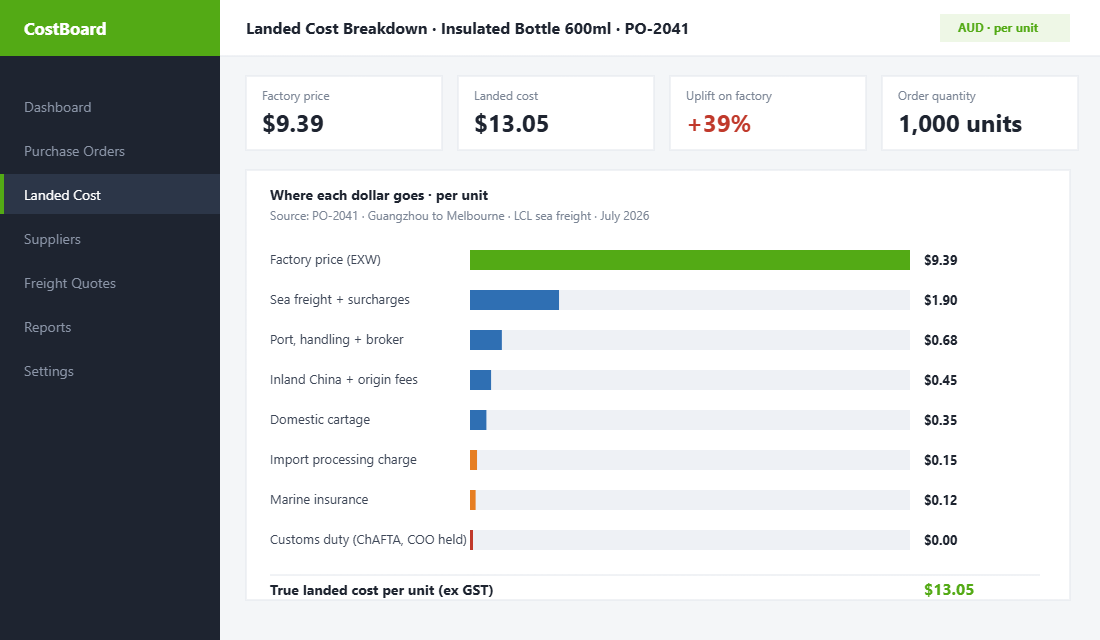
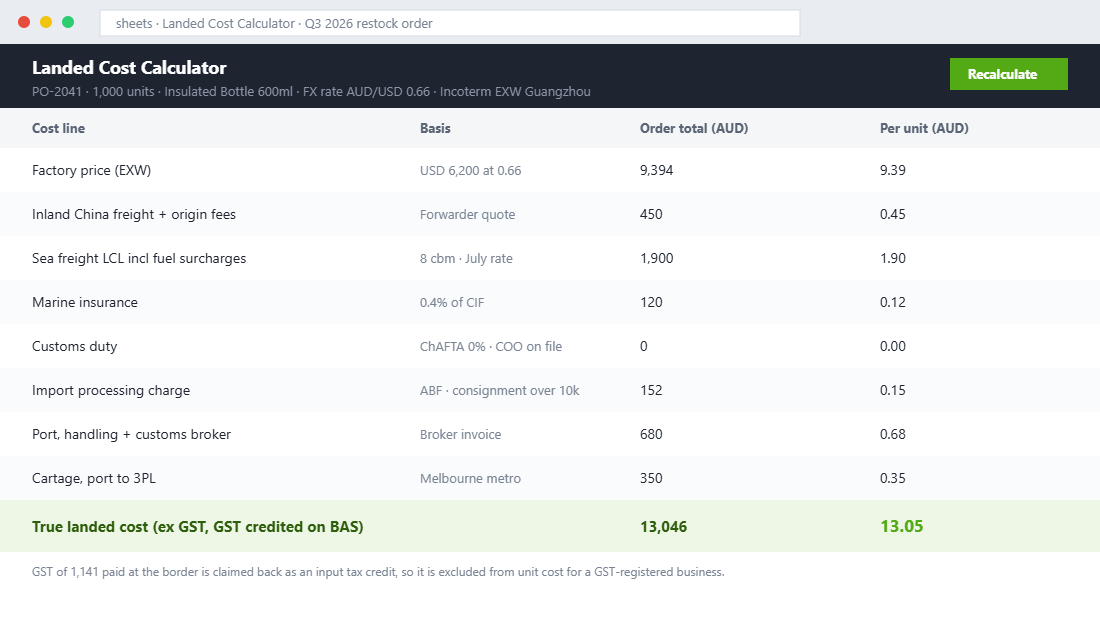
Do not try to build landed cost for your whole catalogue on day one. Pick your hero SKU, the one carrying your ad account, and run it end to end. Here is a worked example: 1,000 insulated bottles, EXW Guangzhou, LCL sea freight into Melbourne in July 2026.
- Factory price: USD 6,200 converted at 0.66 = AUD 9,394
- Inland China freight and origin fees: AUD 450
- LCL sea freight including current fuel surcharges: AUD 1,900
- Marine insurance: AUD 120
- Customs duty with a ChAFTA certificate of origin on file: AUD 0
- Import processing charge (consignment over 10,000 dollars): AUD 152
- Port, handling and customs brokerage: AUD 680
- Cartage from the port to the 3PL: AUD 350
Total: AUD 13,046 for the order, or 13.05 per unit. The founder who quotes the supplier invoice thinks this product costs 9.39. The real number is 39% higher.
Now the GST nuance that trips up almost everyone. At the border you will also pay 10% GST, calculated on the customs value plus duty plus international transport and insurance. On this order that is roughly 1,141 dollars. But if you are GST registered, you claim every cent back as an input tax credit on your next BAS. So GST is a cash flow cost, not a unit cost. Leave it out of your landed figure, but never forget to plan the cash for it.
Feel the difference this makes. If your pricing rule was 2.8 times cost and you used 9.39, you are selling at 26.29 and believing you have a 64% gross margin. Your actual gross margin at that price is 50%. Every ROAS target, every discount, every bundle you built off the wrong number is quietly bleeding.
Step 3: Plug the Three Silent Leaks
Leak 1: Duty you should not be paying. Australia’s general duty rate is 5% for most consumer goods, but Australia has free trade agreements with 15 countries plus regional deals like ChAFTA, AANZFTA, RCEP and the CPTPP. For most goods from China or Vietnam, the preferential rate is zero, provided a valid certificate of origin travels with the shipment. On our worked example, that single document deletes a 470 dollar duty bill. Ask your supplier for the certificate on every order, and ask your broker to confirm the preferential rate for your exact tariff code. Founders pay 5% for years simply because nobody asked.
Leak 2: Exchange rate drift. You modelled the order at 0.68. You pay the 70% balance three months later at 0.64. Nothing changed on the invoice, yet your cost just rose roughly 6%. Three fixes: model every order at a conservative rate a couple of cents below spot so surprises land in your favour; pay suppliers through a multi-currency account like Wise Business, Airwallex or OFX instead of a bank’s retail spread; and once your orders pass the 50,000 dollar mark, talk to your provider about forward contracts that lock the rate for the balance payment.
Leak 3: Freight surcharges and timing. Surcharges now move faster than contracted base rates, which is why your invoice climbs while your quote looks stable. Build a 10 to 15% buffer on freight into any pricing you are committing to for delivery later this year. Book sailings 2 to 4 weeks earlier than you are used to. And if you are shipping LCL every month, price up moving to a consolidated FCL order each quarter: fixed surcharges hurt far less when they are spread across a full container.
Speed matters too. Queensland activewear brand LSKD runs on fast, frequent drops, and that cadence only works when inbound freight is planned like a campaign rather than an afterthought. If your restock lands three weeks late, the leak is not just freight cost, it is the stockout on your best seller during the exact window you paid Meta to fill.
Step 4: Get Landed Cost Into Shopify So Your Reports Tell the Truth
A landed cost figure living in a spreadsheet is useful. A landed cost figure living inside Shopify changes how you run the business, because every profit report, every app and every dashboard downstream starts telling the truth. The tool for the job is Shopify’s built-in cost per item field, and it takes about 20 minutes to set up properly:
- 1. Finalise the landed figure per variant. Run your calculator from Step 2 for each variant on the latest purchase order. Different sizes and colourways often land at different costs, so resist the urge to use one blended number.
- 2. Enter it in Shopify. Admin, then Products, open the product, select the variant, and paste your figure into the Cost per item field in the Pricing section.
- 3. Bulk update the rest of the catalogue. Use the bulk editor (select products, then Edit variants) or export the product CSV, fill the Cost per item column, and re-import. An hour of admin, once.
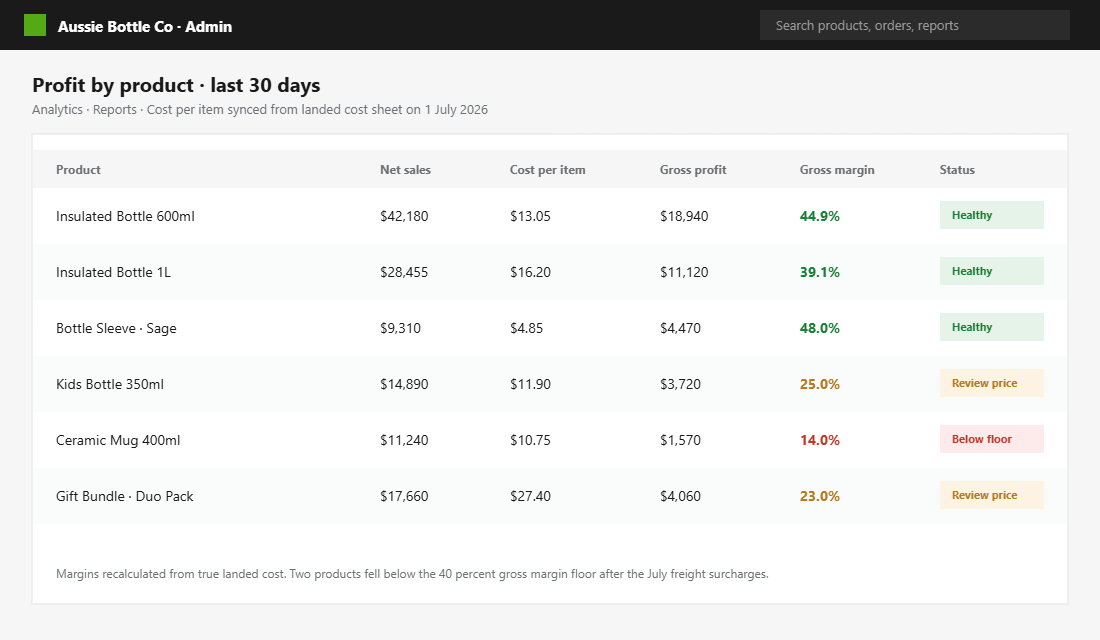
- 4. Check your profit reports. Analytics, then Reports, then Profit by product. Gross margin per SKU is now real, and the products quietly losing money will surface within a week.
- 5. Update on every receipt. New shipment, new landed cost. Make updating the field part of your goods-received routine, because a July 2026 shipment does not cost what a January one did.
When the catalogue grows past 50 or so SKUs, automate the allocation. Unleashed and Cin7 Core both spread actual freight, duty and brokerage invoices across a shipment automatically and sync the resulting cost to Shopify, and Freightos will give you current indicative freight rates before you commit a purchase order rather than after.
Step 5: Reprice From the Real Number and Set a Floor
Now that every SKU knows its true cost, the pricing conversation changes. You are no longer asking what the market will pay in the abstract. You are asking whether each product clears your margin floor after real costs.
Set the floor deliberately. For a DTC brand funding paid acquisition, hero SKUs generally need 60% or better gross margin on landed cost to carry ads, and anything sitting under 40% cannot fund acquisition at typical Australian CPMs without borrowing margin from somewhere else. Products below the floor get three options: reprice, re-engineer the cost (bigger orders, cheaper freight mode, supplier negotiation), or retire.
Then make repricing a ritual, not an emergency. Once a quarter, refresh the three volatile inputs (freight, FX, factory price) and rerun the sheet. This pairs directly with the system in our contribution margin playbook, which takes the landed number and carries it through to what each order actually earns after shipping and payment costs. And when the sheet shows factory price is your biggest line, the supplier negotiation playbook gives you the levers to attack it.
The Compound Effect: When Every SKU Knows Its True Cost
Here is what actually happens in the 90 days after a founder does this work, because we watch it happen inside the Circle constantly.
Ad spend gets reallocated. ROAS targets built on real margin reveal that the hero product can profitably run at a lower ROAS than you thought, while the low-margin bundle everyone loved needs to come off paid entirely. Discounting gets discipline: BFCM depth is set per product from the real margin ladder, not one blanket 25% that turns half the catalogue unprofitable. The free shipping threshold gets recalculated from real per-unit economics. Even sourcing decisions improve, because the sheet shows exactly what a switch from LCL to FCL, or from a 0.64 to a 0.68 hedge, is worth in dollars per unit.
One number, calculated properly, upgrades every decision that sits on top of it. That is why landed cost is the first artefact we build in the Profit pillar, before dashboards, before forecasts, before anything clever. It pairs naturally with the sourcing side too: if you are still choosing suppliers, the product sourcing playbook shows you how to vet the partners these numbers depend on.
Sea or Air: Let Landed Cost Make the Call
One decision your new sheet will settle instantly is the sea versus air argument. Air freight from China typically costs 4 to 6 times sea on a per-kilo basis, and 2026 has squeezed it further: airspace restrictions have cut capacity on preferred routes into Australia, pushing rates up and availability down through the middle of the year.
Run both modes through the calculator and the answer usually writes itself. On our worked bottle example, air would add roughly 4 to 5 dollars per unit, turning a 44% gross margin product into a 30% one. That is not a freight decision, that is a margin decision wearing a freight costume.
The playbook most disciplined Aussie brands land on: sea freight for planned replenishment, with orders placed early enough to absorb the current schedule slippage, and air reserved for two situations only. A genuine stockout on a hero SKU where the lost contribution clearly outruns the extra freight, or a small first order of a new product where speed of learning is worth more than unit economics. If air is rescuing your planning every month, the problem is the forecast, not the freight bill.
Either way, the decision now happens with numbers on the table. Cost per unit by mode, margin impact, and the contribution you protect or give away. Thirty seconds in the sheet beats another season of gut feel.
Fund the Order Without Starving the Business: Landed Cost Meets Cash Flow
Knowing the true cost per unit is half the job. The other half is knowing when every dollar of it leaves your bank account, because a landed cost of $13.05 does not arrive as one payment. On the worked bottle order it arrives as at least six, spread across three months, and most of it is gone before a single unit is sellable.
- Day 0: 30% deposit to the factory. Around $2,800 on our order, paid before production starts.
- Day 30 to 40: 70% balance on completion. Roughly $6,600, and this is the payment exposed to FX drift, so it is where your multi-currency account or forward contract earns its keep.
- Day 45: freight and insurance. About $2,000 to the forwarder, usually due before the vessel sails.
- Day 65 to 75: border charges. Duty, the import processing charge, port and brokerage, plus the $1,141 of GST you will claim back on the BAS but must fund in cash for up to three months. Call it $2,000 out the door in one week.
- Day 75 to 80: cartage and 3PL receiving. A few hundred dollars, plus receiving fees of around $2 to $5 per carton that most founders forget to model.
So roughly $13,500 leaves the business over 80 days, and the first dollar of revenue from those units arrives around day 85 at the earliest. At a 25% sell-through in the first month, you recoup about $6,500 of it in month one and the rest over the following two. That gap is the real reason growing brands feel broke while their P&L says they are profitable, and it is why the inventory funding playbook treats the purchase order, not the ad account, as the cash decision that shapes the quarter.
Three habits close the gap. First, add a “cash out by week” row to your landed cost sheet, so every purchase order shows its payment calendar next to its unit cost. Second, negotiate terms before you negotiate price: a supplier who moves you from 30/70 to 30/40/30 with the last tranche 30 days after shipment has just funded a month of your cash cycle for free. Third, size the order from the forecast, not the discount ladder. A 15% price break for doubling the order is a bad trade if it doubles the cash locked up for 90 days; the inventory forecasting playbook shows how to set the order quantity from weeks of cover, then let landed cost tell you whether the bigger order clears the floor.
The Landed Cost Checklist
Print this, stick it next to your monitor, and run it on your next purchase order:
- All 10 ledger lines costed for the order, converted to AUD at the rate you actually paid
- GST excluded from unit cost but the border payment planned in cash flow
- Certificate of origin requested from the supplier and confirmed with your broker
- Tariff code and preferential duty rate confirmed for your exact product
- FX modelled at a conservative rate, balance payment method chosen (multi-currency account or forward)
- Freight quote is current month, includes all surcharges, and carries a 10 to 15% buffer
- Sailing booked 2 to 4 weeks earlier than your old habit
- Cost per item updated in Shopify for every variant on receipt
- Gross margin per SKU reviewed against your floor (60% heroes, 40% minimum)
- Quarterly reprice ritual booked in the calendar
Most founders discover at least one product they are effectively paying customers to take. Finding it now, in July, gives you a full quarter to fix pricing before BFCM locks you in.
Inside eCommerce Circle, profit clarity is one of the core pillars we work on with every member, and landed cost is where it starts. If you want a second opinion on your numbers before the next order goes in, let’s talk.