Your email list is the single most valuable asset in your Shopify store. It is the one channel you own outright, the one that keeps selling when your ad account gets throttled or your cost per acquisition blows out. For most Aussie DTC brands, email and SMS quietly drive between 25 and 40 percent of total revenue. So here is the uncomfortable question almost no founder asks: what happens to that number when a chunk of your emails never reach the inbox?
What’s in This Article
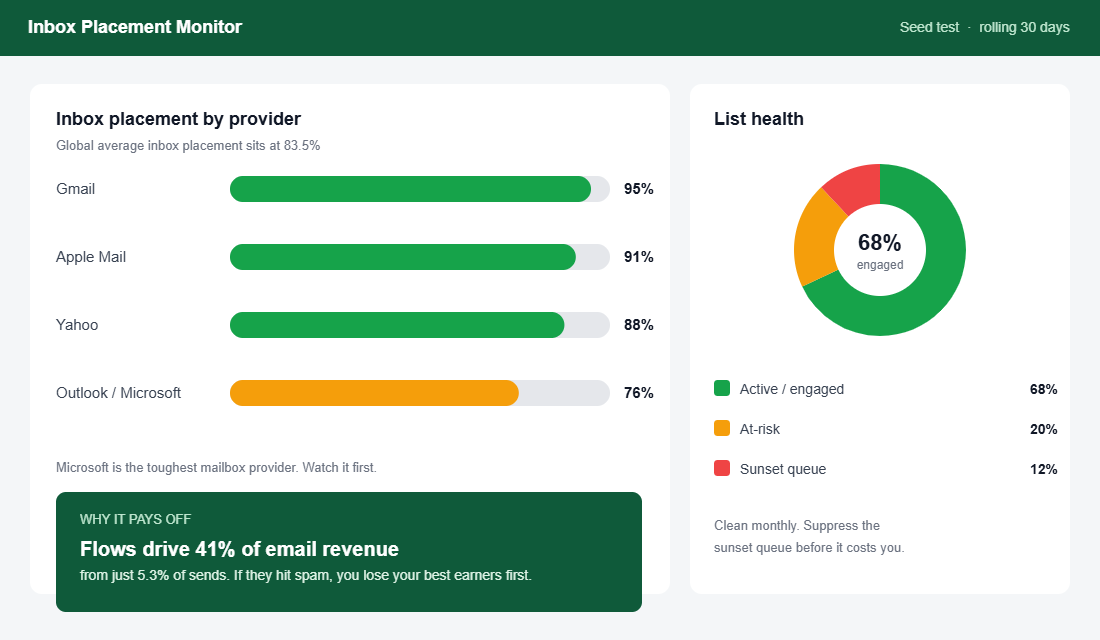
Most operators pour their energy into subject lines, GIFs and discount copy, hit send, and assume the message landed. Meanwhile their sender reputation is slowly rotting, and a growing share of every campaign gets filed straight into spam or buried where nobody looks. The global inbox placement rate sits at just 83.5 percent. That means roughly one in six marketing emails never makes it to the inbox at all.
Deliverability is the plumbing behind your revenue. Get it wrong and every clever email tactic you try is just bailing water out of a leaking boat. Get it right and the same list, the same offers and the same team suddenly produce more orders. This is the exact system we walk founders through inside eCommerce Circle when their open rates start sliding for no obvious reason.
Deliverability Is the Silent Tax on Your Biggest Revenue Channel
Inbox placement is not evenly spread. Gmail delivers well-behaved senders to the inbox around 95 percent of the time, while Microsoft and Outlook are the toughest mailbox providers in the market, landing legitimate mail in the inbox only about 76 percent of the time. If a big slice of your Aussie list runs on Outlook or Hotmail addresses, you can be losing a quarter of that audience without a single bounce showing up in your reports.
Here is why this hits harder than founders expect. Your automated flows, the welcome series, the abandoned cart, the post-purchase, generate around 41 percent of total email revenue from just 5.3 percent of your sends. Automated emails earn roughly 1.94 dollars per recipient versus about 10 cents for a one-off campaign. When your reputation slips, those high-value flow emails are the first to get filtered, because they fire continuously to people who may not have opened in weeks.
So a deliverability problem is never just a technical annoyance. It is a direct tax on the highest-earning part of your marketing. The five steps below are how you stop paying it.
Step 1: Lock Down Authentication (SPF, DKIM, DMARC)
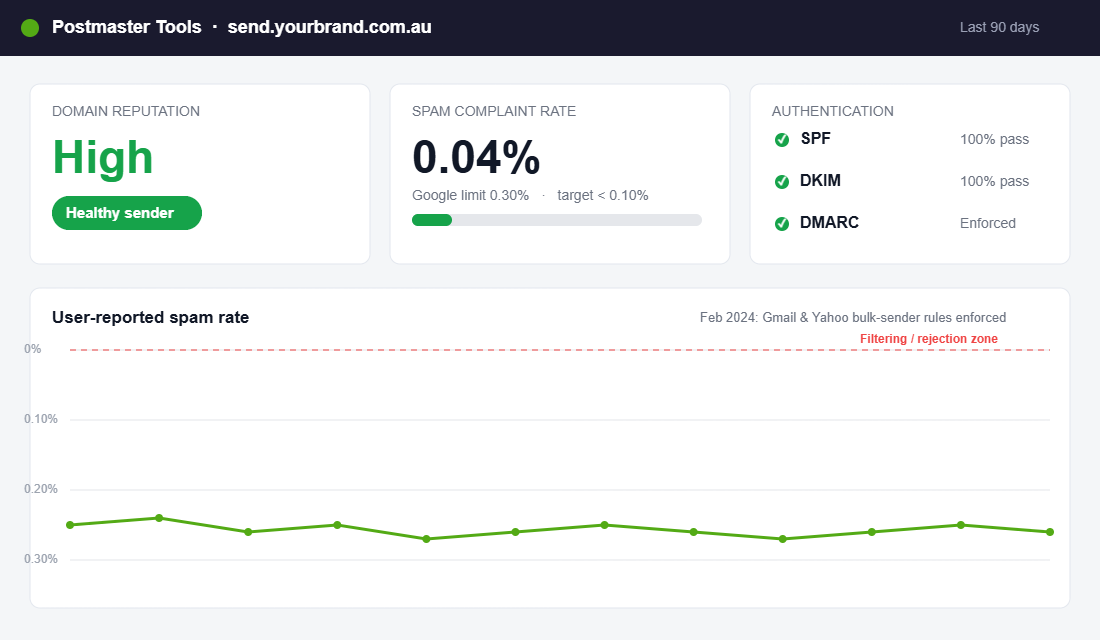
Since 1 February 2024, Google and Yahoo require any sender pushing more than 5,000 emails a day to authenticate properly. This is not a best-practice suggestion anymore. It is the price of entry, and Microsoft has since tightened its own rules to match.
There are three records that do the work, and you want all three in place:
- SPF tells inbox providers which servers are allowed to send on behalf of your domain.
- DKIM adds a cryptographic signature that proves the email was not tampered with in transit.
- DMARC ties the two together and tells providers what to do with mail that fails. Start at p=none to monitor, then move to quarantine and eventually reject once you are confident.
Two practical moves make the biggest difference. First, send marketing from a dedicated subdomain like send.yourbrand.com.au rather than your root domain, so a bad campaign never poisons the address you use for invoices and support. Klaviyo can set this up as a dedicated sending domain in a few clicks. Second, turn on one-click unsubscribe (the List-Unsubscribe header), which Gmail and Yahoo have mandated since mid-2024. If you run Klaviyo or a similar platform, most of this is a settings job, not a developer project.
Step 2: Guard Your Complaint Rate Like a Hawk
Gmail draws a hard line in the sand: keep your spam complaint rate below 0.30 percent, and ideally under 0.10 percent. That sounds generous until you do the maths. The danger cliff is three complaints per thousand delivered emails. The healthy target is one per thousand. A single careless blast to a cold list can tip you over the edge in an afternoon.
The complaint rate is the metric that quietly kills brands, because every “report spam” click is a direct vote against your reputation. Protecting it comes down to a few disciplines:
- Only email people who actually opted in. Never buy, scrape or import a list you did not earn.
- Make unsubscribing obvious. A visible unsubscribe link is your friend. When people cannot find it, they hit the spam button instead, and that costs you far more.
- Match the content to the promise. If someone signed up for 15 percent off, do not bury them in daily sends they never asked for.
- Watch your cadence. Complaint rates climb fastest when sending frequency jumps without warning.
Your email popup is where a lot of this is won or lost. If you are capturing addresses with a weak or misleading offer, you are building a list that complains. Our Shopify Email Popup Playbook covers how to capture subscribers who actually want to hear from you.
Step 3: Send on Engagement, Not Ego
Inbox providers do not just read your headers. They watch behaviour. Opens, clicks, replies, how fast someone deletes without reading, and whether they fish you out of spam all feed a live judgement about whether your mail is wanted. The brands with the best deliverability are ruthless about who they send to.
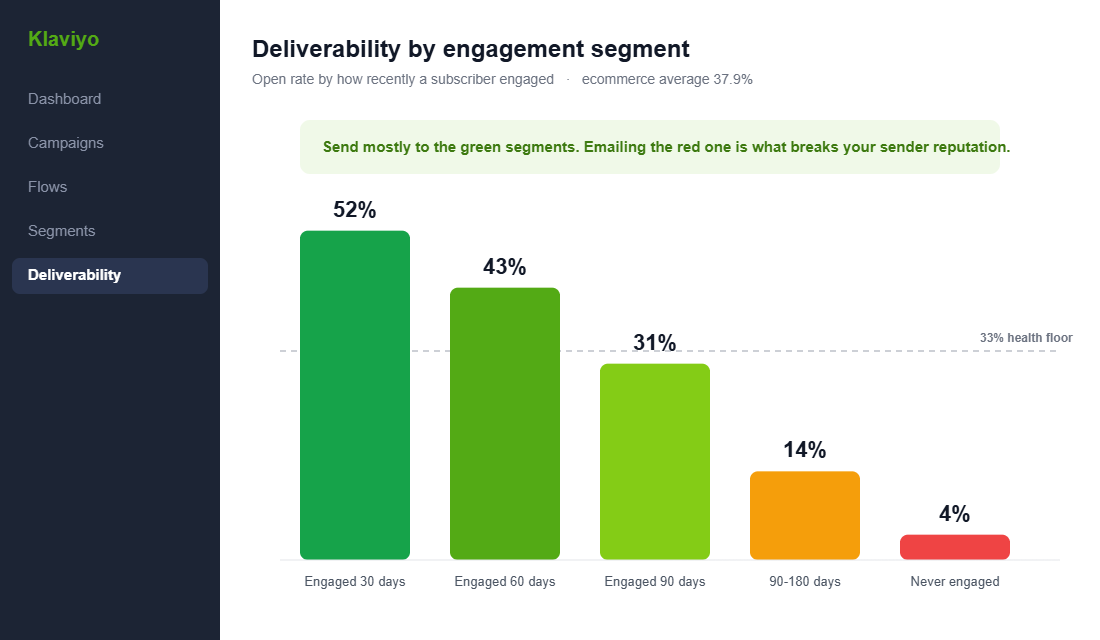
The move is engagement-based segmentation. Build segments for people who have opened or clicked in the last 30, 60 and 90 days, and send your regular campaigns mostly to those. Klaviyo reports the average ecommerce open rate at 37.9 percent, and you want to keep your engaged sends comfortably above the 33 percent health floor. When you launch a major campaign, send to your most engaged people first, confirm the numbers look strong, then widen the audience in waves.
This is also where good list structure pays off. If your segments are a mess, you are flying blind. The Shopify Customer Segmentation Playbook shows how to build the segments that make engagement-based sending simple.
Step 4: Clean Your List Every Single Month
Every unengaged profile you keep emailing does two things, and both are bad. It drags your sender reputation down, and it inflates your Klaviyo bill, since most platforms charge on active profiles. Cleaning is not a one-off spring clean. It is a monthly habit.
The routine is simple. Once a month, build a segment of contacts who have not opened or clicked in the last 90 to 120 days. Exclude them from your regular campaigns. Then run a sunset flow: two or three final emails that give them one clear reason to re-engage. Anyone who bites goes back into your active list. Anyone who ignores it gets suppressed, not deleted, so you keep the record without the reputational drag.
It feels counterintuitive to email fewer people on purpose. But a smaller, engaged list of 8,000 will out-earn a bloated list of 20,000 that is quietly poisoning your inbox placement. Your welcome flow is the front door to this whole system, so it needs to set the right expectation from day one. Our Shopify Welcome Email Flow Playbook walks through the sequence that turns a new subscriber into an engaged buyer.
Step 5: Warm Up, Then Watch the Signals
If you switch email platforms, move to a new sending domain, or you have been dormant for months, do not blast your whole list on day one. Warm up gradually. Start with your most engaged subscribers and ramp your daily volume over two to four weeks. Providers reward senders who behave predictably and punish sudden spikes that look like a compromised account.
Then monitor, because deliverability drifts slowly and you want to catch it before a campaign tanks. Google Postmaster Tools is free and shows your domain reputation, spam rate and authentication status straight from the source. Pair it with a periodic seed or inbox placement test to see exactly which providers are sending you to spam. Keep an eye on open rate by provider: if Gmail holds steady but Outlook craters, you have found your problem before it spreads.
How the Five Steps Compound
None of these steps works in isolation, and that is the point. Authentication earns you the right to be trusted. A low complaint rate and strong engagement build the reputation. Monthly cleaning protects it. Monitoring catches the drift early. Each one feeds the next.
Once the flywheel is turning, it works for you. Providers place trusted senders in the primary inbox more often, which lifts opens and clicks, which signals even higher quality, which improves placement again. That is why two brands with identical lists and identical offers can see wildly different revenue. One is compounding reputation. The other is quietly leaking it.
Your Deliverability Health Check
Run this checklist against your store this week. If you cannot tick every box, you have found where your revenue is leaking:
- SPF, DKIM and DMARC are all configured, with DMARC at quarantine or reject.
- Marketing sends from a dedicated subdomain, not your root domain.
- One-click unsubscribe is enabled and the unsubscribe link is easy to find.
- Spam complaint rate is under 0.10 percent (check Postmaster Tools).
- Regular campaigns go to 30, 60 and 90-day engaged segments, not the whole list.
- Engaged open rate sits above the 33 percent health floor.
- A sunset flow runs monthly and unresponsive profiles get suppressed.
- Google Postmaster Tools is connected and checked at least fortnightly.
- New domains or platforms are warmed up over two to four weeks, never blasted.
- Inbox placement is monitored by provider, with Microsoft watched most closely.
Work through it top to bottom. Most brands find three or four boxes unticked, and fixing them is often the fastest revenue win available, because you are not creating new demand. You are simply collecting orders you already earned.
Deliverability Benchmarks: The Numbers to Judge Yourself Against
Most founders have no idea whether their deliverability is fine or quietly failing, because they have never seen a benchmark. Here is what healthy looks like for an Aussie DTC list.
- Spam complaint rate: under 0.10 percent. Gmail and Yahoo both enforce a 0.30 percent ceiling for bulk senders, and 0.30 percent is where damage has already happened, not where it starts.
- Hard bounce rate: under 0.5 percent per send. Anything above 2 percent means your list hygiene has broken down.
- Open rate on engaged segments: 35 to 55 percent. On a full-list blast, 20 to 30 percent is normal. If your engaged segment is under 30 percent, you have an inbox placement problem, not a subject line problem.
- Unsubscribe rate: 0.2 to 0.5 percent per campaign. Consistently above 1 percent usually signals a sending frequency or relevance problem.
- Inbox placement: 95 percent or better to the primary inbox. Under 85 percent needs immediate action.
- Flows versus campaigns: automated flows should generate 25 to 40 percent of your email revenue off a fraction of the send volume, because they go to engaged buyers and therefore land better.
Write these down and check them monthly. Deliverability rarely collapses overnight. It erodes, and the founders who catch it are the ones watching a number rather than a feeling.
Your Monitoring Stack: What to Watch Every Week
You cannot fix what you cannot see, and your email platform only shows you half the picture. Klaviyo will tell you a campaign was delivered. It will not tell you whether it was delivered to the Promotions tab, the spam folder, or nowhere useful at all.
- Google Postmaster Tools: free, and the single most valuable thing on this list. It shows your domain reputation, spam rate and authentication pass rate as Gmail actually sees them. Set it up once, check it weekly, and treat any drop from High to Medium reputation as urgent.
- A DMARC report reader: Postmark’s free DMARC digest or dmarcian. Raw DMARC XML is unreadable. These turn it into a weekly email telling you who is sending as your domain and whether it passed.
- A seed or placement test: GlockApps or Mailtrap, roughly AUD $30 to $90 a month. Run one before any large campaign to see primary versus Promotions versus spam placement across providers.
- MXToolbox blacklist check: free. Check your sending domain monthly. Getting listed on Spamhaus is rare, but you want to find out before your customers do.
- Your own inbox: keep a real Gmail, Outlook and iCloud address on your list and actually look at where the email lands. It takes 30 seconds and catches things dashboards miss.
Fifteen minutes a week across these five covers you. Put it in the calendar on the same day you review your RFM segments, because the two decisions feed each other.
The Sunset Flow: Letting Dead Subscribers Go Without Losing Revenue
Every founder resists this one. You spent money acquiring those subscribers, and deleting them feels like burning cash. But a subscriber who has not opened an email in 12 months is not an asset, they are a tax on everyone else’s inbox placement.
The answer is not a hard delete. It is a sunset flow that gives them one honest last chance, then removes them automatically.
- Trigger: no open or click in 120 days, and no purchase in 180 days.
- Email 1 (day 0): a plain-text style “are we still a fit?” from a person, not the brand. Plain text consistently outperforms heavily designed templates here because it looks like a real message.
- Email 2 (day 5): your single best offer. If they will not move for this, they will not move.
- Email 3 (day 12): “we are removing you on Friday” with a one-click stay button. Expect 2 to 5 percent to re-engage, and those are worth having.
- Day 15: suppress everyone who did not act. Suppress rather than delete, so you keep the record without paying to mail them.
Stores running this properly typically suppress 15 to 30 percent of their list the first time, and almost always see open rates jump 10 to 20 points on the next campaign. Your revenue does not fall, because the people you removed were not buying. What changes is that the people who were buying now reliably see your email. Pair it with a well-built post-purchase sequence so new buyers stay engaged in the first place, and consider moving your most time-sensitive messages to SMS where inbox placement is not a variable.
Where Deliverability Fits
Email is the highest-return channel most Shopify brands own, but only when the messages actually land. Fix the plumbing and everything downstream, your flows, your campaigns, your launches, quietly starts performing better.
Inside eCommerce Circle, deliverability is one of the core pillars we work on with every member, because it protects the revenue you have already built. If you want a second opinion on yours, let us talk.