When Aussie founders want a bigger order, their first instinct is almost always a discount. Slap 15% off, run a sale, watch revenue tick up, then wonder six weeks later why the bank balance has not moved. Discounts lift orders and gut your margin at the same time. There is a better lever sitting right under your nose, and most stores are barely using it.
What’s in This Article
Bundling. Not the lazy “buy more, save more” banner, but a deliberate value structure that gets customers to add more to their cart because it genuinely makes sense to. Done well, product bundles lift average order value by 20 to 30% on average, and up to 30% of ecommerce revenue now comes from bundled products. Bundle buyers are also worth 2.7 times more over their lifetime than single-item buyers.
Here is the part that should make you sit up. McKinsey found brands using bundles see roughly a 20% sales increase and a 30% profit increase. Profit, not just revenue. This is the playbook for building bundles that raise your AOV without torching the margin you worked so hard to protect.
Why Bundles Beat Discounts on Margin
The maths is the whole argument. A flat 15% discount on a $100 order with a 60% gross margin does not cost you 15% of revenue. It comes straight off the profit. Your $60 of margin drops to $45. You have just given away a quarter of your profit to sell the exact same thing.
A bundle works the other way around. Instead of discounting one item, you get the customer to buy two or three, then share a small slice of the extra margin as the incentive. The order value goes up, your total dollar margin goes up, and the customer feels they got a deal. Everybody wins except the discount culture you are trying to escape.
This is why we treat bundling as a profit tactic, not a promotion. If you have been leaning on sitewide sales to hit your numbers, read our Shopify Price Testing Playbook alongside this one. The two together will change how you think about every dollar of AOV.
The Five Bundle Types That Actually Work
Not all bundles pull the same weight. These are the five that consistently move AOV for Aussie Shopify stores, roughly in order of how easy they are to launch.
- Curated fixed bundles. You pick the combination, like a “starter kit” or “full routine”. Harry’s does this brilliantly, bundling by activity such as a shave or skincare routine so the set feels like a necessity, not an upsell.
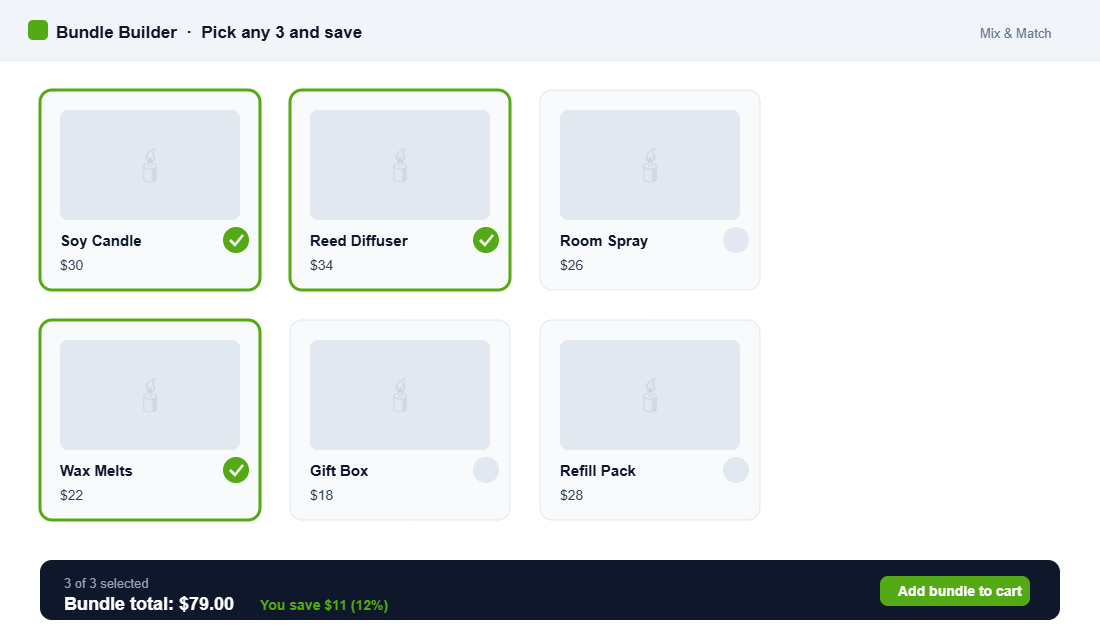
- Mix and match. The customer builds their own bundle from a category, say “pick any 3 candles”. This converts hard: 72% of bundle-builder sessions end with items added to cart.
- Volume or quantity breaks. Buy 2 get 10% off, buy 3 get 15%. Perfect for consumables people reorder anyway.
- Buy X get Y. Classic BOGO or “buy the kit, get the travel size free”. Great for introducing a hero product.
- Frequently bought together. AI-suggested pairings on the product page. Low effort, quietly effective, and easy to test.
One rule beats all the others: offer bundles and individual items, never bundles alone. This mixed approach generates 25 to 35% more revenue than pure bundling, because you never force a customer who only wants one thing to walk away.
The Pricing Rule That Protects Your Margin
This is where most founders overcorrect. They get excited about bundles, then discount them so heavily that the AOV win evaporates. A bundle that saves the customer 40% is just a sale with extra steps.
The sweet spot is a 10 to 15% saving off the combined individual prices. That is enough to feel like real value and shift behaviour, but small enough that the extra units more than cover it. Remember the goal: you are trading a thin slice of margin per item for a much bigger basket.
A quick worked example in AUD. Three items at $30 each is $90 at full price. Bundle them at $79, a 12% saving. If your unit margin is 60%, you make $54 selling one item alone, but $37.40 on a bundle that moves three units. Same customer, same session, and you have nearly doubled your dollar margin while they feel like they saved.
Bundling is also the cleanest way to move slow inventory without a fire sale. Pair a slow mover with a bestseller and you clear stock at close to full value. Our Shopify Dead Stock Playbook goes deep on that specific play.
Where to Place Bundles for Maximum Lift
A great bundle in the wrong spot earns nothing. Placement decides how many customers ever see the offer, so put it in the three moments where intent is highest.
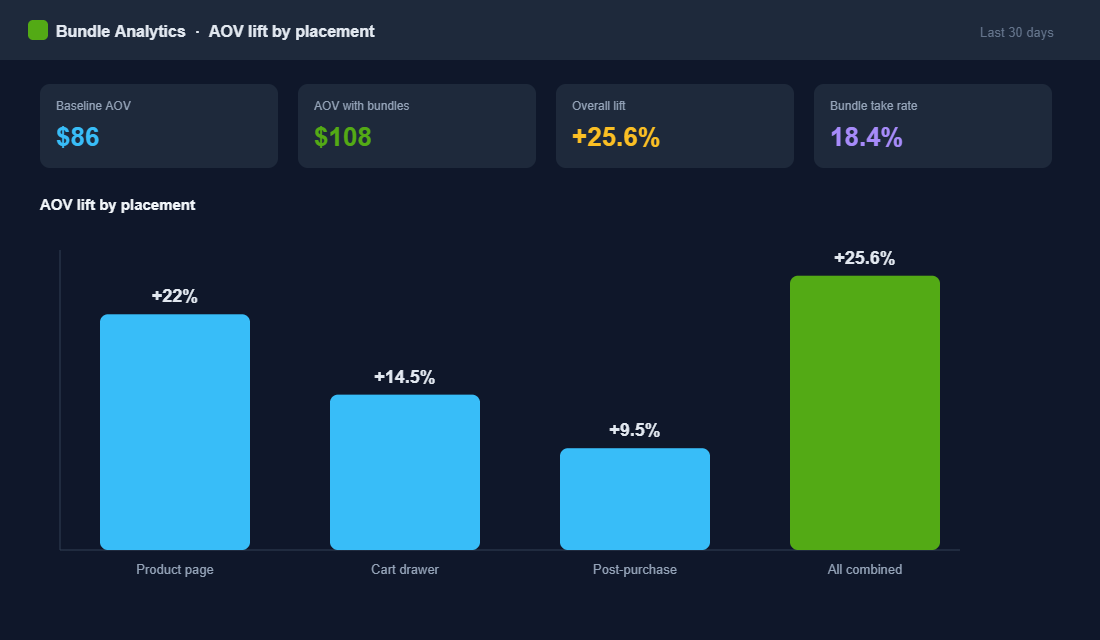
- The product page. Show a “frequently bought together” or “complete the set” block right under the add-to-cart button. This is prime real estate, and it is where Au Vodka lifted US AOV by more than 20% using dynamic bundles on the product page.
- The cart. A “customers also added” bundle in the cart drawer catches people already committed to buying. Small nudge, high acceptance.
- Post-purchase. A one-click bundle offer on the thank-you page adds revenue with zero risk to your conversion rate, because the sale is already banked.
Test one placement at a time. If you bolt bundles onto all three at once and AOV moves, you will never know which one did the work.
The Tools and How to Set Them Up
Shopify’s native bundles are fine for simple fixed sets, but a dedicated app gives you mix and match, volume breaks, and analytics in one place. The two we point members to most are Fast Bundle for value and range, and Rebuy for AI-driven dynamic bundles once you are past mid-six figures.
Setting up your first bundle with Fast Bundle takes about 20 minutes:
- Install and choose a type. From the Shopify App Store, add Fast Bundle, then pick your format: fixed, mix and match, volume, or frequently bought together.
- Select the products. Add the items and set your discount at 10 to 15% off the combined price, no deeper.
- Set the display. Choose where the widget appears, starting with the product page under add-to-cart.
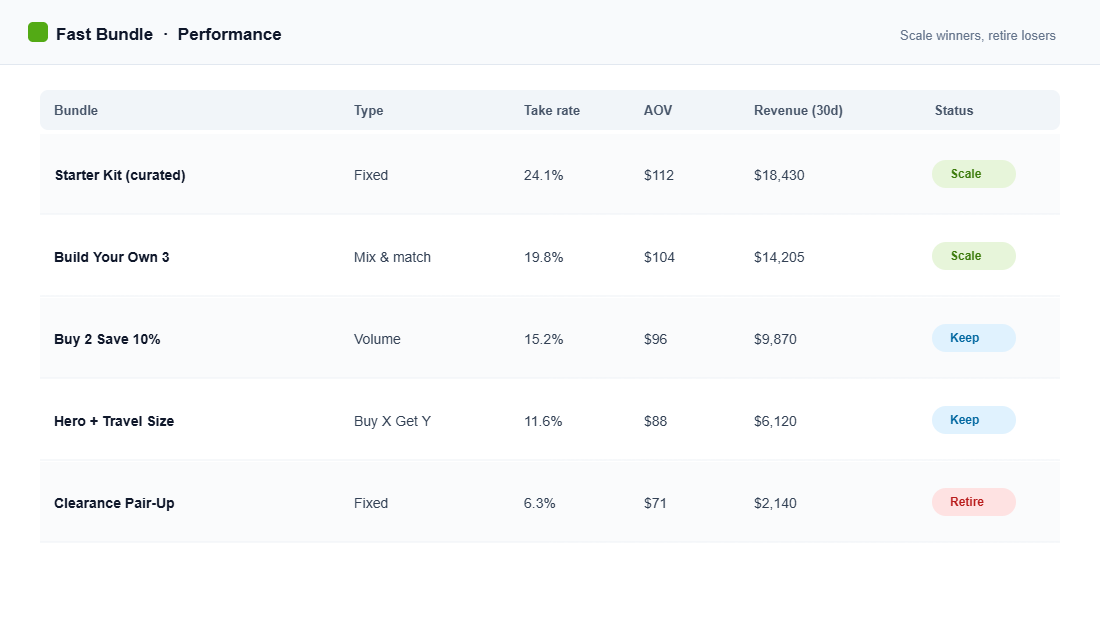
- Turn on analytics. Enable bundle reporting so you can see AOV and take rate per bundle, then kill the losers and scale the winners.
Whatever tool you pick, insist on per-bundle analytics. Brands running dedicated bundling tools report an average revenue increase of 23.7%, but only because they can see which bundles work and double down.
Proof It Works: Real Brand Results
The numbers are not theoretical. Supplement brand Olly used dynamic bundles and subscription upsells to lift AOV by just over 25%, while growing subscription revenue by 63%. Ritual Zero, the non-alcoholic spirits brand, saw a 46.3% AOV boost applying bundle best practices.
Then there is the compounding effect on retention. Bundling improves customer lifetime value by 25 to 35% through higher purchase frequency, and personalised bundles drive 40% higher retention than non-bundled offers. You are not just winning a bigger first order, you are starting a better relationship.
The pattern across every one of these brands is the same. They stopped treating bundles as a discount and started treating them as value architecture, deciding what genuinely belongs together and pricing it to protect margin.
The Three Ways Bundles Quietly Lose Money
Bundles fail in ways that do not show up in the bundle report, which is exactly why founders keep running unprofitable ones for months. Three failure modes to watch.
Cannibalisation dressed up as growth. Your bundle take rate climbs, AOV looks flat, and revenue has not moved. What actually happened is customers who were going to buy two items separately now buy the same two at a 12% discount. The check is straightforward: compare units per order and revenue per session, not AOV alone. If units per order is unchanged and revenue per session has dipped, you are discounting existing behaviour rather than creating new behaviour.
Fulfilment cost creep. A three-item bundle often needs a larger satchel, more protective packaging, and a longer pick time. Add $3 to $6 AUD per order in packaging and labour, and a bundle showing 58% gross margin on paper can land nearer 48% once it hits the warehouse. Ask your 3PL for a per-order pick cost by SKU count before you set the bundle price, not after.
Return rate drift. Bundles typically carry a 15 to 30% higher return rate than single items, because a customer only has to dislike one component to send the whole thing back. Partial returns are worse again, since they strand the remaining items at bundle economics without bundle revenue. Set your bundle policy explicitly (all-or-nothing return, or a defined partial refund value per component) before launch rather than improvising it at the first request.
Run all three checks at the 30-day mark on every bundle. The rule we give members is simple: a bundle earns its shelf space if it lifts revenue per session by at least 5% after fulfilment and returns, not if it merely sells. Anything that fails that test is a discount with extra steps, and the deeper version of that argument sits in our breakdown of the pricing mistakes killing your margins.
One placement note while you are auditing. Bundle offers surfaced in the cart drawer convert differently to bundles on the product page, because the customer has already committed to buying something. Most stores under-use that moment, and our cart drawer optimisation framework covers the eight elements worth testing there.
Why Bundling Compounds Across Your Store
Here is where the pieces click together. A higher AOV means every dollar you spend acquiring a customer works harder, because you earn more on the first order. That better first-order economics lets you outbid competitors on ads without losing money.
Then the 2.7 times lifetime value of bundle buyers kicks in over the following months. You acquired a more valuable customer at a better margin, and they come back more often. That is a flywheel, not a one-off sale. If you want to measure the downstream effect properly, pair this with our Shopify LTV Playbook.
Discounting shrinks the pie to move more of it. Bundling grows the pie and hands the customer a slightly bigger slice. Over a year, those are two completely different businesses.
Your Bundle Launch Checklist
Work through this to launch your first profitable bundle this week:
- 1. Pick the pairing. Choose two or three products that genuinely belong together, ideally a hero plus a complement.
- 2. Choose the type. Start with a curated fixed bundle or frequently bought together, the two easiest to launch.
- 3. Price for margin. Discount 10 to 15% off the combined price, never more.
- 4. Keep singles available. Offer the bundle and the individual items side by side.
- 5. Place it on the product page first. Under the add-to-cart button, then test the cart and thank-you page.
- 6. Track take rate and AOV. Turn on per-bundle analytics and review after two weeks.
- 7. Scale winners, cut losers. Double down on the bundles that lift AOV and quietly retire the rest.
Inside eCommerce Circle, building a margin-safe bundle strategy is one of the core Profit pillars we work on with every member, because it is the fastest way to grow order value without training your customers to wait for a sale. If you want a second opinion on your bundle and pricing mix, let’s talk.