You launched an affiliate program six months ago. You have forty sign-ups, three of them have ever made a sale, and the dashboard has quietly become a tab you avoid opening. Sound familiar? You are not alone, and the program is not the problem. The way it was set up is.
What’s in This Article
Most Aussie DTC founders treat affiliates as a set-and-forget app install. They bolt on a tool, generate a few discount codes, email a handful of customers, then wait. When nothing happens, they conclude affiliate marketing does not work for their brand. Meanwhile affiliate marketing drives roughly 16% of all ecommerce sales across the US and Canada, and around 65% of retailers say it contributes up to 20% of their annual revenue.
Here is the shift. A profitable affiliate program is not a channel you switch on. It is a system you run. The brands earning between $6.50 and $15 back for every $1 they put in are not luckier than you. They have a structure. This is the five-part structure we use with eCommerce Circle members to turn a dead affiliate tab into a channel that compounds month after month.
Part 1: Build an Offer Partners Actually Chase
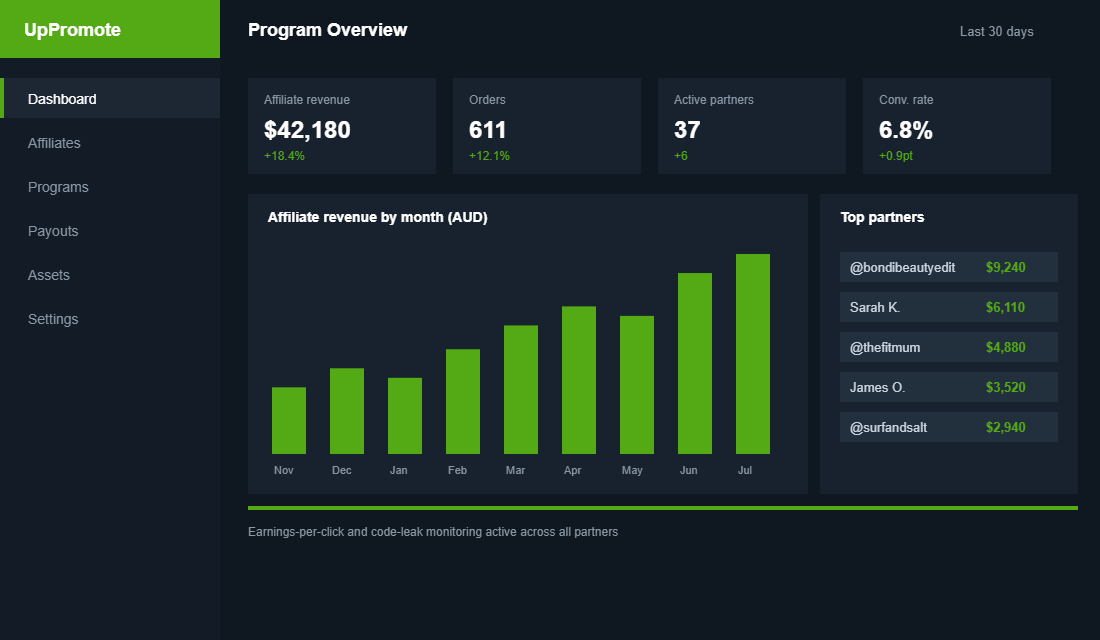
Your commission is the engine. Get it wrong and no amount of recruiting saves the program. Most founders default to a flat 10% and wonder why serious partners never show up. A content creator with real reach can earn 20% to 30% promoting someone else. Your 10% offer never makes their shortlist.
Work backwards from your contribution margin instead of guessing. If a product lands 65% gross margin after cost of goods and shipping, you have real room to pay 20% and still bank a healthy profit on a sale you would not have made otherwise. That is the point most people miss: an affiliate sale is incremental. You are paying for revenue you did not have, not discounting revenue you already owned.
Structure the offer so it pulls the behaviour you want:
- Set a headline rate that beats the category. In beauty and apparel, 15% to 20% is competitive. In lower-margin categories, lead with a fixed dollar bounty per order so the maths still works.
- Add a performance tier. Bump partners from 15% to 20% once they clear a monthly sales threshold. It costs you nothing on quiet months and gives your best affiliates a reason to push harder.
- Give the customer a reason too. Pair the affiliate link with a 10% first-order code. The partner promotes a genuine offer, not just a naked link, and your conversion rate climbs.
One benchmark to hold in your head: average affiliate conversion sits between 0.5% and 1%, but well-matched partners promoting to a relevant audience convert at 5% to 10%. The offer sets the ceiling. Partner quality decides where you land inside it.
Part 2: Recruit for Alignment, Not Audience Size
The single biggest mistake in affiliate recruiting is chasing follower counts. A creator with 200,000 followers and no buying intent will send you traffic that bounces. A micro-affiliate with 4,000 engaged followers who genuinely use your product will outperform them on revenue per click every time.
Start with the partners already in your database. Your happiest customers are your warmest affiliates, and they convert because the recommendation is real. Coco & Eve and Sand & Sky, two Australian beauty brands that scaled globally from Shopify, both lean heavily on customer-turned-affiliate and ambassador programs rather than cold influencer deals. The advocacy was already there. They just built the rails to reward it.
Run recruiting as three concentric circles:
- Circle one, your customers. Invite five-star reviewers and repeat buyers first. Tools like Social Snowball auto-enrol customers as affiliates on the thank-you page, so every buyer leaves with a personal link the moment they check out.
- Circle two, your niche creators. Search hashtags and tagged posts for people already mentioning you or your category. A short, specific DM beats a mass email.
- Circle three, professional affiliates. Marketplaces inside Refersion and UpPromote list millions of partners actively looking for programs to join. Use these once your offer and assets are dialled in, not before.
Recruit in small, deliberate batches. Twenty aligned partners you can onboard properly will beat two hundred sign-ups you never speak to. This is the same logic behind a strong loyalty program: depth of relationship beats breadth of list.
Part 3: Track Every Click and Defend Your Codes
You cannot pay for performance you cannot measure. Clean attribution is what separates a program you trust from one you quietly suspect is leaking money. This is the part founders skip, and it is the part that decides whether the numbers you report are real.
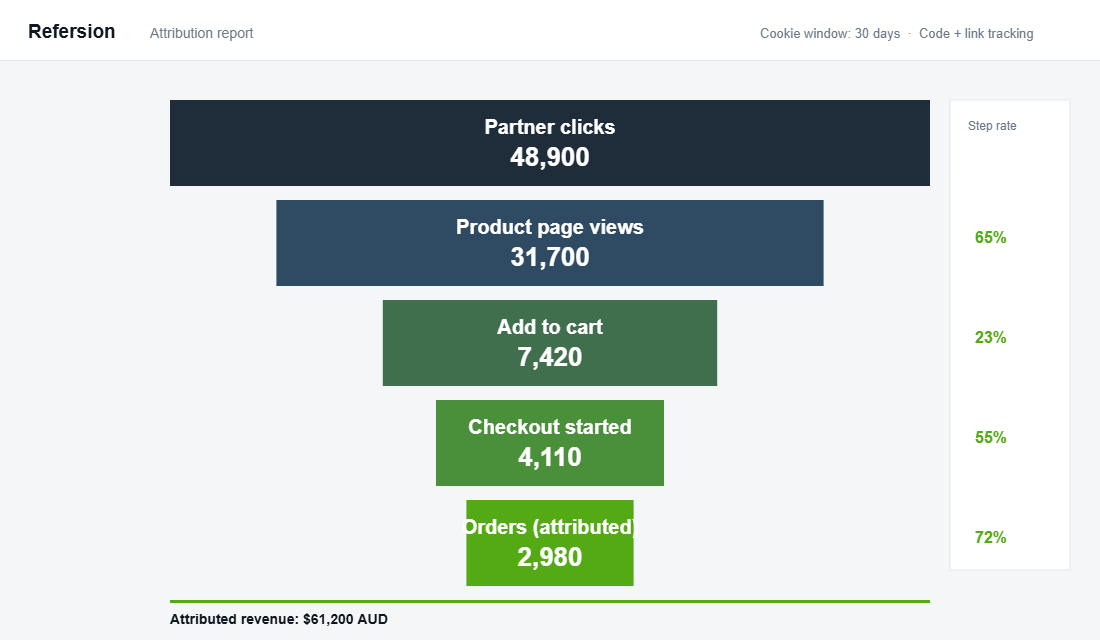
Give every partner two tracking methods: a unique referral link with a cookie window (30 days is the sensible default) and a personal discount code for anyone who shops on mobile or types the URL directly. The code catches the sales the cookie misses, which on mobile-heavy Aussie stores is a meaningful share of orders.
Then defend those codes. Public affiliate codes get scraped and dumped onto coupon sites within days, and suddenly you are paying commission on sales that would have happened anyway. Protect margin with a few controls:
- Use unique, non-obvious codes. Avoid “SARAH10”. Use a randomised code tied to the partner so it is hard to guess and easy to trace.
- Block coupon-site domains. Most affiliate apps let you disallow known coupon aggregators from earning commission.
- Watch earnings-per-click, not just total sales. A partner with high sales but suspiciously high EPC is often riding demand you already created.
Whichever platform you choose, the reporting should let you see revenue, orders, conversion rate and earnings-per-click per partner at a glance. If you cannot answer “who are my top five affiliates by profit this month” in ten seconds, your tracking is not doing its job.
Part 4: Arm Your Affiliates So They Actually Post
Sign-up is not activation. The gap between the two is where most programs die. A partner who joins, gets a link, and hears nothing else will forget you inside a week. Your job is to make promoting you the easiest thing on their to-do list.
Build a simple affiliate kit and send it the day they join:
- Ready-to-post assets. Three or four on-brand images, a short video, and two caption templates they can paste and tweak. Remove the blank-page problem entirely.
- Clear dos and don’ts. One page covering how to disclose the partnership, what claims they can make, and your brand basics. This keeps you compliant with Australian Consumer Law and protects your reputation.
- A launch nudge. Ask for one post in the first 72 hours while motivation is high, and reward it with a small bonus or early commission bump.
Keep partners warm with a monthly email: new products, top-performer shout-outs, seasonal angles, and a reminder of what they have earned. Treat it like the affiliate version of a Klaviyo flow. Consistent, useful, and always pointing at the next action. The affiliates who feel like insiders are the ones who post without being asked.
Part 5: Pay Fast and Prune Ruthlessly
Nothing kills partner trust faster than slow or confusing payouts. Nothing builds it faster than paying on time, every time. Affiliates talk to each other, and a brand with a reputation for clean, prompt payments attracts better partners without lifting a finger.
Set a fixed payout cadence, monthly is standard, with a short hold period to cover returns. Automate it through your affiliate app so approved commissions flow to PayPal or bank transfer without you touching a spreadsheet. Some brands pay in store credit instead of cash, which recycles the cost back into inventory and turns the affiliate into a repeat customer too.
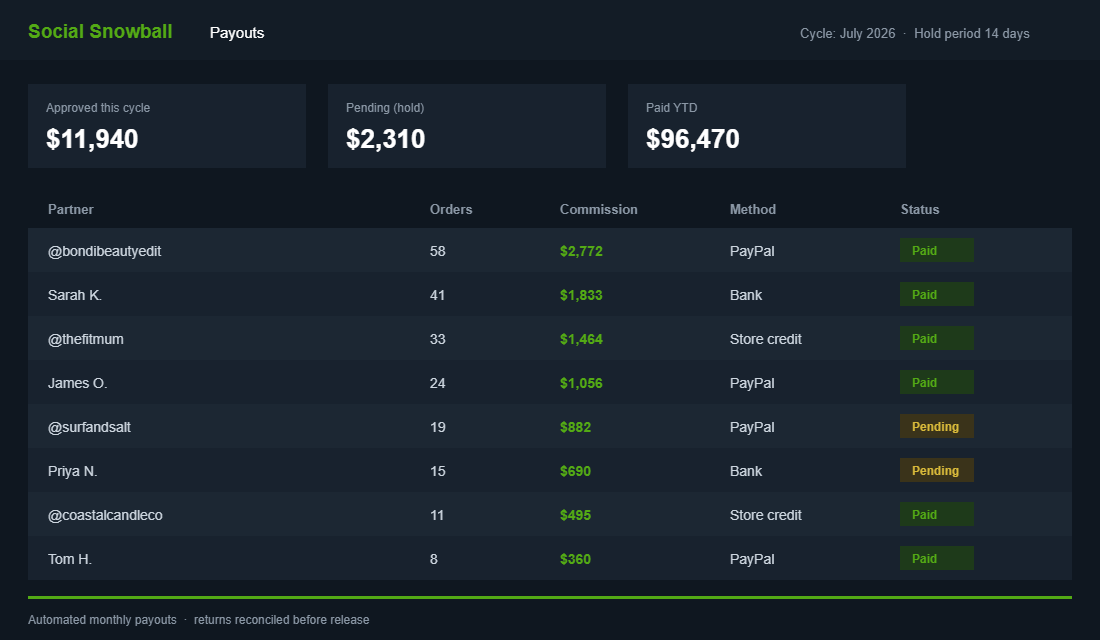
Then look at the data and act on it. Around 80% of your affiliate revenue will come from the top 20% of partners. Your quarterly job is simple:
- Double down on the top tier. Offer them higher commission, exclusive products, or a proper ambassador retainer. These relationships are worth protecting.
- Reactivate the middle. A personal message and a fresh angle often wakes a lapsed partner who simply got busy.
- Prune the dead weight. Partners who never post clutter your reporting and inflate your sign-up vanity metric. Clear them out so you are managing a real program, not a mailing list.
How to Launch Your First Program in UpPromote
If you want a concrete starting point, UpPromote is the most approachable option for a Shopify store. It installs free, scales to a paid plan at around $29.99 a month when you are ready, and covers everything in this playbook. Here is the fastest path to a live program:
- Install and connect. Add UpPromote from the Shopify App Store. It syncs your products and orders automatically.
- Create your first program. Set the commission (start at 15% or a fixed bounty), the cookie window at 30 days, and a customer-facing discount code.
- Build the sign-up page. Use a branded template so the registration page matches your store. Link it in your footer and post-purchase emails.
- Turn on auto-enrolment. Invite existing customers to become affiliates straight from the thank-you page and your order-confirmation flow.
- Upload your affiliate kit. Load your assets and guidelines so every new partner gets them on approval.
- Set the payout rule. Choose monthly payouts with a 14-day hold, then let the app handle approvals and tracking.
Refersion (from around $49 a month) suits larger influencer-led programs, and Social Snowball (from around $99 a month) is built for viral, customer-driven referral loops. Start with the tool that matches your stage, not the most expensive one.
Why the Five Parts Compound
Run any one of these in isolation and you get a mediocre program. Run all five together and something different happens. A sharp offer attracts aligned partners. Aligned partners convert, which makes your tracking data trustworthy. Trustworthy data tells you exactly who to arm and reward. Fast payouts and smart pruning concentrate your effort on the partners driving profit, who then recruit their friends because your program has a reputation.
That is the flywheel. It is why affiliate marketing is projected to grow past $27 billion globally by 2027, and why roughly 80% of brands now run some form of partner program. It is also why the customers affiliates bring tend to have strong lifetime value: they arrive through a trusted recommendation, not a cold ad. Feed those buyers into your retention engine and the maths gets even better. We break that down in the customer lifetime value playbook, and the thank-you page playbook shows exactly where to capture that first affiliate opt-in.
Affiliate marketing is not a growth hack. It is a sales team you only pay when they sell. Build the system once, run it with discipline, and it becomes one of the most profitable channels you own.
Inside eCommerce Circle, building a partner channel that actually pays is one of the core pillars we work on with every member. If you want a second opinion on yours, let’s talk.
Related reading: the TikTok Shop Australia playbook.