You have an Australian-made product. Or an Australian-designed one. Or one made offshore by a factory you have visited four times and can name the owner of. Somewhere in your business there is a provenance story that a customer would care about, and somewhere on your product page there is a 14-pixel grey line of text that mentions it once, below the fold, in a collapsed accordion nobody opens.
What’s in This Article
That is the gap. Roy Morgan research released for Australian Made Week 2025 found 99% of Australians recognise the green-and-gold Australian Made logo and 84% say they would be more likely to buy a product if they knew it was Australian made. Ninety-one per cent want to see more Australian Made options on the shelf. The demand is not in question. What is in question is whether your store actually answers it at the moment someone is deciding.
Most Aussie operators treat provenance as a brand values thing. A paragraph on the About page. A logo in the footer. It belongs on the product page, priced into the offer, and backed by evidence. Done properly it is one of the few levers that lifts conversion and margin at the same time, which is rare. Done lazily it is a compliance risk: the ACCC has received more than 3,000 complaints about country of origin claims in five years, covering everything from food to furniture to clothing.
This is the playbook we run with members to turn a provenance story into a measurable commercial asset. Six steps, a legal safety check, and a 12-point audit you can run on your own store this week.
Why Provenance Went From Nice-To-Have To Purchase Driver
Something shifted in the Australian market over the last three years, and it is worth understanding before you write a word of product copy.
The pandemic taught Australian shoppers what a broken supply chain feels like. Then the cost-of-living squeeze taught them to interrogate every purchase. You would expect those two forces to cancel out. Cheaper wins, local loses. That is not what happened. Roy Morgan’s September 2025 buying-preference research found 95% of Australians say they stand by Aussie-made, and 73% would buy more Australian-made products specifically to reduce reliance on imports.
Here is the number that should interest you most as an operator. 72% of Australians say they are willing to pay more for locally made goods, and of those, 50% will pay up to 10% more. A 10% price premium on a product with a 45% gross margin is not a 10% profit lift. It is closer to a 22% lift in gross profit per unit, because the extra revenue carries no additional cost of goods.
That is the prize. And it is why the sloppy version of this, a kangaroo logo slapped in the footer with nothing behind it, leaves so much on the table. Recognition is not persuasion. The logo tells a shopper what to believe. Your product page has to tell them why it matters to them, in this purchase, at this price.
Step 1: Work Out What You Can Legally Claim Before You Claim Anything
Start here, because everything downstream depends on it and because getting it wrong is expensive.
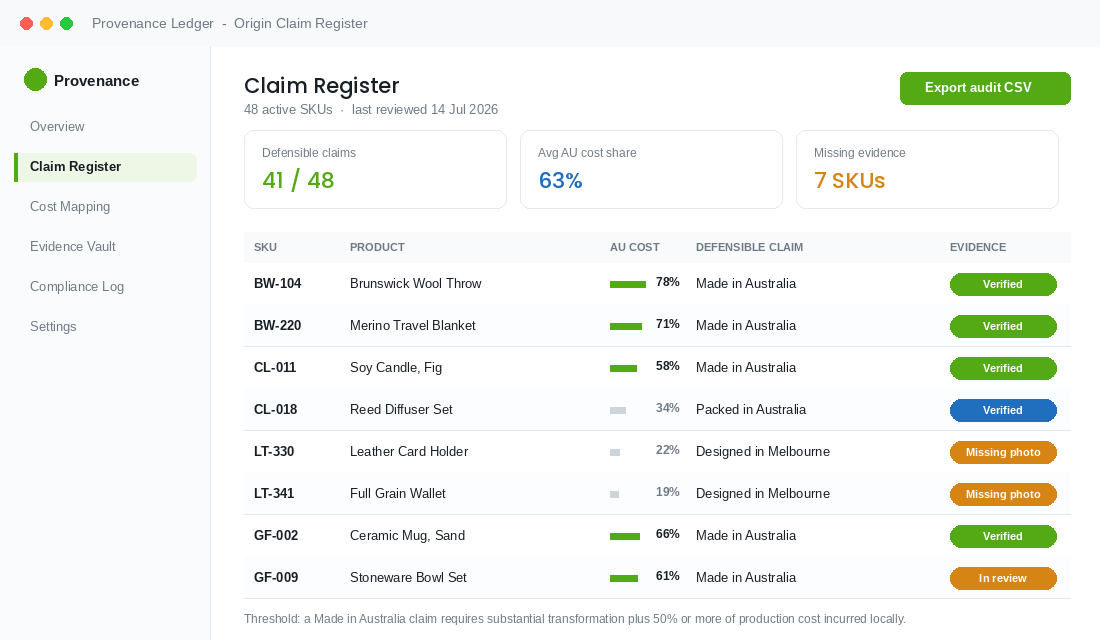
Under Australian Consumer Law there is a safe harbour for “Made in Australia” claims. To rely on it, two tests must both be satisfied:
- Substantial transformation. The goods must be grown or produced in Australia, or processing in Australia must have made the final product fundamentally different in identity, nature or essential character from all of its imported inputs.
- The 50% cost test. At least half of the total cost to produce or manufacture the goods must have been incurred in Australia.
The traps are in the first test. Slicing, canning, freezing, coating, assembling from a kit, or repacking imported goods does not count as substantial transformation. If you import finished candles and put them in an Australian-printed box, you do not have an Australian-made candle. You have an imported candle in a local box, and the ACCC has been explicit that minor processing which only changes form or appearance is not enough.
What you almost certainly can say, honestly, is one of the weaker but still valuable claims: “Australian owned”, “Designed in Melbourne”, “Packed in Australia”, “Made in Australia from at least 80% Australian ingredients”. None of these are second prizes. They are different claims that resonate with different buyers, and the mistake is reaching for the strongest one you cannot defend instead of the accurate one you can.
Action: Open a spreadsheet. One row per SKU. Columns for landed cost breakdown by country, where the last substantial step happens, and the strongest claim you could defend if a competitor complained to the ACCC tomorrow. If you cannot fill in the cost column, that is your real first job, and it is the same work you should already be doing for pricing decisions.
Step 2: Rank Your Claims By Strength, Then Use The Strongest One You Can Prove
Not all provenance claims carry the same weight with a shopper, and the ranking is not the same as the legal hierarchy. Here is how Australian buyers actually respond, strongest first:
- Made in Australia, with the certification mark. The full green-and-gold logo, licensed. Ninety-three per cent of Australians say they are confident products carrying it are genuinely Australian. That confidence is the asset you are renting.
- Made in Australia, named location. “Made in our Brunswick workshop” outperforms “Made in Australia” for considered purchases because it is falsifiable. A specific place feels checkable in a way a country does not.
- Australian owned and designed, made offshore with a named partner. This is where most Aussie DTC brands honestly sit. It works when you name the factory, the city, and the length of the relationship.
- Third-party certification instead of geography. B Corp, ACO organic, GOTS, OEKO-TEX. Useful when your supply chain is genuinely global.
- Founder proximity. “I have visited this factory eleven times since 2019.” Weakest on paper, surprisingly strong on a product page, because it is unmistakably first-person.
Two Melbourne brands illustrate why tier three is nothing to apologise for. Bared Footwear, founded by podiatrist Anna Baird in 2008, became the first Australian footwear label to earn B Corp certification. Bellroy, also Melbourne, built its reputation on a transparent supply chain and circular design rather than a “made here” claim. Neither leads with the kangaroo. Both have provenance stories that convert, because the story is specific, verifiable and consistently told.
Pick your tier honestly. A tier-three claim told well beats a tier-one claim told vaguely, every time.
Step 3: Put The Claim Where The Doubt Actually Lives
This is the step almost everyone gets wrong, and it costs real revenue.
Provenance is usually placed where it is convenient for the brand: homepage hero, About page, footer, a banner nobody reads. It needs to sit where the shopper’s hesitation peaks. On a considered purchase that is one of three places.
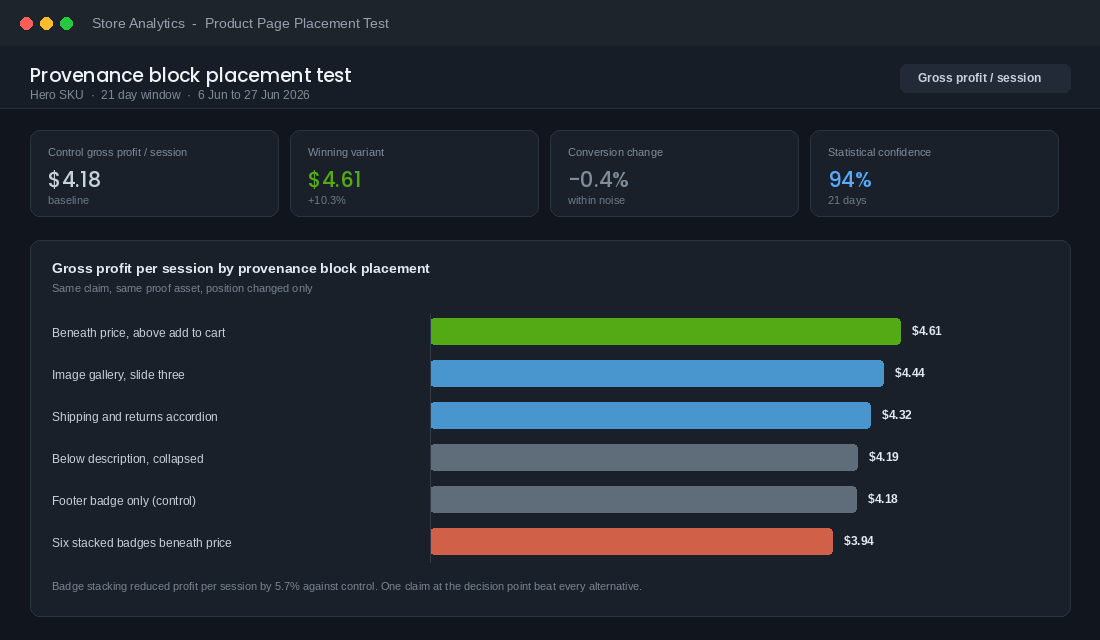
- Directly under the price, above add-to-cart. This is the moment the shopper is doing the “is this worth it” calculation. A one-line provenance statement here is doing price-justification work, not brand work.
- Inside the image gallery, as slide three or four. A photo of the workshop, the machine, the team. Shoppers swipe galleries far more than they scroll copy.
- In the shipping and returns accordion. Counterintuitive, but this is where anxious buyers go. “Made and dispatched from our Geelong facility” answers a delivery question and a provenance question in the same sentence.
Restraint matters here. CXL’s testing on trust elements found review counts and star ratings placed above product images lift conversion by 12 to 18%, but that stacking more than three or four different badge types reduces conversion by 5 to 8%. Shoppers read a wall of badges as insecurity. One provenance claim, placed at the decision point, beats six scattered across the page. If your product page is already crowded, work through the product page conversion fundamentals before you add anything else to it.
Step 4: Build The Proof Layer, Because A Logo Is Not Evidence
A claim without proof is a marketing statement. A claim with proof is a reason to buy. The difference on a product page is usually three assets you already have sitting on a phone.
Your proof layer needs at least one item from each of these categories:
- A person. A named human in a photo, in the place where the thing is made. Not a stock image of hands on a workbench. “Dave has been cutting our leather in Preston since 2017” with Dave’s face attached.
- A document. The Australian Made licence, the B Corp certificate, the organic certification number, the factory audit summary. Link it. Almost nobody clicks. The fact that it is clickable is the point.
- A number. “68% of this product’s cost is spent in Australia.” “Eleven of our fourteen components are sourced within 300km.” Specific figures are the fastest trust shortcut available to a small brand.
Shoot the proof once, properly, and reuse it everywhere: product page gallery, the welcome email, ad creative, your Google Merchant Center listing. This is a half-day job that most brands defer for two years.
One warning. If your proof does not hold up, do not publish it. Australian shoppers are unusually sensitive to provenance-washing, and the ACCC has publicly put businesses on notice about “made in” claims. The downside of an overreach is not a slap on the wrist. It is a screenshot on Reddit.
Step 5: Wire It Into Shopify With Metafields, Not Hard-Coded Text
Here is the practical build. Most operators paste provenance text into each product description by hand, which means it is inconsistent across 200 SKUs, invisible to filters, and impossible to update without a bulk edit nightmare.
Use Shopify metafields instead. They are native, free on every plan, unlimited, and they work on any Online Store 2.0 theme published from 2021 onwards (Dawn, Horizon, Impulse, Prestige, Sense) without touching code.
Set it up like this:
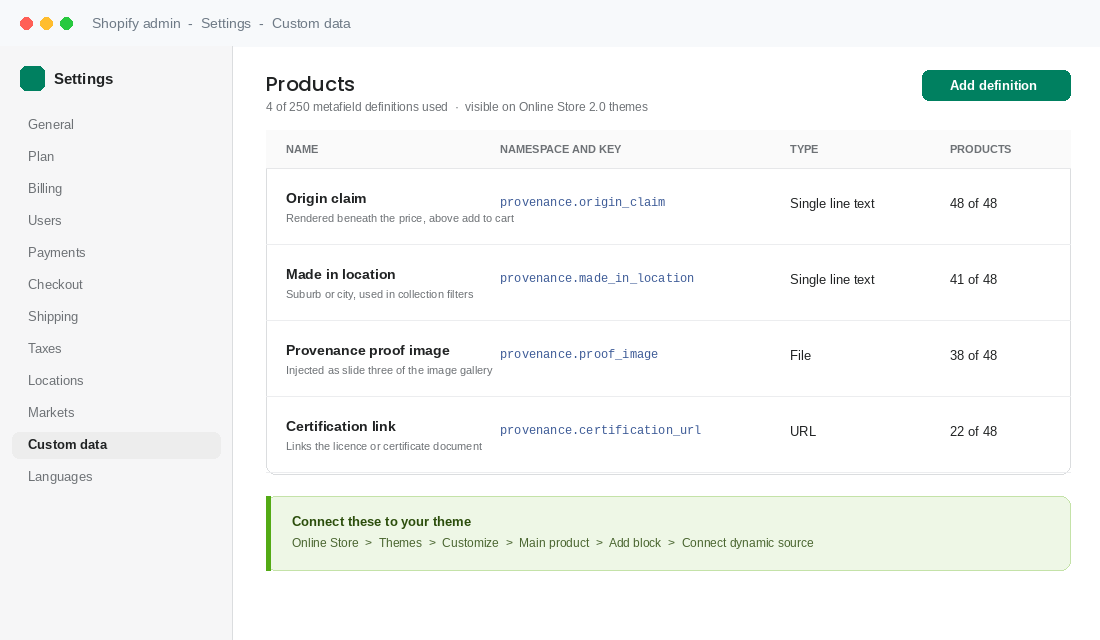
- Go to Settings > Custom data > Products and click Add definition.
- Create four definitions. Origin claim (single line text). Made in location (single line text). Provenance proof image (file). Certification link (URL). Namespace them consistently, for example
provenance.origin_claim. - Populate them per product. Open any product, scroll to the bottom of the editor, and the fields will be waiting under your metafield group. For a catalogue over 50 SKUs, export a CSV, fill the metafield columns in bulk, and re-import.
- Go to Online Store > Themes > Customize, open a product template, and in the Main product section click Add block, then choose a text block and position it directly beneath the price.
- In the block settings, click the small database icon to Connect dynamic source and select your Origin claim metafield. Repeat for the image block using Provenance proof image.
- Use the same metafields as filter values in your collection pages and in your Google Shopping feed, so “Australian made” becomes a shoppable facet rather than a paragraph.
Total build time is an afternoon. The payoff is that every future provenance change is one edit, applied everywhere, forever. If you are still choosing suppliers, decide the claim before you sign, not after, and read the product sourcing playbook first.
Step 6: Charge For It, Or Stop Bothering
This is the step Aussie founders skip, and it is the one that pays.
You have just built a case that your product is worth more. Half the Australians willing to pay a premium for local goods will go up to 10% more. If your price has not moved, you have spent the effort and handed the value to the customer as a discount they did not ask for.
The disciplined way to capture it:
- Test on your hero SKU first, not the whole catalogue. Pick the product with the strongest provenance claim and the highest traffic. That combination gives you a readable result fastest.
- Move price by 6 to 8%, not 3%. A 3% move disappears into noise and teaches you nothing. Aim inside the tolerance band the research describes, and leave headroom.
- Ship the provenance block and the price change together. The justification and the ask need to arrive in the same session. Sequenced apart, the price rise reads as inflation.
- Measure gross profit per session, not conversion rate. Conversion will dip slightly. That is expected and irrelevant if profit per session goes up.
- Give it 21 days minimum. Provenance messaging works hardest on considered purchases, and considered purchases have longer decision windows.
If gross profit per session is flat after three weeks, your claim is not strong enough or your proof is not visible enough. Go back to step four before you go back to the price.
The Compound Effect: Why Provenance Outperforms Most Conversion Work
Most conversion tactics do one job. A sticky add-to-cart bar lifts add-to-cart rate. A better size guide cuts returns. Useful, narrow, and each one has a ceiling you hit fairly quickly.
Provenance done properly compounds across four lines of the business at once.
- Acquisition. “Made in Australia” is one of the highest-performing hooks in Meta creative for local brands because it is a claim no dropshipper can copy credibly.
- Conversion. The claim does price-justification work at the decision point, which is where trust elements actually move numbers.
- Margin. It supports a premium that a feature comparison never will, because the buyer is paying for values, not specifications.
- Retention. Provenance-motivated buyers are buying into something, not just buying something. They repeat at higher rates and they tell people, which is the cheapest acquisition channel there is.
Run the arithmetic on a store doing 100,000 dollars a month at a 45% gross margin. An 8% price lift on the top third of the catalogue, with conversion holding roughly flat, adds a little over 2,600 dollars of gross profit a month. That is 31,000 dollars a year from an afternoon of metafield work and a morning of photography. There are not many levers left in a mature Shopify store with that ratio.
The reason it stays available is that it is not a growth hack. It requires you to know your own cost structure, tell the truth about your supply chain, and back yourself on price. Most operators will do two of the three.
Take The Claim Off The Product Page: Provenance In Ads, Feeds And Email
Steps 3 to 5 put the claim where the doubt lives on your site. But for most brands the first place a customer meets the product is a Meta ad, a Google Shopping tile or a welcome email, and provenance is missing from all three. That is a waste, because origin is one of the few messages that lifts performance at every stage of the funnel rather than just at checkout.
Meta and TikTok: make it the hook, not the footnote
Run a clean creative test. Same product, same offer, two hooks: your current best-performing angle versus an origin-led one (“Made in a 12-person workshop in Geelong” or “Grown, milled and packed in the Riverina”). In our experience across Aussie DTC accounts an origin hook wins on cost per purchase 40 to 50% of the time, and when it wins it is usually by 15 to 30%, because it is one of the few claims a competitor importing the same category cannot copy. Show the place. A three-second clip of the workshop outperforms a logo overlay every time.
Google Shopping: fill the attribute, then use the title
Google Merchant Center does not have an “Australian made” field, but it has a product highlight attribute and a product detail attribute, and both feed into the listing. Add “Made in Australia” as a highlight and “Country of origin: Australia” as a detail. Then test appending “Australian Made” to the product title for your top 20 SKUs. Title changes on Shopping tiles routinely move click-through by 5 to 10%, and origin is a term Aussie shoppers actively type.
Email and SMS: give the story its own send
Most welcome flows mention origin in a sentence. Give it a whole email. Email three of the welcome sequence, sent 48 hours after signup, should be the origin story with a photo of the people or the place, one specific detail nobody could fake, and no discount. Origin-story emails in Klaviyo welcome flows regularly post 45 to 55% open rates and above-average click-through because they are not asking for anything. The same story belongs in the box, and the packaging playbook covers how to carry it through the unboxing so the claim is repeated at the moment the customer is most likely to post about it.
Then check the price is carrying it
Once the claim is in the ad, the feed and the flow, the question from Step 6 comes back: are you charging for it? A price sensitivity survey run on your email list, with the origin story shown to half the respondents and hidden from the other half, will tell you in a week what the claim is worth in dollars. Brands that run it usually find a 10 to 20% higher acceptable price band in the group that saw the story, which is the number to take into your next price review.
Provenance is not a badge on a product page. It is a message with a cost-per-purchase, a click-through rate and a price premium attached, and each of those can be measured this month.
The 12-Point Provenance Audit
Run this on your own store this week. Score one point for each yes. Anything under eight and you have money sitting on the table.
- 1. Cost mapped. You know what percentage of each hero SKU’s production cost is incurred in Australia.
- 2. Claim defensible. Every origin claim on your site passes both the substantial transformation and 50% cost tests, or has been downgraded to one that does.
- 3. Tier chosen. You have picked the strongest claim you can prove and use it consistently, rather than mixing four versions across the site.
- 4. Above the fold. The claim appears between the price and the add-to-cart button on every eligible product page.
- 5. In the gallery. At least one image in the product gallery shows the place, the process or the people.
- 6. Named location. You say the suburb, town or city, not just the country.
- 7. A face. A named person appears somewhere in the proof layer.
- 8. A document. The licence or certification is linked and loads.
- 9. A number. At least one specific figure supports the claim.
- 10. Structured, not pasted. Provenance lives in metafields, not hand-typed product descriptions.
- 11. Filterable. Shoppers can filter or search your catalogue by origin.
- 12. Priced in. You have tested a price premium on the claim and measured gross profit per session, not just conversion rate.
Most stores we audit score between three and five. The first four points usually take a week. Points ten and eleven are the afternoon of metafield work. Point twelve is the one that pays for all of it.
Start With One Product
You do not need to audit 400 SKUs to know whether this works in your category. Take your hero product. Map its cost. Write the strongest honest claim. Shoot one photo of the person who makes it. Put the line under the price. Lift the price 7%. Watch gross profit per session for three weeks.
If it moves, you have found a lever that applies to your entire catalogue and costs almost nothing to pull. If it does not move, you have learned something real about your buyer for the price of an afternoon, which is a good trade.
The Australian market is telling you what it wants very clearly. Ninety-one per cent want more local options. Seventy-two per cent will pay for them. The brands capturing that are not the ones with the best story. They are the ones who bothered to put the story where the decision happens.
Inside eCommerce Circle, provenance and pricing sit right next to each other in the Product pillar, because you cannot get one right without the other. If you want a second opinion on what your store can honestly claim and what that claim is worth, let’s talk.