A supplier emails you on a Friday afternoon. One of the components in a batch you shipped three months ago failed a test. They are not sure how many units are affected. They are not sure which units. They just wanted to give you a heads up.
What’s in This Article
Most Aussie founders read that email and feel their stomach drop, then do the worst possible thing: nothing, for about four days, while they try to work out whether it is really their problem. That gap is where a manageable batch issue turns into a business-threatening one.
Here is the number that should reframe how you think about this. The ACCC is notified of roughly 650 consumer product recalls every year, and only about half of the affected products ever come back. Excluding cars, that leaves around 1.7 million recalled items sitting in Australian homes, which the ACCC estimates touches almost one in four households. Recalls are not rare events that happen to big importers. They are a routine part of selling physical goods, and the brands that survive them are the ones that had a system before the email arrived.
This playbook is the six-phase system I walk Aussie DTC founders through. It covers what to build before anything goes wrong, what to do in the first 48 hours, how to run a notification sequence that beats the national return rate, and how to close the loop so the same batch problem never reaches a customer twice.
Why Australian Founders Get Caught: The Two-Day Clock Nobody Reads
Section 131 of the Australian Consumer Law is short and most operators have never read it. It says that a supplier of consumer goods must notify the Commonwealth Minister, in practice via the ACCC, within two days of becoming aware of a death, serious injury or serious illness that they or anyone else considers was caused, or may have been caused, by the use or foreseeable misuse of their product.
Two days. Not two business days in the sense most people assume. Not two weeks while your lawyer drafts something. And the obligation applies to everyone in the chain: importers, manufacturers, retailers, installers, repairers and assemblers. If you buy white-label stock from overseas and put your brand on it, you are the supplier.
Notice the trigger too. It is not “once you have confirmed the product caused the injury”. It is once you become aware that someone considers it may have. A single customer email saying their child was burned by your product starts the clock, even if you are convinced they misused it.
The cost of getting this wrong changed sharply this year. For conduct on or after 28 March 2026, the maximum corporate penalty for many Consumer Law contraventions doubled to 100 million dollars per contravention, or three times the benefit obtained, or 30 per cent of adjusted turnover during the breach period, whichever is greater. Those numbers are aimed at large players, but the framework applies to your ABN too.
Phase 1: Build the Trace Layer Before You Need It
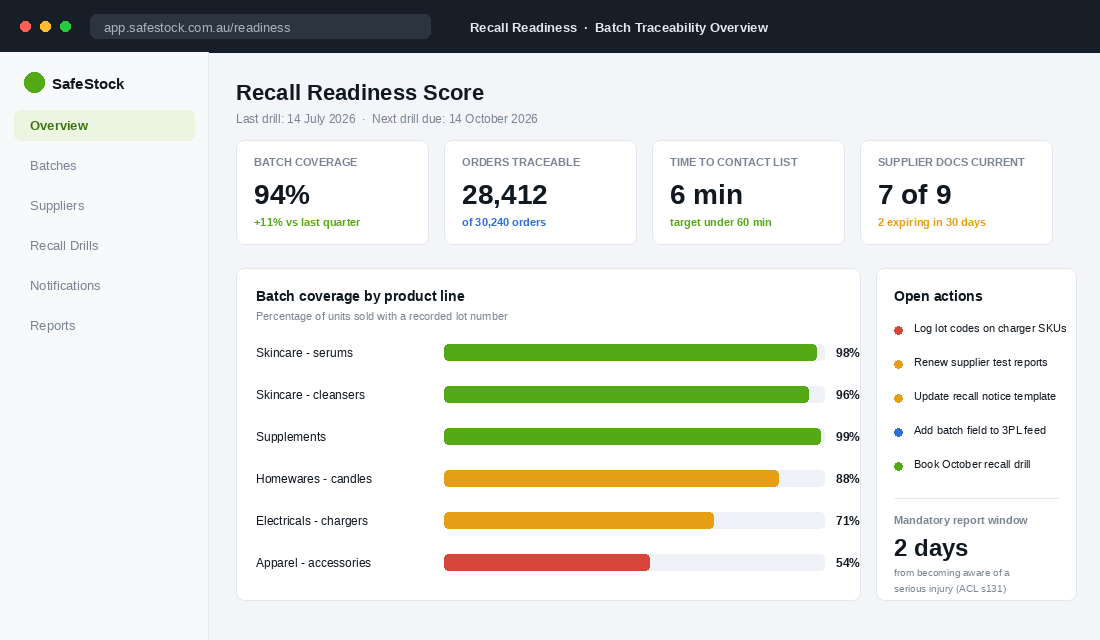
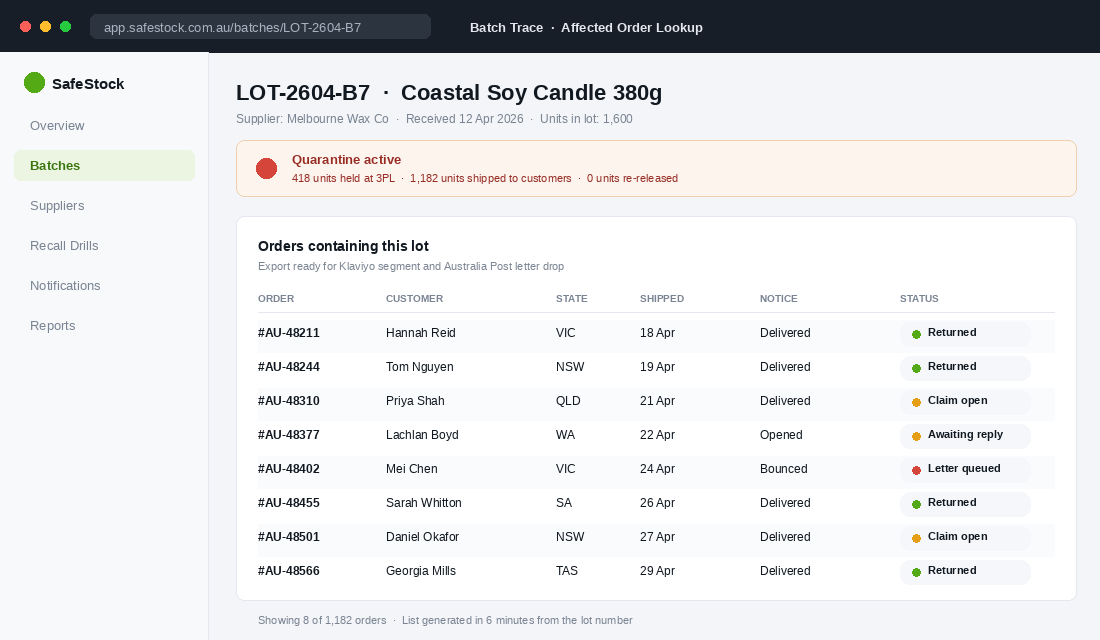
Every recall comes down to one question: which customers received the affected units? If you can answer that in under an hour, you run a contained, professional recall. If it takes you three weeks, you end up recalling everything you have ever sold, which is roughly ten times more expensive and far more damaging to trust.
Shopify does not solve this natively. Standard Shopify tracks inventory at SKU level, not lot or batch level, so if you sell 4,000 candles across six production runs, Shopify sees 4,000 candles. It has no idea which run went to which order. That is the gap you need to close.
Set up batch tracking in Shopify
Freshly Batch Inventory is the app I point most Australian merchants to for this. It was built for merchants selling consumables, cosmetics and regulated goods, won Shopify’s app challenge in 2020 and was a winner in the FDA’s New Era of Smarter Food Safety Traceability Challenge in 2021. Setup takes an afternoon:
- Install and pick your tracked SKUs. Do not batch-track everything on day one. Start with anything ingested, applied to skin, powered by a battery, or used by children. That is where recall risk concentrates.
- Define your lot code format. Use something readable like LOT-YYMM-XX, where YYMM is the production month and XX is the run. LOT-2604-B7 tells you it was the seventh run of April 2026 without opening a spreadsheet.
- Create a batch on every goods-received event. When stock lands at your 3PL or warehouse, log the lot code, supplier, quantity received, production date and expiry if relevant. This is the step people skip when they get busy, and it is the step that costs them later.
- Enable FIFO or FEFO allocation. The app assigns the oldest batch to each order automatically, so the lot number attaches to the order without anyone typing it.
- Confirm the lot writes to the order. Place a test order and check the lot code appears on the order record as a line-item property or note attribute. If it does not, the whole exercise is decorative.
- Push the field to Klaviyo. Map the lot attribute into your Klaviyo order-placed event so you can build a segment from a lot number in about ninety seconds when you need one.
The three records that make a recall survivable
- Lot to order mapping. Which orders contained which production run. This is the one that generates your contact list.
- Supplier compliance file. Test reports, certificates of compliance, and specification sheets for every batch, filed by lot code. When the ACCC asks for evidence of compliance, you want a folder, not a memory.
- Complaint log. Every safety-adjacent customer message, tagged and dated, with the order number and lot code attached. Three unrelated complaints look like noise. Three complaints from the same lot are a pattern, and you only see the pattern if you are logging it.
This trace layer sits alongside the inbound checks in the Shopify Quality Control Playbook. Quality control stops most defects before they ship. The trace layer is what saves you on the ones that get through anyway.
Phase 2: Triage the Signal Without Burning the Clock
Not every complaint is a recall. Most are not. But you need a documented triage process, run by a named person, that turns a customer message into a decision inside 48 hours. Ad hoc judgement calls made by whoever happened to read the ticket are how brands end up either over-reacting or missing something serious.
Run every safety-flagged signal through four questions, in order:
- Is there an injury, illness or fire? If yes, the two-day s131 clock has started. Report first, investigate second. Reporting is not an admission of liability and the ACCC says so explicitly.
- Is there a plausible hazard even without injury? Sharp edge, small part on a kids product, overheating battery, allergen not on the label. If a reasonable person could be hurt, treat it as live.
- Can it be isolated to a batch? Pull the lot codes from every related complaint. Same lot means a manufacturing defect. Spread across lots means a design or specification problem, which is bigger.
- How many units are exposed? Units in the affected lots, minus what is still quarantined at the warehouse, equals your customer exposure. This number drives the size of your notification programme.
Give this a service level: any ticket tagged safety gets a senior human within four hours during business days. Train your support team on the tag. Most safety signals arrive worded as a normal complaint, not as an emergency, and a junior agent will close it with a refund and a apology if nobody has taught them what to escalate. That training sits naturally inside the escalation ladder in the Shopify Customer Service Playbook.
Phase 3: Quarantine and Stop the Bleed
Before you tell a single customer anything, stop selling the affected stock. Every unit that ships after you know about a hazard is a new problem, and it looks appalling on a timeline if a regulator ever reconstructs one.
Your first-hour actions, in this order:
- Set affected variants to unavailable in Shopify. Do not just zero the inventory. Unpublish the variant or move the product to a draft state so it cannot be bought through a direct link, a saved cart or a Shop app reorder.
- Freeze the lot at the warehouse. Email your 3PL with the lot code and the instruction to physically segregate and hold. Ask for a written unit count back. That count becomes the difference between what you shipped and what you still hold.
- Pause paid media on the affected products. Nothing undermines a recall notice like a retargeting ad for the recalled item appearing in the same feed.
- Kill the automated flows. Replenishment reminders, back-in-stock alerts, cross-sell blocks and post-purchase upsells that feature the product all need to be switched off. This is the step almost everyone forgets.
- Pull it from marketplaces and retail partners. If you sell through eBay, Amazon, the Shop app or stockists, they each need a direct call. Do not assume an email is enough.
Then hold the stock. Do not destroy anything yet. You need physical samples for testing, for your supplier, and potentially for the regulator. Label the pallet, photograph it, and record the count.
Phase 4: Notify Across Four Channels, Not One
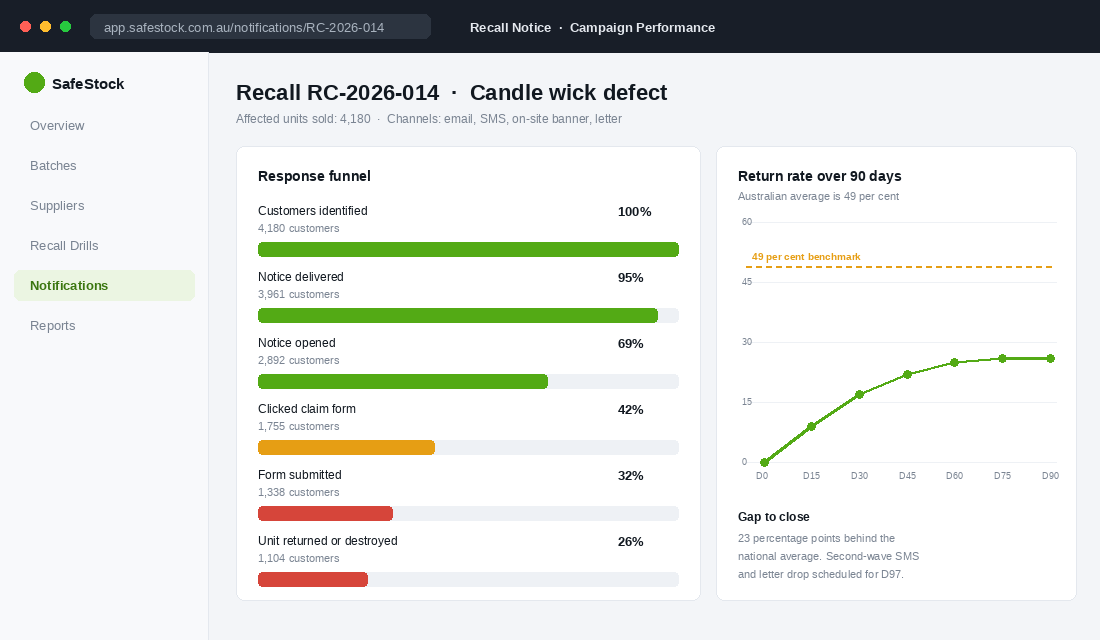
Here is where most recalls quietly fail. The OECD found the average return rate for Australian recalls, excluding motor vehicles, is 49 per cent. Half the affected product never comes back. And a single email blast will land you well below that average, because email open rates on a message people did not ask for sit in the 30 to 40 per cent range at best.
If you want to beat 49 per cent, you need overlapping channels hitting the same customer list.
The four-channel sequence
- Day 0, direct email. Plain text from a real person at the brand, not a designed template. Subject line states the product and the word “safety”, with no marketing language. Klaviyo segment built from the lot attribute, sent as a one-off campaign with all smart sending and quiet hours disabled.
- Day 0, SMS to the same segment. Short, factual, one link. SMS gets read within minutes and it catches the customers whose email address has changed or gone stale.
- Day 1, sitewide banner and a dedicated recall page. A permanent URL like yourbrand.com.au/product-safety-notice that lists affected lot codes, photos of where to find the lot code on the packaging, the hazard, what to do, and the claim form. Link it from your footer and keep it live afterwards.
- Day 7, second wave to non-responders. Re-send to everyone who has not clicked through, with a different subject line. Then at Day 14, post a physical letter to any customer whose email bounced. Australia Post letters cost a couple of dollars each and reliably lift response on high-risk recalls.
What the notice must actually say
The ACCC has a published guideline for conducting a consumer product safety recall, and the required elements are not negotiable. Your notice needs the product name and identifiers, the affected lot codes or date range with a photo showing where to find them, a clear description of the hazard and what could happen, an instruction to stop using the product immediately, the remedy on offer, and how to claim it.
What it must not contain: reassurance that dilutes the message. Lines like “out of an abundance of caution” and “in the unlikely event” reduce response rates because they tell people this probably does not matter. Say what could go wrong, plainly. A customer who understands the risk acts on it.
Phase 5: Make the Remedy Easy Enough That People Bother
Return rates are low for a boring reason: claiming is a hassle. A customer has to find the receipt, package the item, get to a post office and wait for a refund. Weighed against a low-probability hazard, plenty of people decide it is not worth the trip.
Your job is to remove every point of friction between the notice and the resolution:
- No receipt required. You already know they bought it, because you built the trace layer. Asking for proof of purchase on a safety recall is indefensible and it kills response.
- Prepaid return label or no return at all. For low-value items, ask for a photo of the product with the lot code visible, then instruct safe disposal. Getting the item out of the home is the goal, not getting it back in your warehouse.
- Refund immediately on claim, not on receipt. Waiting until the parcel arrives adds two weeks and a reason to give up.
- Offer a choice. Full refund, free replacement from a safe lot, or store credit at a premium value. Roughly speaking, the more customers who choose replacement or credit, the less the recall costs you in net revenue.
- One short form, mobile first. Order number or email, address confirmation, remedy choice. Nothing else. Every extra field costs you responses.
Handle the money honestly with yourself, too. Recall costs include the refunds, the replacement stock, the freight both ways, the destroyed inventory, the support hours and the paid media you cannot run on that product for a quarter. Model it before you commit to a remedy, using the same margin discipline you apply in the Shopify Returns Playbook.
Then look at where the cost should sit. If a supplier shipped an out-of-specification component, your purchase agreement should make them liable for the recall costs. Most Australian founders discover mid-recall that their supplier agreement says nothing about it. Fix that clause on your next order, not this one.
Phase 6: Close the Loop With a Post-Recall Audit and a Drill
A recall that ends when the returns stop coming is a recall you will repeat. The closeout is where the value is.
Run a written post-recall review inside thirty days covering five things:
- Root cause, not proximate cause. “The wick was too long” is proximate. “We accepted a substitute component without re-testing because the order was late” is root. Fix the second one.
- Detection gap. How many days between the first customer signal and your decision to act? If the answer is more than seven, your triage failed, not your product.
- Notification performance. Delivery rate, open rate, claim rate and final return rate against the 49 per cent benchmark. Which channel produced the most claims per dollar?
- Supplier consequence. Corrective action plan in writing, revised inspection regime, or a second supplier qualified. A recall with no supplier consequence is an invitation.
- Total cost. All-in, including the soft costs. This number is what justifies the prevention budget next quarter.
Then book a drill. Once a quarter, pick a random lot code and time how long it takes someone on your team to produce the full affected-customer list, the draft notice and the claim form. Target is under sixty minutes. The first time you run this you will find something broken, which is exactly the point of running it when nothing is actually wrong.
What the Brands Doing This Well Actually Look Like
Two recent Australian examples are worth studying, for opposite reasons.
Anker ran a global voluntary recall in 2025 covering power bank models A1257, A1647, A1681 and A1689 after finding a manufacturing defect in some lithium-ion cells that created a fire risk. What they did well: they published a dedicated recall page per model, listed the exact model identifiers, gave a serial-number checker so customers could self-verify in seconds, and instructed people to stop use immediately rather than softening the language. That is textbook. The context is sobering though. The ACCC has published 17 power bank recalls since 2020, nine of them in a recent sixteen-month window, with an estimated 34,000 recalled units still in circulation. Even a well-run recall by a large brand leaves a long tail.
Kmart and Target recalled several decorative sand products, including the Active Sandtub 14-piece Sand Castle Building Set, over concerns about asbestos contamination. The instructive detail is the sale window: products sold between 2015 and 2025. A decade of orders, a children’s product, and a hazard with no visible symptom. If your record keeping cannot reach back years, a recall like that becomes unbounded. Their ability to name the specific product lines and direct customers to safe disposal advice is what kept it contained.
There is a third pattern worth noting. When the LightEASE hexagonal LED lighting unit was pulled from Bunnings over live accessible parts and a non-approved power cable, the affected sale window was about five weeks. Short windows are what tight batch discipline buys you. The narrower you can define the affected units, the smaller the recall and the less trust you spend.
Worked Example: How a Perth Baby Products Brand Ran Its First Recall
Imagine you run a Perth baby-goods brand doing around $180K a month, and on a Thursday afternoon your Vietnamese supplier emails to say a batch of 1,400 silicone teethers may have a bonding fault on one mould. You have sold 860 of them across Shopify, Amazon Australia and two stockists over the past eleven weeks.
Because the trace layer existed, the next 48 hours went like this. A batch tag on the product variant pulled every affected Shopify order in four minutes. The 3PL had the remaining 540 units quarantined by 5pm on a separate bin with a red hold label. The mandatory ACCC notification went in on Friday morning, inside the two-day clock. Klaviyo sent a plain-text notice to 612 direct customers with the batch number, a photo of the mould mark, and a one-click replacement form. Amazon and both stockists got the same notice with a pull request the same day.
- Notice open rate: 71%, replacement claim rate: 58% within 14 days. Australian recall return rates average around 50%, so a plain email with a one-click form beat the national average.
- Direct cost: about $11,400 covering replacement stock, freight both ways and the 3PL handling fee. Less than 7% of one month of revenue.
- Reviews: zero one-star reviews mentioning the recall. Three five-star reviews specifically praising how it was handled.
- Supplier outcome: a $9,000 credit negotiated against the next order, because the batch records made the fault undeniable.
The founder later said the scariest part was not the fault. It was realising that without batch tags she would have had to email every customer who had ever bought a teether, which would have turned an 860-unit problem into a 6,000-customer panic.
The Recall-Ready Tool Stack (and What Each Layer Costs)
None of this requires enterprise software. It requires four layers that most Aussie brands already half-own and never connect.
- Batch capture in Shopify: a “batch” metafield on the variant plus a line-item property at fulfilment. Free with Shopify Flow, or use an inventory app such as Stocky or Prediko if you want batch-level stock counts. Budget: $0 to $100 a month.
- 3PL or warehouse hold process: a written quarantine SOP with your 3PL, tested once a year. Most Aussie 3PLs will do a batch hold in under two hours if the batch is in their WMS. If it is not, ask why. Budget: $0, one hour of your time.
- Customer notice engine: a pre-built Klaviyo campaign template in plain text, a Shopify Forms or Typeform replacement claim form, and a saved segment definition you can filter by product and date range. Budget: 90 minutes to build once.
- Records and reporting: supplier certificates of conformity, test reports and batch manifests in one shared drive folder named by SKU and batch, plus a one-page recall log template. Budget: $0. This is the layer that wins the supplier credit negotiation.
Recall readiness is downstream of supplier discipline, so if this post has exposed gaps, the supplier risk playbook covers the audit and diversification work that stops most faults reaching your customers at all. And for the compliance obligations that sit alongside recalls, from mandatory standards to labelling, the product compliance playbook is the companion piece.
The Compound Effect: Recall Readiness Is Really Supply Chain Discipline
Here is the part most founders miss. Every capability in this playbook pays off long before a recall happens.
Batch tracking tells you which production run has the higher return rate, which supplier drifts on specification, and which lot is about to expire in your 3PL. Complaint logging with lot codes surfaces quality problems months before they escalate. A supplier compliance file makes your due diligence trivial when you go looking for inventory finance or an acquirer. A quarterly drill is the cheapest ongoing test of whether your operations data is actually joined up.
Brands that build this discover their defect rates fall, because measurement changes behaviour at the supplier end. Their warranty claims get cheaper to process, because they can tell a genuine batch fault from customer misuse. Their warranty programme becomes a real trust asset rather than a liability they hope nobody uses.
And the reputational maths is stark. Australian consumers forgive a defect handled openly and quickly. They do not forgive being told nothing, then finding out from a news article. The brands that come out of a recall with their reputation intact are almost always the ones that moved fastest, said the most, and made claiming easiest. None of that is possible to improvise.
Your Recall Readiness Checklist
Work through this over the next fortnight. Most of it is a few hours of setup, not a project.
Build now, before anything goes wrong
- Batch or lot tracking live on every ingested, applied, powered or children’s SKU
- Lot code writing to the Shopify order record and syncing to Klaviyo as an event property
- Supplier compliance file per lot: test reports, certificates, specifications
- Safety tag in your helpdesk with a four-hour escalation rule and a named owner
- Recall costs and corrective-action obligations written into supplier purchase agreements
- Draft recall notice template and claim form built and stored, ready to fill in
- A permanent product-safety-notice URL that currently sits empty
Run when a signal arrives
- Four-question triage completed within 48 hours by a senior person
- ACL section 131 report lodged within two days if there is any injury, illness or fire
- Affected variants unpublished, lot frozen at the 3PL, written unit count received
- Paid media, replenishment flows, back-in-stock alerts and upsells switched off
- Marketplaces, the Shop app and stockists notified directly
- Four-channel notification sequence launched: email and SMS Day 0, banner and page Day 1, second wave Day 7, letters Day 14
- Claim process with no receipt required, refund on claim, and a remedy choice
- Return rate tracked weekly against the 49 per cent national benchmark
Close out within thirty days
- Written root cause analysis, not proximate cause
- Detection gap measured in days from first signal to decision
- Supplier corrective action agreed in writing
- Total recall cost calculated including soft costs
- Next quarterly recall drill booked in the calendar
Start With the Trace Layer
If you only do one thing from this article, make it batch tracking on your highest-risk SKUs. Everything else in the playbook depends on being able to answer “which customers got the affected units” in minutes rather than weeks.
Most Australian founders will never run a full recall. But almost all of them will get that Friday afternoon email from a supplier at some point, and the difference between a contained problem and an existential one is decided by work you did months earlier.
Inside eCommerce Circle, product protection is one of the ten pillars we work on with every member, and recall readiness is usually the first gap we find in a growing physical-product brand. If you want a second opinion on yours, let’s talk.