Most Aussie founders try podcast advertising exactly once. They sponsor a show they personally listen to, hand over four or five grand, wait a fortnight, check the promo code report, see eleven redemptions, and quietly decide podcasts do not work for ecommerce.
What’s in This Article
That is not a channel failure. That is a measurement failure wrapped around a buying failure. Podscribe’s benchmark data found that pixel-based attribution uncovers roughly seven times more conversions than surveys and more than four times more than promo codes. If your only counting method is the code, you are looking at a quarter of the result and calling it the whole result.
Meanwhile the channel keeps getting bigger underneath you. Australian podcast advertising revenue reached $134 million in 2025, growing 13.5% year on year, more than double the growth rate of streaming audio. There are now 9.6 million monthly podcast listeners in Australia, about 47% of everyone aged 15 and over. And 69% of Australian advertisers told IAB they plan to increase podcast investment in 2026. Your competitors are working out how to buy this properly. Here is the system.
Why Podcast Ads Break Every Habit You Learned on Meta
On Meta you buy an auction. You set a budget, the algorithm finds people, and you can kill a bad ad set in 48 hours. Podcast advertising is the opposite on every axis. You buy inventory in advance, you cannot optimise mid-flight, and the person hearing your ad usually cannot click anything because they are driving, walking the dog or doing the dishes.
What you get in exchange is borrowed trust. Nielsen’s 2025 podcast ad effectiveness research found host-read ads produce 68% higher brand recall than pre-recorded spots. Podtrac’s work found listeners are 4.5 times more likely to take action after a host-read ad than after a standard produced spot. The host is not reading your copy, they are lending you their relationship with the audience.
That changes what a good outcome looks like. A podcast flight does not produce a clean same-day ROAS. It produces a lift in branded search, a bump in direct traffic, a slow rise in your post-purchase survey mentions, and a promo code number that badly understates all of it. If you are not set up to see those four things together, do not buy the spot yet.
Step 1: Pass the Readiness Gate Before You Spend a Dollar
Podcast advertising punishes brands that are not ready for it. You are buying awareness at the top of the funnel and asking a stranger to remember a URL. If anything downstream leaks, you will never see the money come back.
Run these four checks before you contact a single network:
- Contribution margin above sixty dollars per order. At Australian CPMs of $35 to $70 you need real margin per order to survive a 60 to 90 day payback. Thin margin plus slow attribution is how founders talk themselves out of a channel that was working.
- A brand name people can spell after hearing it once. Say your domain out loud in a noisy car. If it needs spelling, buy a vanity redirect that does not.
- A landing page that matches the promise. Sending podcast listeners to your homepage wastes the trust the host just handed you. Build a dedicated page that repeats the host’s framing in the first line.
- At least three months of clean baseline data. You cannot measure lift without a before. Branded search sessions, direct traffic and post-purchase survey mix all need a stable pre-flight reading.
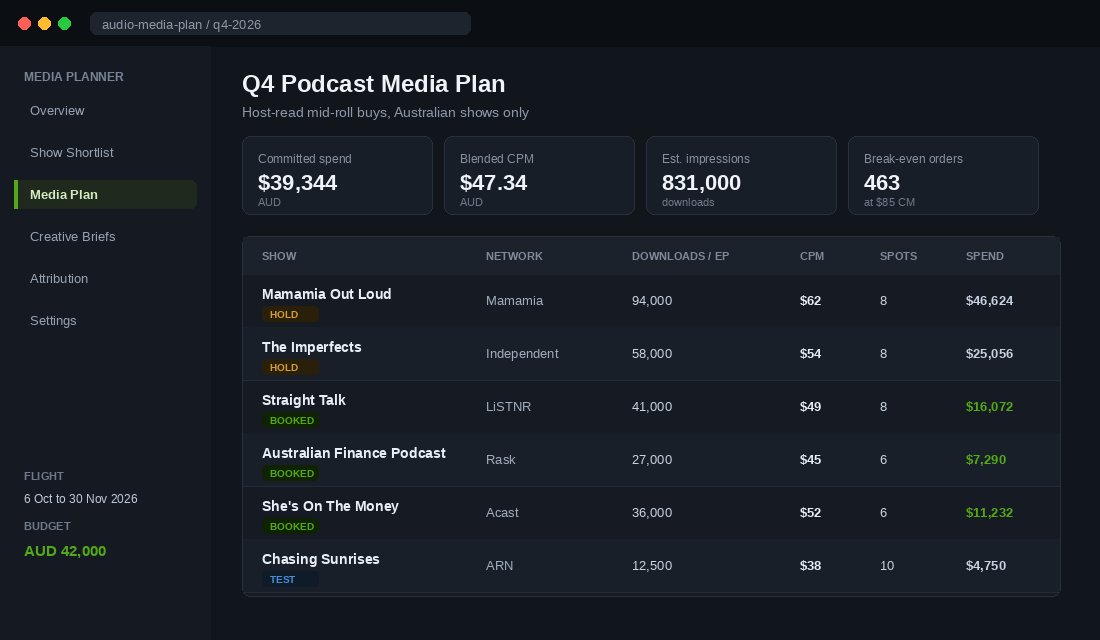
The budget floor matters too. A single episode sponsorship tells you nothing. Plan a minimum viable flight of four to six episodes on two or three shows, which in practice means $12,000 to $20,000 AUD before you have anything worth reading. If that number makes you flinch, the honest answer is to spend it somewhere else this quarter and revisit when margin allows.
Step 2: Build the Shortlist From Audience Overlap, Not Download Counts
The biggest mistake in the shortlist stage is buying the show at the top of the Australian Podcast Ranker because it is the biggest. Big shows carry big CPMs, heavy ad loads and audiences that only partially overlap with your buyer.
Score every candidate show out of 100 across four dimensions, and refuse to buy anything under 70:
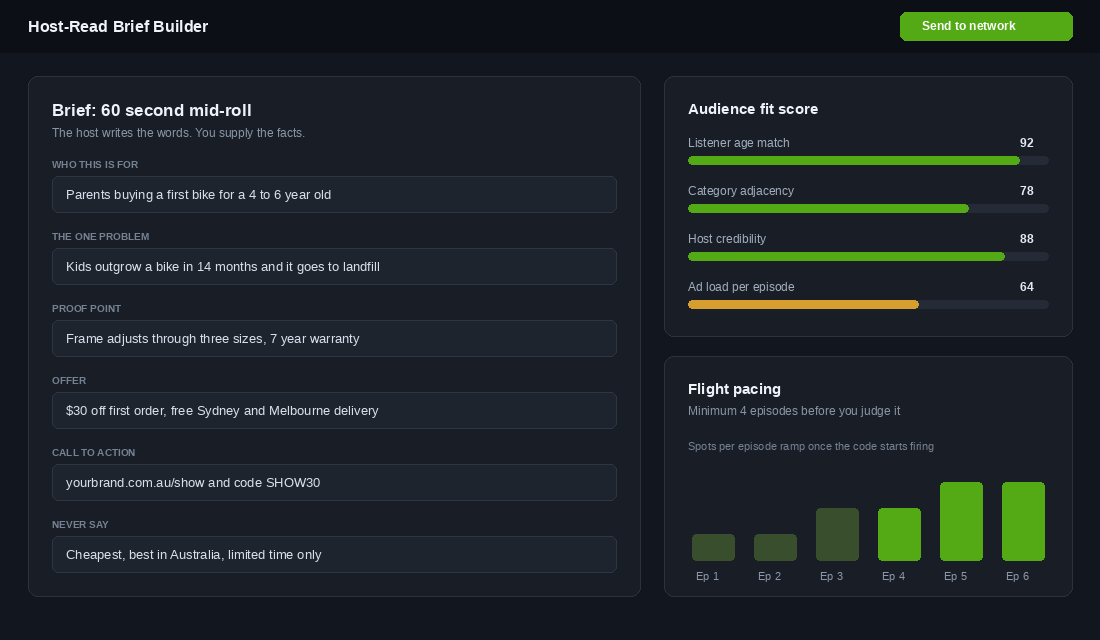
- Listener age and life stage match. Pull your own buyer profile first. A kids bike brand wants parents of four to six year olds, not “people aged 25 to 54”.
- Category adjacency. The best performing shows are adjacent, not identical. A sleep brand does better on a parenting or wellbeing show than on a mattress review podcast, because there is no comparison shopping happening in the listener’s head.
- Host credibility on your topic. Can this host talk about your product without it sounding like a read? If the host has never mentioned your category unprompted, expect a flat delivery.
- Ad load per episode. Count the spots in the last three episodes. Six or more advertisers per episode means your 60 seconds is competing with a wall of noise.
Do the listening work yourself. Play three recent episodes of each shortlisted show at full length, including the ads, and note which advertisers keep coming back month after month. Repeat advertisers are the strongest possible signal that a show converts, because nobody renews a spot that lost money.
Who Gives A Crap, the Melbourne-founded recycled paper brand, built a large part of its early awareness on host-read segments across shows like The Guilty Feminist and Off Menu. The pattern is instructive. None of those shows are about toilet paper. They are about audiences who care about the values the brand leads with.
Step 3: Negotiate the Buy Like a Media Planner, Not a Fan
Podcast inventory in Australia is sold on CPM, cost per thousand downloads. Established Australian shows doing 10,000 or more downloads per episode typically run $35 to $70 AUD CPM for host-read placements, with $50 to $70 common for a 60 second mid-roll on a popular show. Acast’s self-serve guide sits around the $25 to $40 mark for broader buys. Business and finance shows sit at the top of the range because the audience is expensive to reach anywhere else.
Five things to push on before you sign:
- Mid-roll over pre-roll, always. Pre-roll is where listeners skip. Mid-roll sits inside the episode where skipping costs them content. Pay the premium.
- Sixty seconds, not thirty. Thirty seconds forces the host into a rushed read of your copy. Sixty gives them room for a personal anecdote, which is the entire reason you are buying host-read.
- A flight, not a spot. Negotiate four to eight episodes minimum on one show. Frequency is what converts. A single insertion is a coin flip you paid full price for.
- Category exclusivity for the flight. Cheap to ask for, expensive to skip. You do not want your competitor read out two episodes later.
- Make-goods in writing. If the host mangles the code or the episode drops without your read, you want free replacement inventory, not an apology.
Ask for the last three months of average downloads per episode, measured at the IAB 2.0 standard, not total lifetime downloads for the show. Lifetime numbers are how inflated CPMs get justified. If a network will not share episode-level averages, that is your answer on how the rest of the relationship will go.
Step 4: Write the Brief, Never the Script
This is where most founders destroy their own campaign. They send 200 words of polished brand copy and ask the host to read it verbatim. The host complies, the delivery goes flat, and the brand pays a host-read premium for a produced spot.
Send a brief instead. Six fields, one page, no more:
- Who this is for. One sentence describing the listener you want to reach, in plain language the host can restate.
- The one problem. A single pain point, stated concretely. “Kids outgrow a bike in 14 months and it goes to landfill” beats “sustainable, high-quality kids bikes”.
- The proof point. One specific, checkable fact. A warranty length, a materials claim, a number of customers.
- The offer. Simple enough to say once. A flat dollar amount off beats a percentage, and free delivery beats both if you can carry it.
- The call to action. One vanity URL and one code, both easy to say. Repeat them once at the top of the read and once at the end.
- Never say. Your legal and brand guardrails. Under Australian Consumer Law, claims made by a host on your behalf are still your claims, so this field is not optional.
Then send the product. Actually ship it, at least two weeks before the first read, and to the host personally. Interview-style integrations where the host has genuinely used the product achieve the highest response rates in the research, in the range of 6 to 11%, because the host has something real to say. A host who has never touched your product will read your brief. A host who unpacked it on the weekend will talk about it.
HelloFresh has run the same structure across Australian podcasts for years. Different hosts, different shows, same skeleton every time: a personal cooking story, one problem, one offer, one code. That repetition is not laziness. It is a brief that works being reused across a network.
Step 5: Install Measurement Before the First Spot Airs
You need four measurement layers running before episode one drops. Set them up after the flight and you have wasted the spend, because there is no baseline to compare against.
- Pixel attribution. Install the network’s tracking pixel, whether that is Spotify Ad Analytics, Podscribe or Claritas. The pixel fires when an exposed device visits your site within the attribution window, typically 30 days, whether or not they clicked. This is the only layer that catches the listener who heard your ad on Tuesday and searched your brand on Sunday.
- A vanity URL per show. yourbrand.com.au/showname, redirecting to the dedicated landing page with UTMs attached. One per show, never shared, so you can separate performance.
- A unique promo code per show. Under-counts, but it is a clean floor number and it gives the host something concrete to say.
- A post-purchase survey question. Add “podcast” as an explicit option with a free text field. This is your only route to the listener who never clicked anything and typed your name straight into Google.
If you have not built the survey layer yet, start there before you spend on audio. Our post-purchase survey playbook walks through the exact question set, and it becomes the backbone of measurement for every channel that does not click.
Also snapshot your baseline manually. Weekly branded search sessions from Search Console, weekly direct traffic sessions from GA4, and the current split of your post-purchase survey answers. Save the numbers for the eight weeks before the flight. You will need them in step six and you will not be able to reconstruct them later.
Step 6: Read the Results With the Right Multiplier
Here is where the discipline pays off. You now have four numbers that disagree with each other, and the temptation is to pick the one that supports the decision you already wanted to make.
Read them in this order:
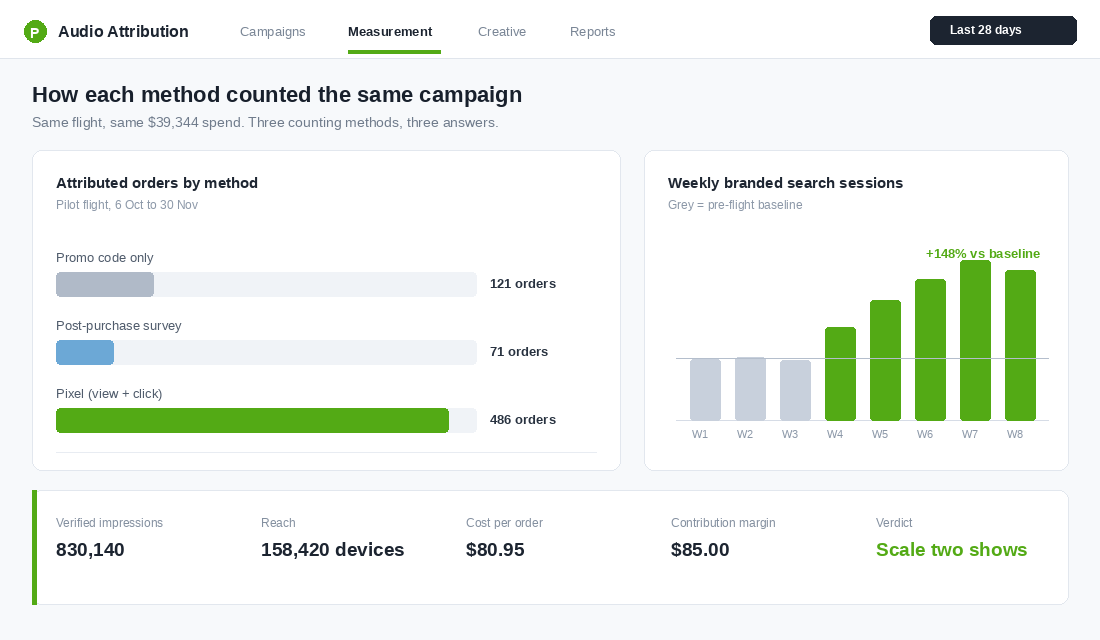
- Promo code redemptions are your floor. Whatever this number is, the real number is higher. Never make a kill decision on this alone.
- Pixel conversions are your working number. Expect it to land at roughly three to five times the promo code count based on the published benchmarks. Sanity check it against total site orders in the window so you are not double counting.
- Branded search lift is your reality check. Compare weekly branded search sessions during the flight to your eight week pre-flight baseline. If the pixel says the campaign worked and branded search did not move at all, be sceptical of the pixel.
- Survey mentions are your slow signal. Podcast mentions in your post-purchase survey will keep climbing for four to six weeks after the last episode airs. Do not close the books early.
Then judge the whole flight, not the individual episode. Podcast spend belongs in your blended efficiency view, not in a channel silo. If you have already built a marketing efficiency ratio, add podcast spend to the numerator and watch what happens to total revenue over the flight plus 30 days. Our marketing efficiency ratio framework covers the maths, and it is the fairest way to assess a channel that does not report its own conversions honestly.
If the flight is big enough to matter, the strongest evidence available is a holdout. Run the same creative on comparable shows in two states and not in two others, then compare revenue per capita across the geographies. Our incrementality playbook sets out the geo holdout method in detail, and it is the only approach that answers the question every founder is actually asking, which is whether these orders would have happened anyway.
Step 7: Decide to Scale, Hold or Kill
Write the decision rules before the flight starts, while you are still objective. Once the invoices land and the host has been lovely to deal with, your judgement is compromised.
- Scale when pixel-attributed cost per order sits below your contribution margin per order, and branded search lifted at least 20% against baseline. Increase spots per episode on that show before you add a new show. Depth beats breadth in audio.
- Hold and re-brief when the pixel numbers are close but the branded search lift is flat. That is usually a creative problem, not a show problem. Change the offer or the opening line and buy four more episodes on the same show.
- Kill when cost per order exceeds contribution margin and branded search did not move across the full flight plus 30 days. Kill the show, not the channel. One bad show does not indict podcast advertising any more than one bad ad set indicts Meta.
When a show works, lock it in for a season. Long-run sponsorships get better rates, better placement and, most importantly, better reads, because the host stops treating you as a client and starts treating you as something they use. That familiarity is what drives frequency-based recall in audio.
Why the Seven Steps Compound
Look at what each step actually buys you. The readiness gate stops you burning cash on a channel your margin cannot support. The shortlist scoring means the audience you reach is already predisposed to your product. The negotiation means you are paying for mid-roll frequency instead of skippable pre-roll. The brief means the host sounds like themselves. The measurement means you can see what happened. The multipliers mean you read it honestly. The decision rules mean you act on it fast.
Skip any one of those and the whole thing collapses into the story we started with. Great show, bad brief, no pixel, eleven promo codes, channel written off. The seven steps are not seven optional improvements. They are one system where the weakest link sets the result.
There is a second compounding effect worth naming. Audio builds an asset that outlives the flight. Every listener who heard a trusted host describe your product is now a person who recognises your name in a Meta feed, in a search result and on a shelf. That recognition shows up as cheaper paid social, higher branded search volume and better email opt-in rates months later. Podcast advertising sits in exactly the same family as newsletter sponsorships: you are renting somebody else’s trust, and the trust keeps paying after the invoice clears.
The Podcast Ad Checklist
Copy this into your planning doc and work top to bottom. Do not skip ahead.
- Readiness gate. Contribution margin above sixty dollars, sayable brand name, dedicated landing page, three months of clean baseline data, minimum flight budget of twelve thousand.
- Shortlist. Score six to ten shows on age match, category adjacency, host credibility and ad load. Buy nothing under 70. Listen to three full episodes each and note the repeat advertisers.
- Negotiate. Mid-roll, 60 seconds, four to eight episode flight, category exclusivity, make-goods in writing, episode-level download averages at IAB 2.0.
- Brief. Six fields on one page. Who it is for, the one problem, the proof point, the offer, the call to action, the never-say list. Ship the product two weeks early.
- Measure. Pixel installed, vanity URL per show, unique code per show, post-purchase survey option live, eight week baseline saved.
- Read. Code is the floor, pixel is the working number, branded search is the reality check, survey mentions are the slow signal. Judge at flight plus 30 days.
- Decide. Scale, hold and re-brief, or kill the show. Write the thresholds before the first episode airs.
The Australian audio market is still small enough that a disciplined operator can buy genuinely under-priced attention. Digital audio ad spend hit $339 million across the 2025 calendar year, up 8.2%, and measurement gaps remain the single biggest brake on the channel. That gap is the opportunity. Brands that measure properly are buying inventory that other brands have talked themselves out of.
How Often to Refresh the Read Before It Goes Stale
Podcast creative does not fatigue the way Meta creative does, and founders who apply Meta instincts here burn money twice. First by changing the read too early, then by leaving it far too long once they stop paying attention.
The reason is repetition. A listener needs to hear the same brand three to five times before the name sticks. Swap the angle every fortnight and you reset that counter every time. The host also gets better at the read by week three, which is usually when response rates peak rather than dip.
The working cadence for Australian shows looks like this. Hold the same core angle for six to eight weeks. Refresh the opening hook and the offer at around week eight while keeping the product claim identical. Change the underlying angle entirely at roughly week sixteen, or sooner if you see promo code redemptions drop more than 30% across two consecutive fortnights on flat delivery.
One thing worth knowing about mid-roll ads: they keep working after the campaign ends. Between 20 and 35% of listens on an evergreen show happen more than 30 days after publication, so a spot bought in September is still being heard in November. Build that tail into your payback window rather than judging the buy at day 30.
What to Do When a Show Actually Works
Finding a show that pays back is rarer than founders expect. Roughly one in four shows on a well-built shortlist will clear your target. When one does, most brands under-invest in it and go hunting for the next show instead.
Scale the winner in this order.
- Buy more of the same inventory before you buy anything new. Move from one spot a fortnight to weekly on the same show. Same audience, proven response, no new variables.
- Move from mid-roll to a host-read pre-roll plus mid-roll combination. Expect 15 to 25% more response for roughly 40% more cost, so check the maths on your own numbers before committing.
- Lock a longer term for a better rate. A 13-week commitment typically buys 20 to 30% off rate card in the Australian market, and gives the host reason to care about your results.
- Ask about the network’s similar shows. If a show sits inside a network such as LiSTNR, Acast or Nova Entertainment, the sales rep can point you at the two or three shows with the closest audience overlap. That beats guessing from download charts.
- Only then test a new show. Keep the winner running while you test. Never move budget off a proven show to fund an experiment.
Keep a vanity URL and a unique promo code per show for the life of the relationship, even after you have proved it works. The moment you consolidate codes you lose the ability to tell which show is carrying the result, and six months later you will be renewing a contract on a hunch.
Budget honestly before you start. A meaningful Australian podcast test needs $8,000 to $15,000 across eight to twelve weeks on two or three shows. Anything under about $5,000 will not generate enough signal to make a decision, and you will end up concluding the channel does not work when what actually happened is you never gave it enough data to read. That is the same trap founders fall into with newsletter sponsorships, and the fix is identical: fewer bets, funded properly, measured over a realistic window.
Inside eCommerce Circle, channel discipline like this is one of the core pillars we work on with every member. If you want a second opinion on where your next dollar of awareness spend should go, let’s talk.