Most Aussie Shopify brands treat November as one event. They block out the last week of the month, build a Black Friday offer, and hope the rest of the month behaves itself. Then Click Frenzy runs on the second week, their competitors go loud, sessions spike, and they either scramble to put something together in 48 hours or watch the traffic go somewhere else.
What’s in This Article
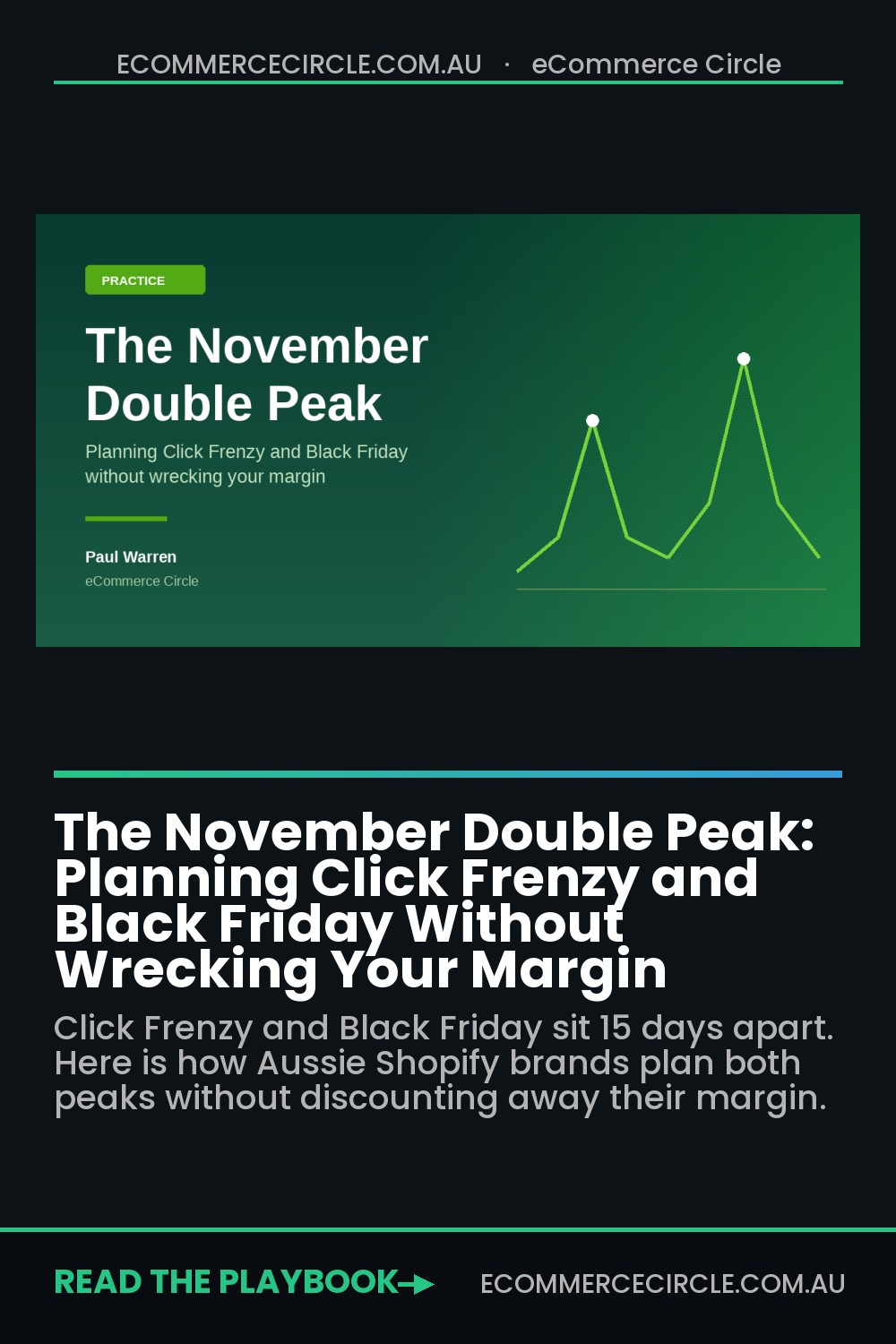
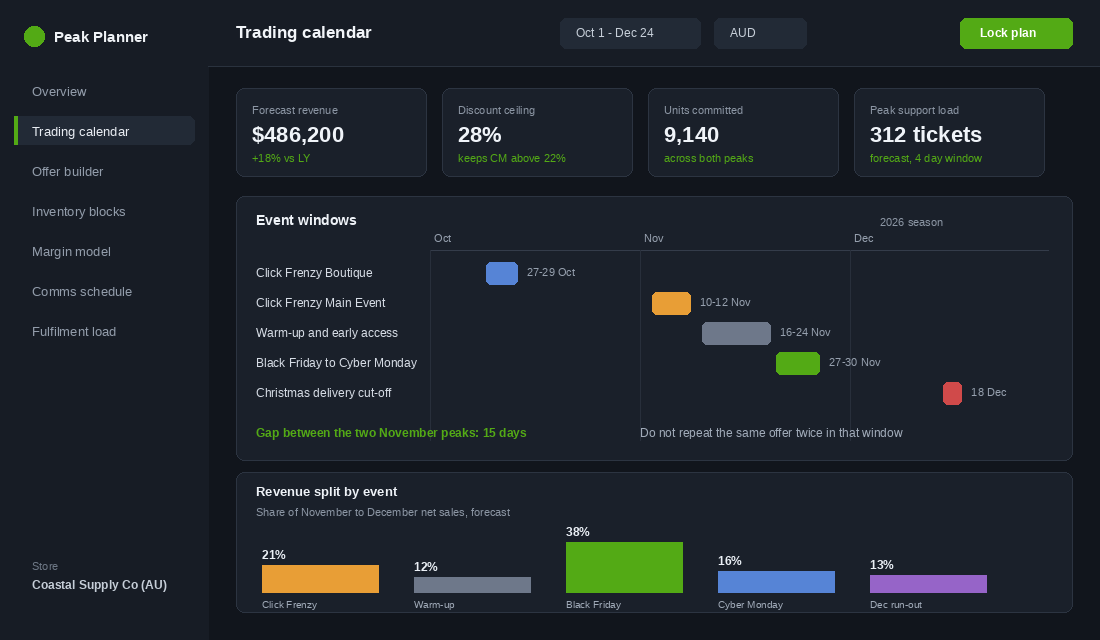
November is not one peak. It is two, sitting about 15 days apart, and each one pulls a different type of buyer. The Australian Retailers Association and Roy Morgan put the Black Friday to Cyber Monday weekend at a record $6.8 billion in 2025, up 4% year on year, with around 6 million Australians taking part and average planned spend of $804 per person. Click Frenzy’s Main Event lands two weeks earlier and is online only, which means it competes directly for the same discretionary dollar before the big one even starts.
Brands that plan both peaks together protect their margin. Brands that plan one and react to the other discount twice, on the same products, to the same list, and end November with more revenue and less profit than the year before. This is the planning process I run with founders inside eCommerce Circle, and it starts in August, not in the second week of November.
Australia Has Two November Peaks, Not One
Write the real dates on a wall before you write a single offer. For 2026 the shape of the month looks like this:
- Click Frenzy Boutique, late October. Smaller, skewed to designer fashion and beauty. A useful test event if your average order value sits above $150.
- Click Frenzy Main Event, around 10 to 12 November. The headline online-only event. In 2025 it ran Tuesday 11 to Friday 14 November. Members get a 30 minute head start, which matters if your offer depends on limited stock.
- Singles Day, 11 November. Not a big driver for most Australian DTC brands, but it overlaps Click Frenzy and lifts marketplace competition for ad inventory.
- Black Friday, Friday 27 November. The main event. Around 35% of November to December sales now land inside this four day window for most retailers.
- Cyber Monday, Monday 30 November. Increasingly just day four of the same sale rather than a separate event.
- Australia Post Christmas cut-offs, mid to late December. Confirm the published dates the moment Auspost releases them, then work backwards to your last promotable day.
The trend that changes your plan is timing. Retail analysts at Style Arcade tracked widespread discounting starting from October in 2025, with the season now behaving more like Black November than a single weekend. David Jones, Bing Lee and Lenovo all had Black Friday pricing live in early November. If your plan is to hold full price until 27 November and then go hard, you are competing against a market that started three weeks earlier.
That does not mean you have to join the October land grab. It means you need to decide, on purpose, which of the two peaks you are actually playing to win, and what the other one is for.
Work Out Your Discount Ceiling Before You Pick a Date
The single most expensive mistake in November is picking the discount first and checking the maths later. Headline offers from the big retailers usually sit between 20% and 50% off, and it is very easy to look at that range and assume you need to match it.
You do not. You need to know your discount ceiling, which is the deepest discount you can run while still holding an acceptable contribution margin after cost of goods, pick and pack, freight, and payment fees. Build it in a spreadsheet in 20 minutes:
- Start with your real full price average order value. Not your list price. Your actual AOV over the last 90 days.
- Subtract landed cost of goods for a typical basket, including inbound freight and duty.
- Subtract fulfilment. Pick, pack, satchel or carton, and the outbound shipping you actually pay after any customer contribution.
- Subtract payment and platform fees. Around 1.7% to 2.2% for most Aussie Shopify stores once you blend card, Afterpay and PayPal.
- Apply your return rate as a haircut on the contribution, not on revenue. A 9% return rate on apparel does more damage than most founders model.
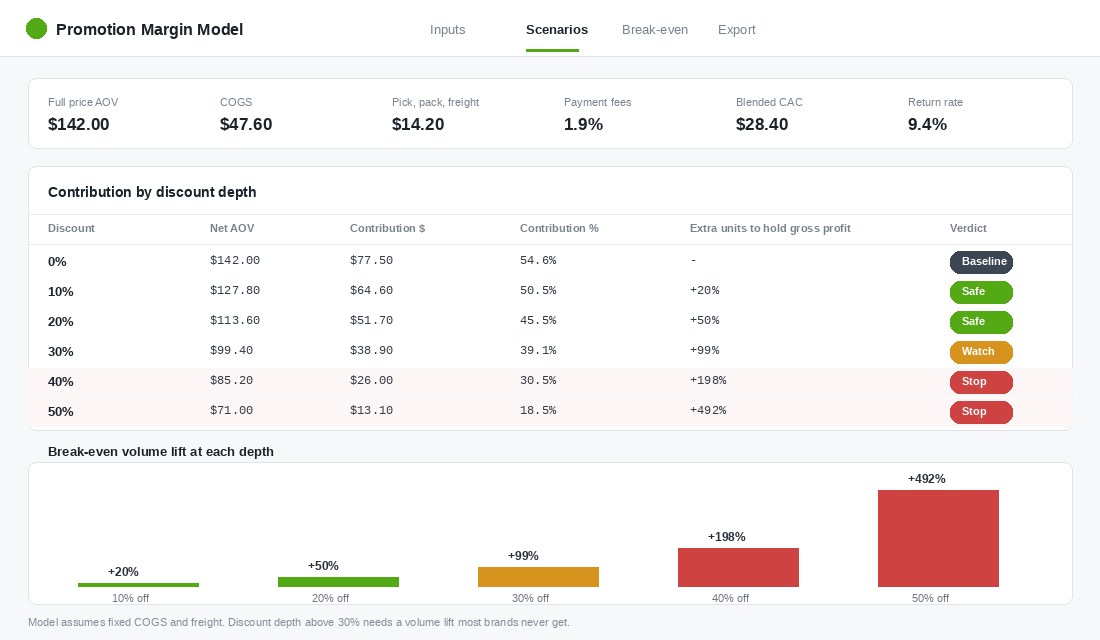
What you are left with is contribution dollars per order before acquisition cost. Now run it at 10%, 20%, 30%, 40% and 50% off and look at what happens to the volume you need. On a store with a $142 AOV and 54% contribution, a 20% discount needs roughly 50% more orders just to hold the same gross profit. A 40% discount needs almost triple. A 50% discount needs close to five times the volume, which no ad account in this country delivers in a four day window.
One analysis of Australian apparel brands found that if a 25% discount pushes your net margin below 15%, participation in deep-discount November stops making sense, and that more than 20% of high-margin Australian apparel brands make more net profit by skipping November discounting entirely. That is a real strategic option, not a cop-out. If you want the full method behind these numbers, work through our contribution margin audit first.
Two Peaks Need Two Different Offers
If you run 25% off sitewide at Click Frenzy and then 25% off sitewide at Black Friday, you have trained your list to wait, cannibalised your own peak, and handed away margin on customers who were going to buy anyway. Fifteen days is not long enough for a customer to forget.
Give each peak a different job and a different offer shape:
- Click Frenzy is your acquisition and clearance peak. Deal-site traffic is cold, price-led, and comparison-shopping. Use bundles, sets, and end-of-line stock. A bundle at an effective 22% off protects your headline price on hero lines while still reading as a real deal.
- Black Friday is your list and hero-product peak. This is where your best customers spend. A tiered sitewide offer, gift with purchase, or spend threshold works because your audience already trusts the brand.
- Never discount the same SKUs at both. Split your catalogue. Clearance and bundles in November week two, hero products and tiers in week four.
- Protect your entry product. If your $49 starter product is your best acquisition asset all year, do not discount it to $29 twice in a fortnight. You will spend Q1 selling a $29 product.
Look at how Australian brands actually play this. July runs a dedicated Black Friday landing page each year and concentrates its discounting there rather than spreading it thin across the month. Bed Threads caps its Black Friday depth at up to 20% off and leans on the range and gifting angle rather than going deeper. Who Gives A Crap sits at the other end and does not run traditional sale events at all, using the moment for a brand campaign instead. All three are defensible. What is not defensible is having no position and reacting to whatever your competitor posts on Instagram.
Write your position in one sentence in August and stick it on the wall. “We run bundles at Click Frenzy and a 3 tier spend threshold at Black Friday, and we do not go past 25% on hero lines.” That sentence saves you five arguments in November.
Split Your Inventory in Units, Not Dollars
Most peak inventory plans are built in dollars, which hides the problem. You need to plan in units per SKU per event, because the failure mode is running out of your best seller on day two of Click Frenzy and having nothing to promote on Black Friday except the sizes nobody wants.
A workable split for a brand that expects both peaks to fire:
- Ring-fence 55 to 60% of peak units for the Black Friday window. It is the larger event and the one with the highest full-margin mix.
- Allocate 20 to 25% to Click Frenzy, weighted towards bundles and slow movers you want cleared before Christmas freight rates climb.
- Hold 15 to 20% back for the December run-out, which is the highest margin selling window of the year because most competitors have already emptied their shelves and stopped discounting.
- Set a hard cut-off per SKU inside Shopify, using inventory locations or a dedicated bundle SKU so the Click Frenzy allocation physically cannot eat the Black Friday plan.
The December run-out is the part people forget. Australia Post delivered almost 111 million parcels across November and December in its busiest festive period on record, and a meaningful share of that volume lands after the discounting has stopped. If you sell your entire buy at 30% off in November, you have given away the best margin weeks of your year. Our BFCM inventory planning playbook covers the forecasting side of this in detail.
Is Click Frenzy Worth It For Your Brand? Run This Test
Click Frenzy is a directory event. Shoppers browse deals on the Click Frenzy site, shortlist favourites, then click through to your store to buy. Retailers register to be listed and do not need to be in an affiliate program to take part. Registration terms move around: for the June 2026 EOFY event, the first 500 retailers to register did so for free.
That model suits some brands and wastes money for others. Run these five checks before you commit:
- Is your category comparison friendly? Homewares, electronics, beauty and fashion do well. Considered, education-led purchases do not convert on a deal directory.
- Can you hit the depth without breaching your ceiling? If a listing effectively requires 30% off and your ceiling is 22%, walk away or list a bundle instead.
- What is your break-even order count? Take the participation cost plus the incremental discount cost, divide by contribution per order. If you need 400 orders to break even and your best day ever is 180, that is your answer.
- Can you tag the traffic properly? Set a dedicated UTM on your listing URL and a discount code unique to the event. Without both, you will never know whether it worked.
- Do the customers come back? Deal-site buyers repeat at a lower rate than list buyers. Measure 90 day repeat rate on the cohort, not just first order revenue.
If three or more of those checks fail, skip the paid listing and run your own event during the same window. The demand is in the market either way. Three in four Australians say they now wait for sales events before buying, so the traffic exists whether or not you pay to be on a directory.
Stress Test the Store for Two Spikes, Not One
Two peaks means two chances to fall over. Australia Post recorded a 6.3% year on year jump in parcel volumes across Black Friday and Cyber Monday, with its busiest delivery day on record at more than 5.8 million parcels in a single day. Roughly $1.5 billion was spent online during the four day cyber window, with 3.1 million Australian households taking part, up 9.2% year on year. That load lands on your theme, your apps, your 3PL and your inbox at the same time.
- Run a Lighthouse check on your busiest template in October, then remove or defer any app script that is not directly earning revenue. Peak traffic exposes every render-blocking script you have been ignoring.
- Test the discount logic in a draft order, including stacking, combinations, gift cards and Afterpay. Broken discount combinations are the number one support ticket generator in peak week.
- Freeze the theme. No code changes from a week before Click Frenzy until December, other than emergency fixes. Every change during peak is an unplanned risk.
- Brief your 3PL in writing with unit forecasts per week, not a total. They staff to your weekly numbers, not your monthly ones.
- Forecast support volume. A four day peak typically generates two to three times normal ticket volume. Write your macros for “where is my order”, “can I use two codes” and “will it arrive before Christmas” before you need them.
The Six Week Comms Plan
Your email and SMS calendar should be locked by the end of October. Sending more is not the goal. Sending in a sequence that builds intent, then rewards your best customers first, is the goal.
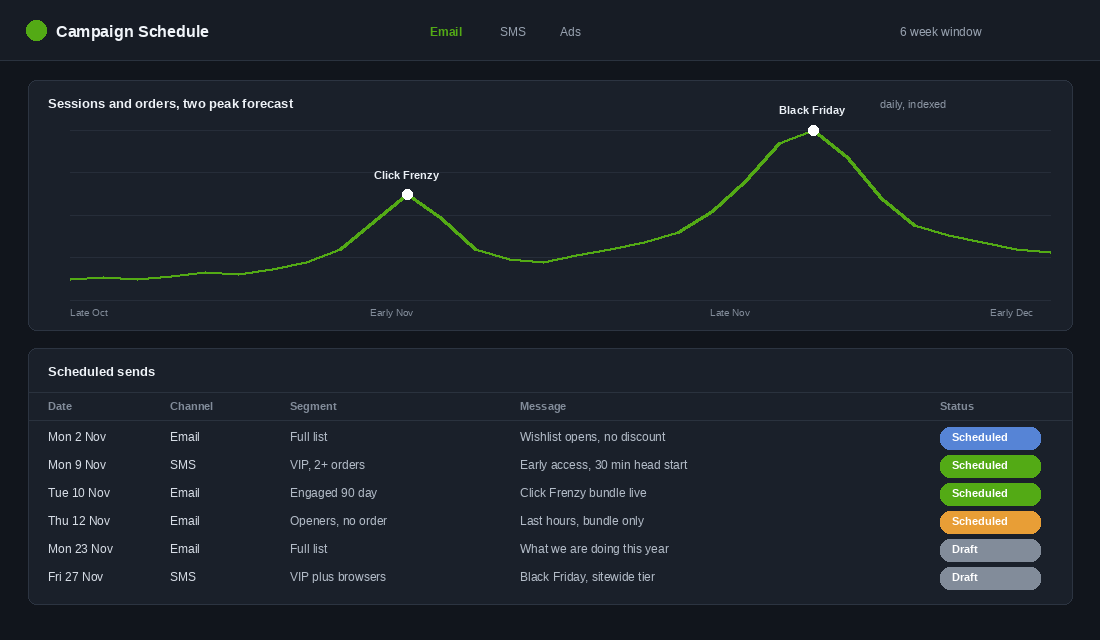
- Week 1, late October. No discount. Wishlist or “add to favourites” campaign. This gives you a high-intent segment to hit on both peaks.
- Week 2, early November. Gift guide or edit. Still full price. Build the browse and click data your ad retargeting will need.
- Week 3, Click Frenzy. SMS early access to VIPs with a real head start, then the main email on day one and a short “last hours” send on the final day. Keep it to three sends.
- Week 4, the quiet week. Deliberately no offer. Content, restock notifications and a single “here is what we are doing this year” email that pre-frames your Black Friday position.
- Week 5, Black Friday to Cyber Monday. VIP early access Thursday evening, launch Friday morning, mid-sale reminder Saturday, final call Monday night. Four sends, tightly segmented.
- Week 6, December. Shipping cut-off urgency and gifting. No discount required. This is where the margin is.
Segment ruthlessly. Suppress anyone who bought in the last 7 days from the follow-up sends, and hold your unengaged 12 month segment back until day two so you do not tank deliverability at the worst possible moment. Our discount discipline framework covers how to structure the tiers themselves.
Automate the Switch-On With Shopify Flow
The most common November failure is human. Someone forgets to publish the discount at 9am, or forgets to turn it off at midnight, and you either lose the first three hours or give away another day of margin. Shopify Flow, free on Shopify and Shopify Plus, removes that risk. Set it up in October:
- Install Shopify Flow from the Shopify App Store and open Flow from your admin sidebar.
- Create your automatic discounts first, in Discounts, with exact start and end date-times in your store’s timezone. Set the combination rules explicitly so shipping and product discounts do not stack unless you want them to.
- Build a scheduled workflow using the Scheduled Time trigger. Set it to run once at your launch time, then add a Tag Products action to apply a “clickfrenzy” or “bfcm” tag to the collection you are promoting.
- Add a second scheduled workflow to reverse it at the end time, removing the tag. Your sale collection should be built as an automated collection driven by that tag, so publishing and unpublishing the sale is one flip.
- Add a low stock guard. Trigger on Inventory Quantity Changed, condition inventory less than your safety threshold, action send an internal email and unpublish the product. This is what stops you overselling your hero SKU during a spike.
- Test the whole thing in the last week of October by setting the schedule an hour ahead and watching it fire on a single test product.
Pair it with a Klaviyo flow that suppresses sale emails to anyone who purchased in the previous 48 hours, and your November runs itself while you deal with the things that actually need a human.
How the Two Peaks Compound
Here is why planning both together beats treating them as separate campaigns. Click Frenzy brings in cold, price-led buyers at a lower contribution per order. On its own that looks like a mediocre event. But those buyers enter your list, get tagged, and become the retargeting pool and the early-access segment for Black Friday two weeks later, where they buy at a shallower discount because they now know the brand.
Meanwhile the wishlist campaign you ran in late October, with no discount attached, hands you a high-intent segment that converts on both peaks at a fraction of your usual acquisition cost. And the inventory you deliberately held back sells through in December at full price to shoppers who missed the sales, because Australia Post volumes stay high well past Cyber Monday.
Globally, Shopify merchants did $14.6 billion over BFCM in 2025, up 27%, across 81 million shoppers, with an average order value a little over $114. The brands taking a disproportionate share of that were not the ones discounting hardest. They were the ones with a plan that had a start, a middle and a deliberate end.
The November Double Peak Planner
Copy this into a doc and fill it in before the end of September. If you cannot answer every line, you are not ready to trade November.
- Discount ceiling. The deepest percentage you can run while holding contribution above your floor. One number.
- Click Frenzy position. In or out. If in, paid listing or your own event, and which offer shape.
- Black Friday position. Offer shape, depth, and which SKUs are excluded.
- SKU split. Which products discount at peak one, which at peak two, which never.
- Unit allocation. Percentage of peak inventory locked to each of the three windows including December.
- Comms calendar. Every send, date, segment and suppression rule, scheduled by 31 October.
- Automation. Flow workflows built and tested, discount combinations verified in a draft order.
- Ops brief. Weekly unit forecast sent to your 3PL, support macros written, theme freeze date set.
- Measurement. Unique UTM and discount code per event, plus a 90 day repeat rate check on each cohort in March.
The brands that finish November with profit rather than just revenue are almost always the ones who made these decisions in August, when nobody was panicking and nobody was watching a competitor’s Instagram story.
Inside eCommerce Circle, peak season planning is one of the core pillars we work on with every member, and this is the exact planner we build together in our workshop. If you want a second opinion on your November before you commit the inventory, let’s talk.