If you sell anything with a date on it, you are running two clocks at once. One is the sales clock everyone watches: orders, ROAS, conversion rate. The other is the expiry clock nobody watches until a pallet of protein powder, serum or dog treats quietly turns into landfill.
What’s in This Article
Most Aussie founders treat expiry as a warehouse problem. They buy stock on the same 12-week forecast they would use for a t-shirt, let the 3PL pick whichever carton is closest to the door, and find out about the short-dated stock when a customer emails a photo of a “best before” that passed last month.
The brands that get this right treat shelf life as a Profit lever, not a compliance chore. They know the remaining shelf life of every batch in the building, they have a markdown plan that kicks in at 120 days rather than 20, and they turn short-dated stock into cash instead of a 100% write-off. Industry estimates put supplement write-offs at 10 to 18% of inventory value. On a $400k stockholding that is $40k to $72k a year walking out the back door. Here is the system to stop it.
Why Expiry Is a Profit Problem, Not a Warehouse Problem
Slow stock in a fashion brand costs you carrying cost. Slow stock in a consumables brand costs you the whole unit. That is the difference most founders miss when they copy an apparel playbook into a supplements, skincare, pet food or pantry business.
Carrying cost on general inventory runs about 20 to 30% of stock value per year. Annoying, but survivable, because the product still sells eventually. A dated product has a cliff. On the day it passes its use-by date it cannot legally be sold in Australia at any price. On the day it passes its best-before date you can still sell it if it is fit for consumption, but try convincing a customer to pay full price for it.
The scale of the problem in this country is not small. Australia generates more than 7.6 million tonnes of food waste a year at a cost of around $36.6 billion, roughly 1.4% of GDP, and supermarkets alone bin about 310,000 tonnes of it. Small brands are not in those headlines, but the same mechanics play out on a smaller stockholding: overbuying, poor rotation, and no plan for the last 90 days of a product’s life.
Here is the reframe. Every batch you receive has a fixed number of sellable days. The question is not “do we have enough stock?” It is “can we sell this batch at full margin before its sellable days run out?” If the answer is no, you did not buy inventory. You bought a future write-off and a disposal fee.
This playbook runs five parts: know the rules for your category, track shelf life at batch level, buy to remaining shelf life, run a staged markdown ladder, and build a disposal and recovery path for the stock you still cannot move. Do all five and expiry write-offs typically fall by half or more. Most brands we see are doing none of them on purpose.
Part 1: Know Which Date Rules Apply to Your Product
Different categories play by different rules in Australia, and the rules decide how much room you have to recover cash from short-dated stock. Get this wrong in the generous direction and you are selling unlawful product. Get it wrong in the cautious direction and you are binning stock you could have sold.
Food and drink (FSANZ Standard 1.2.5). Food Standards Australia New Zealand splits date marks into two types. A use-by date is a safety date: the product cannot legally be sold after it. A best-before date is a quality date: the product can legally be sold after it as long as it is still fit for consumption, and your marketing and pricing are not misleading. Foods with a shelf life of two years or more (many canned and some dried goods) do not need a best-before date at all. If your product carries a best-before, you have a legal runway past the date. If it carries a use-by, you do not.
Supplements and listed medicines. Anything on the ARTG (most vitamins, protein with therapeutic claims, listed medicines) carries a TGA expiry date supported by stability data. Treat it like a use-by: no selling past the date, full stop.
Sunscreen. Therapeutic sunscreens sold in Australia must carry an expiry or use-by date backed by stability testing. Same rule: hard stop at the date.
Cosmetics and skincare. Regulated as industrial chemicals under AICIS rather than as food, with the ACCC watching the claims. Most brands use a manufacture date plus a period-after-opening (PAO) symbol, the little open jar marked 12M or 24M. Fewer hard rules, but customers now decode batch codes online and will happily post a photo of a two-year-old serum on your reviews page.
Pet food and treats. Best-before in almost all cases, which gives you room to move it at a discount. Most pet parents will accept a clearly labelled short-dated bag at 30 to 40% off.
Write your category’s rule at the top of your inventory sheet. It decides whether your last-90-days plan is “discount it” or “get it out of the building before the date.” If you are going to run short-dated promotions, read the sale price compliance playbook first, because “was $89, now $39” on a product you never actually sold at $89 is a separate problem with the ACCC.
Part 2: Track Shelf Life at Batch Level (Shopify Cannot Do It Alone)
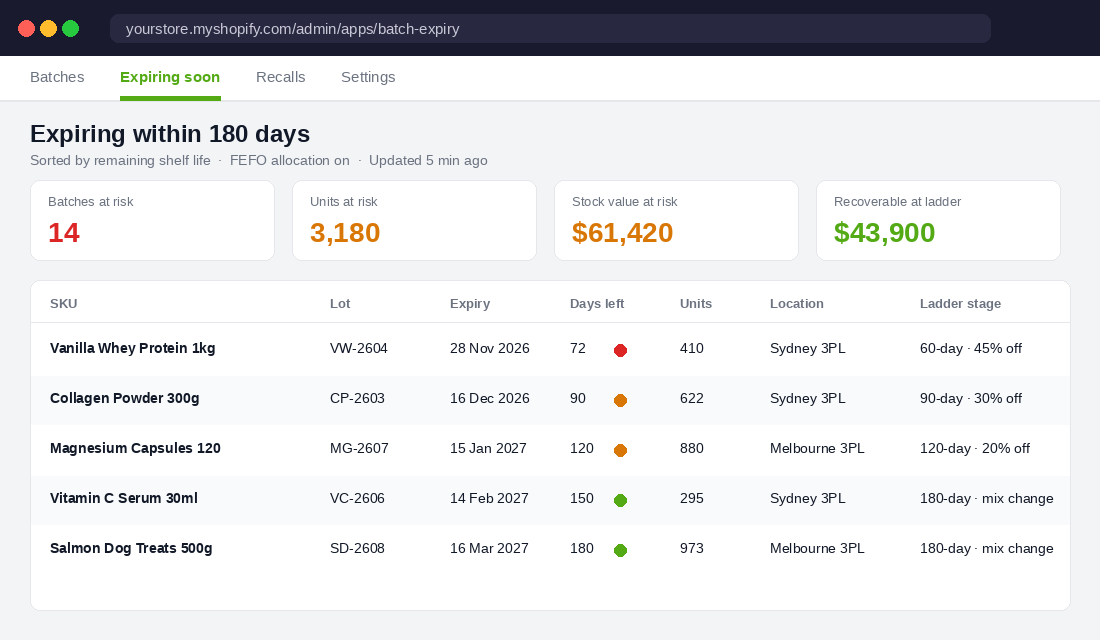
Here is the uncomfortable truth: Shopify’s native inventory has no idea when anything expires. It knows you have 412 units of Vanilla Whey 1kg. It does not know that 180 of them expire in March and 232 in September. If you are managing expiry in Shopify alone, you are managing it in your head.
Batch-level tracking means every inbound carton gets three fields: lot number, expiry date, and quantity per location. Once that exists, three things become possible that were impossible before. You can see remaining shelf life per SKU at a glance. You can pick first-expired-first-out. And you can find every customer who received a specific lot in seconds if you ever have to recall it.
FIFO is not FEFO, and the gap is where expiry write-offs live. Most 3PLs default to first-in-first-out: the oldest carton by receipt date ships first. That works for candles. It fails for consumables the moment a supplier sends you a fresher batch before an older batch has been picked, or a returned unit goes back on the shelf. First-expired-first-out picks by the date on the carton, not the date it arrived. Every 3PL that handles supplements or food should offer it. Gold Coast 3PL Fulfilpackers, for example, applies FEFO picking by default for its supplement clients. If yours cannot, ask why.
Tool recommendation: Batchly (Lot & Expiry Tracking). A Shopify-native batch app with a free plan (one product, unlimited batches) and a US$15 a month plan for unlimited products. It launched in April 2026 and does the four jobs that matter without a separate WMS. Setup takes an afternoon:
- Install and tag your dated SKUs. Not everything needs batch tracking. Start with the 20% of SKUs that carry 80% of your expiry exposure (usually your hero consumables).
- Create a batch for every carton on hand. Lot number, expiry date, quantity, location. If your supplier’s purchase order PDF lists lots, the app can pull batches from it. Do a physical count first; do not trust the last stocktake.
- Set allocation to FEFO per product. Batchly lets you choose FIFO or FEFO per product rather than store-wide, so your non-dated SKUs stay on FIFO.
- Set expiry alerts at 180, 120 and 60 days. These three thresholds drive the markdown ladder in Part 4. The alert email is the trigger, not a dashboard you have to remember to open.
- Turn on auto-discount for near-expiry batches. The app can drop the price as a batch approaches expiry and restore it once that batch sells through. Set it, but keep the human decision on the threshold.
Alternatives worth a look if Batchly does not fit: Freshly Batch Inventory (FEFO rotation, good for multi-location), BatchTrack (simple, soonest-first dashboard with email alerts), and SS: Product Expiration Dates (fuller inventory management with FEFO, FIFO and custom methods). Pick one. A spreadsheet is fine for six SKUs and a disaster at sixty.
Part 3: Buy to Remaining Shelf Life, Not to Forecast
Standard inventory forecasting asks “how many weeks of cover do we want?” For dated products the question has a second half: “and how many weeks of shelf life will be left when it lands?” The gap between those two numbers is your safety margin. Most founders never calculate it, which is why they end up with 40 weeks of stock on a product with 30 weeks of shelf life remaining.
Run this calculation before every purchase order for a dated SKU:
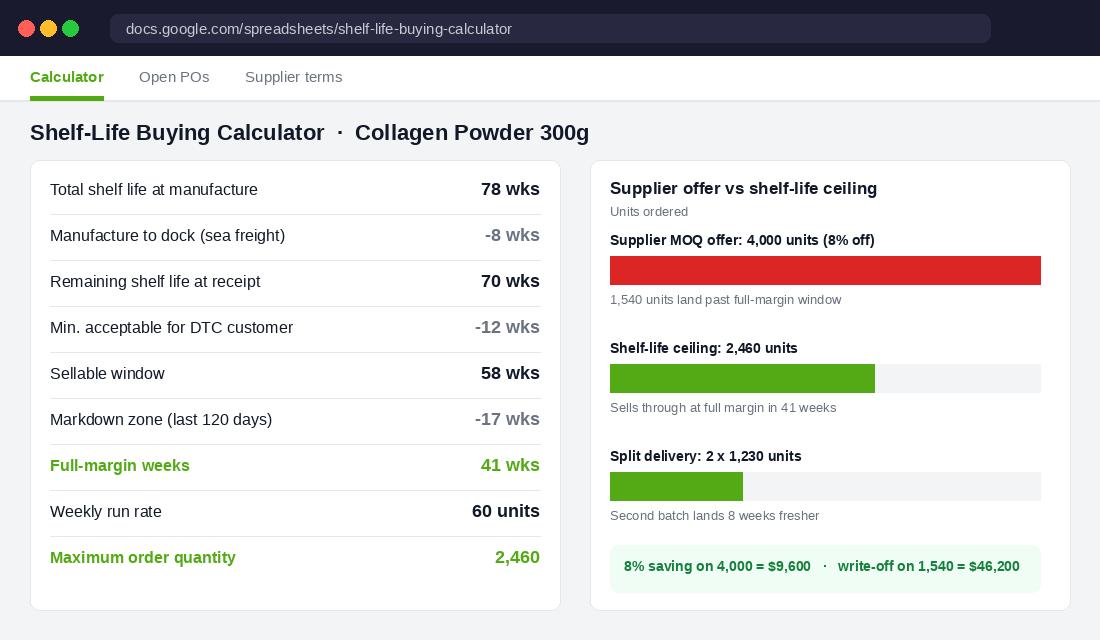
- Remaining shelf life at receipt. Total shelf life from manufacture (say 24 months for a supplement, 12 to 18 for a cream, 6 to 12 for a natural or preservative-free product) minus the time between manufacture and your dock. Sea freight from Asia or Europe can eat 6 to 10 weeks of that before you have sold a single unit.
- Sellable window. Remaining shelf life minus the minimum shelf life your customers and channels will accept. Amazon FBA, for example, will not receive a dated product with less than 90 days remaining plus the product’s consumption window, and will pull units for disposal once they are within 50 days of expiry. Australian retailers and marketplaces have their own minimums, often 6 months for beauty. Your own DTC customers rarely accept less than 3 months on a product they take for 2 months.
- Full-margin weeks. Sellable window minus the last 120 days, which is where the markdown ladder starts. This is the only window where you make your full contribution margin.
- Order quantity. Weekly run rate multiplied by full-margin weeks. Not by lead time plus safety stock. If that number is lower than your supplier’s minimum order quantity, you have a negotiation to have or a product to reconsider, not a bigger PO to place.
Worked example. A collagen powder has 18 months of shelf life at manufacture. It takes 8 weeks to reach your Sydney 3PL, so you receive it with about 70 weeks left. Your minimum acceptable remaining life for a DTC customer is 12 weeks, so the sellable window is 58 weeks. Take off the 17-week markdown zone and you have 41 full-margin weeks. If you sell 60 units a week, the most you should ever hold is about 2,460 units. The supplier’s “buy 4,000 and save 8%” offer is not a discount. It is 1,540 units at a 100% write-off, wearing an 8% hat.
Two more habits that separate the disciplined brands from the rest. First, write minimum remaining shelf life into your supplier agreement: “goods must have no less than 80% of total shelf life remaining at delivery.” Reject anything that arrives short-dated; it is the supplier’s expiry problem, not yours. Second, split large orders into two deliveries six to eight weeks apart. Same MOQ, same price, but the second batch lands fresher and your exposure at any moment halves. Our inventory forecasting playbook covers the demand side of this in detail; treat shelf life as the ceiling that sits on top of whatever the forecast says.
Part 4: The 180/120/60 Markdown Ladder
The single most expensive mistake in this category is discounting too late. A founder notices a batch at 30 days out, slashes it 60%, and still bins a third of it, because a 60% discount does not create demand for 300 units in three weeks. The fix is to start earlier and cut shallower, so the price drop does its work while there is still time for it to work.
Here is the ladder. Adjust the percentages to your margin, but keep the timing.
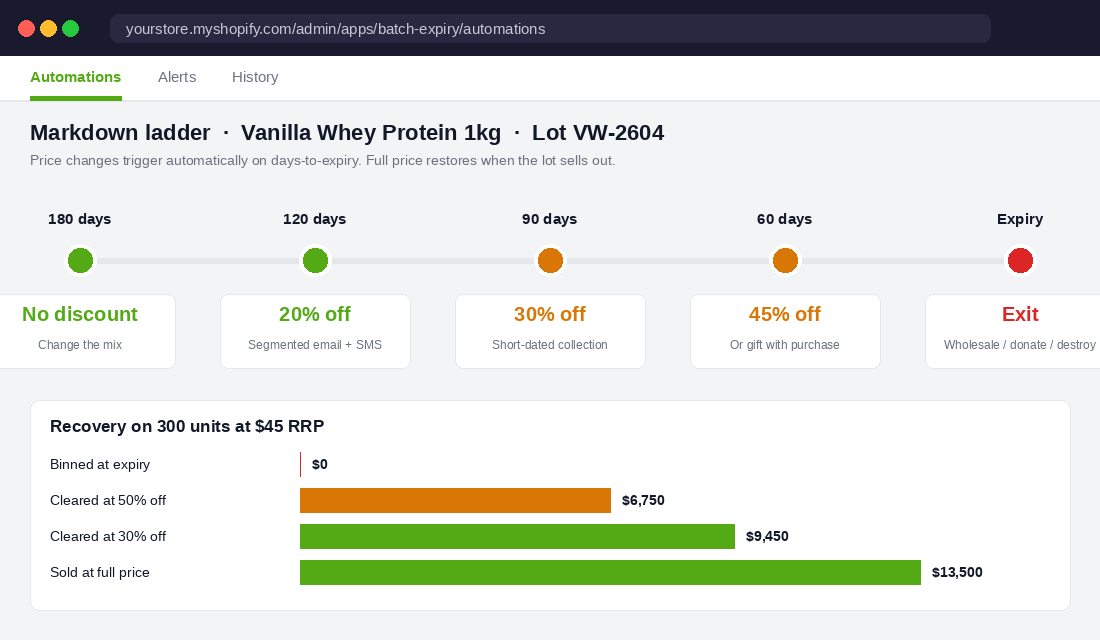
- 180 days out: no discount, change the mix. Push the batch through the channels that already move volume at full price. Feature it in the welcome flow, add it as a bundle component, prioritise it in FEFO picking. Nine times out of ten, a batch that gets attention at 180 days never reaches the next rung.
- 120 days out: 15 to 20% off, quietly. Segmented email and SMS to past buyers of that SKU, with a plain “short-dated, best before [date]” line. Buyers of consumables are used to this; repeat customers treat it as a loyalty perk. Do not put the discount sitewide yet.
- 90 days out: 25 to 35% off, on a dedicated short-dated collection. Australian Sports Nutrition, Nutrition Warehouse and Mr Supplement all run permanent clearance collections that openly list short-dated stock, and Bulk Nutrients keeps a discounts category for the same job. The collection does two things: it captures the deal hunter who was never going to pay full price, and it keeps the discount off your main product page, so your full-price positioning stays intact.
- 60 days out: 40 to 50% off, or bundle it as a free gift. This is the last rung where DTC can realistically clear volume. If the stock is a good fit as a gift-with-purchase on a full-margin order, that often beats a deep discount on unit economics. A $30 cost unit given away on a $150 order costs you less than selling it at $18 and paying to ship it alone.
- Under 60 days: exit via the recovery paths in Part 5. Deeper DTC discounts past this point mostly train customers to wait.
Three rules that make the ladder safe. Always disclose the date. Put “Best before 14 Mar 2027” in the product title or the first line of the description, not buried in a tab. Customers do not mind short-dated; they mind surprised. Never let the two prices collide. The full-price listing and the short-dated listing should be separate variants or separate products so a full-price customer never receives the short-dated batch. Keep a two-week gap between rungs. A price that changes weekly reads as panic.
A note on the maths: a batch of 300 units at $45 that would have been binned is $13,500 of revenue at zero. Moving it at 30% off recovers $9,450. Even at 50% off you recover $6,750 plus the disposal cost you avoided. The “we don’t discount” position is admirable right up until the skip bin arrives.
Part 5: Disposal and Recovery Paths for What Still Won’t Move
Some stock will still be sitting there at 45 days. Plan the exits now, because every one of them takes longer to organise than the time you will have left when you need it.
- Wholesale short-dated lots. Discount supplement and grocery retailers buy short-dated pallets at 20 to 30 cents in the dollar. Low, but it is cash, it is fast, and it clears the shelf. Build the relationship before you need it.
- Gym, clinic and stockist bundles. Your B2B accounts often have faster sell-through than your website on a given SKU. A “buy 20, get 10 short-dated free” offer clears stock and rewards a stockist at the same time.
- Sampling and creator seeding. Short-dated full-size units are excellent for creator gifting, event sampling and sample packs, as long as the recipient will use them within the window. Free product that generates content beats free product that generates a disposal invoice.
- Donation. Foodbank Australia and OzHarvest accept in-date shelf-stable food; check current requirements before shipping anything. Donated stock is still a write-off for margin purposes, but the disposal cost disappears and the brand story is a lot better than a skip bin.
- Compliant disposal. Past a use-by or TGA expiry, the stock has to go. Get it out of the pickable location the day it expires, record the write-off by lot in your books, and make sure the 3PL destroys it rather than “setting it aside.” Expired stock that gets picked by mistake is a refund, a review and possibly a complaint to a regulator.
One more recovery path that most founders forget: the supplier. If a batch arrived with less shelf life than agreed, or if the manufacturer changed a formulation and shortened the date, that is a credit conversation, not a write-off. Lot-level records from Part 2 are what let you have that conversation with evidence. This is also where the dead stock playbook and this one meet: the difference is that dead stock has all the time in the world, and short-dated stock has none.
How the Five Parts Compound
None of these parts is dramatic on its own. Together they change the economics of a consumables brand.
Knowing the rules (Part 1) tells you how much runway you have past the date. Batch tracking (Part 2) turns “we might have some short-dated stock” into a list with numbers on it, and FEFO picking stops fresh stock jumping the queue. Buying to remaining shelf life (Part 3) means far fewer batches ever reach the danger zone, because you stopped buying 40 weeks of a 30-week product. The markdown ladder (Part 4) recovers 50 to 70% of the value of the batches that do reach it, instead of 0%. And the recovery paths (Part 5) turn the last few cartons into cash, content or goodwill rather than a disposal fee.
A brand writing off 12% of a $400k stockholding loses $48k a year. Cut the batches reaching the danger zone by half and recover 60% of the value on the rest, and that number drops to under $10k. The $38k difference is pure margin, and it came from discipline, not from selling a single extra unit. That is what a Profit lever looks like in a consumables business.
Your Shelf-Life Checklist
Run this in the next fortnight. Most of it is a spreadsheet and an afternoon.
- Classify every dated SKU as use-by (hard stop), best-before (sellable past date if fit), TGA expiry (hard stop) or PAO (soft). Write the rule next to the SKU.
- Count stock by lot and expiry, not by SKU. If you cannot do it today, that is the first problem to fix.
- Install a batch app (Batchly, Freshly, BatchTrack or similar) and set FEFO on every dated product.
- Confirm your 3PL picks FEFO in writing. Ask what happens to a returned unit.
- Set alerts at 180, 120 and 60 days and assign a named owner to each alert.
- Recalculate every open PO for dated SKUs against full-margin weeks, not weeks of cover.
- Add a minimum-remaining-shelf-life clause (80% at delivery is a fair ask) to your supplier terms.
- Build a short-dated collection on your store with the date disclosed in every title.
- Line up two exit partners (a discount wholesaler and a charity) before you need them.
- Add “expiry write-offs by lot” as a monthly line in your P&L review. What gets measured gets bought more carefully.
Inside eCommerce Circle, shelf-life discipline sits under the Profit pillar of the More Orders Operating System, alongside margin, cash flow and unit economics, because that is where the money leaks. If you want to see exactly where your store is being capped, take the free More Orders Scorecard. It takes two minutes and shows you which of the 10 P’s to fix first.