Most Shopify founders I work with have a retention plan that looks like this: a welcome flow, a points program, and a 15% “we miss you” code that goes out every 90 days. Then they wonder why their customers treat them like a vending machine.
What’s in This Article
Here’s the problem. Everything in that plan is expected. Customers know the code is coming. They know the points exist. Nothing in it gives anyone a reason to tell a friend, post a photo, or feel something about your brand. The brands that build real loyalty add one more layer: small, unexpected gestures, delivered at the right moment, to the right customer, on a budget they control.
That’s surprise and delight. Done properly, it isn’t fluffy brand stuff. It’s a measurable retention lever that costs a fraction of a discount program. This playbook gives you the five-part system to run it on Shopify: the budget, the moments, the gestures, the automation, and the test that proves it’s paying for itself. It sits squarely in Patrons, the P in the More Orders Operating System that covers everything that happens after the first order.
Why a Surprise Beats a 15% Discount
Discounts train customers to wait. Surprises train them to come back. The difference comes down to one of the oldest findings in behavioural science: reciprocity.
In a well-known restaurant study, researchers found that giving diners a single mint with the bill lifted tips by about 3%. Two mints lifted tips by 14%. But when the server gave one mint, walked away, then turned back and offered a second “for you nice people”, tips jumped 23% (Strohmetz et al., Journal of Applied Social Psychology). Same mints. The only difference was that the second one felt personal and unexpected.
More recent retail research backs this up. A 2025 study in the Journal of the Academy of Marketing Science ran field experiments where shoppers received an unconditional gift (a pack of coffee worth about US$8) at the start of their visit. Those customers spent around US$16.88 more than the control group. The researchers also found gifts of any value lifted gratitude and loyalty, with higher-value gifts adding only a marginal boost.
Read that last line again. You don’t need to spend big. You need to be unexpected and specific. That’s why this works for a $500K store as well as a $20M one.
And the retention maths is worth chasing. Bain & Company’s Fred Reichheld found that a 5% increase in customer retention can lift profits by 25% to 95%, a finding he revisited in Harvard Business Review. Meanwhile, Aussies are spreading their spend wider. The Australia Post eCommerce Report 2026 found shoppers spent a record $82.6 billion online in 2025, across more brands and more occasions than the year before. More choice means less default loyalty. A memorable moment is how you stay in the rotation.
Part 1: Set a Delight Budget Before You Buy a Single Gift
The fastest way to kill surprise and delight is to run it on vibes. Someone in the team throws in a free product “when it feels right”, nobody tracks it, and three months later you have no idea whether it did anything. So start with a number.
My rule of thumb: set aside 0.5% to 1% of monthly revenue as your delight budget. Treat it like a marketing line, not a favour. Here’s what that looks like for a typical Aussie store doing $1.2M a year:
- Monthly revenue: $100,000
- Delight budget at 0.75%: $750 a month
- Average gesture cost (card, sample, postage uplift): $6 to $12
- Gestures you can afford: roughly 60 to 120 a month
Now compare that to your discount spend. If you’re sending a 15% win-back code that gets redeemed on 200 orders at a $120 AOV, that’s $3,600 of margin a month, and a big chunk of it goes to people who would have bought anyway. Your delight budget is a rounding error by comparison.
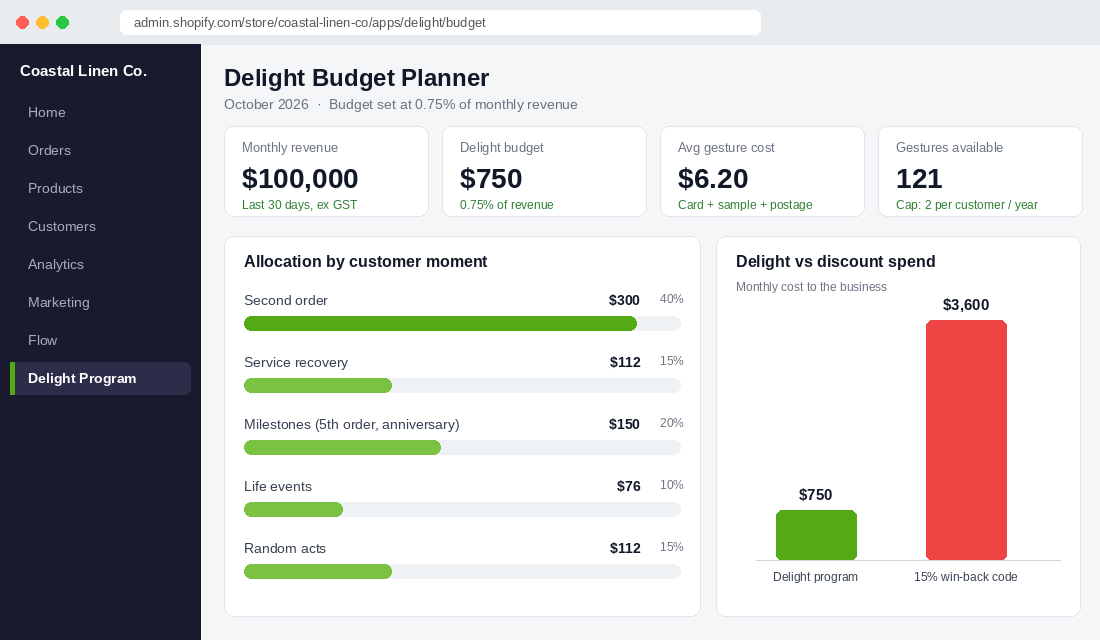
Once you have the total, split it across the moments in Part 2. I usually recommend putting 40% on the second-order moment, because that’s where most stores bleed customers, and holding 15% in reserve for service recovery. The rest spreads across milestones and random acts.
One more guardrail: cap the gesture per customer per year. Two surprises a year for a regular customer feels special. Six feels like a program, and programs get expected. Expected is the opposite of what you’re paying for.
Part 2: Map the Six Moments That Actually Matter
Random acts of kindness are nice. Targeted acts of kindness are profitable. The trick is to put your budget where a customer’s decision to stay or leave is being made. These are the six moments I map with every store:
- The first order. The customer has taken a risk on you. A small, personal touch in the first box confirms they made the right call. This is where a handwritten note earns its keep.
- The second order. The single most valuable moment in your customer’s life. Most Aussie stores see somewhere between 20% and 30% of first-time buyers come back. A customer who places a second order is far more likely to place a third. Reward the behaviour you want repeated.
- The milestone. Fifth order, first anniversary, $1,000 lifetime spend. Customers rarely track these. You should, and you should notice them before they do.
- The service recovery. A late parcel, a wrong size, a damaged item. Handled well, a mistake builds more loyalty than a perfect order ever will. Pair the fix with something they didn’t ask for.
- The life event they told you about. A new baby, a wedding, a pet that passed away. Customers share these with your support team all the time. Log them and act on them.
- The genuinely random. A small slice of budget for a customer picked at random each week. This keeps the whole thing from feeling formulaic, including to your own team.
Chewy is the brand everyone points to here, and for good reason. The US pet retailer started sending commissioned oil portraits of customers’ pets in 2013 and now sends over 1,000 paintings a week. Customers can’t request one. Its support team also sends handwritten notes to new customers and condolence cards when a pet dies. Notice how those map to moments 1, 5 and 6. None of it is random in intent, even when it feels random to the customer.
If service recovery is where your store needs the most work, our Service Recovery Playbook walks through the full process for turning a complaint into a repeat order.
Part 3: Build a Delight Menu (So Your Team Isn’t Guessing)
Your team needs a menu, not a blank cheque. A delight menu is a short list of approved gestures with a cost, a moment and a rule for each. It lets a support agent act in 30 seconds without asking permission, which is exactly how Zappos built its reputation. The US shoe retailer became famous for surprise upgrades to overnight shipping, and about 75% of its purchases came from repeat customers.
Here’s a starter menu I’d give any Australian Shopify store:
- Handwritten note ($2 to $5). Specific beats generic. “Hope the linen set makes the new place feel like home” lands. “Thanks for your order!” doesn’t.
- Shipping upgrade ($4 to $12). Quietly bump a standard AusPost parcel to Express. Tell them after dispatch, not before. The surprise is the point.
- Sample of something they haven’t tried ($3 to $8 landed). Pick a product that fits their last order. This is delight and product discovery in one move.
- Early access to a new release ($0). A personal email from the founder saying “you’re one of the first people seeing this”. Costs nothing but a bit of care.
- A gift for someone else ($5 to $15). A second small item “to pass on to someone who’d love it”. It rewards the customer and puts your product in a new pair of hands.
- A donation in their name ($5 to $10). Works especially well for purpose-led brands and for sensitive moments where a product would feel wrong.
What’s not on the menu: discount codes. A code isn’t a gift. It’s a request for another transaction dressed up as a gift. The Journal of the Academy of Marketing Science study above makes the distinction clearly: unconditional gifts outperformed earned rewards on gratitude. The moment you attach a condition, you’re back to running a promotion.
Also leave out anything that costs you a support ticket. An oversized free product that needs a separate shipment, or a gift that clashes with a customer’s allergy or size profile, turns delight into admin. Keep the menu small, light and safe to put in any box. If your packaging is still plain brown cardboard with a packing slip, fix that first with our Unboxing Experience Playbook. A handwritten note in a forgettable box only does half the job.
Part 4: Automate the Trigger, Keep the Human Touch
Here’s where most stores stall. The founder writes 30 notes in week one, gets busy, and the whole thing quietly dies. The fix is to automate who gets flagged and when, while keeping what they receive personal.
Shopify Flow, which is built into Shopify, is the tool for the job. Here’s how to set up the second-order trigger, the one I’d build first:
- Open Flow from your Shopify admin (Apps, then Flow) and click Create workflow.
- Set the trigger to Order created.
- Add a condition: customer’s number of orders is equal to 2. Add a second condition to exclude orders tagged as wholesale or staff, so you don’t gift your own team.
- Add the action Add order tags with a tag like
delight-2nd-order. Your fulfilment team or 3PL now sees a clear instruction on the pick list. - Add a second action Add customer tags with
delight-received-2026. This is your frequency cap. Add a condition at the top of every delight workflow that skips anyone already carrying that tag twice this year. - Optional: send an internal email or Slack message to your support lead with the customer’s name and last product, so a real human writes the note.
- Turn it on and check the first five tagged orders by hand before you trust it.
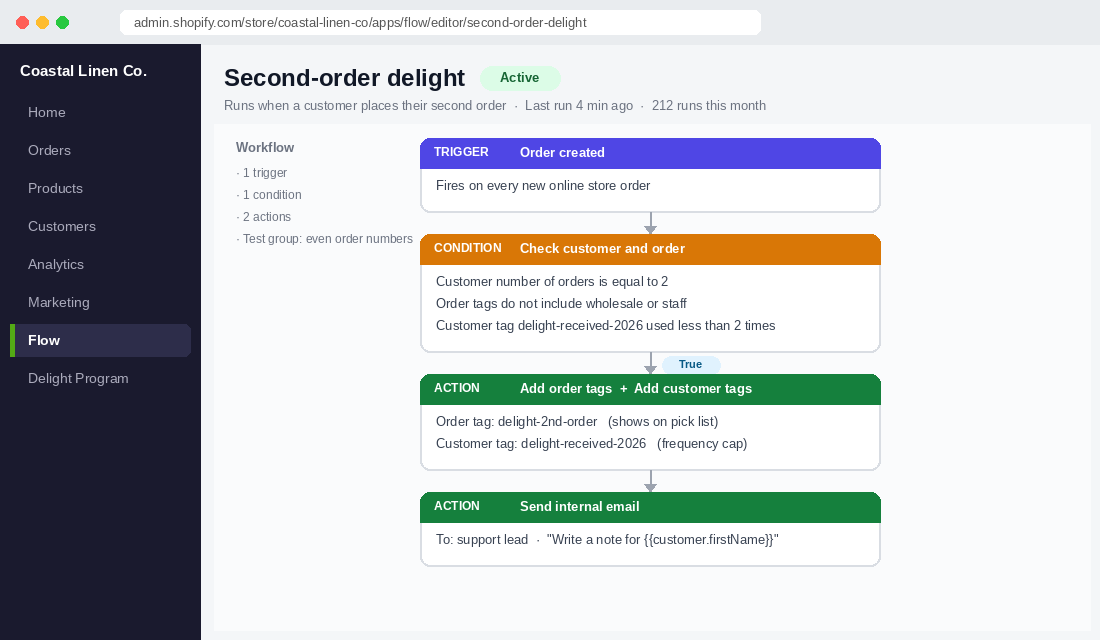
Clone that workflow for your other moments. For the fifth order, change the condition to 5. For service recovery, trigger on a Refund created event or a tag your support team adds manually, such as recovery-gift. For anniversaries, a scheduled Flow that checks customer creation dates works well.
If you ship from a 3PL or don’t want to hand-write at scale, Cardly is worth a look. It’s an Australian business that produces handwritten-style cards locally and connects to your stack through Zapier or its API. A Flow tag can fire a Zap that sends a personalised card to the customer’s address a few days after their parcel lands. It arrives separately, which is a second surprise in itself.
One rule for the words themselves: never let the automation write the message. Automation decides who. A person decides what. Give your team a two-minute brief for each note: the customer’s first name, what they bought, anything in their support history, and one sentence that could only have been written to them.
Part 5: Prove It Pays With a Holdout Test
This is the part nobody does, and it’s why surprise and delight gets cut the first time cash is tight. If you can’t show the number, it looks like a nice-to-have. So measure it the same way you’d measure an ad campaign: with a control group.
The setup is simple:
- Split the eligible customers. In your Flow, add a condition that only tags customers whose order number ends in an even digit. Odd-numbered orders become the holdout. It’s not perfect randomisation, but it’s close enough for a store of this size and costs you nothing.
- Tag both groups.
delight-testanddelight-control, so you can build segments in Shopify or Klaviyo later. - Run it for at least 90 days and at least a few hundred customers per group. Anything less and you’re reading noise.
- Compare three numbers: repeat purchase rate at 90 days, revenue per customer, and the net result after the cost of the gestures.
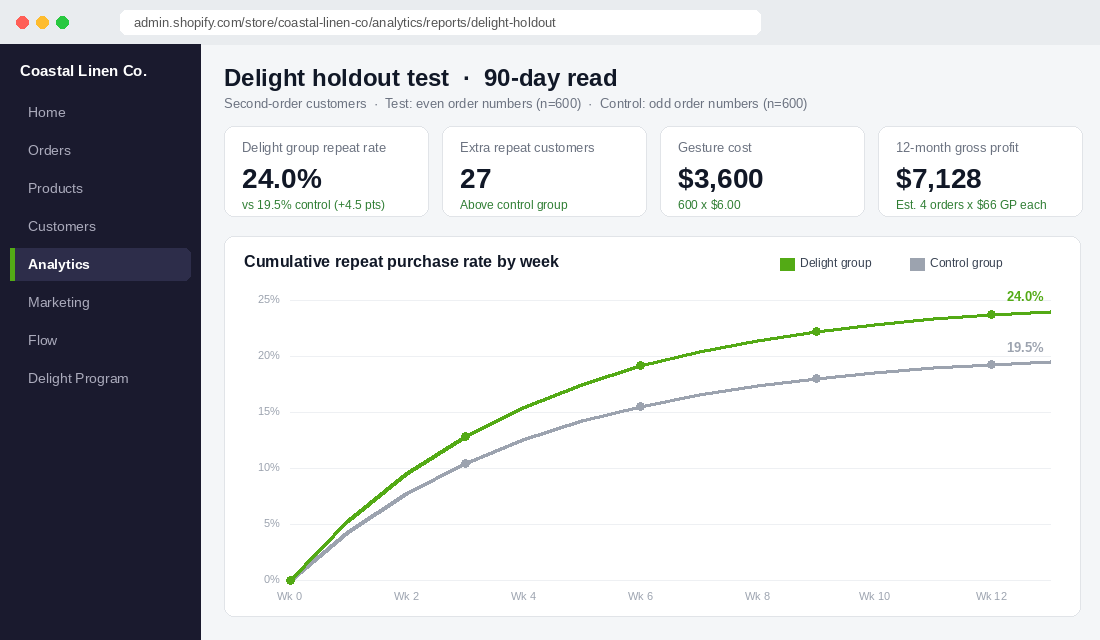
Here’s how to read the result. Say a store doing around $3M a year runs the test and its delight group of 600 second-order customers repeats at 24% and your control repeats at 19.5%. That’s 27 extra customers placing another order. At a $120 AOV and 55% gross margin, those orders are worth about $1,780 in gross profit. If the gestures cost $6 each across 600 customers, that’s $3,600 spent, so on the first repeat order alone you’re behind.
That’s why you track 12-month value, not just the next order. Customers who come back a second time tend to keep coming back. If each of those 27 extra customers goes on to place three more orders over the year, the gross profit on this cohort climbs past $7,000. Now the program is paying for itself roughly twice over, before you count a single referral or social post. Run the test, plug in your own margins, and let the numbers decide whether to scale, tweak or kill it. For the full maths on how that compounding works, our Customer Lifetime Value Playbook breaks it down step by step.
If the test shows nothing, don’t give up on the idea. Change one variable. The most common culprits are a generic message, the wrong moment, or a gesture that’s too small to notice. Test the note against the shipping upgrade before you decide the whole concept doesn’t work for your brand.
The Five Mistakes That Turn Delight Into Noise
I see the same errors over and over when stores try this. Avoid these and you’re ahead of most of the market:
- Announcing it. “Every order over $100 gets a free gift!” is a promotion, not a surprise. The moment you advertise it, customers price it in and the emotional lift disappears.
- Asking for something in the same breath. A lovely card that ends with “Leave us a review!” or a referral code reads as a transaction. Let the gesture stand on its own. Ask for the review in your normal post-purchase flow a week later.
- Being generic. A printed “Thank you for shopping with us” insert in every box is packaging, not delight. If it could go to anyone, it isn’t personal.
- Giving your best customers nothing. Plenty of brands shower first-time buyers and ignore the loyal core. Your top customers drive a huge share of revenue, and our Top 10% Customer Strategy shows how to identify them. Make sure they’re in the milestone moments.
- Letting it drift. No owner, no budget, no tracking. Put one person’s name next to the program and review it in your monthly numbers meeting.
How the Five Parts Compound
Each part on its own is small. Together, they change how customers feel about buying from you.
The budget makes it sustainable, so it survives a slow month. The moments put the money where the stay-or-leave decision is being made. The menu means your team can act in seconds instead of waiting for you. The automation means it still runs when you’re flat out in November. And the holdout test turns it from a nice idea into a line in your P&L that you can defend.
Then the second-order effects kick in. Surprised customers post their parcels. They mention you to a friend. They forgive you faster when something goes wrong, because they’ve got a memory of you going out of your way. None of that shows up in a single email report, but it shows up in your repeat rate and your cost to acquire the next customer.
And timing matters. We’re heading into the busiest quarter of the year. The customers you win in November and December are the ones most likely to vanish in January. Build the second-order trigger now, and every peak-season buyer who comes back gets a reason to stay.
Your Surprise and Delight Launch Checklist
Copy this into your project tool and work through it over the next 30 days:
- ☐ Week 1: Set the budget. 0.5% to 1% of monthly revenue. Split it: 40% second order, 15% service recovery, 45% milestones, life events and random.
- ☐ Week 1: Pick an owner. One name, responsible for the program and the monthly review.
- ☐ Week 1: Write the delight menu. Four to six gestures, each with a cost, a moment and a rule. No discount codes.
- ☐ Week 2: Build the second-order Flow. Order created, orders equals 2, tag the order, tag the customer, alert a human.
- ☐ Week 2: Add the frequency cap. Maximum two gestures per customer per year.
- ☐ Week 2: Brief the team on notes. First name, what they bought, one sentence only they could receive.
- ☐ Week 3: Add the holdout. Even order numbers get delight, odd numbers are control. Tag both.
- ☐ Week 3: Set up service recovery. A manual
recovery-gifttag your support team can apply in one click. - ☐ Week 4: Add a milestone trigger. Fifth order or first anniversary.
- ☐ Day 90: Read the test. Repeat rate, revenue per customer, net result after gesture cost. Scale, tweak or kill.
Make Customers Feel Noticed
Your competitors can copy your products, your prices and your ads. They can’t copy the feeling a customer gets when a brand notices them. That feeling is cheap to create, easy to systemise, and you can measure it.
Inside eCommerce Circle, retention is one of the core pillars we work on with every member, and surprise and delight is one of the quickest wins in the Patrons P. If you want to see exactly where your store is being capped, take the free More Orders Scorecard. It takes two minutes and shows you which of the 10 P’s to fix first.