Most Shopify brands that sell to parents are marketing to a person who does not exist. They picture a relaxed mum scrolling Instagram on a Sunday afternoon, reading every line of the product page, then checking out with a smile.
What’s in This Article
The real buyer is standing in the kitchen at 9:40pm with a toddler who will not go to sleep, one thumb on her phone and a work email still unanswered. She has about four minutes. She is not browsing. She is solving a problem, and she will only buy from a brand another parent has already vouched for.
Get that picture right and parents become the most loyal, highest-lifetime-value customers you will ever have. Get it wrong and you will keep paying Meta to reach people who bounce in eight seconds. This playbook shows you how to build a store, a calendar and a marketing engine around how Australian parents actually buy.
Who You Are Really Selling To (The Numbers Behind the Parent Buyer)
Start with the size of the prize. The ABS Labour Force Status of Families release counted 7.7 million families in Australia in June 2025. Of those, 3.4 million had children or dependants, and 80% of them had at least one child aged 0 to 14.
Now look at the constraint that shapes every purchase. Of the 2.2 million couple families with kids aged 0 to 14, 73% have both parents employed. In 2005 that figure was 60%. Over a third (36%) have both parents working full-time. Time, not money, is the scarcest resource in these households.
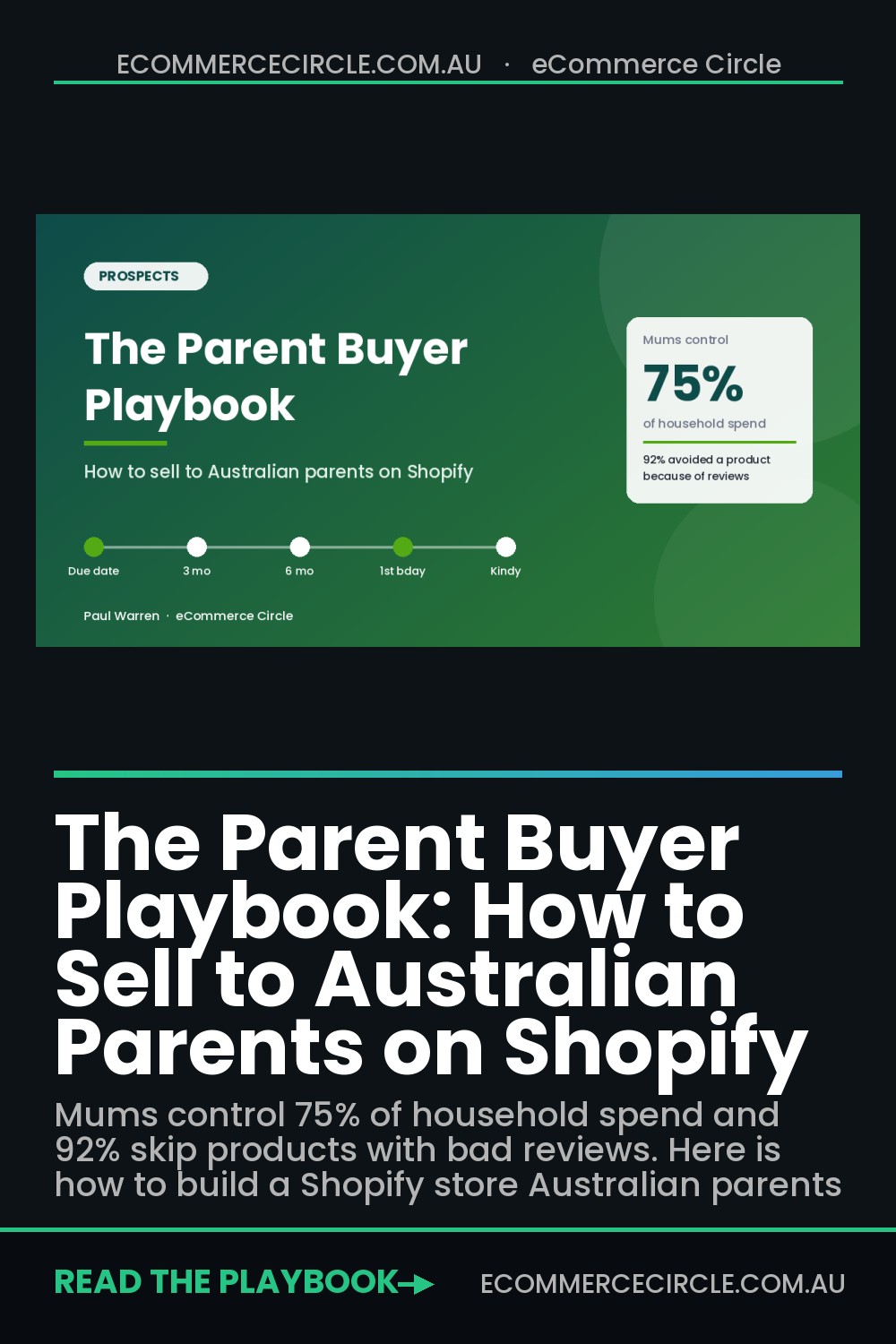
Then look at who holds the card. Mumpower’s 2025 survey of Australian mothers, reported by Power Retail, found mums control around 75% of total household spend across more than 6 million Australian mothers. The ARA and Roy Morgan back-to-school research landed on exactly the same number: women made 75% of back-to-school purchases, versus 13% for men.
The generational layer matters too. Most parents of young children today are Millennials, and the Australia Post eCommerce Report 2026 named them the largest online cohort, spending $29.7 billion online in 2025, with 47% buying online at least once a week.
So your buyer is frequent, digitally fluent, time-starved and sceptical. That combination rewards brands that remove effort and add proof. It punishes brands that add friction and ask for trust they have not earned.
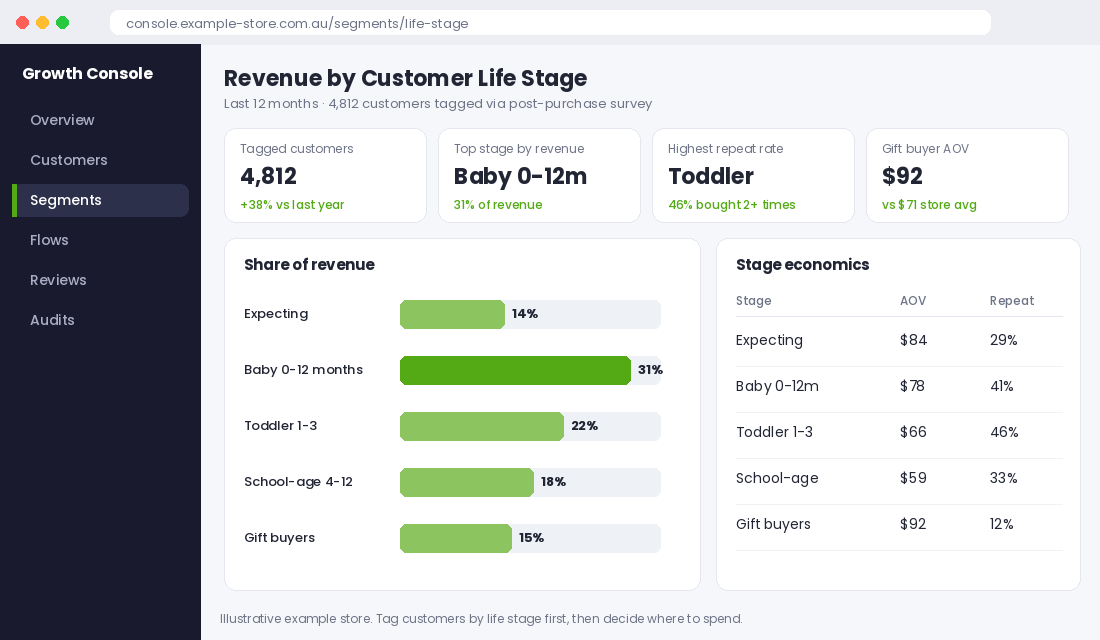
One practical step before you change anything: tag your existing customers by life stage. Add a post-purchase survey question (“Who are you shopping for today?”) with options like expecting, baby under 12 months, toddler, school-age and gift. Within 60 days you will know which stage drives your revenue, and most brands are surprised by the answer.
Life-Stage Triggers Beat the Retail Calendar
Most brands plan around the retail calendar: Mother’s Day, EOFY, Black Friday. Parents run on a different calendar. Their spending is driven by the age of their child, and that clock ticks whether or not you are running a sale.
A baby moves through a predictable sequence of needs. Swaddles and nappy bags in the first weeks. Sleep bags and bottles at three months. Highchairs and bibs around six months. Walkers, shoes and safety gates near the first birthday. Then lunchboxes, drink bottles and school shoes around age five.
Back-to-school alone is a serious moment. The ARA and Roy Morgan forecast for 2026 put total spend at $2.9 billion, with the average shopper spending $573, up 9.1% on 2025. And 44% of those shoppers budgeted more than $500.
Here is the catch: 60% of back-to-school shoppers planned to buy in-store and only 39% online. That gap is your opportunity. The parent who is dreading a Saturday at the shopping centre with three kids in tow is your customer, if you give her a reason to sort it on her phone in January instead.
The fix is to capture the one data point that opens up the whole calendar: the child’s birthday or due date.
How to set up a child-age flow in Klaviyo
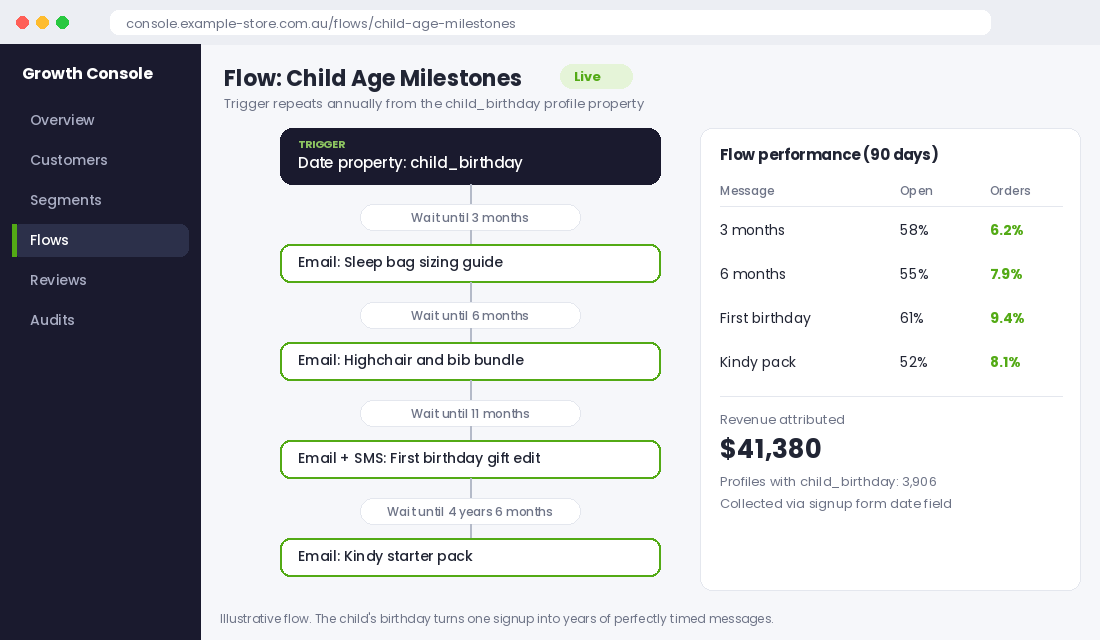
- Add a date field to your signup form. In Klaviyo, edit your form and add a date input with the label “Baby’s due date or child’s birthday”. Map it to a custom profile property such as child_birthday.
- Offer a reason to share it. “Tell us your little one’s birthday and we’ll send you what they’ll need next, before you need it” converts far better than a generic 10% off.
- Build a date-triggered flow. Go to Flows, create a new flow and choose the Date Property trigger. Select child_birthday and set it to repeat annually.
- Add stage-based branches. Use time delays and conditional splits to send the right products at 3, 6, 9 and 12 months, then every birthday after that.
- Sync the property back to Shopify. Use it as a customer tag so you can build Meta and Google audiences by child age.
A well-built life-stage flow does what no seasonal campaign can. It shows up at the exact moment a parent realises they need something, with the answer already in their inbox.
Proof Before Persuasion: Parents Buy on Other Parents’ Word
If you only take one thing from this article, take this. Parents do not trust your ads. They trust each other.
The Mumpower research is blunt. 63% of mums turn first to friends or family for product information. 47% seek information from another mum. 50% check review sites like ProductReview and Choice. 86% have purchased solely because of reviews they read, and 92% have avoided buying something because of reviews.
That last number should change how you run your store. A handful of unanswered one-star reviews on a baby product does more damage than a bad ad ever could, because the stakes for a parent are their child’s safety, sleep and comfort.
Here is how to build proof that actually moves a parent:
- Collect the child’s age with every review. Okendo and Judge.me both let you add custom review questions. “My child’s age” and “Used for how long” turn a generic five-star rating into proof that is relevant to the reader.
- Show photos from real homes. A swaddle on a real baby in a real cot beats a studio shot every time. Ask for photos in your review request and reward them with loyalty points.
- Reply to every negative review within 24 hours. Parents read the replies. A calm, specific fix tells them how you will treat them if something goes wrong.
- Lead with third-party validation. Certifications, safety standards and paediatric endorsements belong above the fold, not buried in a tab.
Love to Dream is the textbook example. Founder Hana-Lia Krawchuk built the Swaddle UP after 18 months of sleepless nights when her son would not sleep more than 45 minutes at a time, as SmartCompany reported. The product’s hip-healthy recognition from the International Hip Dysplasia Institute gives parents a third-party reason to trust it. The brand now sells in more than 45 countries, and it was built on one parent solving a problem other parents recognised instantly.
For a full system on collecting and displaying reviews, see our product reviews playbook.
Design for One Thumb and Four Minutes
Remember the 9:40pm kitchen. Your store has to work for a parent holding a phone in one hand and a child in the other. That changes a lot of design decisions most brands never question.
Start with the product page. Parents scan for three answers, in this order: is it safe, will it fit my child, and how fast can I get it. Put all three in the first screen on mobile. Age range and sizing belong right beside the price, not three scrolls down in a size chart.
Then remove every decision you can:
- Build life-stage bundles. A “Newborn Sleep Kit” or “Starting Kindy Pack” solves the whole problem in one click. It also lifts average order value without discounting.
- Make reordering effortless. Consumables like nappies, wipes, snacks and bath products should offer subscribe-and-save through Shopify Subscriptions, Recharge or Skio. A tired parent will happily hand you a recurring order.
- Turn on accelerated checkout. Shop Pay, Apple Pay and Google Pay remove the typing. Every field you remove at checkout is a field a parent does not have to fill in with one thumb.
- Show delivery dates, not delivery methods. “Arrives Thursday in Melbourne” beats “Standard shipping 3 to 7 business days”. Parents plan around dates.
- Make the search bar work. Parents search by problem (“teething”, “sleep regression”, “car seat”) as often as by product name. Map those terms to collections using Shopify Search and Discovery synonyms.
Test it yourself tonight. Pick up your phone, hold something heavy in your other arm and try to buy your best-seller. Every time you swear under your breath, you have found a conversion leak.
Price for the Occasion, Not the Product
Parents do not only buy for their own kids. Grandparents, aunties, friends and colleagues are a huge share of the baby and kids market, and they buy for occasions: baby showers, first birthdays, Christmas and “just because I saw it”.
b.box for kids understood this early. Co-founders Monique Filer and Dannielle Michaels started with a nappy wallet made from a cardboard prototype. As SmartCompany reported, they researched how much people were willing to spend on a baby shower gift and priced to that number. They also ran a survey of around 200 parents before launch to decide details like how many nappies the wallet needed to hold. The business grew into a multimillion-dollar brand with almost 300 products.
That lesson applies to every parent-focused store:
- Find the gift price points. Most gift buyers work to round budgets like $30, $50 and $100. Build a hero product or bundle at each one.
- Create a gift path. A “Shop Gifts” menu item with filters by age and budget serves the grandparent who has no idea what a 9-month-old needs.
- Add gift wrapping and gift messages. They cost you little and remove a reason to buy elsewhere.
- Offer a baby registry. Registry apps for Shopify let expecting parents build a list and share it. Every registry is a free acquisition channel that brings you a dozen new buyers.
Here is the subtle part. The gift buyer and the parent are two different customers with two different journeys. Tag them separately. The grandparent who bought a first-birthday gift is a great prospect for the second birthday, and the parent who received it is a great prospect for everything else.
Where Parents Actually Discover New Brands
Parents discover brands in places most ad dashboards cannot see. Mothers’ groups, school pick-up conversations, Facebook community groups, WhatsApp chats and the group text between cousins. You cannot buy your way into those rooms. You have to be invited.
The data backs this up. Mumpower found 63% of mums have organically shared opinions about brands online and 72% have used social media to see influencers use products. About 1 in 5 first discovered a product on social media. Social starts the conversation, but it is peer word-of-mouth that finishes the sale.
Here is how to earn your way into the conversation:
- Seed product with micro-creators who are actually parents. Ten local parents with 5,000 engaged followers each will outperform one celebrity mum with half a million. Their audience is other parents in the same suburb and the same life stage.
- Build a parent panel. Recruit 50 to 200 customers who test new products and give feedback, just as b.box did before launch. They become your loudest advocates because they helped build the thing.
- Make sharing easy. A referral program with a two-sided reward (“give $15, get $15”) fits the way mums already recommend products to each other.
- Show up where parents gather. Sponsor a local playgroup, donate a prize to a school fete or offer a discount to a mothers’ group. It is cheap, local and builds exactly the trust your ads cannot.
If you have already worked through our Gen Z buyer playbook, you will notice the contrast. Gen Z discovers through search on TikTok. Parents discover through people they know.
Safety Is Your Conversion Rate
For a parent, a product that might hurt their child is not a product at all. That means compliance is not just a legal box to tick. It is a sales tool.
Children’s products are some of the most regulated goods in Australia. The ACCC enforces mandatory safety standards across categories like toys for young children, cots, prams, baby walkers and products containing button or coin batteries. If your products fall into any of these categories, you need to know which standards apply before you list them, not after a customer complains.
Make that work visible on your store:
- State the standard on the product page. “Tested to AS/NZS ISO 8124.1 toy safety requirements” or “Button battery compartment secured with a screw” answers the question a parent is already asking.
- Publish a safety page. Explain your testing, materials and age recommendations in plain English. Link to it from the footer and every product page.
- Be precise about age ranges. A vague “suitable for all ages” on a kids’ product is a red flag to an informed parent.
- Have a recall plan ready. If something does go wrong, speed and honesty protect the brand parents trusted you with.
Our product compliance check walks through how to audit your catalogue against Australian mandatory standards step by step.
The Parent Buyer Checklist: Audit Your Store This Week
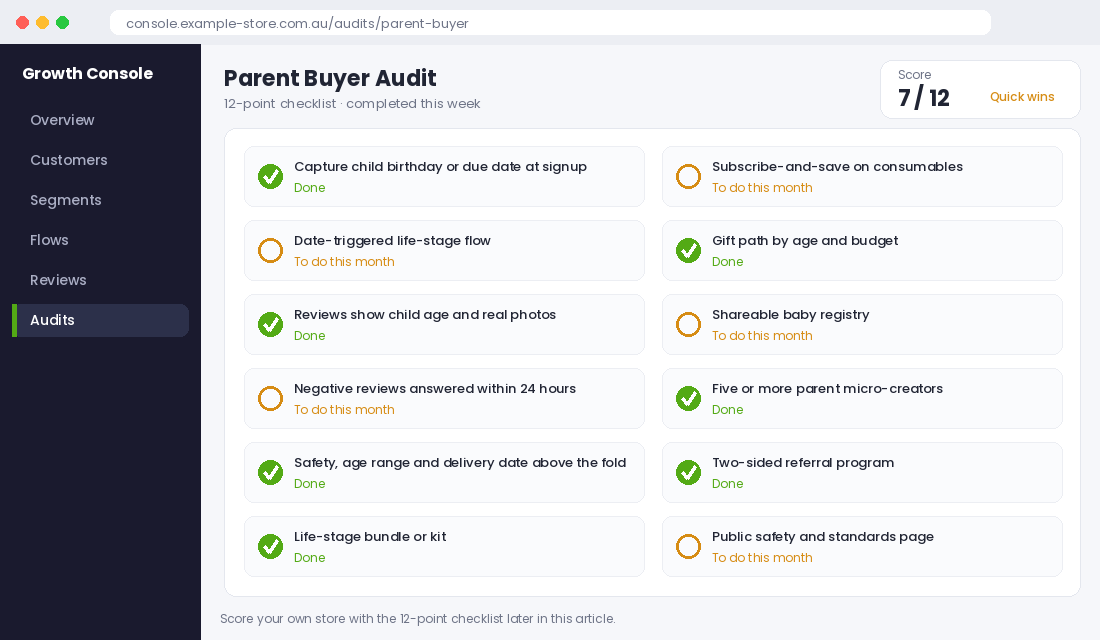
Use this checklist to score your store. Give yourself one point for every item you can tick today.
- Life stage data: We capture the child’s birthday or due date at signup.
- Life stage flow: We have a date-triggered email or SMS flow that sends the next product before it is needed.
- Review context: Our reviews show the child’s age and include real photos.
- Review replies: Every negative review gets a public reply within 24 hours.
- Above the fold: Safety, age range and delivery date are visible on the first mobile screen.
- Bundles: We sell at least one life-stage kit that solves a whole problem in one click.
- Subscriptions: Our consumables offer subscribe-and-save.
- Gift path: Gift buyers can shop by age and budget, with gift wrapping and a message option.
- Registry: Expecting parents can create and share a baby registry.
- Parent creators: We work with at least five micro-creators who are parents in our target life stage.
- Referrals: We run a two-sided referral program.
- Safety page: We publish the standards, materials and testing behind our products.
Score 10 to 12 and you are ahead of most of the category. Score 6 to 9 and you have clear quick wins. Score under 6 and your ad spend is working much harder than it needs to.
How It Compounds: From First Order to Lifetime Customer
Here is why parents are worth building your whole business around. A parent’s needs do not end. They evolve.
The life-stage flow brings a parent back at every milestone. Contextual reviews give the next parent the proof they need to buy. The one-thumb store means that proof converts instead of bouncing. Gift paths and registries turn each customer into a channel that brings in grandparents, friends and colleagues. Parent creators and referrals put your brand into the rooms where other parents make decisions. And visible safety work means none of that trust gets wasted.
Each piece makes the others stronger. A customer who first bought a swaddle can buy a sleep bag at three months, a highchair set at six months, a first birthday gift for her niece and a lunchbox bundle four years later. Your acquisition cost is paid once. The revenue keeps arriving for years.
That is the difference between a store that sells baby products and a brand that grows up with its customers.
Inside eCommerce Circle, understanding your prospects is one of the core pillars we work on with every member, because every other lever depends on it. If you want to see exactly where your store is being capped, take the free More Orders Scorecard. It takes two minutes and shows you which of the 10 P’s to fix first.