Here is a question most Shopify founders have never asked out loud: if you were in hospital tomorrow morning, who would log in to your store?
What’s in This Article
Not “who could figure it out eventually”. Who could log in by 9am, pause the Meta ads, answer the 40 customer emails sitting in the inbox, pay the supplier invoice due Friday and keep orders moving to the 3PL? For most Aussie stores doing $500k to $5m a year, the honest answer is nobody. Every password, every approval and every relationship runs through one phone.
Most founders treat this as a problem for later, something to sort out when they sell or retire. That is the wrong frame. The brands that survive a founder’s sudden absence are not the ones with the best exit plan. They are the ones that built a simple continuity plan while everything was fine. It takes about two focused days, and it is the cheapest insurance you will ever buy.
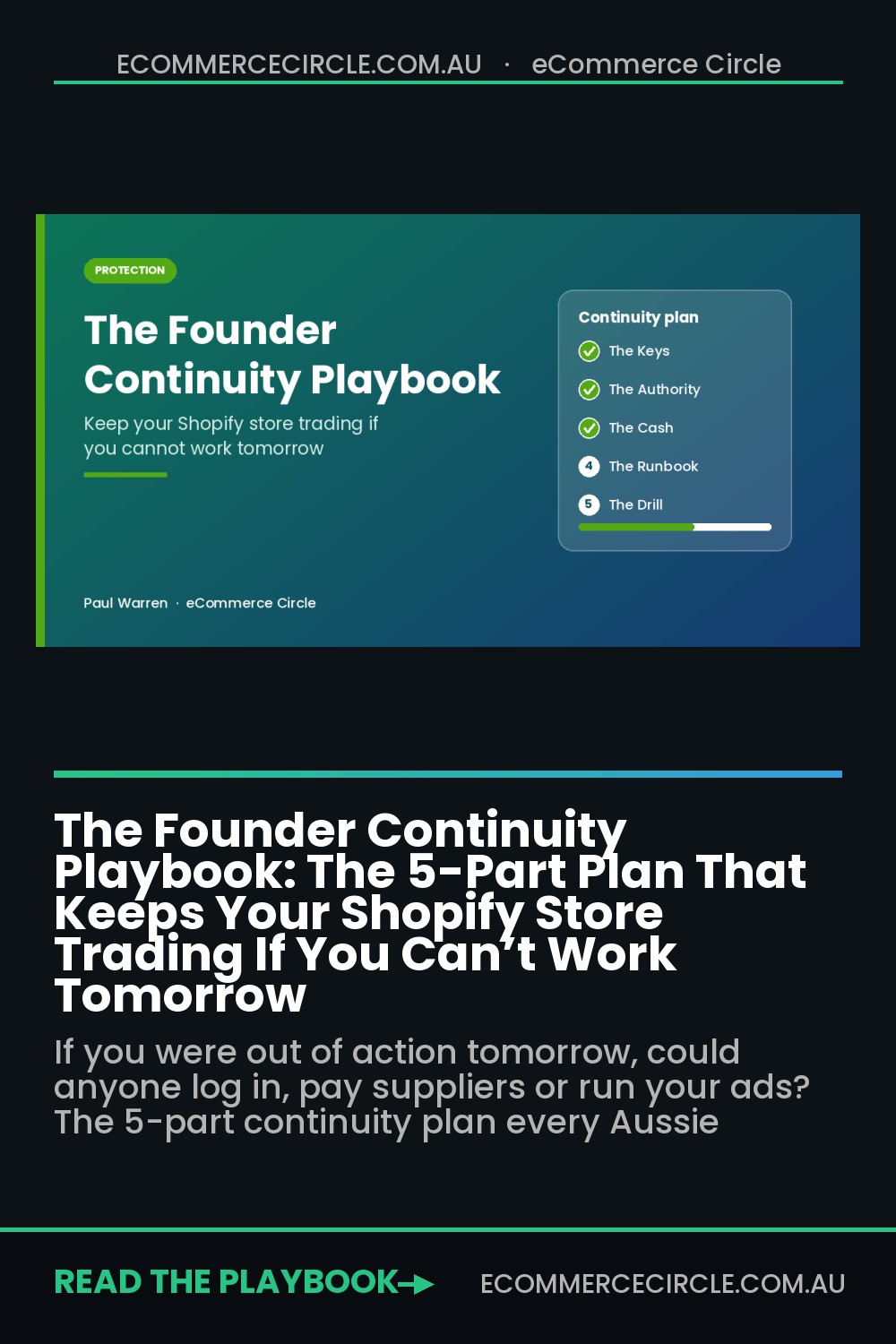
This playbook walks you through the five parts of that plan: the keys, the authority, the cash, the runbook and the drill. By the end you will have a one-page checklist you can finish before peak season.
Why Founder Continuity Is a Real Risk (Not a Morbid One)
Founders avoid this topic because it feels morbid. But the most likely trigger is not death. It is a car accident, a surgery with a six-week recovery, a family emergency overseas, a burnout crash or a baby arriving three weeks early. Any one of them takes you offline with no notice.
It happens more than you think. VistaPrint research published in April 2026 surveyed 510 Australian small and medium business owners and found 40% had already experienced a sudden or unplanned departure from a previous business because of a health crisis, financial pressure, burnout or a market shift. The same study found only 16% of owners planning to retire had a documented succession plan, and 25% had never considered what happens to the business when they leave.
The insurance numbers tell the same story. A BizCover survey of SMEs across 20 industries, reported by Kelly+Partners, found 20% of owners were worried about losing a key person, yet only 2% held key person insurance. Founders know the risk exists. Almost none have done anything about it.
Ecommerce brands carry a sharper version of this risk than a café or a trade business. Your whole business lives inside logins. The store, the payment processor, the ad accounts, the email platform, the domain and the bank are all digital, all protected by two-factor authentication, and usually all tied to one person’s phone number.
The most extreme example is the Canadian crypto exchange QuadrigaCX. When founder Gerald Cotten died suddenly in India in December 2018, about C$190 million in customer funds was reported as locked away because he held the only passwords, and his widow could not open his encrypted laptop. Later investigations uncovered far bigger problems at the company, but the first headline is the one that matters here. One person held every key, and when he was gone, nobody could get in.
Your store is not a crypto exchange. But if your staff cannot log in to Shopify Payments or your ad accounts, the effect on your business is the same: frozen cash, stalled orders and customers who assume you have gone under.
Part 1: The Keys (Map Every Login Before You Need It)
Start with access, because it is where most stores fail first. You cannot hand over what you have not written down.
Open a spreadsheet and list every system your business depends on. For each one, record five things: the system, who owns the account, who else has admin access, where the two-factor codes go, and what happens if nobody can log in for 30 days.
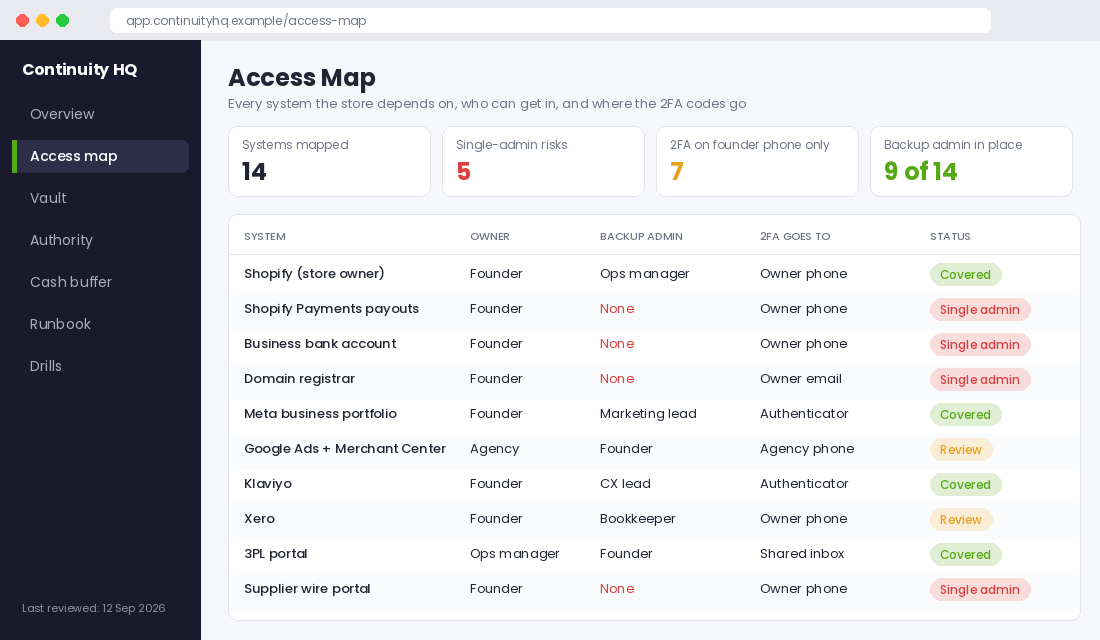
Here are the systems almost every Shopify brand needs on that map:
- Shopify store owner account. The single most important login you have.
- Shopify Payments and any other payment gateways (PayPal, Afterpay, Zip).
- Business bank accounts and cards, including who can approve payments.
- Domain registrar and DNS (Shopify Domains, GoDaddy, Crazy Domains, Cloudflare).
- Meta Business portfolio, Google Ads, Google Merchant Center and TikTok.
- Email and SMS platform (Klaviyo, Omnisend, Postscript).
- Google Workspace or Microsoft 365, because that is where every password reset lands.
- 3PL portal, shipping software (Starshipit, ShipStation) and carrier accounts.
- Accounting software (Xero, MYOB) and the ATO online services portal.
- Supplier portals, especially any overseas manufacturer you pay by wire transfer.
Now the uncomfortable part. On Shopify, a store can have only one owner, and only the store owner can change or transfer ownership. That comes straight from Shopify’s own help centre. If the owner cannot act, a staff member cannot promote themselves. Families dealing with a deceased owner have been told to go through Shopify Support or Shopify’s legal team, and a court order may be needed. That process takes weeks, not hours.
The fix is not to hand out the owner login. It is to make sure at least one trusted person has a full-permission staff account today, so the store can keep trading while ownership is sorted. Here is how:
- In your Shopify admin, go to Settings, then Users, and invite your stand-in with their own email address.
- Give them the permissions they would need to run the store for a month: orders, products, customers, discounts, apps and store settings. Leave billing and payouts with the owner if you prefer.
- Make them turn on two-factor authentication on their own device. Never share one authenticator between two people.
- Write down in your continuity file that this person is the nominated stand-in, and that ownership should transfer to them (or your executor’s choice) if you cannot act.
Do the same on Meta. Meta’s own guidance is to keep at least two in-house admins on your business portfolio for account recovery. If one admin remains, they can restore access for others. If none remain, you are into Meta’s recovery flow, and that is a place no founder wants to be. The Australian Small Business and Family Enterprise Ombudsman supported 482 small businesses in disputes with social media platforms in 2025. One of them, the family-run Forbes Bakehouse in the NSW Central West, faced an appeal process that could take up to 180 days after its Instagram was wrongly suspended. It only got its account back after the ABC contacted Meta. Do not rely on a journalist to rescue your ad account.
If you have not locked down staff accounts and two-factor yet, our Shopify Store Lockdown Playbook covers the security side in detail. Continuity is the other side of the same coin: security keeps the wrong people out, continuity makes sure the right people can still get in.
Set Up a Break-Glass Vault (The Tool That Makes Part 1 Work)
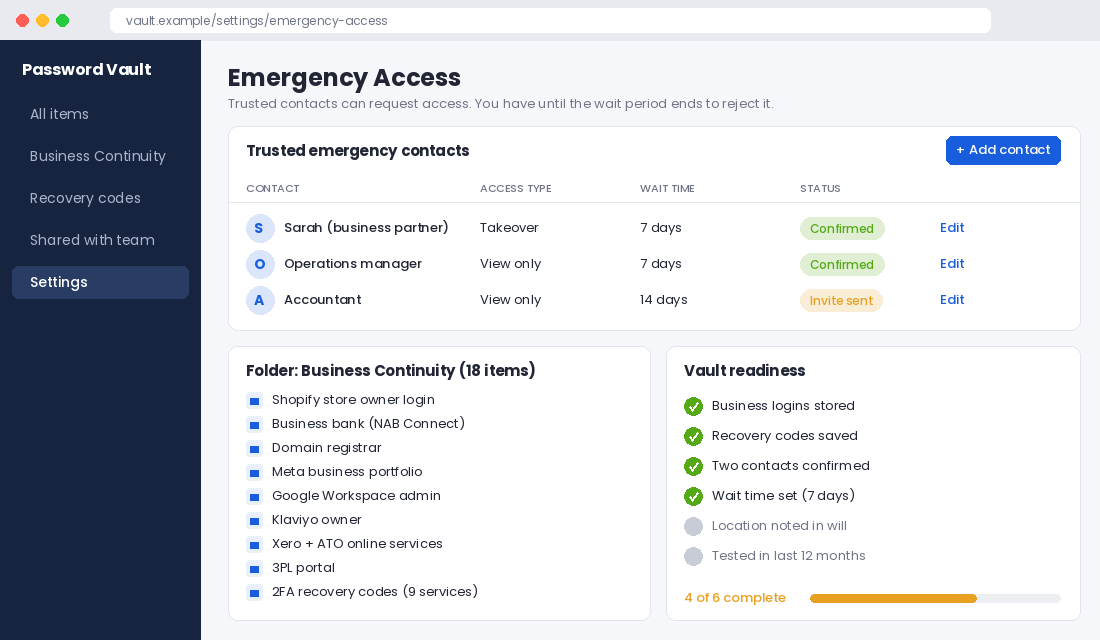
An access map tells people what exists. A break-glass vault lets them actually get in. The best tool for this is a password manager with an emergency access feature, and Bitwarden is a strong, affordable option for small teams.
Bitwarden’s Emergency Access lets you nominate a trusted contact who can request access to your vault. You set a waiting period. If you do not reject the request within that window, access is granted automatically. If you are fine and the request was a mistake (or something worse), you simply deny it.
Here is how to set it up in about 30 minutes:
- Move every business login into the password manager. No passwords in notes apps, browsers or a Word document on the desktop.
- Create a “Business Continuity” folder containing only what a stand-in would need: Shopify owner, bank, domain, Meta, Google, email platform, 3PL and accounting.
- Add your recovery codes. Every service that uses two-factor gives you one-time backup codes. Save them in the folder. This is what stops a dead phone from locking everyone out.
- Nominate one or two emergency contacts under Settings, then Emergency Access. Usually a partner, business partner or senior team member. They need their own account.
- Choose “Takeover” or “View” access and set the wait time. Seven days is a sensible default for most founders. Long enough to catch an error, short enough that the business does not stall.
- Tell the contacts it exists, and put a one-line note in your will and continuity file pointing to it.
If you use 1Password, the approach is slightly different. It relies on a printed or saved Emergency Kit and family or team recovery rather than a timed request. It works, as long as the kit is stored somewhere your stand-in can reach and it survives whatever caused the emergency. Whichever tool you choose, the principle is the same: nobody should need your phone to run your business.
Part 2: The Authority (Who Is Legally Allowed to Act?)
Logins get someone into the systems. They do not give that person the legal right to run your company, sign supplier contracts or move money. This is the part founders skip, and it is where families get stuck for months.
What applies to you depends on your structure. A quick reminder before you read on: this is general information, not legal advice. Book an hour with a lawyer who does both business and estate work, and take this section with you.
If you trade as a sole trader, the business is you. Your ABN cannot be handed to someone else, and on your death the assets (stock, the domain, the brand) pass through your estate. There is no company to keep running. That is a big reason sole trader stops being safe once a store has real revenue, which we covered in the Shopify Business Structure Playbook.
If you run a Pty Ltd with one director who is also the only shareholder, the most common setup for Aussie DTC brands, you have a specific gap. When a director dies or loses capacity, they generally stop being a director. Section 201F of the Corporations Act 2001 lets the deceased director’s personal representative (their executor, once probate is granted) appoint a new director. That fixes the problem eventually, but probate can take months. Meanwhile, nobody has authority to sign anything.
An enduring power of attorney does not fully solve it either. It lets someone act for you personally, including voting your shares, but it does not let them act as a director of your company. If you lose capacity, your attorney can usually vote your shares to appoint a new director, but that only works smoothly when your documents and your company constitution make the path clear.
Here are the four documents to raise with your lawyer:
- A second director or an alternate director. Appointing an alternate director means someone is already legally authorised to act if you are unavailable. For many founders, a spouse or trusted operator becomes a second director once the business has real value.
- An enduring power of attorney that names someone who understands the business, not just someone you love.
- A will that deals with your shares specifically. Who inherits them, and whether the business should be kept, run by a manager or sold.
- A reviewed company constitution. Many off-the-shelf constitutions are silent on incapacity. Your lawyer can check it against your plan.
If you have a business partner, add a buy-sell agreement. It sets out what happens to each owner’s shares if one of you dies, becomes disabled or wants out, and at what price. Without one, your partner could end up in business with your family, or your family could be stuck holding shares in a company they cannot control or sell.
Part 3: The Cash (Buy Time for the Business to Adjust)
Even with logins and legal authority sorted, losing a founder costs money. Ad performance slips because nobody is watching it. Product launches stall. A key wholesale relationship goes quiet. You need a financial buffer to carry the business through the gap.
There are three layers to think about.
Layer 1: Operating runway. Work out your fixed monthly costs (wages, rent, software, loan repayments) and aim to hold at least eight weeks of them in cash, separate from inventory money. If you already run a cash account system, this sits naturally in your reserve account. Also check who can access that cash. If you are the only signatory on the business bank account, your staff can see the money but cannot pay a single bill. Add a second authorised user with sensible limits.
Layer 2: Key person insurance. This pays the business, not your family, if a key person dies or is seriously disabled. The money covers lost profit and the cost of hiring a replacement or manager while the business adjusts. Remember that only 2% of SMEs in the BizCover survey held it. A simple way to size it: take your annual net profit plus the salary it would cost to hire a general manager for 12 months. Talk to a licensed adviser about ownership, tax treatment and how premiums fit your structure.
Layer 3: Your personal cover. Income protection and life cover protect your family if you cannot earn. Check what you already hold inside super before buying more, because many founders are underinsured without realising it, or paying twice for overlapping cover.
One Shopify-specific trap to know about: according to Shopify’s help centre, if you use Shopify Capital or Shopify Credit, you are unable to transfer your store until that is resolved. If you have borrowed against future sales, note it in your continuity file so your executor is not surprised by it.
Part 4: The Runbook (What Your Stand-In Does in the First 72 Hours)
Now write the document your stand-in will actually open. Keep it short. A 40-page operations manual will not get read in a crisis. What they need is a one-page “red folder” that tells them what to do first.
Structure it by time, because that is how a crisis unfolds.
First 24 hours: stop the bleeding.
- Pause or cap paid ad spend. Leave proven always-on campaigns running at a reduced budget and pause all tests. Unwatched ads can burn thousands in a few days.
- Pause any scheduled launches, big sends or price changes that were due that week.
- Set a short, honest customer service auto-reply if response times will slow. No need to explain why.
- Confirm the 3PL or warehouse is still picking and dispatching orders.
Days 2 and 3: keep the lights on.
- Check upcoming bills: supplier invoices, wages, BAS, loan repayments and software subscriptions.
- Contact the top five suppliers personally. Tell them who their point of contact is now.
- Check stock levels against reorder points for the top 20 SKUs.
- Brief the team (and any agency or freelancers) on what is changing and who makes decisions.
Weeks 2 to 4: steady state. Review weekly numbers, restart email flows and core campaigns, and decide with your advisers whether the business needs a temporary manager.
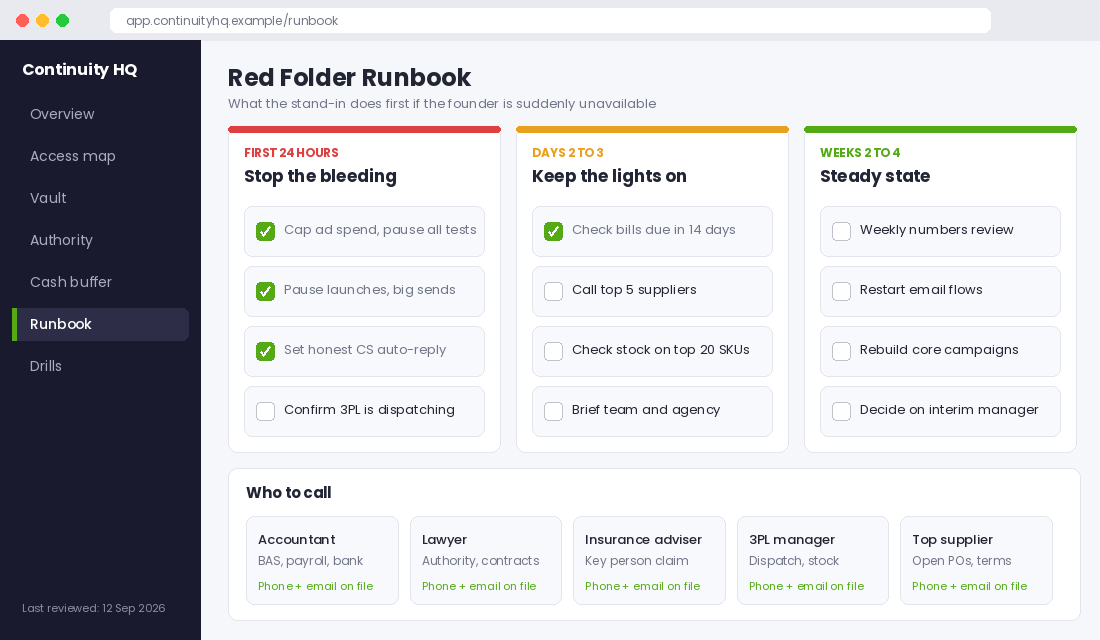
Alongside the timeline, the red folder should hold a short contact sheet: your accountant, lawyer, insurance adviser, bank business manager, 3PL account manager, top suppliers and any agency. Include each person’s role in one line. Your stand-in should never have to search your inbox to work out who your accountant is.
Store the red folder in two places: the break-glass vault, and a printed copy with your will. Tell your stand-in and your partner where both are.
Part 5: The Drill (Test the Plan Before Life Does)
A plan you have never tested is a hope, not a plan. The good news is the test is simple. Run a 72-hour absence drill.
Pick a quiet week, not November. Tell your stand-in they are running the business for three days, hand them the red folder and step away. No phone checks, no “quick questions”. Then debrief with three questions:
- Which logins or approvals did they get stuck on?
- Which decisions did they make, and which did they wait on you for?
- What did they need that was not in the folder?
Every gap they find is a gap that would have been ten times worse in a real emergency. Fix them, then repeat the drill once a year. Many founders pair it with their annual holiday. Our Shopify Founder Holiday Playbook shows you how to step away for two weeks, and a planned break is the perfect live test of your continuity plan.
Put a recurring reminder in your calendar for a quarterly 30-minute continuity check. Remove anyone who has left the business, add new systems you have installed, refresh the recovery codes you have used, and update the contact sheet. The plan decays every time you hire, fire or install a new app.
The Founder Continuity Checklist (Your Two-Day Action Plan)
Work through this list over two focused days. Tick each item only when it is done, not planned.
The Keys
- Access map built for every system, with owner, backup admin and two-factor location.
- A nominated stand-in has a full-permission Shopify staff account with their own two-factor.
- At least two in-house admins on Meta, Google Ads and Merchant Center.
- Domain registrar has a backup contact and auto-renew switched on.
- All business logins and recovery codes stored in a password manager with emergency access set up.
The Authority
- Lawyer consulted on second or alternate director.
- Enduring power of attorney in place.
- Will updated to deal with company shares and the business.
- Buy-sell agreement signed if you have a business partner.
The Cash
- Eight weeks of fixed costs held in a reserve account.
- Second authorised user on the business bank account.
- Key person insurance quoted and decided on.
- Personal income protection and life cover reviewed, including cover inside super.
The Runbook and the Drill
- One-page red folder written with 24-hour, 72-hour and 30-day actions.
- Contact sheet of advisers, suppliers and partners completed.
- Red folder stored in the vault and with your will.
- First 72-hour absence drill booked in the calendar.
- Quarterly 30-minute continuity check set as a recurring reminder.
Score yourself out of 18. Anything under 10 means your business depends on you being healthy and reachable every single day.
The Compound Effect: A Business That Does Not Need You Every Day
Here is what most founders miss. A continuity plan is not only about disaster. Every part of it makes your business better on a normal Tuesday.
The access map cleans up old admins and forgotten apps, which tightens security. The second admin means your team stops waiting on you for simple approvals. The cash reserve means a slow month is an inconvenience, not a crisis. The red folder becomes the start of real standard operating procedures. The drill shows you exactly which decisions still bottleneck on you, and those are the decisions you should delegate next.
It also makes the business worth more. Buyers pay less for a store that only works when the founder is in the room. A brand with clean access, clear authority and documented operations is easier to insure, easier to finance and easier to sell. The same work that protects your family also builds the asset.
And it gives you something harder to measure: the ability to switch off. A founder who knows the business will keep trading without them takes real holidays, sleeps better and makes clearer decisions.
Inside eCommerce Circle, protection is one of the core pillars we work on with every member, because every growth plan depends on the business surviving a bad week. If you want to see exactly where your store is being capped, take the free More Orders Scorecard. It takes two minutes and shows you which of the 10 P’s to fix first.