You uploaded 24 new ads last month. Meta spent almost all your budget on three of them. The other 21 sat at zero impressions, and your media buyer called it a learning phase problem.
What’s in This Article
It was not a learning phase problem. It was a similarity problem. Most Australian Shopify brands film one good founder video, cut it into 24 variations of the same hook, the same voiceover and the same offer, and then wonder why Meta behaves as if they only uploaded three ads. Since Meta rolled out its Andromeda retrieval system, that is exactly what it thinks you did.
This guide explains what Andromeda actually is (without the agency fluff), what the data says about creative volume and diversity, and a repeatable weekly system you can run on a modest Australian budget. If you want the testing mechanics, our Meta creative testing engine covers them. This article is about the layer above it: what Meta’s system rewards before your test even starts.
What Meta Andromeda Actually Is
Andromeda is Meta’s ad retrieval engine. Meta introduced it in an engineering post in December 2024, and agency write-ups report the rollout finishing around October 2025. Retrieval is the first stage of ad delivery. Before any auction happens, Andromeda narrows a pool of what Meta’s own engineers describe as a very large ad inventory down to a short list of candidates for each person. Only then does the ranking and auction stage pick a winner.
That order matters. If your ad does not make the short list, it never reaches the auction, no matter how good your bid or your product is.
Meta’s engineering team published a few numbers. They reported a 6% recall improvement in the retrieval system and an 8% ad quality improvement on selected segments, with a 10,000x increase in model capacity and over 100x faster feature extraction compared with the previous CPU-based components (Meta Engineering). Meta’s Q4 2025 results added that the system now runs across Nvidia, AMD and Meta’s own MTIA chips, which Meta said nearly tripled compute efficiency (PPC Land summary of the January 2026 earnings call).
You do not need to understand the chips. You need to understand one practical consequence: the creative itself is now the main targeting signal. Andromeda reads what your ad shows and says, then matches it to people who respond to that kind of message. Detailed audience stacks matter less. What the ad says about who it is for matters more.
Entity IDs: Why 24 Similar Ads Count as 3
Here is the part that catches most stores. Andromeda groups ads that look and sound alike under a shared identifier, which practitioners call an Entity ID. Meta has not published a formal Entity ID report, so treat the exact mechanics as informed inference. But the behaviour is consistent across agency analyses, including Recharm and Precis: ads that share an Entity ID compete against each other for the same slice of audience, instead of each earning its own distribution.
Swapping the background colour, changing the headline by two words or re-cutting the same footage does not create a new Entity ID. A different person, a different problem, a different format and a different opening line does.
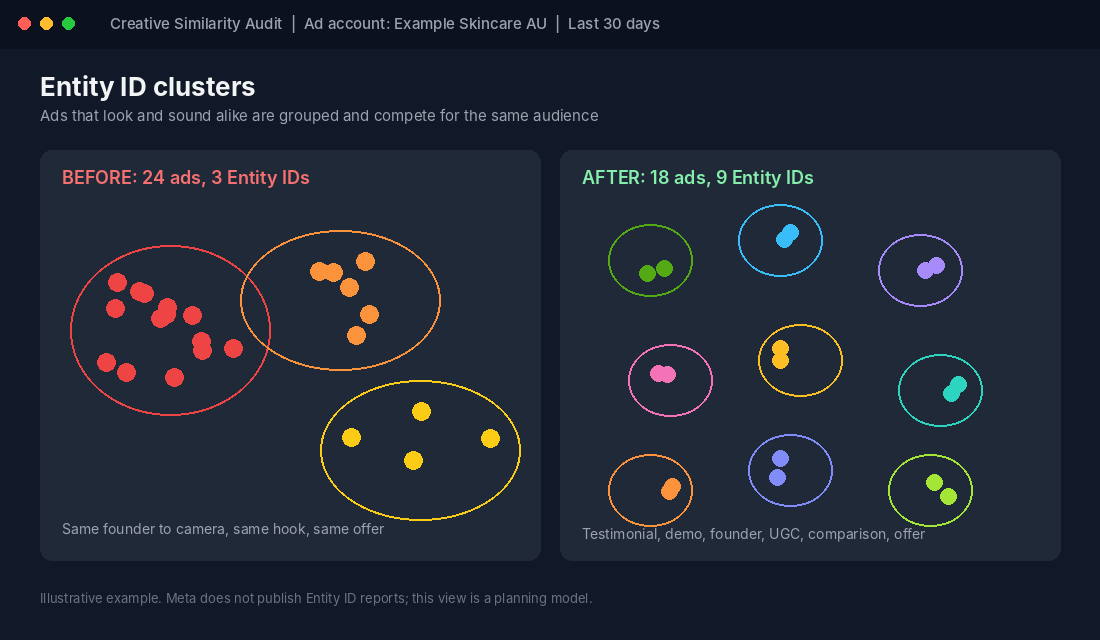
A quick test: can you describe every ad in your account in one sentence? If yes, they are probably one cluster. “Founder talks to camera about the serum” is one idea, however many versions you filmed.
What the Data Says About Creative Volume and Diversity
A caution before the numbers. Most of the public data on Andromeda comes from agencies and tool vendors, not Meta, and several of them sell creative services. Use the figures as directional, not gospel. With that said, they point the same way:
- Rollout turbulence was real. Agency Common Thread reported that a study of 3,014 advertisers saw average ROAS fall about 7% during the rollout, and that effective ad lifespan shrank from 6 to 8 weeks to 2 to 4 weeks (Common Thread). The underlying study is not named, so read it as a signal, not a benchmark.
- Volume correlates with results. The same source links 20+ new ads per month with 65% higher ROAS than fewer than 10. Correlation is not causation here, because bigger accounts test more, but the direction is hard to ignore.
- Meta’s own Advantage+ numbers are strong. Meta reported an average 22% ROAS improvement for Advantage+ sales campaigns through 2025 (PPC Land). Our Advantage+ Shopping campaigns guide shows how to structure them.
- Australian media is not cheap. One 2026 benchmark roundup puts the Australian Meta CPM near A$18.50 and CPC near A$2.10, though the source is inconsistent about currency, so check your own account (Eightx). When your CPM is that high, wasting 80% of your budget on a cluster Meta has already decided to ignore hurts.
The takeaway is not “upload more ads.” It is “upload more different ads.” Volume without diversity just feeds the same cluster.
Two Brands, Two Lessons
Dr. Squatch: one product line, many angles
US men’s soap brand Dr. Squatch is a useful case study because its ads are public in the Meta Ad Library. GoMarble’s analysis counts 3,692 tracked creatives with 636 active, and a mix of roughly 76% video to 24% image in a sampled 30-day window (GoMarble). The interesting part is not the volume. It is the angles: ingredient comparisons against supermarket soap, discovery-style testimonials, reverse social proof and pop-culture collabs. Same product, completely different reasons to care. That is how you get distinct Entity IDs without changing the product.
You do not need 636 ads. You need the habit of asking “what is a different reason someone buys this?” before every shoot.
Frank Body: a voice that is hard to clone
Aussie brand Frank Body built its early growth on customers posting with its own hashtag, and its ads lean on a first-person, cheeky voice and real in-shower content alongside polished creative (AdLibrary). The lesson for a small store is that distinctive voice and real customer content create natural variety. A customer holding the product in their bathroom looks nothing like your studio shot, so Andromeda treats them differently.
The Six Angle Types That Create New Entity IDs
Run every concept through this list. If two ads share the same angle, they are the same ad as far as Meta is concerned.
- Founder story. Why you started the brand, filmed on a phone. Works well for Australian stores because buyers like backing a local business.
- Customer proof. A testimonial or review stack. Screenshots of real reviews are fine as a static variant.
- Product demo. The product in use, shown in under 20 seconds, ending on the result.
- Comparison. You versus the supermarket, the cheap import or the old way of doing it. Name the comparison honestly.
- Problem-first. Open on the pain (“your jeans never fit properly”), not the product.
- Offer. Bundle, free shipping threshold or limited drop. Keep this to one in five ads, not the whole account.
Within each angle, change the person on screen, the setting and the first three seconds. That is what separates a real variant from a cosmetic one. Agency analyses describe hook rate (the share of viewers who watch past the first three seconds) as a primary signal now, which is why the opening line is worth more of your production time than the ending.
How Many Ads Do You Actually Need?
There is no official number from Meta, and anyone selling you a magic one is guessing. Practitioner guidance scales with spend. A creative-ops guide from Web Tonic suggests roughly 3 to 5 new ads a week under US$10K a month, rising to 10 to 20 a week between US$50K and US$150K, with most accounts turning 10 to 15% of tested ads into winners (Web Tonic). Treat those as the author’s guidance, not measured benchmarks.
For a typical Aussie store spending A$5,000 to A$20,000 a month on Meta, a workable target looks like this:
- 3 to 5 genuinely new concepts a week. Not 3 to 5 edits. Five different angles.
- 6 or more meaningfully different ads per ad set at the minimum. Fewer than that and one cluster dominates.
- 20% of spend on testing, the rest on proven winners and your Advantage+ campaign. Our Meta ads budget guide covers how to size that split for your revenue.
- A refresh check every two weeks. If your hook rate and CPA are slipping on your top ad, brief the next concept now, not after the fatigue shows in the numbers.
Fix Your Signal Before You Fix Your Creative
Andromeda finds the right people for each ad by learning from who converts. If your purchase data is thin or wrong, it learns the wrong lesson faster. Before you spend a dollar on new creative, check three things:
- Event Match Quality. In Events Manager, open your Purchase event and check the match quality score. Common Thread suggests aiming above 7. Improve it by passing email and phone through Shopify’s Facebook and Instagram channel and the Conversions API.
- Duplicate events. Browser pixel and server events firing without a shared event ID inflate your numbers and confuse learning.
- Catalogue health. If you run dynamic ads, a clean feed matters. Our Shopify Meta catalogue guide has a feed audit you can run in an hour.
Common Thread’s study also suggested catalogue-heavy accounts did better, with top performers keeping 60+ live catalogue ads. That is a vendor claim, but a clean catalogue is cheap insurance for any store with more than 20 products.
Tool: Audit Your Competitors in the Meta Ad Library (Free)
The fastest way to find angles you have not used is to see what others in your category are running. The Meta Ad Library is free and needs no login to search. Here is the setup:
- Go to facebook.com/ads/library and set the country to Australia and the ad category to All ads.
- Search for three to five direct competitors by brand name, plus two category keywords (for example “vitamin C serum”).
- Filter by Active ads and sort by longest running. An ad that has run for months is usually profitable.
- For each long-running ad, write one line in a spreadsheet: angle type, who is on screen, first sentence, format.
- Count how many distinct angles each competitor runs. Then count yours. The gap is your testing backlog.
Do this monthly. It takes 30 minutes and it is the cheapest creative research you will ever do. Copy the angle, never the execution.
The Weekly Creative Diversity Sprint (Template)
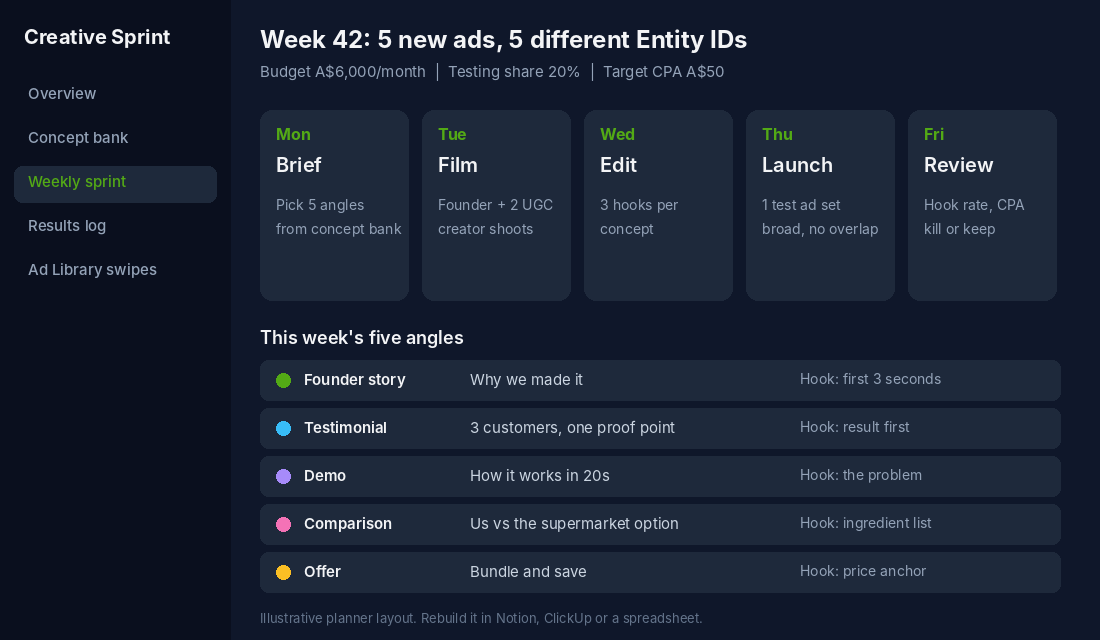
This is the routine we coach inside eCommerce Circle. It fits one person and one phone.
The sprint
- Monday, brief. Pick five angles from your concept bank. No two from the same type in the same week.
- Tuesday, film. Shoot the founder piece yourself and brief two creators for UGC. Ask for three different openings per concept.
- Wednesday, edit. Cut each concept with a distinct hook. Name files by angle, not by date.
- Thursday, launch. Put the new ads into one broad test ad set. Do not split into narrow audiences.
- Friday, review. Check hook rate and CPA by concept, not by individual ad.
The decision rule
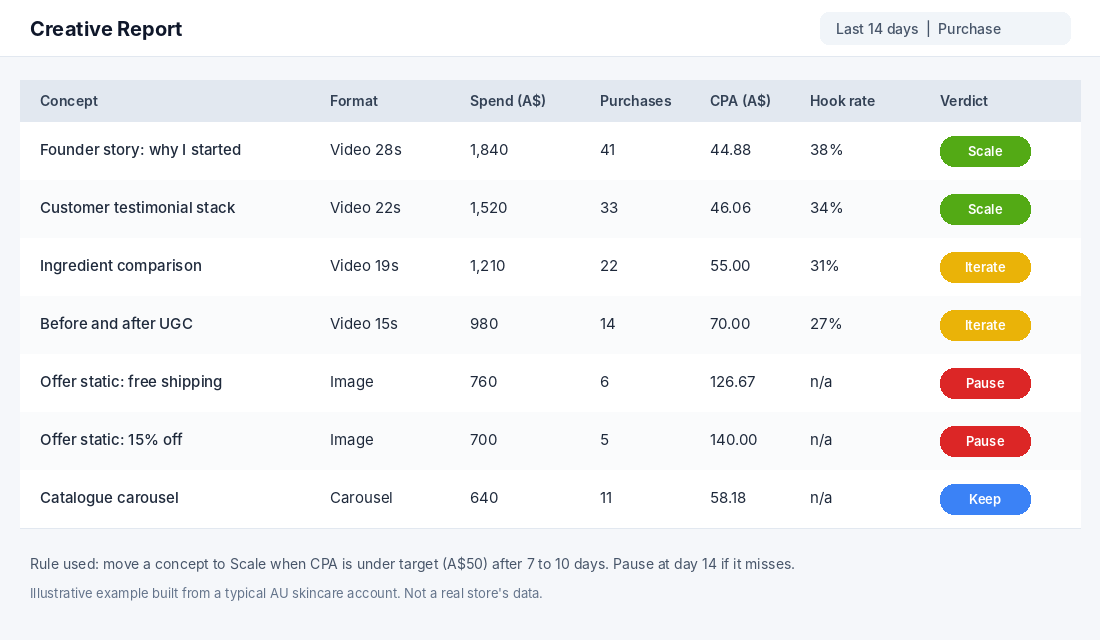
Agency guidance suggests judging concepts after 7 to 10 days, moving winners into your main campaign and pausing misses by about day 14. Adapt it to your numbers: set a target CPA from your contribution margin, then use it as the line. A concept under target at day 10 graduates. A concept over target by 30% at day 14 is paused.
The pre-launch checklist
- Can I describe this ad in one sentence that no other live ad shares?
- Is the person on screen different from the last three ads?
- Does the first 3 seconds make sense with the sound off?
- Is the claim true and backed up? (Under Australian Consumer Law, misleading claims are the advertiser’s problem, not Meta’s.)
- Is the landing page matched to the angle, not just the product?
- Have I named the file by angle so I can read results by concept?
Five Mistakes That Keep Your Ads in One Cluster
- Re-cutting one shoot. Three hooks on the same footage are still one concept. Film different scenes, not different trims.
- Using the same creator for everything. One face across ten ads reads as one idea. Rotate people, ages and settings.
- Putting every offer in every ad. If each ad opens with the same discount, the offer becomes the identity. Keep promotions to a minority of your concepts.
- Judging ads at ad level instead of concept level. A concept with three versions should be read as one result, otherwise a lucky early spender gets the credit.
- Killing a concept after two days. Meta needs a few days of delivery before the numbers mean anything. Cutting early guarantees you never find a winner.
Prepare for the November Squeeze Now
Creative fatigue hurts most when media costs spike. One agency roundup puts November CPMs around 41% above the yearly average, with January about 22% below (Jetfuel). Black Friday this year lands on 27 November, which is just over six weeks away.
That means the ads you will run in the peak window should be tested in the next three to four weeks, while CPMs are still reasonable. Walk into BFCM with a proven bench of winners and fresh concepts ready to rotate in, rather than scrambling to film something in the last week of November. Our Black Friday Australia 2026 guide has the dates and store deadlines to plan around.
How It All Compounds
Each piece of this system makes the others cheaper. Clean signal means Andromeda learns from real buyers. Diverse angles mean it can find a different buyer for each one. A weekly sprint means you always have the next winner in the pipeline before the current one tires. And a clear decision rule stops you wasting budget on concepts that were never going to work.
Notice what is missing: audience hacks, interest stacks and ten-ad-set structures. Those were the lever in 2021. In 2026, the lever is how many different reasons you give Meta’s system to show your product to different people. For the structural side of that, the creative testing engine is the natural next read.
Your First 30 Days
- Week 1: Check Event Match Quality, remove duplicate events and run the Ad Library audit.
- Week 2: Run your first sprint with five distinct angles. Launch into one broad ad set.
- Week 3: Apply the decision rule. Scale winners, pause misses, brief the next five angles.
- Week 4: Review concept-level CPA and hook rate. Retire anything that has fatigued.
Inside eCommerce Circle, creative strategy is one of the core pillars we work on with every member, because it decides how much every other Promotion dollar is worth. If you want to see exactly where your store is being capped, take the free More Orders Scorecard. It takes two minutes and shows you which of the 10 P’s to fix first.