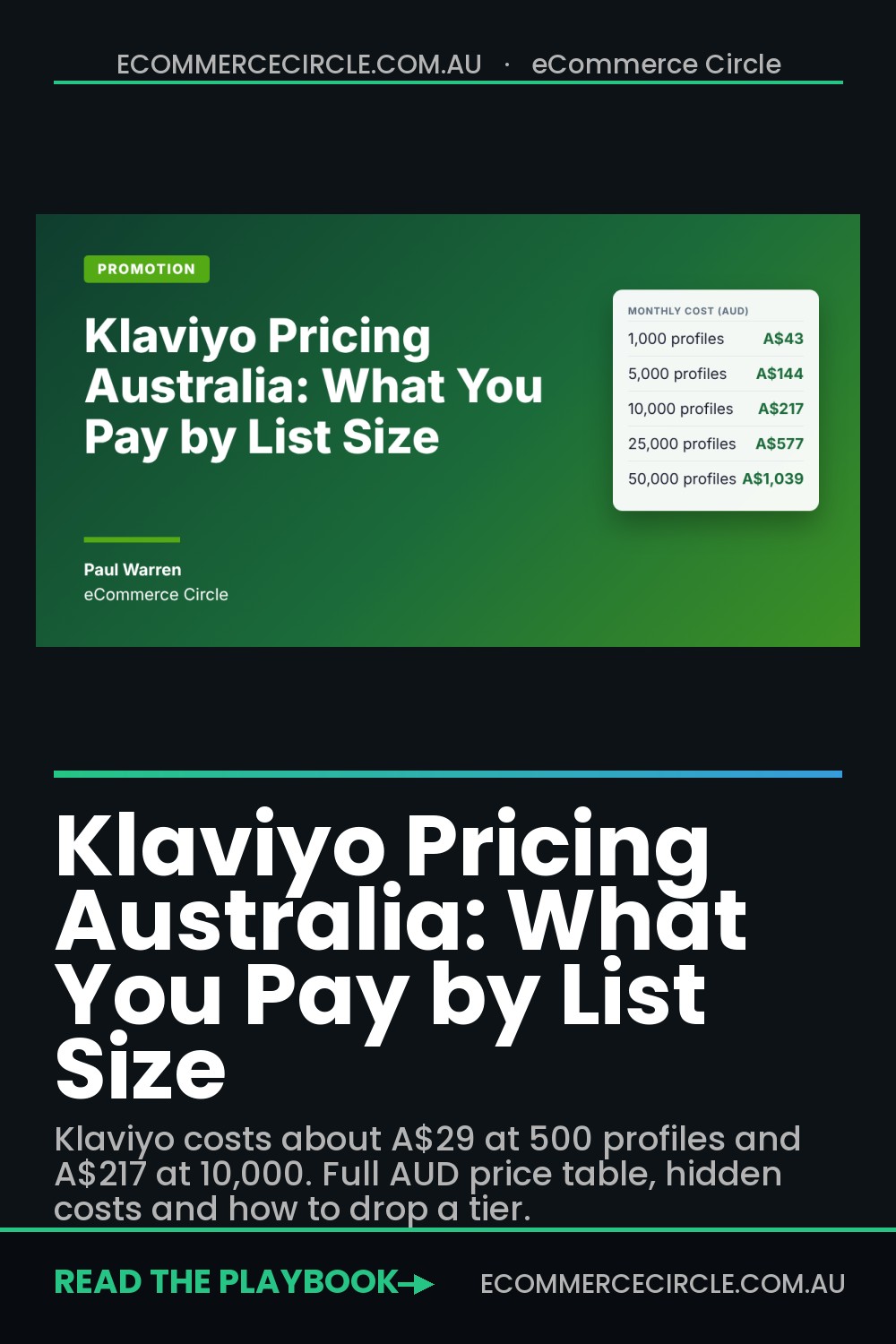
Klaviyo costs US$20 a month at 500 active profiles, US$100 at 5,000 and US$150 at 10,000. At today’s exchange rate (A$1 = US$0.693 on 1 October 2026) that is roughly A$29, A$144 and A$217 a month. There is a free plan up to 250 profiles and 500 sends.
Those are the headline numbers. What the pricing page does not tell you is why two Aussie stores with the same list size can pay very different bills, and how a tidy-up of your list can drop you a tier in an afternoon. That is what this guide covers: the full price table in Australian dollars, the costs that sit outside the table, and a worksheet to work out what email actually costs your store.
Most founders compare email platforms on the sticker price and nothing else. That is the wrong comparison. The right question is what does each email-attributed dollar cost you to earn. A US$150 plan that drives 30% of your revenue is a bargain. A US$40 plan nobody sets up properly is expensive. Pricing is only half the answer, so I have included the other half too.
Klaviyo Pricing in Australian Dollars (Email Plan)
Klaviyo prices by active profiles, not by how many emails you send. An active profile is anyone you can reach by email, SMS or another channel. Unsubscribed and suppressed contacts do not count, but suppression is not automatic. You have to do it.
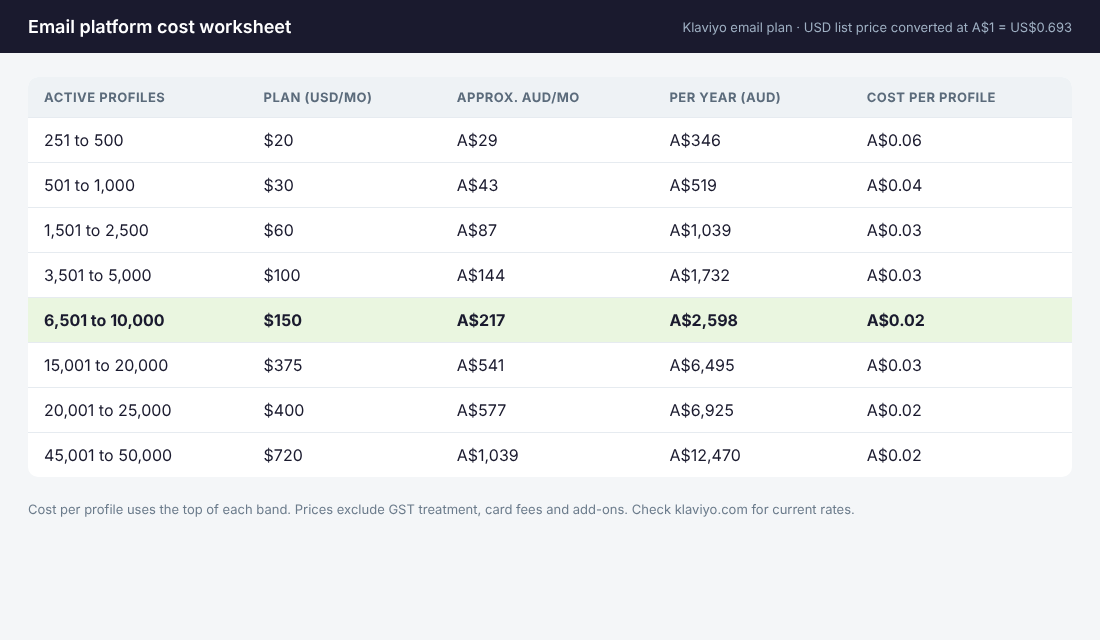
The table below uses Klaviyo’s published email plan tiers as captured in May 2026, converted at A$1 = US$0.693. Klaviyo bills in US dollars only, so your actual charge will move with the exchange rate and your card’s foreign transaction fee. Always check klaviyo.com/au/pricing before you budget.
| Active profiles | Price (USD/mo) | Approx. AUD/mo | Emails included |
|---|---|---|---|
| 0 to 250 | Free | Free | 500 |
| 251 to 500 | $20 | A$29 | 5,000 |
| 501 to 1,000 | $30 | A$43 | 10,000 |
| 1,001 to 1,500 | $45 | A$65 | 15,000 |
| 1,501 to 2,500 | $60 | A$87 | 25,000 |
| 2,501 to 3,500 | $70 to $80 | A$101 to A$115 | 30,000 to 35,000 |
| 3,501 to 5,000 | $100 | A$144 | 50,000 |
| 5,001 to 6,500 | $110 to $140 | A$159 to A$202 | 55,000 to 65,000 |
| 6,501 to 10,000 | $150 | A$217 | 100,000 |
| 10,001 to 15,000 | $175 to $350 | A$253 to A$505 | 105,000 to 150,000 |
| 15,001 to 20,000 | $375 | A$541 | 200,000 |
| 20,001 to 25,000 | $400 | A$577 | 250,000 |
| 45,001 to 50,000 | $720 | A$1,039 | 500,000 |
Two things jump out when you look at the table properly.
First, the cost per profile falls as you grow. You pay about A$0.06 per profile at 500 contacts and about A$0.02 at 10,000. Scale is on your side, which is a good reason to keep building the list rather than endlessly pruning it.
Second, the tiers are lumpy. The 6,501 to 10,000 band is a flat US$150 (A$217), which makes it the best value on the whole table. Cross to 10,001 and you jump to US$175, then US$200 by 10,501. Sitting at 6,600 profiles costs the same as sitting at 9,900, so if you are inside that band you can run campaigns more aggressively without moving your bill.
The Free Plan: When It Works and When It Quietly Costs You
Klaviyo’s free plan covers up to 250 active profiles and 500 email sends a month. It is a proper starting point for a new store, and you get access to flows, forms and reporting.
The catches matter though. Support is email-only for the first 60 days, then you are on community resources. Reviewers of the free tier also note no A/B testing and Klaviyo branding on your emails and forms. And if you go past 250 profiles or 500 sends, sending can be paused until you upgrade.
The 500 send cap is the one that bites. Send a campaign to 250 people and you have used half your month. Add a welcome flow, an abandoned cart flow and a post-purchase flow and you will blow through it. Treat the free plan as a build-and-test stage, not somewhere to live.
My rule for brands I coach: the moment you have a live welcome flow and abandoned cart flow, pay for the US$20 plan. A$29 a month is not the thing standing between you and your next 10,000 dollars in revenue. A flow that is half-built because you are rationing sends is.
The Costs That Are Not on the Pricing Table
This is where Aussie stores get surprised. The sticker price is the email plan. The real bill can include four more things.
1. SMS credits (and Australia costs more than the US)
SMS is a separate line. Klaviyo sells credit packs, and the number of credits each message uses depends on the destination country. Recent pricing breakdowns put a US text at 1 credit (about US$0.009) and an Australian text at 4 credits (about US$0.037, or roughly A$0.053). Klaviyo’s own 2021 announcement of SMS in Australia quoted 3 credits, so check what your account shows today.
Do the maths for your list. A pack of 1,250 credits (US$15) buys you roughly 312 Australian messages. If you have 5,000 SMS-reachable profiles and send each one a single text a month, that is 20,000 credits, or around US$180 (A$260) on top of your email plan. SMS can be a great channel, but price it before you promise your team a weekly text.
2. Add-on products
Reviews is billed separately, starting at US$25 a month for 250 orders. Marketing Analytics, the customer data platform and the service product are each separate. One comparison site estimates that stacking them can double the base price. If you already run Judge.me, Okendo or Yotpo, do not switch on a second reviews product just because it is in the dashboard.
3. Currency and card fees
Because billing is in USD, a swing in the dollar changes your bill. A drop from US$0.69 to US$0.64 makes a US$150 plan jump from A$217 to about A$234. Not a disaster, but put it in your budget as a range. Your accountant will also want to know how GST is treated on the overseas invoice, so ask rather than guess.
4. Tier creep and slow downgrades
Profiles move you up a tier automatically as your count grows. Moving back down is not always automatic. Klaviyo has an auto-downgrade setting, and at least one independent pricing guide notes it is off by default. If you cleaned your list last quarter and are still paying for the old tier, check that setting first.
How to Cut Your Klaviyo Bill Without Losing Revenue
The fastest saving is not a cheaper platform. It is paying for the right number of profiles. Most stores I look at are paying for 15 to 30% of their list that has not opened an email in a year.
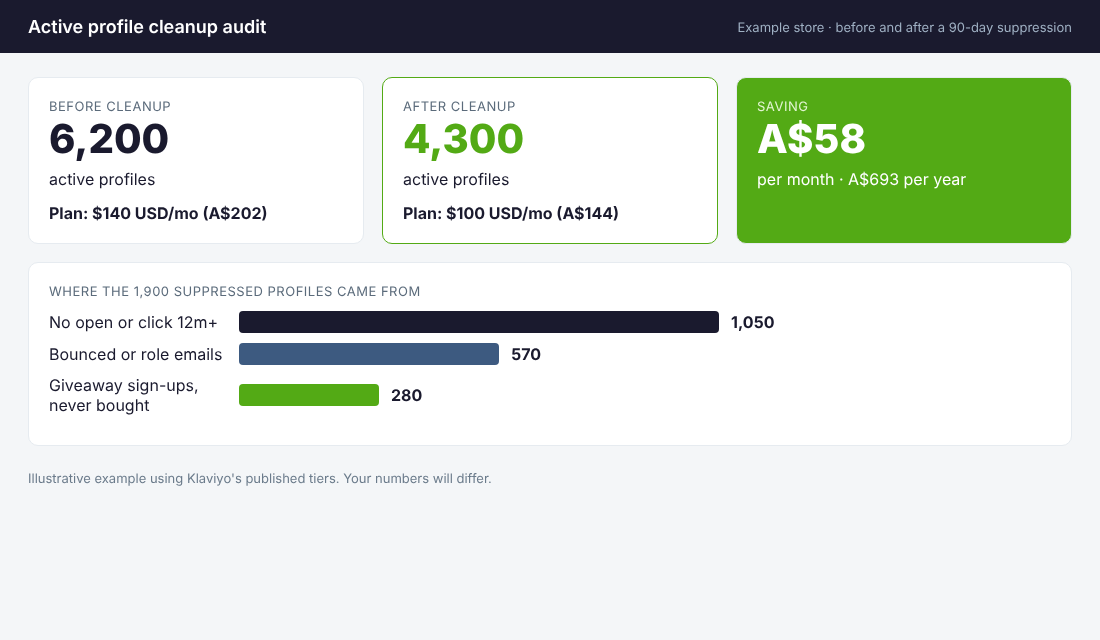
Here is the process I walk members through. It takes about an hour.
- Check your current tier. In Klaviyo go to your account billing page and note your active profile count and where you sit in the tier table above.
- Work out the gap to the next tier down. If you have 6,200 profiles and the 5,001 to 5,500 band costs US$110 (A$159) instead of US$140 (A$202), you need to remove 700 to save A$43 a month.
- Build a segment of the unengaged. Create a segment of profiles who have not opened or clicked an email in the last 180 to 365 days and were created more than 180 days ago. Add anyone who has not placed an order in that window so you never suppress a recent buyer.
- Run a sunset flow first. Send two or three win-back emails with a clear ‘stay on the list’ button. People who click get pulled back in. The rest are safe to suppress.
- Suppress the leftovers. Use the bulk suppress action on the segment. Suppressed profiles stop counting toward billing at the next cycle.
- Turn on auto-downgrade. In your plan settings, enable the downgrade-on-profiles option so the saving actually reaches your invoice.
The bonus is deliverability. Mailbox providers watch how many of your recipients ignore you. Sending only to engaged people improves your inbox placement, which lifts the revenue per send on everyone else. Cleaning the list pays you twice.
If you are sending to the same people too often, that also eats engagement. Our guide to how often to email your Shopify list covers the send cadence side.
What Klaviyo Actually Earns You: Two Aussie Examples
Cost only makes sense against return. Klaviyo publishes a few Australian case studies, and the numbers are worth knowing (they are the vendor’s own figures, so read them as best-case).
Budgy Smuggler, the Australian swimwear and accessories brand, reported 30% of total revenue coming from Klaviyo in 2023, a 30x return on its Klaviyo spend and 45% year-on-year growth in Klaviyo-attributed revenue. The play was segmentation: retargeting people who viewed a specific print, targeting AFL and NRL fans, and sending early-access codes to VIPs instead of blasting the whole list.
La La Land, a Shopify paper goods and homewares store, attributed 43.6% of its revenue to Klaviyo in May 2023. One sale email drove more than A$30,600, its biggest campaign ever. They had moved from Omnisend, imported 40,000+ contacts in two days, and tightened list hygiene by sending only to engaged subscribers and suppressing the rest.
Notice what both have in common. Neither won because of the platform’s price. They won because they segmented and cleaned their lists. The tool gave them the lever; the work was theirs.
For context on where the money comes from inside a Klaviyo account, the platform’s own benchmark data across 183,000 customers shows flows generate about 41% of email revenue from just 5.3% of sends, with an average click rate of 5.58% versus 1.69% for campaigns. If you have not built your core automations yet, start with our Klaviyo flows guide for Shopify and the 5-email welcome flow before you worry about the tier.
Klaviyo vs Omnisend vs Shopify Email: What You Pay
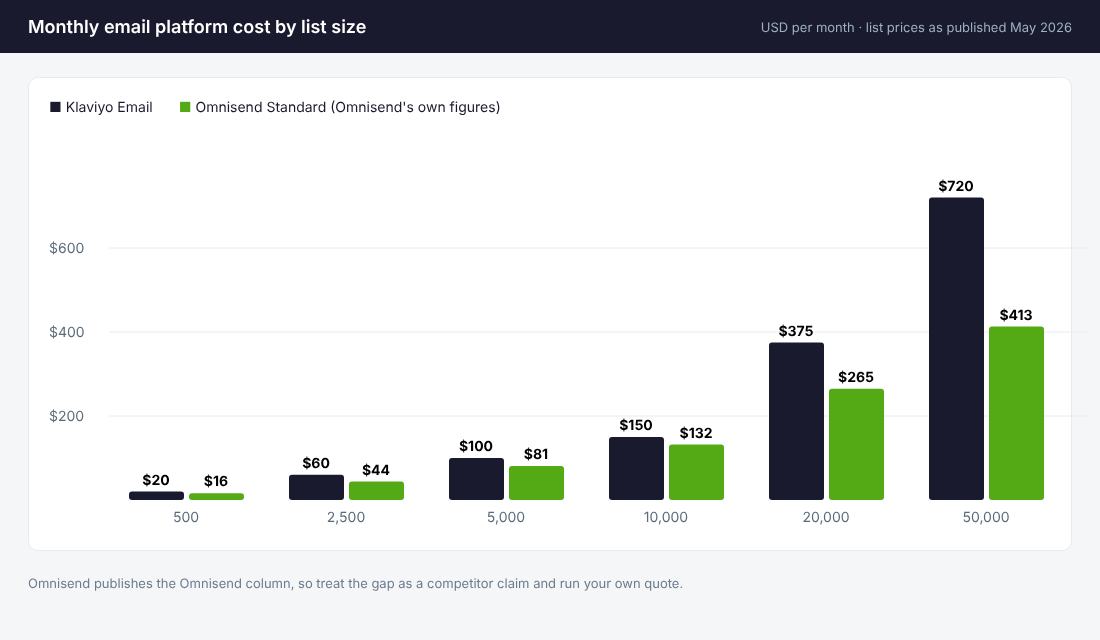
Klaviyo is not the only option, and for some stores it is not the right one. Here is how list prices compare. The Omnisend figures come from Omnisend’s own comparison (a competitor to Klaviyo, so treat the gap as a claim to test, not gospel).
| Profiles | Klaviyo Email | Omnisend Standard | Gap (USD/mo) |
|---|---|---|---|
| 500 | $20 | $16 | $4 |
| 2,500 | $60 | $44 | $16 |
| 5,000 | $100 | $81 | $19 |
| 10,000 | $150 | $132 | $18 |
| 20,000 | $375 | $265 | $110 |
| 50,000 | $720 | $413 | $307 |
Up to 10,000 profiles the gap is under US$20 a month, which is roughly A$26. That is less than a single Meta ad click bidding war in November. Above 20,000 profiles it becomes real money, and it is worth running a quote.
Shopify Email sits in a different bracket. It includes 10,000 emails a month free and, per third-party summaries, charges about US$1 per extra 1,000. It is fine for a plain newsletter and a basic abandoned cart email. It is not built for deep segmentation, split testing or multichannel flows. If you are under 1,000 customers and just need to send, it is a sensible start.
I put the full trade-offs in our Klaviyo vs Omnisend comparison. The short version: switch only if you can name a feature you are missing or a bill you cannot justify. Migrating flows and rebuilding segments costs hours, and hours cost more than A$20 a month.
The Email ROI Check: Is Your Plan Worth It?
Here is the formula I use. Take your email-attributed revenue for the last 90 days from Klaviyo’s reporting, divide by three, and divide that by your monthly Klaviyo bill (plan, SMS and add-ons, converted to AUD).
Worked example: a store on 8,000 profiles pays US$150 (A$217) a month for email and spends about A$100 on SMS. Total A$317. Klaviyo attributes A$38,000 of revenue over 90 days, so about A$12,667 a month. That is a 40x return on the platform bill. Even if you discount attributed revenue by half for overlap with other channels, the ratio stays above 19x.
If your ratio is under 10x, the problem is almost never the price. It is flows that are missing, a list that is stale, or campaigns going to everyone. Fix those before you change tools. Our Australian email marketing benchmarks will tell you whether your open and click rates are where they should be.
Your Email Platform Cost Checklist
Copy this into a doc and fill it in. It takes 20 minutes and will likely save you a few hundred dollars a year.
- Active profiles today: ______ (from your Klaviyo billing page)
- Current tier and price: US$____ = A$____ at today’s rate
- Distance to the next tier down: ______ profiles
- Unengaged profiles (no open or click, 180+ days): ______
- Sunset flow live? Yes / No
- Auto-downgrade on? Yes / No
- SMS credits used last month: ______ (4 credits per Australian message)
- Add-ons you pay for and actually use: ______
- Email-attributed revenue, last 90 days (A$): ______
- ROI ratio (monthly attributed revenue / monthly bill): ______ x
- Next review date: put it in the calendar for 90 days out
Planning Your Tier Before Black Friday
Black Friday lands on 27 November this year, and list growth spikes in the weeks before it. Pop-ups, giveaways and early-access sign-up pages can add thousands of profiles quickly, and each one counts toward your tier from the moment it becomes reachable.
Do the sums in October, not in December. If you sit at 4,600 profiles and plan to add 1,500 before the sale, you will cross from the US$100 band (A$144) into the 5,501 to 6,000 band at US$130 (A$188) and then toward US$140. That is a bigger bill, but at BFCM email volume it is almost always the cheapest revenue you will buy all year. The mistake is being surprised by it.
- Before the sale: clean the list so you start the season on the lowest possible tier.
- During the sale: let the list grow. Do not suppress people who joined last week.
- In January: run the sunset flow on giveaway sign-ups who never bought, then switch on auto-downgrade so the bill falls back.
Klaviyo Pricing FAQs
Does Klaviyo charge in Australian dollars?
No. Billing is in US dollars, so your AUD cost moves with the exchange rate. Budget for a range of about 5% either side.
Is Klaviyo free for Australian stores?
It is free up to 250 active profiles and 500 sends a month. After that you move to a paid tier starting at US$20 a month (about A$29).
What counts as an active profile?
Anyone you can reach by email, SMS or another channel. Unsubscribed and suppressed profiles do not count, but you need to suppress long-dormant contacts yourself.
Is there a discount for paying annually?
Self-serve plans are month to month with no annual discount. Custom annual contracts are generally a conversation for larger accounts, and only through Klaviyo’s sales team.
The Compound Effect: Price Is the Smallest Lever
Put the pieces together. A clean list lowers your tier and lifts deliverability. Better deliverability raises revenue per send. Strong flows turn a small slice of sends into 41% of email revenue. Tight segmentation, the thing Budgy Smuggler and La La Land both did, turns the same list into a bigger result.
Now compare the sizes. Dropping one tier saves you A$40 to A$60 a month. Fixing one weak flow can add thousands a month. So do the list clean-up because it is quick and pays twice, but spend most of your attention on what you send, not what the platform charges.
Inside eCommerce Circle, email is one of the core Promotion levers we work on with every member. If you want to see exactly where your store is being capped, take the free More Orders Scorecard. It takes two minutes and shows you which of the 10 P’s to fix first.