Dropshipping in Australia is worth it only if your gross margin is 65% or more and your supplier ships from an Australian warehouse. Below that, ad costs, card fees and refunds eat the profit before it reaches your bank account.
That is the part most “start dropshipping with $0” guides skip. They show you a $20 product selling for $65 and stop there. They never subtract the $17 you spent on ads to get that one sale, the $8 shipping, the refund you owe when the parcel takes three weeks, or the fact that you are legally the seller if the product is faulty.
This guide gives you the real numbers for 2026, the supplier options that work for Aussie stores (including Shopify Collective, which only opened to Australian merchants in June), the legal obligations you cannot hand to a supplier, and a 30-day test plan so you find out whether a product works before you spend serious money.
What dropshipping actually earns an Australian store
Dropshipping means you sell the product, a supplier holds the stock and ships it to your customer, and you never touch the parcel. You keep the difference between what the customer pays and what the supplier charges you.
The difference is smaller than it looks. TrueProfit analysed more than 1,200 dropshipping stores, and net profit margins typically landed between 15% and 25% for established sellers. Not gross margin. Net, after ads, fees and refunds. Newer stores often sit below that range for months.
Here is the worked example that shows why. A $65 sale of a product that costs you $20 from the supplier:
- Selling price: $65.00
- Product cost (COGS): $20.00, which gives a 69% gross margin before shipping
- Shipping charged by the supplier: $8.00
- Payment processing: about $2.19 (2.9% plus 30 cents)
- Ad spend to win that order: $17.00
- Returns provision: $3.00
- Net profit: about $14.81, or roughly 23% of the sale
One order, $14.81. To replace a $75,000 salary at that rate you need around 5,000 orders a year, and that is before software, your time and tax. Dropshipping is a real business model, but it is a volume game with thin margins, and the stores that win treat it that way from day one.
Notice the gross margin in that example is already 69%. The same source suggests most stores need a 65% to 70% gross margin before ad spend, transaction fees and refunds to land in that 15% to 25% net range. If your product costs $35 and sells for $65, you are at 46% gross margin and the model breaks.
The market is big, but the shopper is hard to impress
Demand is not your problem. Australia Post’s latest eCommerce report, reported by Inside Retail, shows Australians spent $82.6 billion online in 2025, up 14% on the year before. Shoppers now buy from an average of 16 brands a year and make four more online purchases annually than they did the year before.
Three other numbers from the same report shape how you should plan:
- Average basket: $96, down 0.4% year on year. Customers are buying more often but not spending more per order, so a $25 accessory with a $17 ad cost is a losing bet.
- Online marketplaces took $18.9 billion, the biggest single category ahead of food and liquor at $16 billion and fashion at $11.6 billion. Your customer is comparing you against Amazon, eBay and Kogan on price and delivery speed every time.
- Millennials are the most active buyers, with 47% shopping online weekly and $29.7 billion in annual spend. They also check delivery times before they check out.
Put those together and the picture is clear. Australians buy online constantly, but they have a lot of places to buy from. A dropshipped product with no brand, a three-week delivery estimate and the same photo as five other stores does not win that comparison. A product with a local warehouse, a clear return policy and a store people trust does.
Break-even ROAS: the number that decides if you have a business
Before you list a single product, work out the return on ad spend you need just to break even. Most beginners skip this and discover the problem after spending $2,000.
Use the $65 example. Take the sale price and subtract everything except ads: $20 product, $8 shipping, $2.19 processing and $3 returns provision. That leaves a contribution of $31.81 per order before ads.
- Break-even cost per purchase: $31.81. Spend more than that to win an order and you lose money.
- Break-even ROAS: $65 divided by $31.81, which is 2.04. Every dollar of ads must return $2.04 in revenue just to cover costs.
- Target ROAS for a 20% net margin: you need roughly $13 net per order, so ad cost must stay under about $18.80, a ROAS of around 3.5.
If your Meta Ads are returning a ROAS of 1.8, you are not “nearly there”. You are paying to sell product. Our Meta Ads ROAS benchmarks for Australia post covers what good looks like by category, and the contribution margin guide walks through the same maths for any product.
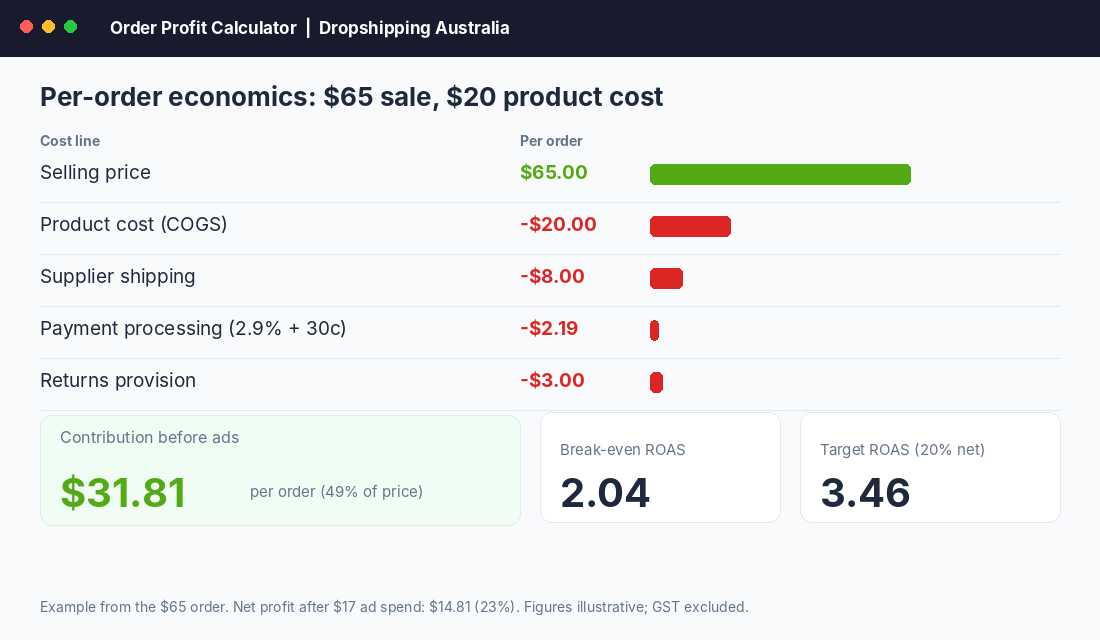
The screenshot above is the per-order view to build before you test any product. Four lines matter more than the rest: contribution before ads, break-even CPA, break-even ROAS and target ROAS. Build that into a spreadsheet before you test any product and you will reject most of the ideas on your list within ten minutes, which is the point.
Local supplier or overseas supplier: pick one on purpose
This is the single biggest decision in Australian dropshipping, and most beginners make it by accident because the overseas price looks cheaper.
The delivery gap is large. Overseas suppliers typically take 1 to 3 weeks. Suppliers with stock in Australian warehouses deliver in 2 to 7 days. Overseas suppliers also produce higher return and dispute rates, which is why the gross margin you need to be profitable is higher than the sticker price suggests.
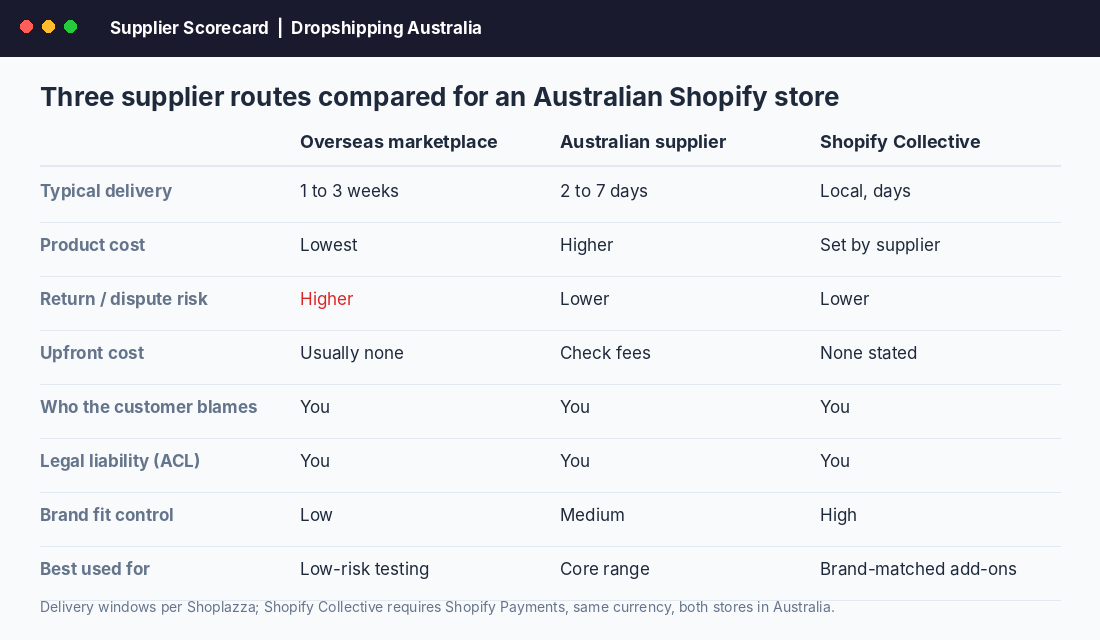
Here is how the three realistic options compare for an Australian Shopify store:
- Overseas marketplace supplier (AliExpress-style). Lowest product cost and the widest range. Longest delivery, the least control over quality, and you carry the legal liability for faulty goods. Only works for low-risk, low-return products where the customer expects to wait.
- Australian dropship supplier. Higher cost per unit, which squeezes margin, but delivery in days and far fewer “where is my order” emails. Your refund and complaint load drops noticeably.
- Shopify Collective. Local suppliers connected straight into your store, with Shopify handling the plumbing. Covered in the next section.
Australian suppliers worth knowing about include Dropshipzone, an Australian B2B2C platform that offers over 10,000 products and has a dedicated Shopify app so you can import products with descriptions and images directly into your store. Factory Fast is often listed for fitness equipment and garden furniture, and Brands Gateway for fashion and accessories. Check current terms with each one directly, because pre-order fees, subscription costs and minimums change.
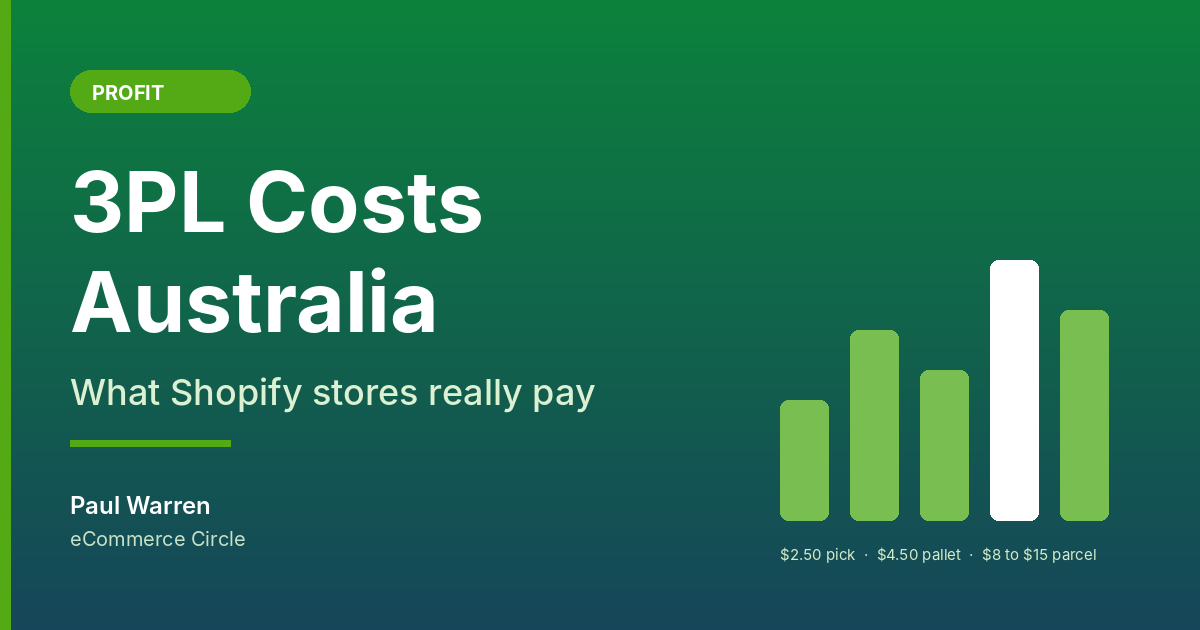
Whichever you choose, order the product yourself first. Time the delivery, inspect the packaging and photograph what a customer will open. If you would be embarrassed to receive it, do not sell it. Our post on 3PL costs in Australia is also worth reading before you choose, because the day your product works, you will need to decide whether to hold stock yourself.
Shopify Collective: the new option for Australian stores
On 10 June 2026 Shopify announced that Shopify Collective is now available to merchants in Australia. It lets you sell products from other Australian Shopify stores through your own storefront without buying stock or paying anything upfront. The supplier packs and ships the order; you keep your brand, your customer relationship and your margin.
The requirements are specific. According to Shopify, both stores must be based in Australia, use the same currency and have Shopify Payments activated. That rules out overseas suppliers by design, which is exactly why it is useful: every product comes from a local business that operates under the same consumer law you do.
Here is how to set it up:
- Step 1. Confirm Shopify Payments is active on your store (Settings, then Payments). Collective will not connect without it.
- Step 2. Install Shopify Collective from the Shopify App Store.
- Step 3. Browse the supplier catalogue and filter for brands that fit your audience, not just the cheapest products. A supplier whose brand matches yours is the whole value of this channel.
- Step 4. Import a small set, no more than 5 to 10 products, and write your own product copy and photography notes rather than using the supplier’s defaults.
- Step 5. Place a test order to yourself, check the packaging, the delivery time and how the supplier handles a return.
- Step 6. Only after the test order arrives, publish the products and switch on ads.
Shopify’s changelog does not state fees, so check the margin the supplier offers inside the app before you plan around it. Run the contribution maths from the last section on the actual wholesale price, not a guess.
The legal part you cannot hand to your supplier
This is where Australian dropshippers get caught. Most overseas guides assume no consumer guarantees. Australia has them, and they apply to you.
The ACCC states that businesses must follow all the usual consumer laws that apply to selling products, including consumer guarantees, and that this applies to overseas businesses selling directly to Australian consumers as well. If a customer receives a faulty product that does not match its description, they can ask you, the seller, for a refund, replacement or repair. “My supplier shipped it” is not a defence.
LegalVision notes that where a manufacturer is overseas, you are considered the supplier and the manufacturer for Australian Consumer Law purposes. You can assign complaint handling to a supplier in your dropship agreement, but the obligations stay with you.
Your practical obligations:
- Get an ABN. You need one for tax and invoicing, and the ATO treats you as a business from the first sale. No special dropshipping licence is required.
- Register for GST at $75,000. Once annual turnover reaches $75,000 you must register and charge 10% GST. Build the 10% into your pricing before you hit the threshold or you will take a margin cut overnight.
- Write a refund and returns policy that matches the law. Do not claim “no refunds” on faulty goods. Misleading statements about refunds can attract penalties. Our shipping policy template for Australian stores gives you wording you can adapt.
- Make accurate delivery claims. If your product takes three weeks, say three weeks. Advertising “fast shipping” on a slow overseas product is a misleading claim.
- Check product safety. Goods must meet mandatory safety standards. For children’s products, electrical items and anything worn on skin, ask the supplier for compliance documents before you list.
The stakes are real. Under the 2022 reforms the maximum penalty for serious consumer law breaches by a company is the greatest of $50 million, three times the benefit obtained, or 30% of adjusted turnover. A new store will not face that for one late parcel, but the penalty tells you how seriously regulators treat misleading claims. Also read our guide to product liability insurance for online stores, because a supplier’s insurance rarely covers you. This is general information, not legal advice, so have a lawyer review your terms before you launch.
Where Aussie dropshippers lose money
Five mistakes cost new Australian dropshippers the most.
- They price off the supplier’s cost, not the break-even ROAS. A markup of 3x sounds generous until a customer costs $30 to acquire. Price from the contribution maths, not from a rule of thumb.
- They sell what everyone else sells. If a product appears in a hundred stores, ad costs rise and your margin disappears. Look for products where you can add something: a bundle, a guide, better photos, an Australian-specific angle.
- They ignore delivery time in ads and on the product page. Customers who expected two days and got twenty open disputes with their bank. A chargeback costs you the sale, the product and a fee. Tell the truth about timing up front.
- They never test the product. Order it, open it, use it. Half of the “winning products” fail this step.
- They treat the store as a side project. With a 15% to 25% net margin, you cannot afford sloppy customer service or a slow site. Treat it like a brand and you can eventually stop dropshipping altogether and buy stock in bulk for a much better margin.
That last point matters. Dropshipping is best used as a testing method, not a permanent model. Once a product sells steadily, move it to a 3PL or your own stock and keep the margin your supplier was taking.
How to choose products that survive the maths
Run every product idea through this filter before you spend a dollar on ads:
- Gross margin of 65% or higher. Selling price minus product cost, divided by selling price. Under 65%, drop it.
- Selling price above $50. The average basket in Australia is $96. Below $40, a single ad-driven sale rarely covers its own acquisition cost.
- Under 5% expected return rate. Avoid sizing-heavy fashion, fragile items and anything electrical you cannot test.
- Local or Collective supplier available, or an overseas supplier with delivery under ten days and tracking.
- A reason to buy from you. Can you bundle it, guarantee it, or explain it better than a marketplace listing?
- Pass the mailbox test. Would you be happy to receive it as a customer?
If a product fails two or more of these, move on. There are thousands of other products and you only need a few that pass.
A 30-day test plan that limits your downside
Treat your first month as a controlled experiment with a capped budget, not a launch.
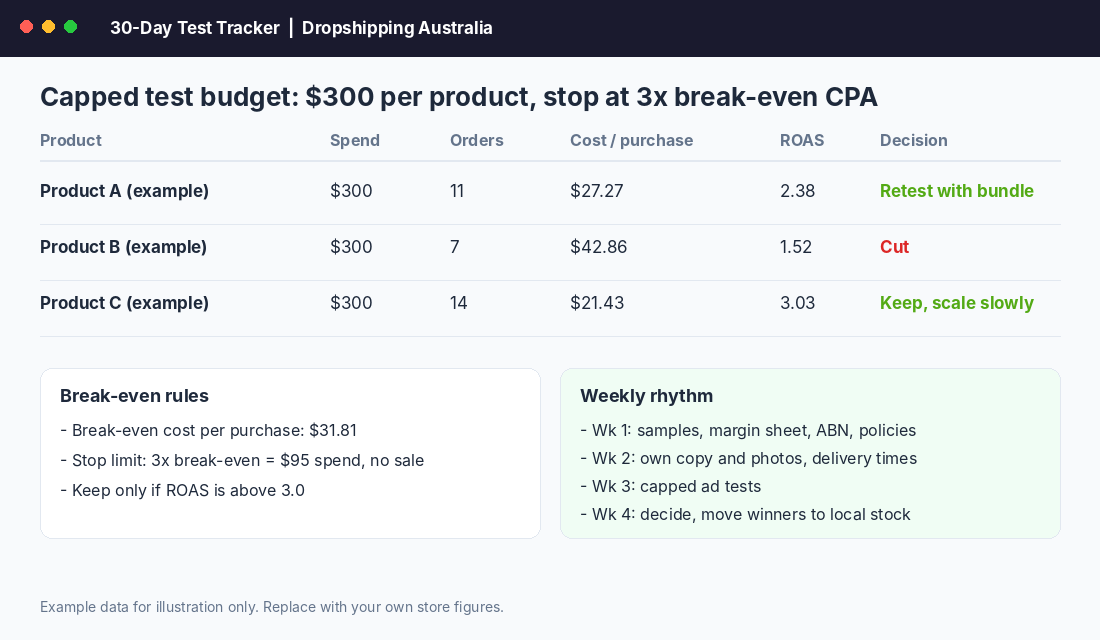
- Week 1: Set up and test. Choose 3 products that pass the filter. Order samples. Build the contribution spreadsheet. Set up your ABN, GST plan, refund policy and Shopify Payments.
- Week 2: Build. Write your own product copy and photograph what you receive. Add delivery times to the product page, cart and checkout. Install tracking so you can see cost per purchase.
- Week 3: Test with a capped budget. Spend a fixed amount per product, for example $300 each. Stop any product whose cost per purchase is above your break-even number after you have 3 times that figure in spend.
- Week 4: Decide. Keep products with ROAS above your target. Cut the rest. For the survivors, plan the move to local stock or a better supplier terms.
The cap is the safety net. A $900 test budget that ends in “this does not work” is cheap. A $9,000 ad spend that ends the same way is not.
The compound effect: margin, supplier and law work as one system
Every section above pulls on the same number. A local supplier cuts delivery from weeks to days, which lowers refunds and chargebacks, which lifts your net margin by a few points. A higher gross margin lowers your break-even ROAS, which makes your ads viable at the cost per purchase you can actually achieve. A clear legal setup means a complaint becomes a refund rather than a dispute. Fixing one at a time helps. Fixing all three turns a 15% net margin into the 25% top of the range.
That is why the stores that last are the ones that start with the maths and the supplier, not the product. The product is the easy part. The system around it is what pays you.
Where to go from here
Inside eCommerce Circle, margins, suppliers and the legal groundwork are core parts of how we help store owners build something that lasts past the first month. If you want to see exactly where your store is being capped, take the free More Orders Scorecard. It takes two minutes and shows you which of the 10 P’s to fix first. If you would rather talk it through with the team, you can get in touch here. And if you are earlier on the journey, start with our guide on how to grow a Shopify store.