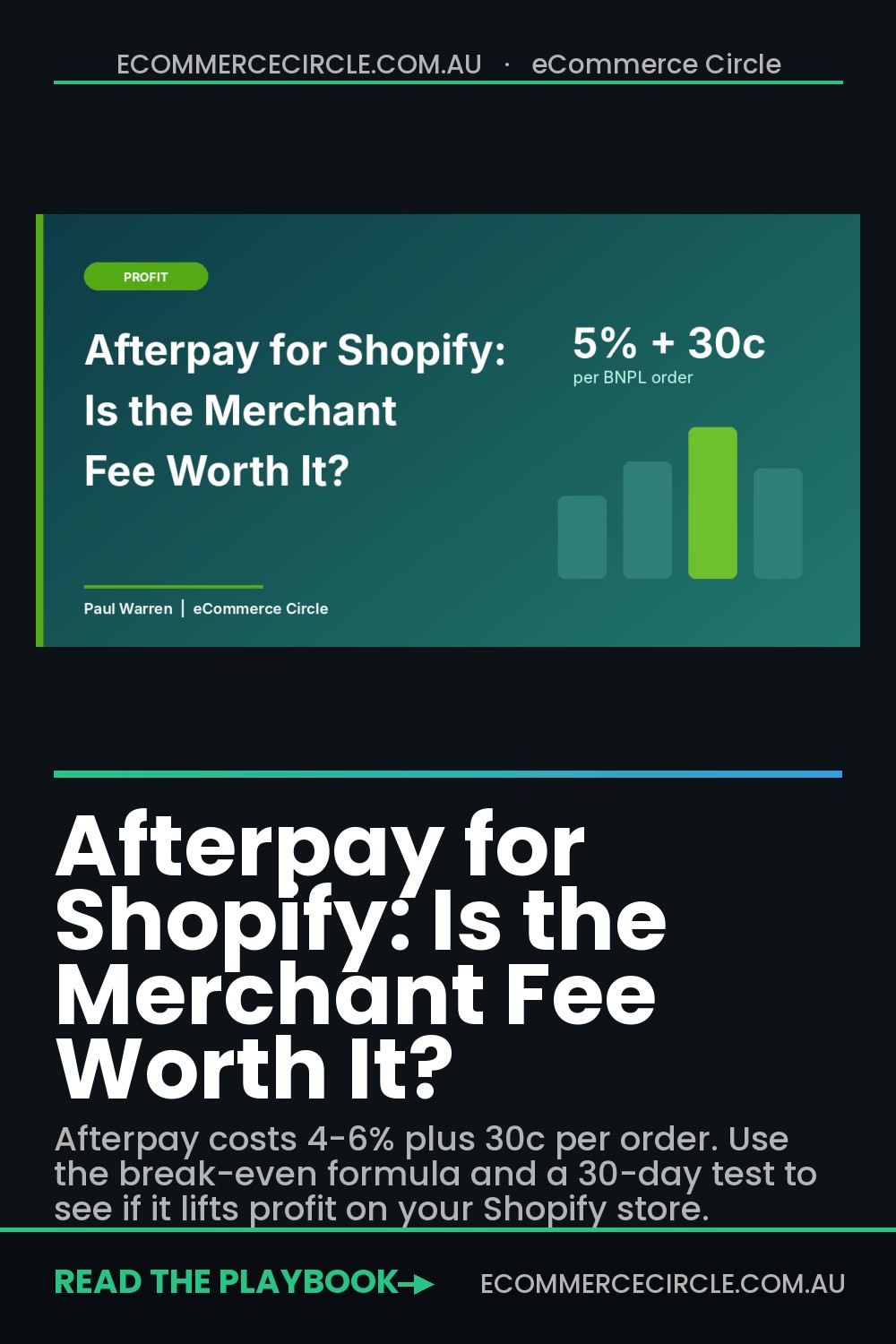
Afterpay costs most Australian merchants somewhere between 4% and 6% of every order it touches, plus 30 cents. Whether that fee is worth paying depends on one number: the share of Afterpay orders that would not have happened without it. On a store with a 55% gross margin, that number is about 6%. On a store with a 25% margin, it is closer to 14%.
Most founders never calculate it. They either switch Afterpay on because a competitor has it, or they leave it off because the fee feels like a rip-off. Both are guesses. The brands that get this right treat buy now pay later (BNPL) like a paid channel with a cost per sale, a test period and a kill switch.
This guide gives you the fee maths, the break-even formula, a 30-day test you can run on your own Shopify store, and the setup steps if the numbers say yes. It sits in the Profit part of the More Orders Operating System because the real question is not "does Afterpay lift sales?" It is "does it lift profit?"
What Afterpay actually costs a Shopify store in Australia
Afterpay does not charge a sign-up fee or a monthly fee. It takes a commission on each order plus a flat fee. According to a CreditorWatch breakdown of Afterpay merchant fees, that is a flat $0.30 per transaction and a commission of 4% to 6%, with the percentage falling as the item price rises. Your rate is set in your merchant agreement, so treat those figures as a range and check your own contract.
For context, the Reserve Bank of Australia’s data, reported by Savings.com.au in 2021, put typical BNPL merchant fees at 4% to 7% per transaction against 1% to 1.5% for credit cards. That data is a few years old and card costs vary by plan and gateway, but the gap is the point. BNPL is the most expensive way for a customer to pay you.
Here is what that looks like on a single $120 order with a 55% gross margin, using a 5% Afterpay rate and an assumed 1.75% + $0.30 card cost (swap in your own gateway rate):
| Line | Amount | Note |
|---|---|---|
| Gross profit before payment fees | $66.00 | $120 x 55% |
| Afterpay fee (5% + $0.30) | $6.30 | 9.5% of gross profit |
| Card fee on the same order (assumed) | $2.40 | What you would have paid anyway |
| Extra cost of choosing BNPL | $3.90 | The number that matters |
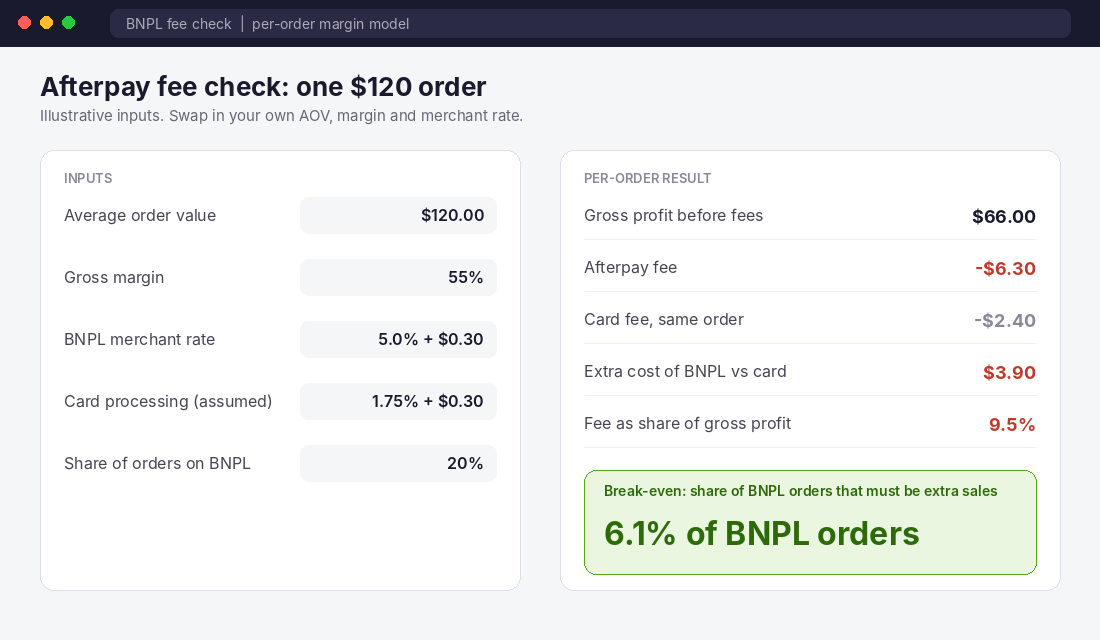
Notice what the table does not say. It does not say Afterpay costs $6.30 per order. Every order that would have been paid by card anyway only costs you the $3.90 difference. That distinction drives the whole decision, and it is where most "Afterpay is too expensive" arguments go wrong.
The only question that matters: how many of those orders are extra?
BNPL helps in two ways. It converts shoppers who would have abandoned, and it lifts basket size because splitting four payments makes a $160 cart feel like $40. Both of those are incremental profit. The orders that would have been paid by card anyway are not. They are just a more expensive way of collecting the same money.
So the maths is simple. Call the share of BNPL orders that are truly extra "s". Extra orders earn you their full gross profit minus the BNPL fee. Non-extra orders cost you the BNPL fee minus the card fee you would have paid. Set the two equal and you get the break-even:
Break-even share = (BNPL fee – card fee) / (gross profit – card fee)
On the $120 example: $3.90 divided by $63.60 is 6.1%. If more than about 6 in every 100 Afterpay orders are sales you would not otherwise have made, you are ahead. If fewer, you are paying 4% to 6% to move customers from one payment method to another.
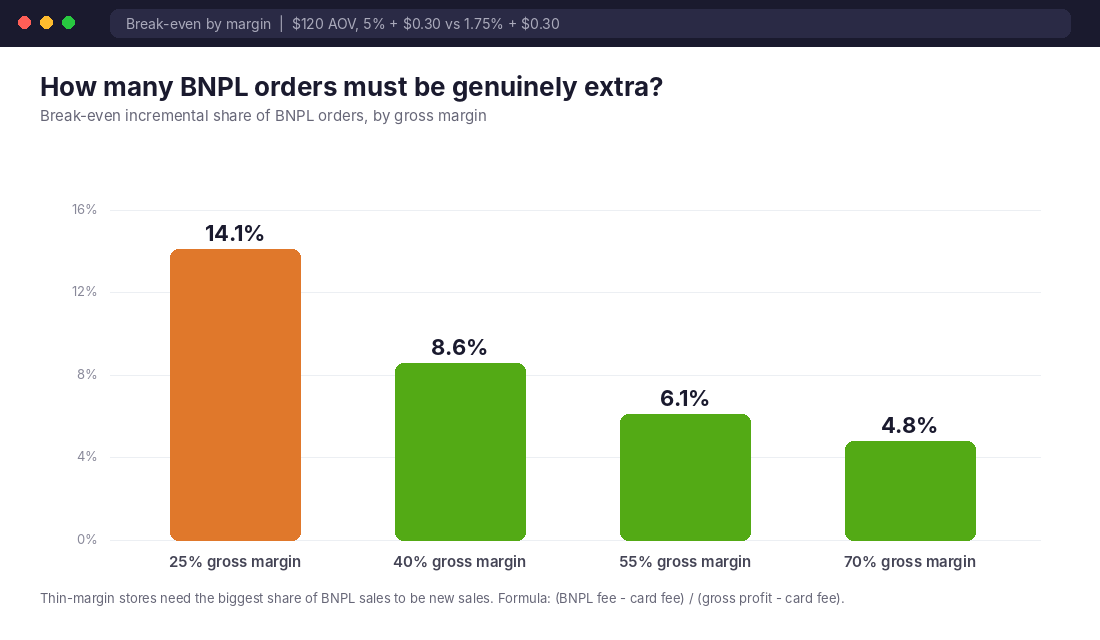
| Gross margin | Gross profit on $120 | Break-even incremental share |
|---|---|---|
| 25% | $30.00 | 14.1% |
| 40% | $48.00 | 8.6% |
| 55% | $66.00 | 6.1% |
| 70% | $84.00 | 4.8% |
This is why Afterpay is an easy yes for a jewellery or skincare brand with a 70% margin and a harder call for a thin-margin electronics reseller at 25%. The fee is the same percentage. The cushion to absorb it is not. If you have not worked out your real product margins after freight, packaging and discounts, start with the Black Friday discount calculator and get that figure first.
What the vendor numbers say (and why you should discount them)
Afterpay publishes plenty of upbeat statistics. They are worth knowing, and worth reading with the source in mind. All of the numbers below come from Afterpay’s own material, not independent studies.
- Basket size. In sponsored content on SmartCompany, Afterpay cites an average order value 28% higher for Afterpay customers than non-Afterpay customers (June 2022 study) and 21% higher purchase frequency.
- Small business revenue. Afterpay’s February 2022 newsroom post claims Australian small businesses partnering with it saw an average 13% revenue uplift, about $32,000 in new annual revenue.
- Returns. The same post says Afterpay purchases had return rates of 2% to 6% against 9% to 20% for the average Australian retailer. That one is worth testing yourself, because returns are a profit killer.
- Conversion. Afterpay’s merchant guide claims an average 20% lift in cart conversion across partners. No method is shown.
The catch is selection bias. Customers who choose Afterpay are not a random sample. People with bigger intended baskets are more likely to reach for instalments, so a higher AOV among Afterpay users does not prove Afterpay made the basket bigger. Treat these figures as the optimistic end of the range, and run your own test before you believe them.
Three Australian brands and what they reported
Real examples are more useful than averages. Each of these comes from Afterpay’s own newsroom, so they are success stories chosen by the vendor, but they show where BNPL tends to work.
- Empire Skate saw a 15% rise in average order value after enabling Afterpay on its online store, and Afterpay customers spent 25% more than customers using other payment methods. A streetwear and skate brand with a younger customer base and mid-priced baskets is the natural fit.
- Peggy & Twig, a jewellery brand from rural NSW, reported more orders for its higher-priced pieces after offering Afterpay. Considered purchases with a big price tag are where instalments remove the final hesitation.
- Pablo & Co, a Brisbane dog accessories brand, nearly sold out during a Disney collaboration drop, with founder Loren Cunliffe saying the team "almost sold out within 20 minutes." Launch moments with a strong audience are where fast checkout options earn their keep.
The pattern: mid to high price points, emotional or considered purchases, and an audience that already uses BNPL. If your average order is $25 and your product is a repeat-buy consumable, the evidence is much thinner.
The rules changed in 2025: what that means for you
BNPL used to sit outside Australian credit law. That ended on 10 June 2025. Under the new framework, as Stripe’s summary of the rules explains, providers now need an Australian credit licence, must be members of the Australian Financial Complaints Authority, and must check a customer’s finances before approving a purchase, even a $100 one. They must also decline a transaction if repaying it is likely to cause the customer substantial hardship.
For you as a merchant, that has two practical effects. First, some customers will be declined at checkout where they would previously have sailed through. Your BNPL share may be lower than the vendor numbers suggest, which makes the break-even maths above more important, not less. Second, the rules are aimed at providers, so your obligations as a retailer are mostly unchanged. The fee caps in the legislation apply to customer fees, not to the commission you pay, so ask your provider directly about your rate.
A related question comes up often: can you add a surcharge for BNPL? The RBA recommended in 2021 that BNPL providers drop their no-surcharge rules, but I could not confirm the current position, and most Australian shoppers react badly to a surcharge at the final step. Check your merchant agreement before trying it, and expect conversion to drop if you do.
The 30-day Afterpay test (a framework you can copy)
Do not rely on vendor stats or gut feel. Run a clean before-and-after test and let your own profit decide. This works whether you are adding Afterpay for the first time or deciding whether to keep it.
- Set the baseline (30 days). Record checkout conversion rate, average order value, new customer share, return rate and net profit after payment fees. Pull these from Shopify Analytics and GA4. If you are not sure what a normal conversion rate looks like for your category, check our Shopify conversion rate benchmarks first.
- Switch it on without other big changes (30 days). No new offers, no theme overhaul, no big ad shift. Seasonal spikes will blur your result, so avoid starting a test in the week before a major sale.
- Compare the same metrics. Export your orders and group them by payment gateway so you can see BNPL orders separately from card orders.
- Calculate your actual incremental share. A rough proxy: compare the change in total orders and AOV with the share of orders paid through Afterpay. If your total order count is flat and BNPL has simply taken 20% of orders from cards, the share of extra orders is close to zero.
- Make the call. Keep it if net profit after the extra fee is higher. Remove it, or restrict it to higher-priced products, if not.
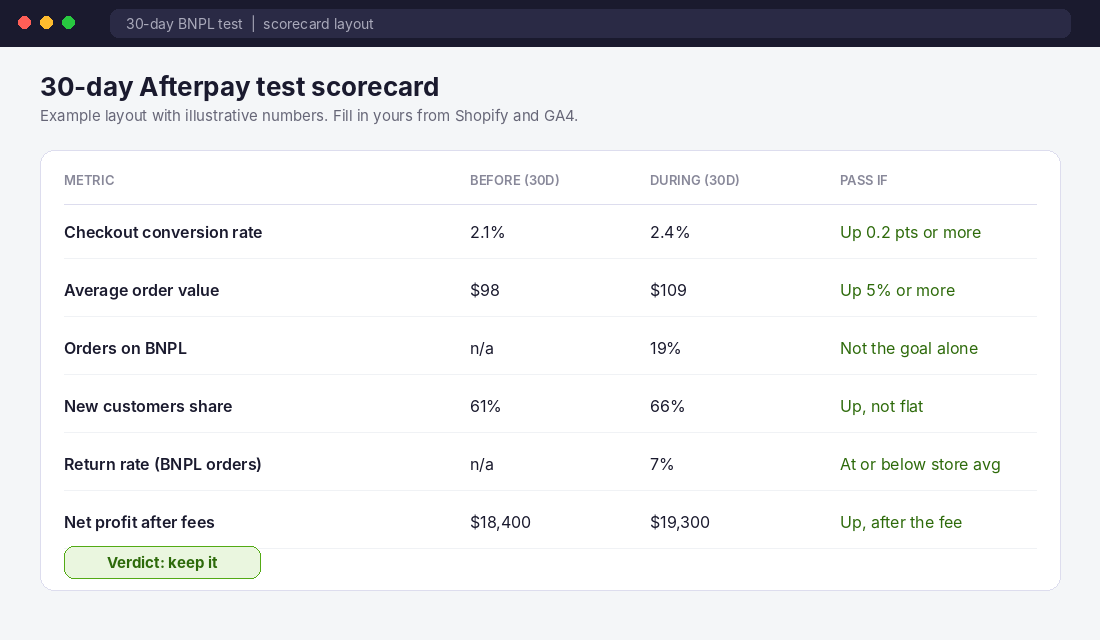
The scorecard above is the exact layout. The most important row is the last one. Conversion and AOV can both rise while profit falls, if the fee takes more than the uplift gives back.
Pass or fail: a quick rule
- Pass: net profit after fees is up, and either conversion or AOV is up by enough to cover the extra cost.
- Fail: orders are flat, a fifth of them moved to BNPL, and your payment costs went up.
- Maybe: profit is flat but new customer share rose. That can still be worth it if your repeat purchase rate is healthy, because the acquisition cost is partly covered by the fee.
How to set up Afterpay on Shopify in Australia
If the test says yes, the setup is quick. Afterpay’s Shopify getting started guide lists the prerequisites, and the Afterpay and Clearpay app on the Shopify App Store is the install route. The app is free to install, but the listing notes that a minimum annual fee and volume-based usage fees can apply, billed in USD, so read the pricing section before you commit.
- Check your store address. In Shopify admin go to Settings, then General. The store country must be Australia, Canada, New Zealand or the United States, and it has to match your Afterpay account region.
- Check your currency. Under Standards and formats, the store currency must be AUD (or USD, NZD, CAD).
- Check your payment capture setting. Under Settings, then Payments, make sure payments are captured automatically at checkout or automatically when the order is fulfilled. Manual capture needs extra steps.
- Install the Afterpay and Clearpay app from the Shopify App Store, add your gateway configuration and activate it.
- Add on-site messaging. Afterpay’s on-site messaging shows the instalment amount on product pages and in the cart. Messaging is where most of the conversion benefit comes from, because shoppers see "4 payments of $30" before they reach checkout.
- Test a real order. Place a small test order and confirm the payment shows in your Shopify Orders list under the right gateway name, so your test data is clean.
One more point on pricing. If you set a free shipping threshold, put the instalment message on the products that push baskets over it. Our free shipping threshold guide shows how to set that number, and the two work well together because both nudge the same behaviour: adding one more item.
Where to put the instalment message
Placement decides whether Afterpay earns its fee. A line buried in the footer does nothing. Put the instalment amount directly under the price on product pages, in the cart drawer and on the cart page. Keep the wording plain: "or 4 payments of $30.00 with Afterpay." Do not shout about it in an announcement bar, because that reads as a discount and cheapens the brand.
Then check it on mobile. Most Australian Shopify traffic arrives on a phone, and a message that wraps onto three lines pushes your add to cart button below the fold. Test it on your own device before you trust the preview in the theme editor.
When to say no, and what to do instead
Skip BNPL, or limit it to select products, if any of these apply:
- Your margin is under 30%. The break-even share climbs fast, and one bad month of non-incremental orders wipes out profit.
- Your average order is under $40. The flat 30 cents is a bigger slice of the sale, and small baskets rarely need instalments.
- Your customers are not BNPL users. Trade, B2B and older audiences use cards or PayPal. Ask in a post-purchase survey before you assume.
- You have a high return rate. You may refund the order but still bear the fee depending on your agreement, so check how refunds are treated.
If you decide against it, you can still lift conversion with faster checkout (Shop Pay, Apple Pay), clearer shipping costs and stronger social proof. If you are short on traffic quality, that is a different problem, and our guide to Shopify in Australia: pricing, payments and setup covers the payment options available to you.
The compound effect: payments are part of your margin system
Treat payment methods like any other lever in your margin stack. Your product margin sets the cushion. Your payment mix sets a variable cost on top. Your conversion rate and AOV decide whether that cost buys you anything. Change one and the others move.
A store with a 55% margin and a clear BNPL lift can afford Afterpay, put the instalment message on products over $80 and use it as a basket builder. A store at 30% should test it only on its higher-margin range, protect the rest with a lower-cost checkout and put its ad budget behind products that carry the margin. Same tool, opposite decisions, because the maths is different.
That is the real discipline: fix the number first, then pick the tool. When you know the break-even share, every payment decision becomes a 30-day test instead of a debate.
Your next step
Inside eCommerce Circle, payment fees and margin maths are part of the Profit pillar we work on with every member. If you want to see exactly where your store is being capped, take the free More Orders Scorecard. It takes two minutes and shows you which of the 10 P’s to fix first.