Every few weeks a founder in our community gets the email. “We’d love to invite your brand to join Bunnings Marketplace.” Or Myer. Or Big W Market. It feels like a milestone, and in a way it is. A household-name retailer wants your products on their website.
What’s in This Article
Here’s where most brands go wrong. They say yes because the logo is impressive, upload their whole catalogue, and find out three months later that the commission, the returns and the extra customer service have eaten the margin. Or worse, they quietly start undercutting their own Shopify store and wonder why DTC sales flattened.
The brands that win on retailer marketplaces do it differently. They treat each invitation as a channel decision, not a compliment. They run the maths before they sign, pilot a small range, and only scale what earns its place. With Australians spending $82.6 billion online in 2025 according to the Australia Post eCommerce Report 2026, and the big retailers racing to add third-party ranges, this decision is landing on more Aussie founders’ desks than ever. This playbook gives you the 5-gate test to make it properly.
Why Retailer Marketplaces Are Suddenly Everywhere in Australia
A retailer marketplace is when a traditional retailer lets approved third-party sellers list products on its website. The customer checks out on bunnings.com.au or myer.com.au, but you hold the stock, ship the order and usually handle the return. The retailer takes a commission for the traffic and the trust.
This model has exploded locally over the past three years. Here’s the landscape right now:
- Bunnings Marketplace has grown to more than 500 sellers and over 180,000 marketplace SKUs, with SKU count up more than 800% since FY21, according to Wesfarmers’ 2025 strategy briefing. It keeps adding categories, recently automotive and assisted living.
- Myer Marketplace sales grew 41.4% in FY25, and Myer is moving the marketplace onto the Mirakl platform to add more brands faster (Ragtrader).
- Big W Market launched in November 2023 with more than 9,000 extra products from brands like Appliances Online, Emma Sleep and Embellir (Ragtrader).
- Everyday Market from Woolworths sits under the Woolworths MarketPlus seller platform alongside Big W Market and MyDeal, with partners including Appliances Online and Koala.
- Kmart was flagged by Wesfarmers to launch its own marketplace in the first half of FY26, and THE ICONIC has run a marketplace for fashion and sport brands for years.
Now compare that with the pure-play marketplaces. Australians spent $18.9 billion on Amazon, Temu and similar platforms in 2025, up 13% and equal to 23% of all online spend. And Australia Post is explicit that this figure excludes retailer-owned marketplaces like Big W Market (Australia Post Category Insights). So the retailer marketplace slice sits on top of that, and it is growing.
If you’ve already read our Amazon Australia playbook or the eBay Australia playbook, you know the pure-play marketplaces are price-led battlegrounds. Retailer marketplaces are a different animal. The audience is narrower, the curation is tighter, and the shopper is often already in a buying mood for your category. That’s the opportunity. The risk is that the economics are rarely published, so you have to work them out yourself.
Gate 1: Customer Fit (Does Their Shopper Already Want What You Sell?)
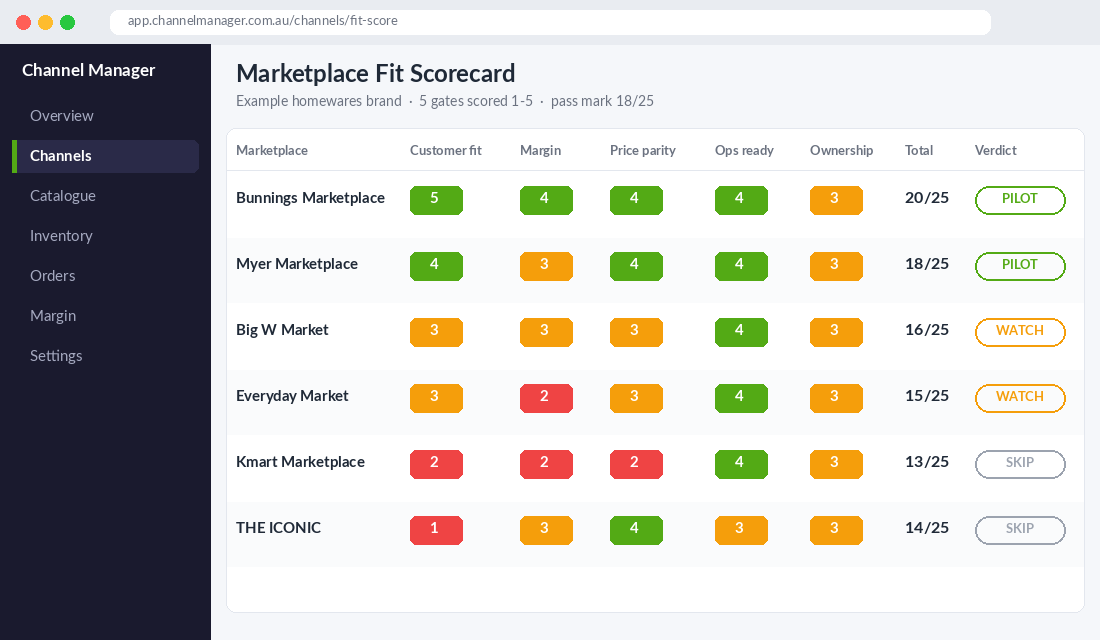
The first gate kills more bad deals than any other. A marketplace only works if the retailer’s existing shopper is already looking for your category. You are renting their foot traffic, so the question is simple: is your customer already walking past this shelf?
Australia Post found that 29% of shoppers start their product discovery on marketplaces, and Myer reports that almost 50% of its marketplace baskets also contain Myer-stocked products. Shoppers are using these sites as one-stop shops. Your products need to look like they belong in that basket.
Here’s a quick fit guide based on what each retailer is known for:
| Marketplace | Shopper sweet spot | Strong fit for |
|---|---|---|
| Bunnings Marketplace | Home owners, renovators, tradies, gardeners | Outdoor living, garden, tools, storage, pet, home improvement |
| Myer Marketplace | Gift buyers, fashion and beauty shoppers, Myer One members | Premium homewares, beauty, fashion accessories, gifting |
| Big W Market | Value-focused families | Furniture, kids, home decor, tech accessories |
| Everyday Market | Woolworths shoppers chasing Everyday Rewards points | Household, pantry-adjacent, health, baby, pet |
| Kmart Marketplace | Price-first households | Lower price point homewares, toys, lifestyle |
| THE ICONIC | Fashion and activewear shoppers, younger skew | Apparel, footwear, activewear, accessories |
How to score this gate (1-5):
- Search their site for your category. If you see 10 to 50 relevant products with reviews, demand exists. If you see zero, you’re asking them to create a category for you. If you see 2,000, you’re walking into a price war.
- Check your price against their range. If your hero product is triple the median price on that site, the shopper isn’t your shopper.
- Ask your customers. Add one question to your post-purchase survey: “Where else do you shop for [category]?” If Bunnings or Myer keeps coming up, that’s a strong signal.
A score of 4 or 5 means their traffic is already your traffic. A 1 or 2 means you will be paying commission to sit in an aisle nobody walks down.
Gate 2: Margin (Run the Numbers Before You Sign Anything)
This is where the invitation email gets quiet. Most Australian retailer marketplaces don’t publish their commission rates. Myer agrees fees per seller during onboarding. Bunnings charges a monthly fee that varies by merchant plus a commission that depends on category. THE ICONIC has no setup or monthly fee, but its commission depends on how much support you need, such as content production. So you need to model it yourself, and you need to do it per order, not per month.
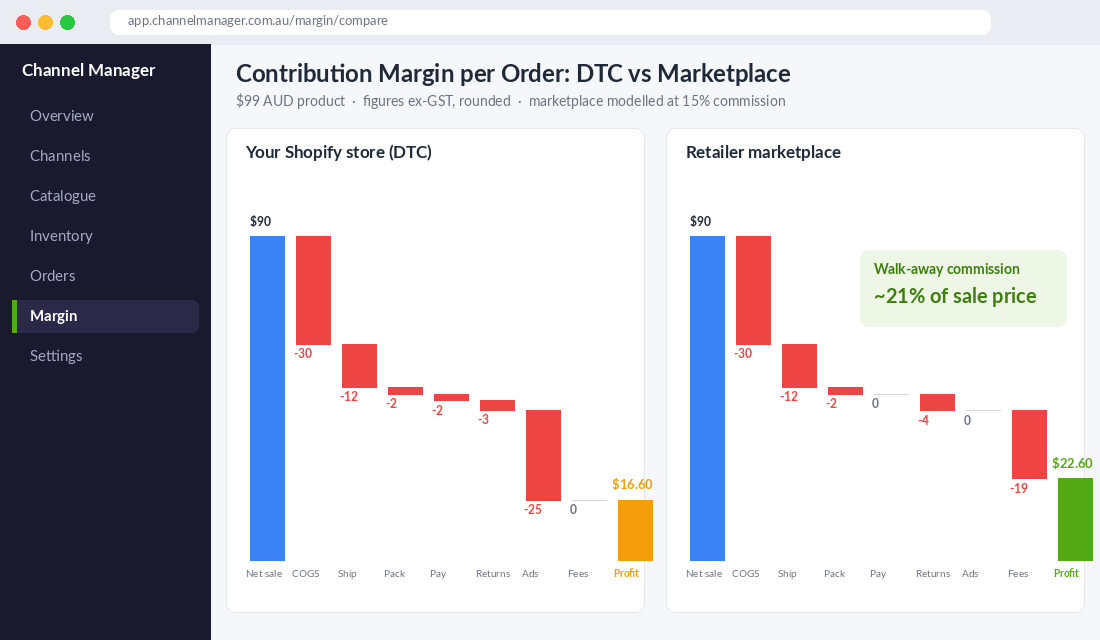
The right lens is contribution margin, which we break down fully in the Shopify contribution margin playbook. Here’s a worked example on a $99 AUD product, all figures ex-GST and rounded:
| Line item | Your Shopify store | Retailer marketplace (15%) |
|---|---|---|
| Net sale (ex-GST) | $90.00 | $90.00 |
| Product cost (COGS) | -$30.00 | -$30.00 |
| Shipping to customer | -$12.00 | -$12.00 |
| Packaging | -$2.00 | -$2.00 |
| Payment fees | -$1.70 | $0 (retailer collects) |
| Returns allowance | -$2.70 (3%) | -$4.50 (5%) |
| Ad cost per order | -$25.00 | $0 (base case) |
| Commission + monthly fee share | $0 | -$18.90 |
| Contribution per order | $16.60 | $22.60 |
Surprised? Most founders are. When your blended Meta and Google cost per order sits around $25, a 15% commission can be cheaper than buying the customer yourself. That’s the real case for marketplaces. You pay for the customer only when they buy.
But watch how fast it flips. Work backwards and you’ll find your walk-away commission, the rate where the marketplace order makes less than your DTC order. In this example, it’s about 21% of the sale price. Above that, every marketplace order is a worse order than one on your own site.
Your Gate 2 checklist:
- Ask for the full fee schedule in writing before you upload anything: commission by category, monthly fee, any fulfilment or late-dispatch penalties, and whether commission is charged on the GST-inclusive price or on shipping.
- Model returns higher than DTC. Marketplace shoppers didn’t buy into your brand story, so assume a higher return rate until your own data says otherwise.
- Include retail media. Many retailers sell sponsored placements to marketplace sellers. If you’ll need them to get seen, add that cost per order back in.
- Calculate your walk-away commission and write it on the top of your negotiation notes. If their number is above it, either negotiate or walk.
Score it a 5 if the marketplace order clearly beats your DTC order, a 3 if it’s roughly equal, and a 1 if it only works with heavy sponsored spend.
Gate 3: Price Parity (Protect Your Own Store First)
Here’s the trap nobody warns you about. The moment your products appear on a big retailer’s site, you’ve created a price comparison for your own customers. If your linen throw is $149 on your store and $129 on Myer, your loyal email list will find it, and you’ve just trained them to buy from Myer instead.
That might sound fine because you still get the sale. But a marketplace sale doesn’t give you the customer’s email permission, it doesn’t build your repeat-purchase engine, and it pays a commission. Every DTC customer you push onto a marketplace is a downgrade.
Set these rules before you go live:
- Price parity is non-negotiable. Your marketplace price should never be lower than your Shopify price. If the retailer runs a promo, check whether you’re expected to fund it and whether your own site needs to match.
- Separate the range where you can. Many smart brands list a curated “marketplace edit” of 10 to 30 SKUs: proven sellers, bundles, or exclusive colourways. Your full range and newest launches stay on your own site.
- Keep the best offer on your store. Your loyalty points, free gift wrap, bundles and subscription pricing should only exist on your Shopify site. That gives repeat customers a reason to come back to you.
- Watch for unauthorised resellers. If you also wholesale, make sure stockists aren’t listing your products on the same marketplace at a lower price.
Score this gate on how cleanly you can keep the channels apart. A brand with exclusive bundles and a firm parity policy scores 4 or 5. A brand that would list its entire catalogue at a discount scores a 1.
Gate 4: Operations Ready (Can You Ship Like a Retailer?)
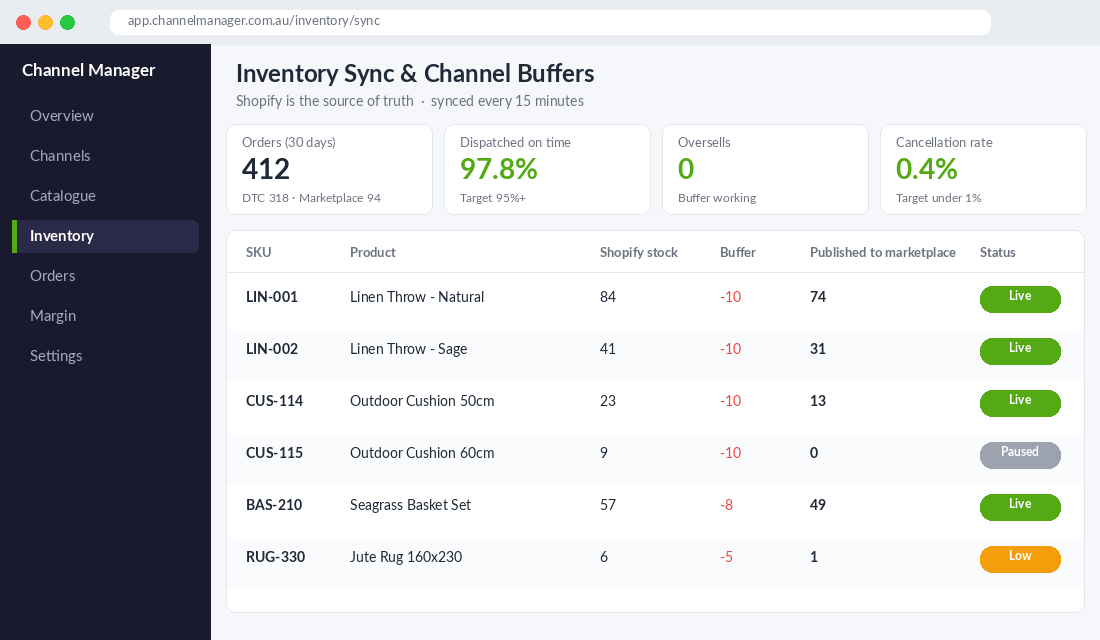
On a retailer marketplace, the customer thinks they bought from Bunnings or Myer. If your parcel is late, the retailer gets the angry review and you get a performance warning. Most retailer marketplaces run on a drop-ship model: you list the product, the retailer takes the payment, and you pick, pack, ship and process returns. Kmart’s marketplace terms, for example, make sellers responsible for listing content, delivery and returns.
That means your operations need to be tight before you add a second storefront. Here’s what to check:
- Dispatch speed. Retailers set dispatch and tracking standards and measure you against them. If you can’t reliably ship within two business days today, fix that before applying.
- Inventory sync. This is non-negotiable. Overselling on a retailer marketplace leads to cancellations, which damages your seller rating fast. Use your Shopify stock as the single source of truth and push quantities out automatically. Our stock allocation playbook covers how to split limited inventory between channels.
- Stock buffers. Publish less than you have. A buffer of 5 to 10 units per SKU means the marketplace listing pauses before you run out on your own site.
- Product data. Retailers have strict content rules: image specs, attribute fields, barcodes and category mapping. Clean GTINs and good product data save weeks of onboarding back-and-forth.
- Customer service. Marketplace queries usually come through the retailer’s seller portal with response time targets. Someone on your team has to own that inbox daily.
Tool setup: connecting Shopify with Mirakl Connect
Myer and Woolworths both run their marketplaces on Mirakl, and Mirakl Connect gives sellers a free-to-join hub with a Shopify app. Here’s how to set it up:
- Install the Mirakl Connect app from the Shopify App Store and create your seller account. Joining is free, with pricing tiered by sales volume.
- Connect your Shopify store and choose which products to sync. Start with a tagged collection, such as “marketplace-edit”, rather than your whole catalogue.
- Map your product data to the retailer’s category and attribute requirements. Fill in barcodes, dimensions and materials properly here, as this is where most listings get rejected.
- Set stock rules. Keep Shopify as your inventory source and set a buffer on every SKU so you never oversell.
- Test the order flow end to end. Place a test order, confirm it lands in Shopify, ship it, and check the tracking number flows back to the retailer.
If a retailer uses a different platform, such as Bunnings or THE ICONIC, check their approved integration partners. ChannelEngine, Omnivore and Rithum all offer connectors for Australian marketplaces. Whatever you use, the principle is the same: one stock source, automated sync and a buffer.
Gate 5: Ownership (What Are You Giving Away?)
The final gate is the strategic one. Every marketplace order is a customer you don’t fully own. You get a name and delivery address to ship the order, but you don’t get marketing permission, and many marketplace terms limit what you can put in the box. You can’t add them to your Klaviyo flows or retarget them like you would a Shopify customer.
There’s a second ownership risk too: platform risk. In January 2025, Wesfarmers announced that Catch would close after losing $96 million in 2024 (Wesfarmers). Sellers who had built a big chunk of revenue on Catch had to rebuild elsewhere within months. Marketplaces change commission rates, change rules and occasionally close. Your Shopify store is the only channel you control.
Here’s how to protect yourself:
- Cap marketplace revenue at 20-30% of total sales in year one. That’s a guide, not a law, but it stops any single retailer becoming a dependency.
- Build brand recall in the product itself. Your logo on the product, a care card or warranty registration (where the marketplace terms allow it), and packaging that makes your brand name memorable. Shoppers who love the product will search for you later.
- Watch your branded search. If your Google Search Console brand searches rise after launch, the marketplace is acting as discovery. That’s the best possible outcome.
- Keep your exclusive range at home. Launches, limited editions and bundles stay on your own store so marketplace shoppers have a reason to visit you directly.
Australia Post sums it up well: use marketplaces as acquisition engines, and nurture your own channels for brand storytelling, loyalty and margin. That’s exactly what this gate is testing.
The 90-Day Marketplace Pilot (How to Start Small and Scale What Works)
If a marketplace scores 18 or more out of 25 across the five gates, don’t go all in. Run a 90-day pilot. Here’s the structure we recommend to brands inside eCommerce Circle:
| Phase | Timing | What you do |
|---|---|---|
| Set up | Weeks 1-3 | Negotiate fees in writing, connect the integration, list 10-30 proven SKUs with full content and a stock buffer |
| Learn | Weeks 4-8 | Track sales, contribution per order, return rate, dispatch performance and customer queries weekly |
| Decide | Weeks 9-12 | Compare actual contribution to your model. Scale the winners, delist the duds, or exit |
Track these five numbers every week during the pilot:
- Contribution per marketplace order versus your walk-away number
- Return rate compared with your DTC return rate
- On-time dispatch rate (aim for 95% or higher)
- Cancellation rate from stock issues (aim for under 1%)
- DTC revenue trend on the same SKUs, to catch any cannibalisation early
A note on timing. With BFCM and Christmas weeks away, don’t try to onboard a new marketplace in November. Retail onboarding queues get long, and you don’t want to be learning a new seller portal during your busiest fortnight. If you’re reading this in October, use the next few weeks to score your options and apply, then launch your pilot in the new year when traffic is calmer and your data will be cleaner.
The Marketplace Decision Checklist (Copy This)
Use this before you reply to any marketplace invitation:
- ☐ Their shopper already buys my category, at my price point (Gate 1)
- ☐ I have the full fee schedule in writing, including penalties and promo funding (Gate 2)
- ☐ I’ve calculated contribution per order and my walk-away commission (Gate 2)
- ☐ I have a written price parity policy and a curated marketplace range (Gate 3)
- ☐ I can dispatch within two business days, every day (Gate 4)
- ☐ Inventory syncs automatically from Shopify with a buffer on every SKU (Gate 4)
- ☐ Someone owns the seller portal inbox daily (Gate 4)
- ☐ Marketplace revenue is capped at a level I can afford to lose (Gate 5)
- ☐ My exclusive range, bundles and loyalty perks stay on my own store (Gate 5)
- ☐ I’ve set a 90-day review date and the numbers that decide stay or exit
If you can’t tick at least eight of these, the answer for now is “not yet”. That’s a perfectly good answer. The invitation will still be there when you’re ready.
How the Five Gates Work Together
Each gate on its own protects you from one mistake. Together, they turn a marketplace from a distraction into a profitable acquisition channel.
Customer fit makes sure you’re in front of people who already want what you sell. Margin makes sure each of those orders actually pays you. Price parity protects the DTC business you’ve worked so hard to build. Operations readiness keeps your seller rating strong so the retailer keeps showing your products. And ownership makes sure the marketplace feeds your brand rather than replacing it.
Get all five right and something useful happens. The marketplace finds you new customers at a cost you only pay when they buy. Some of those customers search for your brand and come back to your Shopify store. Your DTC customers stay on your site because that’s where the best range and perks are. And if a retailer changes the rules, you’ve capped your exposure and can walk away without the business wobbling.
That’s the difference between brands that get burned by marketplaces and brands that grow with them. The burned brands said yes to a logo. The growing brands said yes to a set of numbers.
Your Next Step
Inside eCommerce Circle, channel decisions like this are one of the core pillars we work on with members, because adding a channel too early is one of the fastest ways to dilute a profitable store. If you want to see exactly where your store is being capped, take the free More Orders Scorecard. It takes two minutes and shows you which of the 10 P’s to fix first.