The short answer: sell something that people already search for, that earns you at least a 35-40% contribution margin after postage, that ships cheaply in a satchel or small box, and that gives you a reason to email the buyer again. If a product cannot pass those four tests on paper, no amount of clever advertising will rescue it.
Most Aussie founders do this backwards. They fall in love with a product, order 500 units, build the store, and only then find out the postage costs more than the margin. Then they spend three months and $6,000 on ads trying to make the maths work. It never does.
The brands that last do the dull work first. They check demand, price the product properly, and test with a small order before they commit real cash. This guide gives you the seven checks we run with coaching members, a scoring sheet you can copy, and a 14-day test that costs a few hundred dollars instead of a few thousand.
What the Australian market is telling you right now
Before you pick a product, look at where the money and the competition sit. Australians spent roughly $82.6 billion online in 2025, according to the Australia Post 2026 eCommerce Report, and online retail grew about 14% on the year. That is a big pie, but it is not evenly sliced.
Here is the part most beginners miss. Australia Post’s category data (as summarised by Eightx) shows fashion and apparel grew 11.5%, slower than the 14% national average. Yet apparel is the single most crowded category on Shopify. Storeleads data puts Australian apparel stores at 21.5% of all active Australian Shopify stores, out of 152,323 stores in total. The category most newcomers pick is growing slower than the market and has the most competitors.
Compare that with the faster movers. Hobbies and recreational goods grew about 17.1%, consumer electronics about 16%, and health and beauty about 15.1%. Pet products reached $1.4 billion in online spend, and the average online basket sits around $90 according to Australia Post’s latest quarterly update, with growth coming from more orders rather than bigger baskets.
- The takeaway on size: a $90 average basket tells you what shoppers are comfortable paying online. A product priced at $25 needs volume or bundling to cover postage. A product at $60 to $120 gives you room to breathe.
- The takeaway on crowding: a growing category is not enough. You want a growing category where you can own a narrow niche, such as pet travel gear instead of pet products, or sensitive skin body care instead of skincare.
- The takeaway on marketplaces: 73% of Australian online shoppers bought from a marketplace last year, which means Amazon, Kogan and Temu are your default competitors on any commodity item.
If you are still deciding whether to start at all, read our guide to starting an online store in Australia first. If you already have a shortlist, keep going.
Check 1: Prove people already search for it
The safest demand is demand that already exists. You are not trying to create a market. You are trying to find a market that is under-served and step into it.
Start with Google Trends, which is free. Here is the exact setup:
- Go to Google Trends and set the region to Australia and the date range to Past 5 years.
- Type in your product name the way a customer would say it, such as “dog travel water bottle”, not your brand name.
- Add up to four competing phrases to compare them on the same chart.
- Switch the category filter to Shopping to strip out news and research noise.
- Scroll to Related queries and note every rising query. Those are your sub-niches.
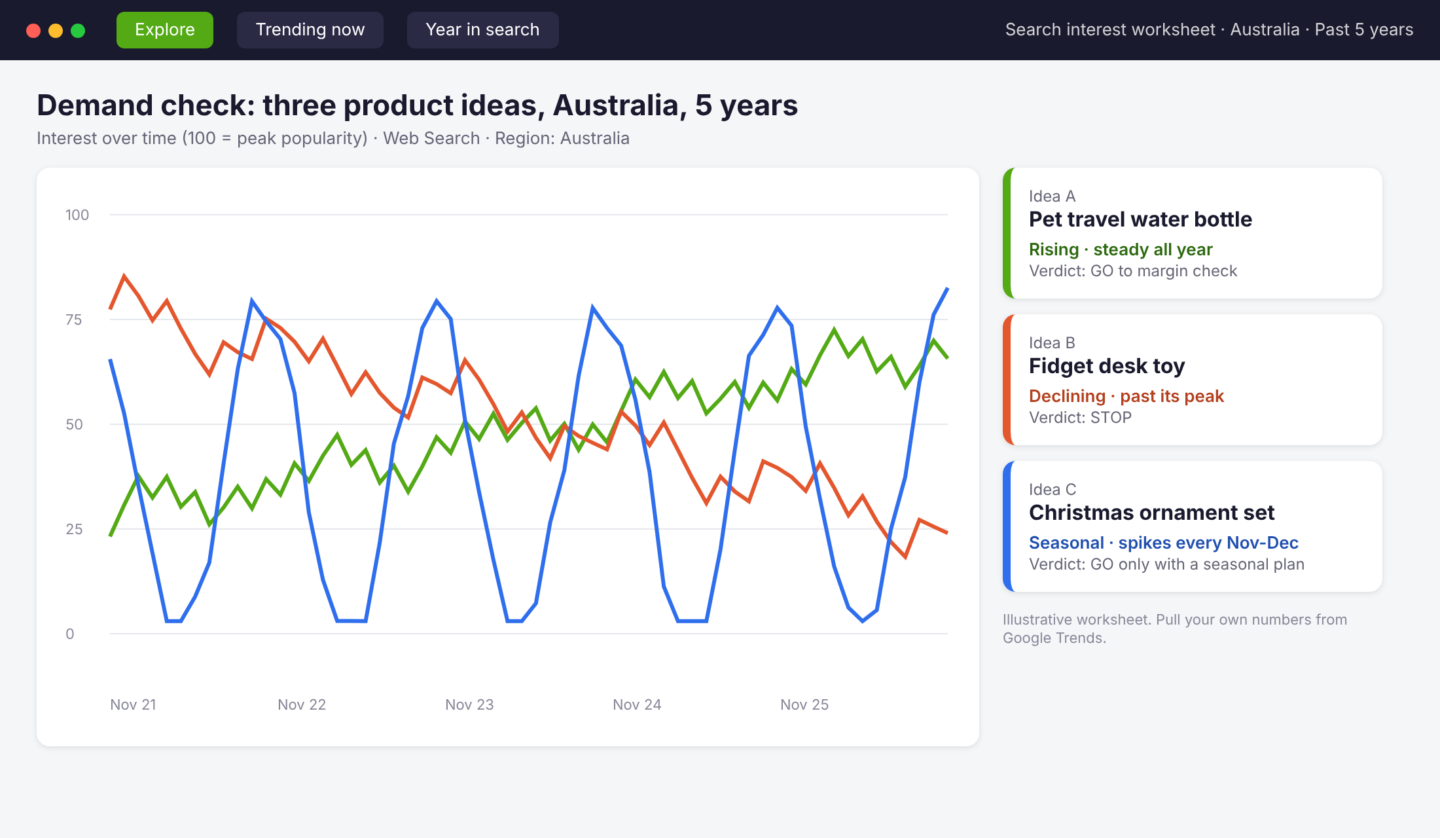
Read the shape, not the height. A line that rises steadily over five years is a growing market. A line that spiked and fell is a fad. A line that peaks every November and December is seasonal, which is fine if you plan cash flow around it and terrible if you do not.
Then confirm with real volume. Open Google Keyword Planner (free with any Google Ads account) and check monthly searches in Australia. As a coaching rule of thumb, you want at least 1,000 combined monthly searches across your main phrases before you build a store around a product. Below that, you are relying entirely on paid traffic and social discovery, which costs more.
Finally, search your product on Amazon Australia and Etsy and read the one-star and three-star reviews. Every complaint is a gap you can fill with a better product, better packaging or better support.
Check 2: Run the margin maths before you fall in love
This is the check that kills the most ideas, and it should. Gross margin is not enough. You need contribution margin, which is what is left after the product, the postage, the payment fees, the packaging and the returns allowance. Our guide to contribution margin goes deeper, but here is a worked example.
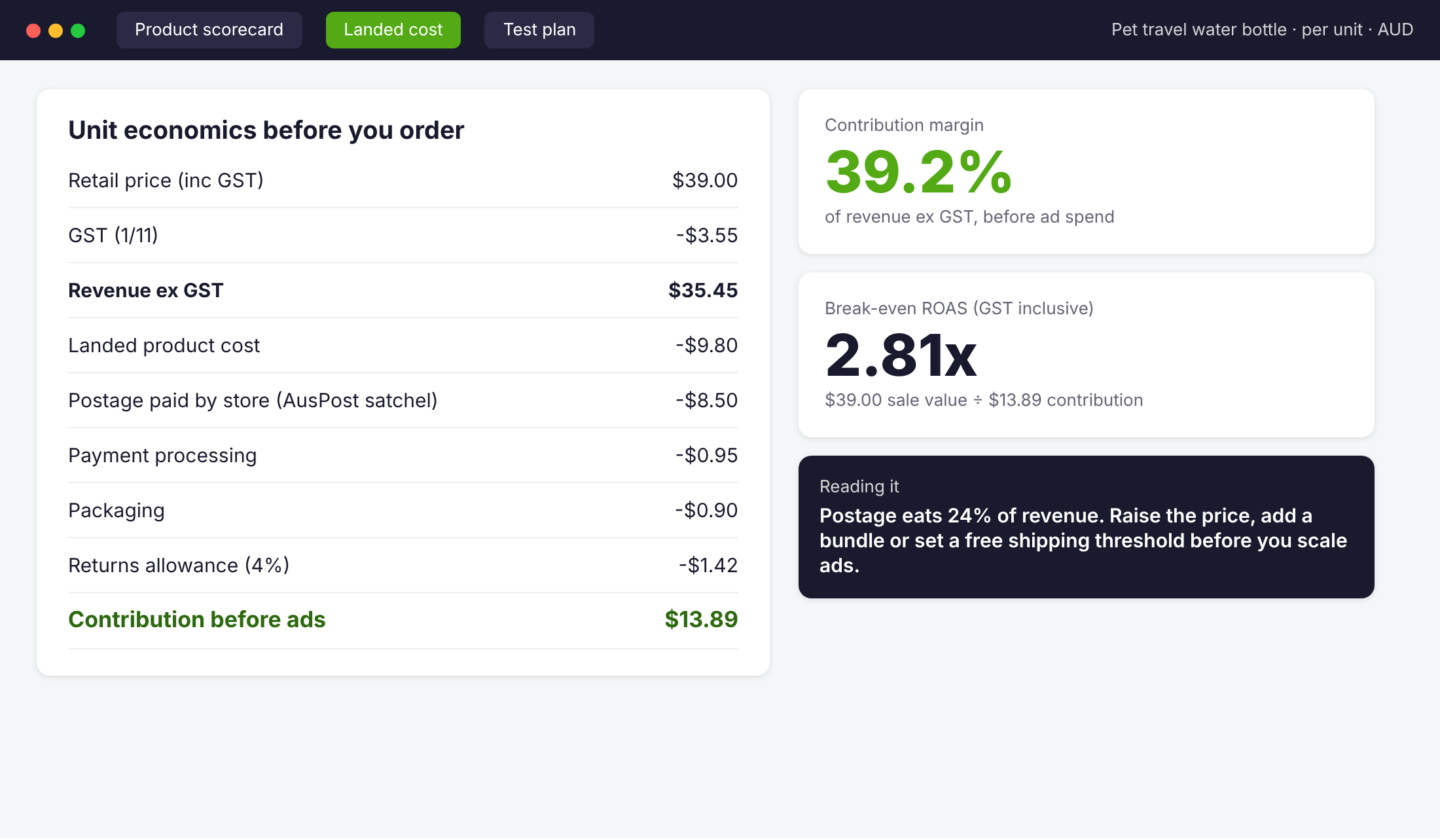
The product costs $9.80 landed, so most beginners see a $29 profit on a $39 sale. In reality GST takes $3.55, an AusPost satchel costs $8.50, payment processing and packaging take another $1.85, and a 4% returns allowance takes $1.42. What is left is $13.89 per order before a single dollar of advertising.
That number sets your ceiling. Divide the $39 sale value by the $13.89 contribution and you get a break-even ROAS of 2.81. If your Meta campaigns return 2.5x, you are paying to lose money on every order. Our break-even ROAS guide has the formula and a calculator.
Here are the rules we give members:
- Target a contribution margin of 40% or more before ads. Below 30% you will struggle to scale on paid traffic.
- Price to the market, not to your cost. Cost-plus pricing leaves money on the table. Check what shoppers pay for the best alternative and price relative to that.
- Get a real landed cost. Include freight, duty, customs fees and any prep. Our landed cost playbook shows how.
- Test the price at 20% higher. Many founders find the higher price sells just as well, which can double contribution.
Check 3: Look at the shipping profile
Postage is the silent margin killer in Australia, where distances are long and cubic weight rules punish bulky items. Before you commit to a product, weigh it, measure it in its packaging, and quote it to three postcodes: one metro (Sydney 2000), one regional (Dubbo 2830) and one remote (Alice Springs 0870).
- Under 500g and satchel-friendly is ideal. Jewellery, supplements, skincare minis, accessories and small pet items fit here.
- Boxy, light and fragile products such as candles and ceramics need strong packaging, which adds cost and returns risk.
- Heavy or oversize products such as furniture and gym gear need freight quotes and often a 3PL. Our 3PL cost breakdown shows what to expect.
A simple filter: if postage is more than 20% of your ex-GST price, you need either a higher price, a bundle, or a free shipping threshold to make the product work. The $39 bottle above spends 24% of revenue on postage, which is why it needs a bundle.
Check 4: Build in a reason for the second purchase
A product that sells once costs you a new customer every time. A product that sells again lets your email list, not your ad budget, do the heavy lifting. This is why consumables and refillable products make such good first products.
Who Gives A Crap is a good Australian example. It launched in July 2012 with an Indiegogo campaign that raised its first $50,000, and it sells a product every household has to buy again and again. It later expanded into tissues and paper towels, and its giving model (half of profits donated, over $13 million AUD by 2024) gives customers a reason to stay. Whatever you think of toilet paper, the repeat purchase logic is hard to beat.
Ask yourself these questions about your product:
- Does the customer run out of it? If yes, you have a natural reorder cycle.
- Can you sell a refill, a companion item or an upgraded version?
- Does one purchase lead to a collection, such as a second colour or a set?
- Would a subscription or replenishment email make sense at day 30, 60 or 90?
If the answer to all four is no, the product can still work, but you must budget for higher acquisition costs and lean on bundling. Our guides to repeat customer rate and private label products cover both paths.
Check 5: Estimate the returns risk
Returns eat margin twice: you refund the sale and you often lose the postage both ways. Categories like fashion carry the highest risk because fit and colour are subjective. Electronics carry a different risk, because faulty units and warranty claims land on you.
Our ecommerce return rate benchmarks article breaks down typical rates by category. Use it to set a realistic returns allowance in your margin sheet, and be honest. Seventy-five percent of Australian shoppers say an easy returns process makes them more likely to buy again, so you cannot simply make returns hard. You have to choose products that return less.
- Low risk: consumables, accessories, one-size products, items with clear specifications.
- Medium risk: home and garden items, small electronics, items with a size range.
- High risk: apparel, footwear, anything where fit and colour drive the purchase.
Check 6: Size up the competition honestly
There are two kinds of competition. Direct competitors sell the same thing. Indirect competitors, mainly marketplaces, sell something close enough at a lower price. Temu and Amazon set the price anchor for any commodity product, so if your product is easy to copy, you are competing on price against factories.
Run a simple competition audit. Search your product on Google, Amazon Australia and Instagram, and count how many Australian brands sell it with a real website, real reviews and real advertising. Look at what they charge, what they promise and what they do badly.
- Few competitors, no demand usually means no market.
- Many competitors, strong demand is fine if you can differentiate on design, quality, service or story.
- A few big brands and a gap in the middle is often the sweet spot.
Jane Lu’s Showpo is a useful case study in the middle path. She started it in 2010 from her parents’ garage with stock from a consignment dealer who only wanted payment once items sold, so she did not carry inventory risk up front. She grew early traffic with a Facebook modelling contest that took her following from about 3,000 to 20,000 in a month. The business later passed $30 million in annual revenue. The lesson is not to copy her tactics. The lesson is that she found a way to test demand without betting her savings. Our Temu-proofing guide covers how to compete when marketplaces undercut you.
Check 7: Check compliance and liability
This is the check beginners skip and regret. Some products carry rules that can shut you down or leave you personally liable.
- Product safety: items for babies and children, heaters, electrical goods and some cosmetics must meet mandatory Australian standards. The ACCC publishes the list.
- Therapeutic claims: supplements, skincare and anything that claims to treat a condition can fall under TGA rules.
- Restricted items: vapes, knives, some batteries and dangerous goods have shipping and sale limits.
- Insurance: if your product can hurt someone, you need cover. Read our guide to product liability insurance for ecommerce before you place your first order.
When in doubt, pick a product with fewer rules. You are building a business, not a legal education.
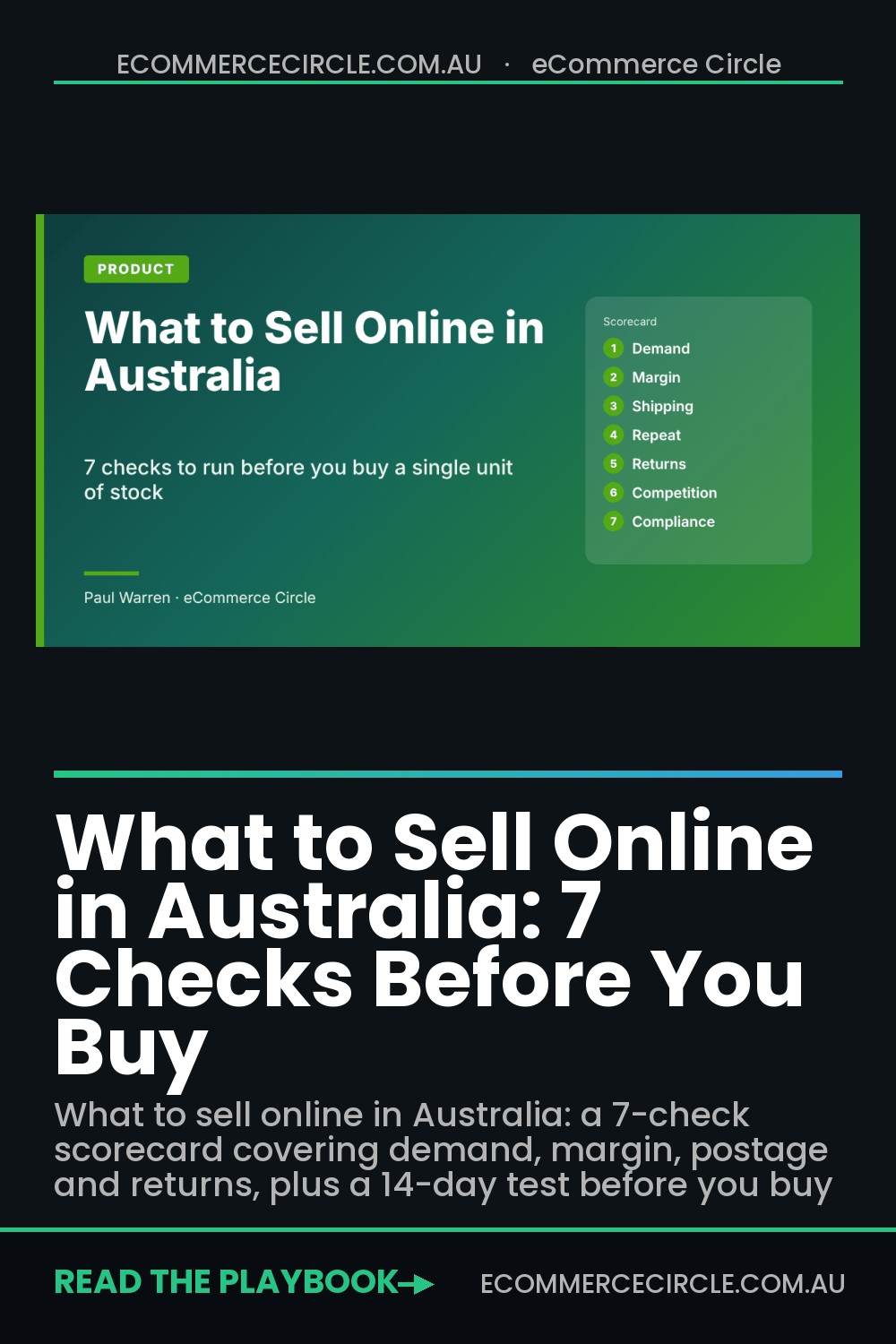
The 7-check product scorecard (copy this)
Now put the checks together. Score each product from 1 to 4 on every check, where 1 is a problem and 4 is a clear strength. Add the scores. A total of 24 or more out of 28 earns a test order. Between 18 and 23, fix the weak spots first. Below 18, drop it. One more rule: any single score of 1 is a veto, whatever the total says.
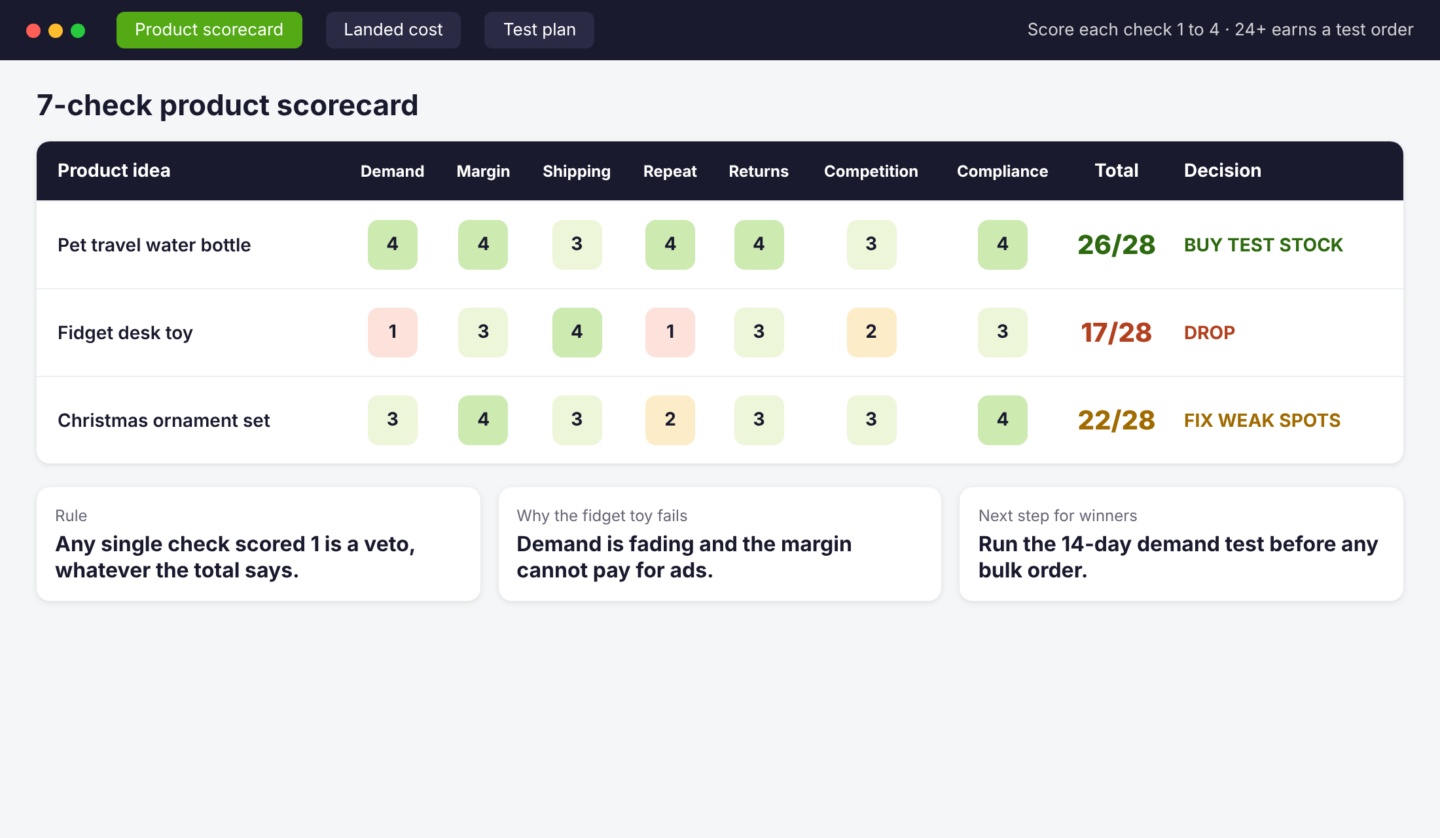
- Demand: 4 means steady or rising Australian searches above 1,000 a month. 1 means falling or negligible searches.
- Margin: 4 means 45%+ contribution before ads. 1 means under 25%.
- Shipping: 4 means satchel-friendly and under 15% of ex-GST price. 1 means bulky or over 30%.
- Repeat: 4 means a natural reorder cycle. 1 means a one-off purchase with no add-ons.
- Returns: 4 means low return risk. 1 means fit-driven or fault-prone.
- Competition: 4 means a clear gap you can own. 1 means commodity pricing against marketplaces.
- Compliance: 4 means no special rules. 1 means heavy regulation or liability.
The 14-day demand test (before you buy stock)
A high score earns a test, not a container. Here is a cheap way to confirm real buying intent before you order in bulk. Budget around $300 to $600 and two weeks.
- Day 1 to 3: Build a single product page on Shopify with clear photos (supplier images or a sample), a real price and an honest delivery estimate. Use a waitlist or pre-order button so you are not selling stock you do not have.
- Day 4 to 7: Run $20 to $30 a day of Meta traffic to the page with two or three angles. Track cost per add to cart and cost per email signup.
- Day 8 to 12: Message your first 50 sign-ups and ask what they would pay and what worries them. Real answers beat guesses.
- Day 13 to 14: Decide. If 2%+ of visitors add to cart and you can capture emails at under $5 each, order a small first batch. If not, kill it and move to the next idea.
This sits alongside our full 5-step product validation playbook, which covers surveys and pre-sale tactics in more detail. Treat the scorecard as your filter and the test as your proof.
How the seven checks compound
Each check on its own saves you a little money. Together, they change what kind of business you build. Demand tells you the market exists. Margin tells you the market can pay for your growth. Shipping and returns protect that margin from leaking. Repeat purchase lowers your acquisition cost over time. Competition and compliance keep you from walking into a fight you cannot win.
Brands that skip these checks usually discover the problem six months in, with a garage full of stock and a Meta account losing money. Brands that run them find the problem in an afternoon, for the price of a spreadsheet. That gap is the difference between a business and an expensive hobby.
Inside eCommerce Circle, product selection is one of the core pillars we work on with every member, because every other part of the business depends on it. If you want to see exactly where your store is being capped, take the free More Orders Scorecard. It takes two minutes and shows you which of the 10 P’s to fix first.