Founder led marketing means you, the person who owns the store, become the face and voice of its content: short videos, personal emails and posts in your own name. For most Australian Shopify stores, three hours a week is enough to do it properly, and it gives your ads something a competitor cannot copy: a real person who stands behind the product.
Most founders get this wrong in one of two ways. They hand every bit of content to a junior who has never packed an order, so the feed sounds like every other brand. Or they promise to “post more” and then disappear for six weeks. Neither builds trust, and trust is what is getting more expensive to buy. Eightx estimates that a pure-play Australian apparel brand pays between A$90 and A$200 to win a customer, with a midpoint of A$135. Those are modelled bands, not audited averages, but they match what we see inside eCommerce Circle.
The brands that cope with those numbers do something different. They show the person behind the logo. In this guide you get the exact weekly routine, the four clip types worth your face, a 65/25/10 content mix, a step-by-step way to put ad dollars behind your best clips, and a checklist you can copy today.
What founder led marketing is (and what it is not)
Founder led marketing is a content approach where the founder is the main character. It is not a personal brand project, and it is not about becoming an influencer. You are not trying to get famous. You are trying to make a stranger think, “a real person made this, and they will fix it if something goes wrong.”
In practice it covers four channels:
- Short video on TikTok, Instagram Reels and YouTube Shorts, filmed on a phone.
- Founder emails sent from your name, not from “The Team”.
- Founder-voiced ads, where your best organic clips are boosted as paid ads.
- Replies to comments and DMs, written by you or someone trained to sound like you.
What it is not: posting product shots with your face in the corner, or a polished brand film that happens to feature you. The clips that work are plain, specific and slightly uncomfortable to publish.
Why founder led marketing works when ads keep getting dearer
Founder content works for three reasons, and none of them is magic. It earns attention for less money than paid reach. It gives buyers a reason to trust a store they have never heard of. And it hands your ads better raw material.
Here is what the data says, with the caveats attached:
- 65% of Australian small business owners now create content themselves, and posts from business leaders get on average 8x more impressions and 4x more engagement than the average post, according to LinkedIn data reported by Mediaweek. That data comes from LinkedIn, so it is skewed to B2B, but the direction holds for any founder.
- Founder ads are more likely to get spend. MHI Media looked at 38 DTC brands on Meta between September 2025 and October 2026. Across the median brand, 13.3% of founder ads reached £1,000 in spend, against 6.9% of other ads. Cost per purchase for founder ads ran about 7% higher. So founder ads are not a cost-cutting trick. They are a format Meta keeps funding, which gives you more winners to scale. MHI sells founder ads, so treat it as a signal, not proof.
- Australian online brands spend 10% to 17% of revenue on marketing, based on Eightx’s review of listed retailers. Adore Beauty sits at 12.0%. If you are running at 25% or more, content that earns attention for free is the lever that brings that number down.
If you are still working out how much a customer really costs you, read our guide to customer acquisition cost for Shopify first. Founder content does not remove the need to know your numbers. It makes them easier to hit.
Three real brands, three different ways to show up
You do not need a studio. You need a point of view and a habit. These examples show what that looks like.
Liaison the Label: turn a mistake into a loyalty moment
Stefana Avara, founder of Liaison the Label, posts on her personal TikTok several times a day. When a drop accidentally cancelled nearly 100 orders, she made a video explaining what went wrong, then contacted every affected customer personally with an apology, a discount code and early access to the next drop. That is a refund-and-sorry email upgraded into content. Planoly reported the story in March 2026.
Your version: the next time you ship late, mis-pick an order or run out of a bestseller, film a 45-second explanation before you write the apology email. The video does the work of a hundred “we value your feedback” lines.
Cocokind: let customers watch you make the decisions
Priscilla Tsai, founder of Cocokind, invites customers to weigh in on upcoming packaging and walks through how products are developed, including the pricing and why the team nearly scrapped one. Showing the trade-offs makes the final price feel earned rather than arbitrary.
Your version: film yourself choosing between two supplier samples, then ask your list to vote. You collect market research and pre-sell the winner in the same clip.
Frank Body: write like a person, not a company
Frank Body, the Australian coffee scrub brand, started on Instagram when few brands were using it. Co-founder Jess Hatzis described the approach as coming in a way that felt “very un-corporate” and holding one-on-one conversations with customers. NAB reported the business turned over $20 million in 2017. A Glossy profile later described the founders launching a month-long Instagram campaign with a personal letter. The channel has changed since then. The lesson has not: a founder voice scales when it is consistent.
Your version: pick one phrase you use with customers in real life and put it in your emails and captions. If your cleaner or your mum would not say it, cut it.
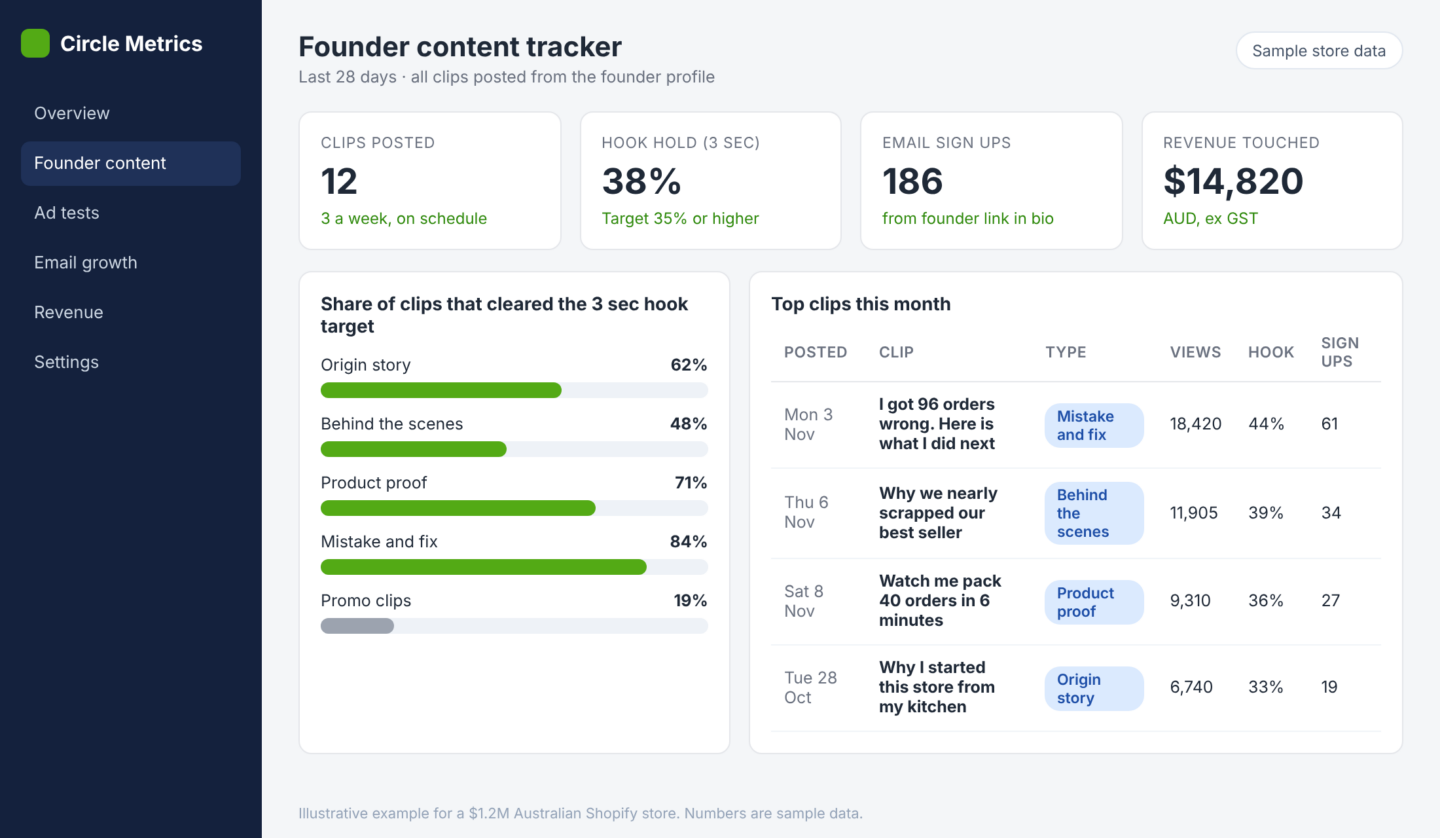
The four clip types worth putting your face on
Founder content fails when it is vague. “Day in the life” clips with no point earn views and no sales. These four types have a clear job.
| Clip type | Job it does | Example hook (first 3 seconds) |
|---|---|---|
| Origin story | Explains why you started and who the product is really for | “I started this store from my kitchen because nothing on the market fit my kids.” |
| Behind the scenes | Shows the decisions, costs and supplier trade-offs buyers never see | “Here is why this costs $10 more than the one on Temu.” |
| Product proof | Demonstrates the product working, in real conditions, unedited | “Watch me pack 40 orders in six minutes.” |
| Mistake and fix | Builds trust by owning an error and showing the repair | “I got 96 orders wrong. Here is what I did next.” |
Notice what is missing: the hard sell. That is deliberate. Founder clips earn the right to run an ad later.
The 65/25/10 content mix (and why you need only three themes)
RevBoss recommends a split of 65% educational, 25% personal story and 10% sales content, with no more than three or four core themes. We agree with the shape, so adopt it as a starting point, then adjust once your own data comes in.
For a store selling sleep products, the three themes might be: how to sleep better, how we make the product, and what customers get wrong when they buy. Every clip belongs to one of those three. If it does not, do not film it.
- 65% teach. Answer a question your customers ask. Show a technique. Compare two options honestly.
- 25% personal. Origin, mistakes, decisions, wins you are proud of.
- 10% sell. Launches, offers, restocks. Keep these short and direct.
Your 3-hour weekly founder routine
Consistency beats volume. RevBoss reports that a single 90-minute session can produce a month of material. We use a slightly gentler version: one recording block, then short follow-ups. It adds up to 180 minutes.
| Day | Task | Time | Output |
|---|---|---|---|
| Monday | Batch record: film six clips in one sitting, same spot, phone on a tripod | 60 min | 6 raw clips |
| Tuesday | Edit and caption: you or a VA cuts dead air, adds captions, exports 9:16 | 30 min | 6 finished clips |
| Wednesday | Founder email: 150 words, one story, one link, from your name | 30 min | 1 email |
| Thursday | Post two clips and answer every comment for 20 minutes | 30 min | 2 posts, replies |
| Friday | Review hook hold, pick the best clip, authorise it for ads | 30 min | 1 ad candidate |
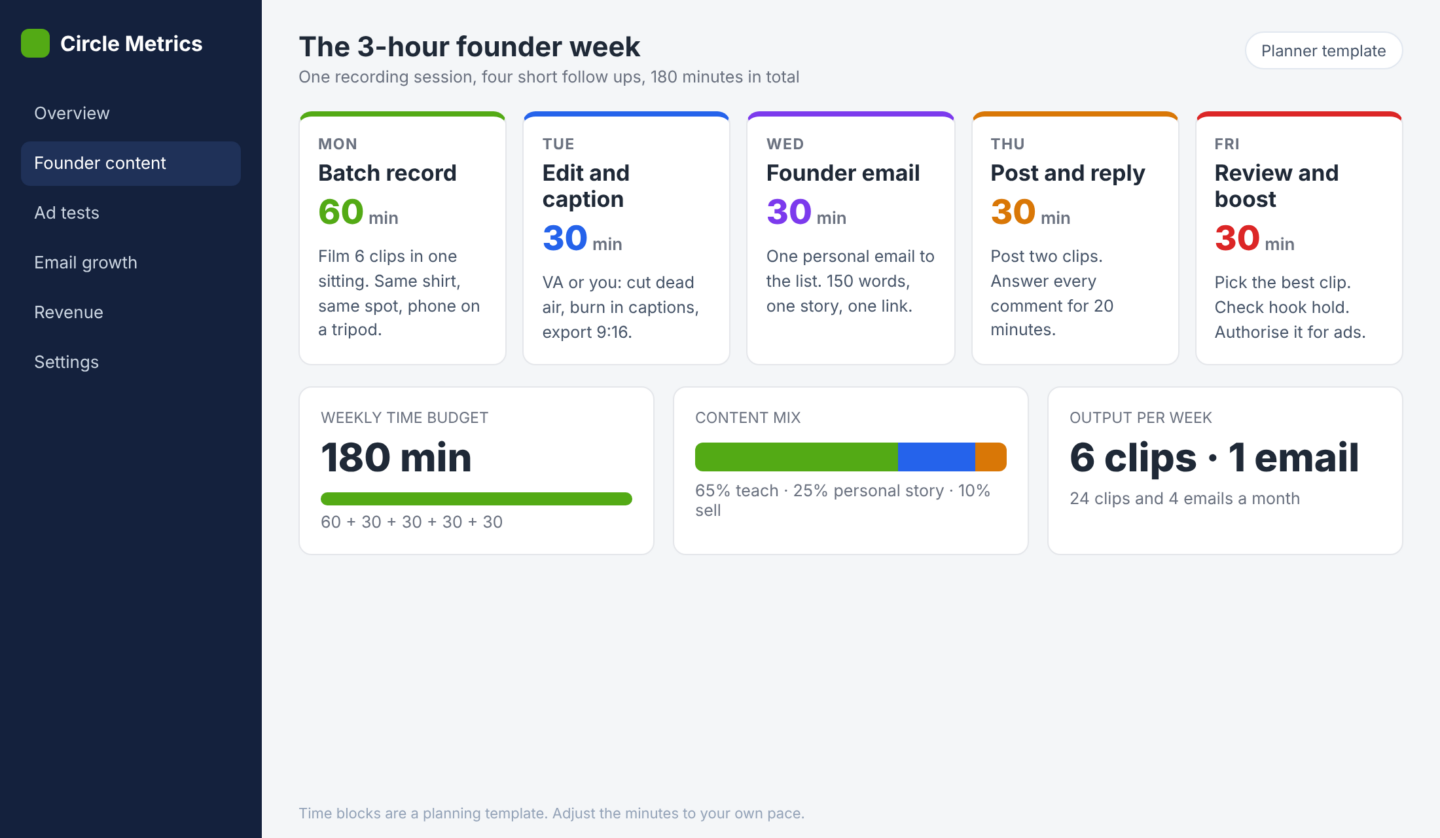
Two rules keep this alive. First, film in one place wearing the same top, so six clips look like six days. Second, never edit on the day you record. Record on Monday, edit on Tuesday. Separating the two stops you cutting good clips because you hate how you sound.
Once the routine works, hand the Tuesday block to a virtual assistant. Our guide on how to hire a virtual assistant for your Shopify store covers what to delegate and what to keep.
What to put in the Wednesday founder email
The founder email is the cheapest part of this system, and the one most stores skip. It works because it lands in an inbox you own, not a feed you rent.
Keep it plain. Send from your first name and your store, in plain text or a very light template, and write as if replying to one customer. A simple structure works every time:
- One story from the week: a customer message, a supplier problem, a thing you changed.
- One lesson the reader can use, even if they never buy.
- One link: the best clip, a product, or a restock. Never three.
In Klaviyo, you can set this up as a weekly campaign to your engaged segment, and reuse the same voice in the first email of your welcome flow so new subscribers hear from a person on day one. Keep replies switched on. Every reply is a free piece of customer research, and replies also tell inbox providers your emails are wanted.
How to put ad money behind your best founder clips
Organic reach has a ceiling, so your best clips should become ads. Both major platforms let you run an organic post as an ad without losing its likes and comments.
Tool setup: TikTok Spark Ads, step by step
- On your personal TikTok, open the video you want to promote, tap the menu and find the ad authorisation setting. Menu names move around, so search for “ad authorization” if you cannot see it.
- Choose how long the permission lasts and generate an authorisation code.
- In TikTok Ads Manager, create an ad, choose Spark Ads, and paste the code in. The ad now runs from your account with the original engagement attached.
- Set an equal budget for each ad you are testing and run them for the same seven days.
On Instagram, the equivalent is partnership ads. Approve your store’s account in your personal professional account’s settings, then choose the existing post when you build the ad in Meta Ads Manager. If you want more setup detail, see our TikTok ads playbook.
Test it fairly
The MHI data shows founder ads are not a guaranteed discount, so test them against your current best ads. Same product, same offer, same landing page, same budget, same week. Then let margin decide the winner, not views.
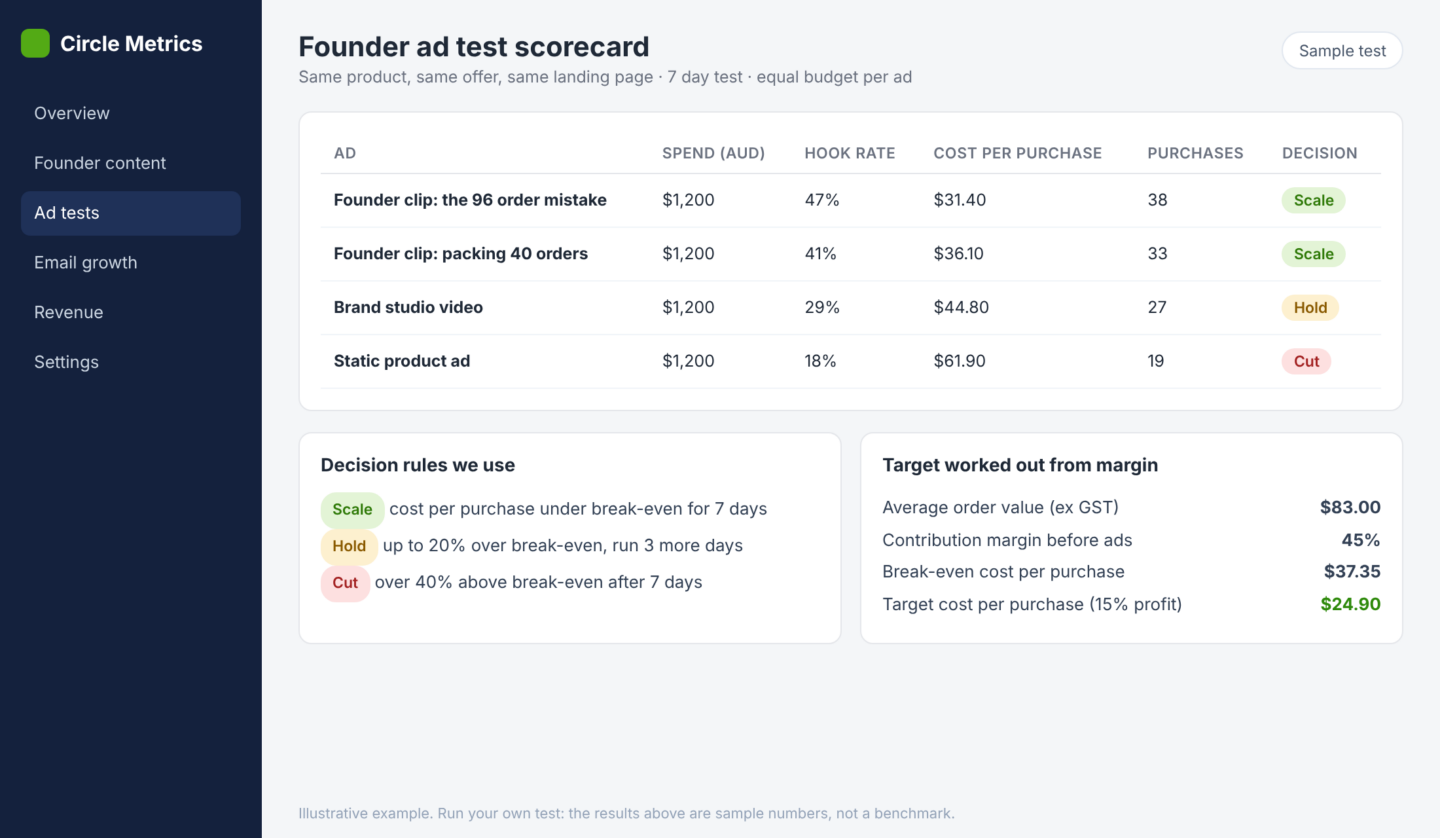
Work out the break-even first. If your average order is $83 ex GST and your contribution margin before ads is 45%, you can pay up to $37.35 per purchase before you lose money. A target that leaves 15% profit is $24.90. Any ad that sits under break-even for seven days is a candidate to scale. If you want the full method, our break-even ROAS guide has the formula and a sheet you can copy.
Where founder led marketing breaks (and how to fix it)
The model has real failure modes. Know them before you start.
- You become the bottleneck. Mailchimp co-founder Ben Chestnut said of the early days, “I was the bottleneck… There were too many decisions that had to go through me.” Fix it by writing down how you speak, then letting someone else edit, schedule and reply.
- The audience remembers you but not the store. Give the brand its own memory: a colour, a catchphrase, a recurring set. Put the brand name on screen in the first clip of every batch.
- Scattered themes. If someone cannot describe in one sentence what you post about, you have too many topics. Stick to the three.
- Covering for weak demand. If clips get views but the product page converts poorly, content will not fix it. Check your trust signals and product page first.
- Too much selling. Anything above about 10% promotional content starts to feel like an ad break.
The compound effect: how one Monday session feeds the whole store
Founder content is not a separate channel. It feeds the rest of your business.
A Monday clip becomes a Wednesday email. A strong clip becomes a Friday ad. A good mistake story becomes a pinned FAQ that cuts support tickets. The same footage supplies fresh creative when your UGC and customer content runs dry. And because the founder voice is the same everywhere, buyers who meet you in an ad, an email and an unboxing card feel like they have met the same person three times.
That repeated familiarity is the real asset. It lowers the cost of every other channel, because the buyer arrives already trusting you. Over a year, 24 clips a month and four emails a month give you around 290 clips and 48 emails, built on about 156 hours of your time.
The founder content starter checklist
Copy this and tick it off before you record your first batch.
- Pick three themes your customers ask about. Write them at the top of a doc.
- Write down your four clip types and one hook for each.
- Set up a recording spot: window light, a tripod, same top every week.
- Block 60 minutes on Monday and 30 minutes on Tuesday in your calendar.
- Record six clips. Do not edit on the same day.
- Add captions and the brand name on screen. Export 9:16.
- Write one founder email, 150 words, one story, one link.
- Post two clips on Thursday and reply to every comment.
- On Friday, pick the clip with the best 3-second hold and authorise it for ads.
- Run a seven-day test against your best current ad using break-even as the rule.
- After four weeks, delete the theme that gets the least response and keep going.
Make founder content part of the system
Founder led marketing is a habit, not a campaign. Start with one Monday session this week, send one email on Wednesday and decide on Friday what to boost. Then do it again.
Inside eCommerce Circle, building a consistent promotion engine is one of the core pillars we work on with every member. If you want to see exactly where your store is being capped, take the free More Orders Scorecard. It takes two minutes and shows you which of the 10 P’s to fix first.
Sources: Mediaweek (LinkedIn data), MHI Media founder ad study, Eightx Australian CAC 2026, Planoly (Codi Foster, March 2026), RevBoss, NAB, Glossy.