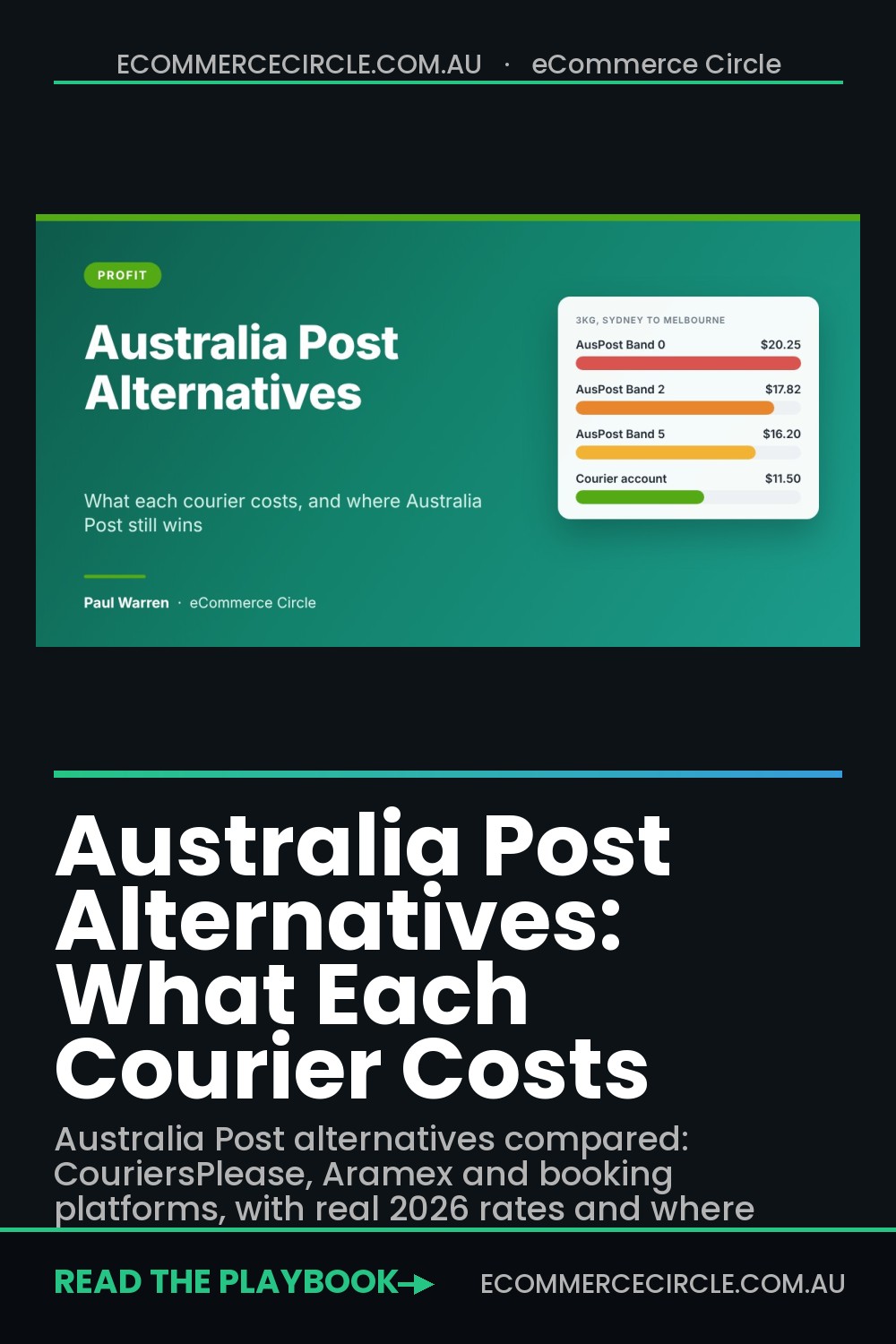
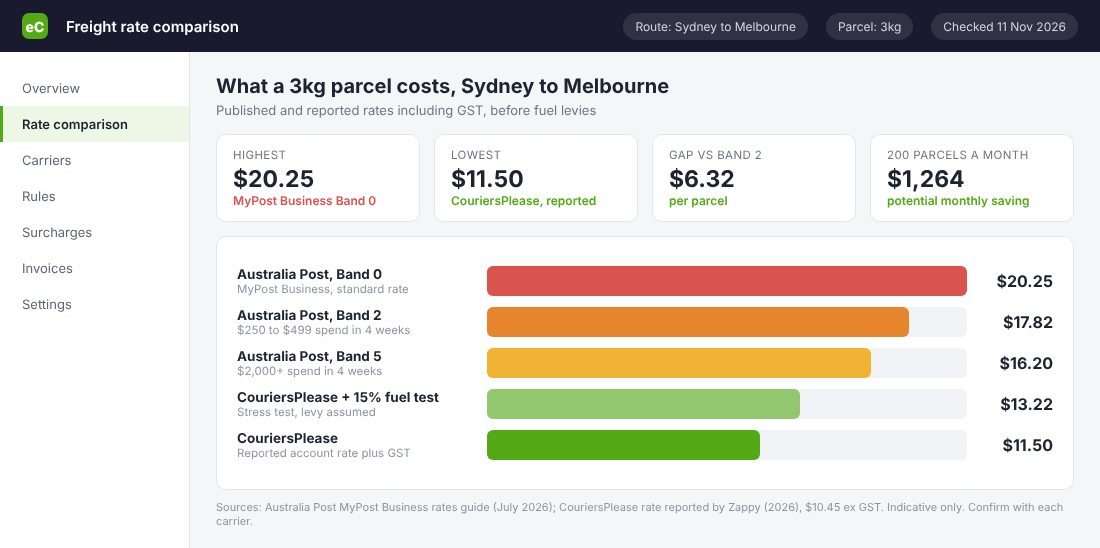
The main Australia Post alternatives for an online store are CouriersPlease, Aramex, Allied Express and Team Global Express, plus booking platforms such as Interparcel, Shippit and Zappy that resell those networks. On a 3kg parcel from Sydney to Melbourne, reported CouriersPlease account rates sit around $11.50 including GST, against $16.20 to $20.25 on MyPost Business, so the saving is real on metro parcels and close to zero on rural ones.
Most Aussie store owners get this decision wrong in one of two ways. They stay on Australia Post for everything because it is easy, and quietly hand over $4 to $6 a parcel on their metro orders. Or they chase the cheapest label they can find, move every order to one discount carrier, and find out the hard way that it cannot deliver to a PO Box in Dubbo.
The stores with the healthiest freight line do neither. They keep Australia Post for the jobs only Australia Post can do, send metro parcels through a second carrier, and let a rules engine pick the label. On a store sending 200 metro parcels a month, that split is worth roughly $900 to $1,250 a month in margin, with no extra traffic and no extra ad spend.
This guide gives you the real numbers we could verify on 11 November 2026, what each alternative is good and bad at, and a scorecard you can copy to choose your own mix.
Why store owners are looking for Australia Post alternatives in 2026
Three things happened this year, and each one pushed freight up the list of things founders worry about.
1. Prices went up again. Australia Post lifted Parcel Post and Express Post by an average of 4.95% on 1 July 2026, and the MyPost Business pickup fee rose 9.7%. A pickup now costs $15.60 for most small senders. If you send 300 parcels a month at an average of $9.50, that rise alone is about $141 a month.
2. Fuel surcharges got ugly for contract customers. In April, Australia Post took its fuel surcharge on contract parcels from 4.8% to 12%. It peaked at 19.5% in June, and the published rate is 13.5% for November and 14.0% for December 2026. SmartCompany reported at the time that MyPost Business and retail customers were not affected, so check your own invoices before you assume either way.
3. The best known alternative disappeared. Sendle stopped taking bookings on 11 January 2026 and went into liquidation on 25 February. It had sent more than 65 million parcels. Booking platform Zappy told ACS Information Age it saw an 880% jump in search volume in the days that followed, as thousands of small stores went looking for a new carrier at once.
One warning on that last point. Sendle’s old pricing page was still online when we checked, complete with rate tables. Plenty of comparison articles still quote it. If a blog post tells you Sendle is the cheapest option, close the tab.
Meanwhile, delivery matters more to your customers than ever. The Australia Post eCommerce Report 2026 found Australians spent a record $82.6 billion online in 2025, up 14%, across 9.8 million households. 73% of shoppers said a good delivery experience makes them more likely to shop online, and 69% want a range of delivery options at checkout.
So you are being squeezed from both sides. Freight costs more, and customers expect more from it. That is exactly why a second carrier is worth an afternoon of your time.
First, know what you actually pay Australia Post
You cannot compare alternatives until you know your own baseline. Most founders quote the retail counter price in their head, which is not what a business account pays.
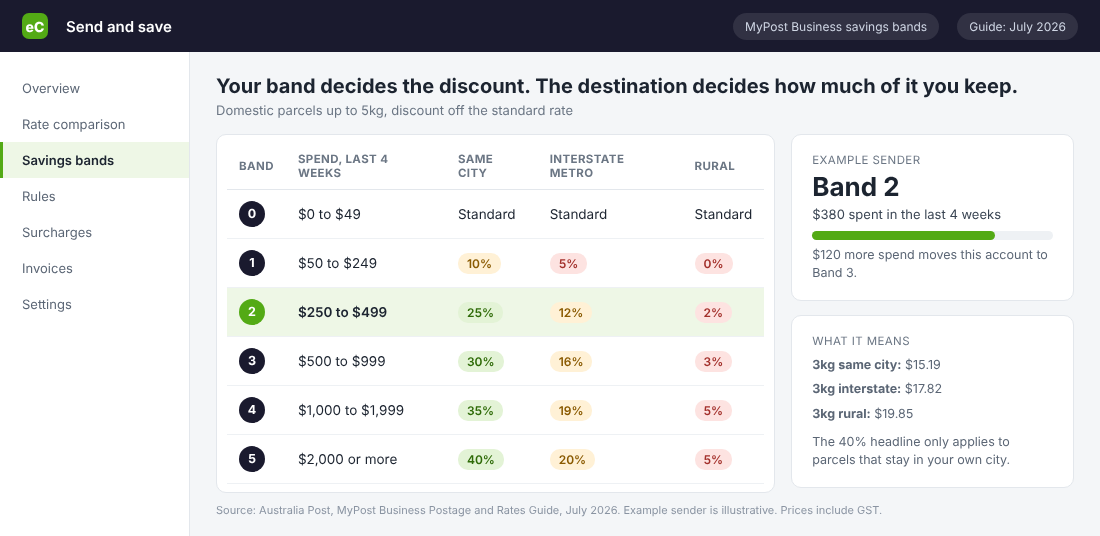
MyPost Business puts you in one of six savings bands based on what you spent in the last 4 weeks or the last 12 months, whichever is better for you. The discount then depends on where the parcel is going.
| Band | Spend, last 4 weeks | Same city (Zone 1) | To another capital or major area (Zone 2) | To rural (Zone 3) |
|---|---|---|---|---|
| 0 | $0 to $49 | Standard | Standard | Standard |
| 1 | $50 to $249 | 10% off | 5% off | 0% |
| 2 | $250 to $499 | 25% off | 12% off | 2% off |
| 3 | $500 to $999 | 30% off | 16% off | 3% off |
| 4 | $1,000 to $1,999 | 35% off | 19% off | 5% off |
| 5 | $2,000 or more | 40% off | 20% off | 5% off |
Read that table twice, because it explains the whole game. The famous “up to 40% off” only applies to parcels staying in your own city. Send interstate and the best you will ever get is 20%. Send to a rural address and it is 5%.
Here is what that looks like in dollars for Parcel Post, including GST:
| Parcel | Band 0 | Band 2, same city | Band 2, interstate | Band 5, same city | Band 5, interstate |
|---|---|---|---|---|---|
| 500g | $11.70 | $8.78 | $10.30 | $7.02 | $9.36 |
| 1kg | $16.00 | $12.00 | $14.08 | $9.60 | $12.80 |
| 3kg | $20.25 | $15.19 | $17.82 | $12.15 | $16.20 |
| 5kg | $24.45 | $18.34 | $21.52 | $14.67 | $19.56 |
Your action for today: log in to MyPost Business, open the Send and Save tab and write down your band. Then export last month’s orders from Shopify and count how many went to your own city, to another capital, and to a rural postcode. Those three numbers decide whether an alternative is worth it for you.
The Australia Post alternatives, compared honestly
A fair warning before the numbers. Private couriers in Australia mostly do not publish a national rate card. Your price depends on your depot, your volume and what you negotiate. The figures below are published or reported rates we could find, with the source and date, so treat them as a starting point for your own quote and not a promise.
| Carrier | Indicative price | Best for | Watch out for |
|---|---|---|---|
| CouriersPlease | Sydney to Melbourne: $7.32 (500g), $9.69 (1kg), $10.45 (3kg), $12.02 (5kg), excluding GST and fuel. Reported by Zappy, 2026. | Metro to metro parcels under 5kg | Regional and remote areas go through outside agents, with fewer scans |
| Aramex (formerly Fastway) | From about $7.46 for a 1kg metro parcel. Reported by Easyship, January 2026. Satchels from A5 to A2 carry up to 5kg. | Satchel sized orders, local and metro delivery | Franchise network, so pricing and service vary by region |
| Allied Express | About $15.49 for a 1kg road express parcel. Reported by Easyship, January 2026. | Bulky items, same day and next day metro | Not built for small, light parcels |
| Team Global Express | Quote only | Higher volume stores and heavier freight | Account minimums, aimed at larger shippers |
| Booking platforms (Interparcel, Shippit, Zappy, Transdirect) | Varies. Zappy’s indicative Sydney to Melbourne range is $9 to $12 for 1kg and $11 to $15 for 3kg. | Low volume stores that cannot get a direct account | You are buying through a reseller, so check who holds the carrier contract |
CouriersPlease
CouriersPlease is the closest like-for-like swap for metro parcels. It runs 18 depots and more than 600 franchise territories across Sydney, Melbourne, Brisbane, Adelaide, Canberra and the Gold Coast, plus over 3,000 HUBBED pickup and drop-off points.
Add GST to the reported rates above and a 3kg Sydney to Melbourne parcel is about $11.50. On MyPost Business Band 2 the same parcel is $17.82. That is a $6.32 gap before fuel. Stress test it with a 15% fuel levy and the courier is still around $4.60 cheaper.
The gap shrinks fast on small parcels. At 500g the difference is closer to $2.25, and a Band 5 sender posting within their own city pays Australia Post just $7.02, which beats the courier’s interstate price.
Aramex
Aramex took over the old Fastway network and still runs on regional franchises. It was also one of the delivery partners behind Sendle, which is why it moved quickly in January. Regional director Mark Little told retailbiz the business was “ready to support e-commerce and B2B businesses that are seeking an alternative courier partner”.
The upside is price on satchel sized orders and strong local delivery. The downside is consistency. Your experience depends heavily on your local franchise, so ask other store owners in your area before you commit. You can send one-off parcels without an account, which makes it easy to test.
Allied Express and Team Global Express
These two are not small parcel specialists. Look at them if you sell furniture, fitness gear, cartons of drinks or anything over 22kg, where Australia Post either will not carry it or prices it painfully. For a store shipping t-shirts and skincare they are the wrong tool.
Booking platforms and aggregators
Interparcel, Shippit, Zappy and Transdirect give you one login and access to several carriers at rates you could not negotiate alone at 50 parcels a month. If you used the Sendle app on Shopify, it has been replaced by Joovii Shipping, which says it offers up to 50% off courier rates.
They are a sensible starting point, with one lesson from January worth remembering. Sendle owned no trucks. It was a platform reselling other networks, and when the platform ran out of money, parcels already collected were delivered “at the discretion of the delivery partner”. When you buy through any reseller, ask two questions: which carrier actually moves the parcel, and what happens to parcels in transit if you stop trading?
Where Australia Post still wins (and why you should not leave)
Here is the opinion most “cheapest courier” articles will not give you: almost no Australian store should drop Australia Post completely. It does four jobs nobody else does well.
- PO Boxes and Parcel Lockers. These are Australia Post facilities, so private couriers generally cannot deliver to them. Australia Post lists 635+ Parcel Lockers, and its 2026 report found 32% of shoppers would switch retailers to get out-of-home collection.
- Rural and remote addresses. Private networks hand these to agents or add remote surcharges. Australia Post delivers everywhere, at a known price.
- Easy lodgement. 4,300+ Post Offices and 15,500+ street posting boxes mean you can skip the $15.60 pickup fee entirely while you are small.
- Small, light, local parcels. On a high band, a 250g or 500g parcel staying in your city is hard to beat.
Ben Chester, COO of Sprout Organic and 3PL provider Better Brands, made the same point to SmartCompany when the fuel surcharge jumped. Better Brands already uses around 15 logistics partners, yet he said the private providers lack a national consumer distribution network, which left the business “over a barrel”. Sprout’s response was to lift its free shipping threshold, not to walk away from the carrier.
In the same article, Ben Van der Veen from Victorian retailer Hunt the Night, which ships more than 50,000 parcels a year through Australia Post, said thin margins meant passing the full increase on to customers.
Both are big senders with real negotiating weight, and both are still with Australia Post. The lesson for a smaller store is clear. The goal is not to replace Australia Post. The goal is to stop giving it the parcels someone else can carry for less.
How to choose: the carrier scorecard
Price is one of six things that matter. Copy this scorecard into a spreadsheet and score each carrier you are quoting from 1 to 5.
| Criteria | What to ask | Weight |
|---|---|---|
| All-in price | Base rate plus GST, fuel levy, residential and remote surcharges, on your three most common parcel sizes | 30% |
| Coverage | What share of last quarter’s postcodes can they deliver without an agent or surcharge? | 20% |
| Speed and scans | Days to your top five destination cities, and how many tracking scans per parcel | 15% |
| Failed delivery handling | Authority to leave, redelivery fees, collection points | 15% |
| Claims | Included cover, time limits and how a lost parcel claim actually works | 10% |
| Integration | Does it connect to Shopify or your shipping software without manual label entry? | 10% |
Two rules make the scorecard work.
Quote on cubic weight, not dead weight. Every carrier charges on the greater of actual weight and volume. A light product in a big box is priced as a heavy one. If you have not measured your packed parcels, do the cubic weight audit first, because shrinking a box can save more than switching carrier.
Get the surcharges in writing. A cheap base rate with a 15% fuel levy, a residential fee and a remote area charge is not cheap. Our carrier rate card guide walks through every line to check before you sign.
Set up a two-carrier split in Shopify (step by step)
Shopify’s own Australian carrier page listed a single domestic carrier when we checked: Australia Post, through MyPost Business. To run a second carrier properly you need shipping software sitting between Shopify and your carriers.
We usually point members to Starshipit. It is Australian, connects to Shopify, Australia Post, Aramex and CouriersPlease, and has a 30-day free trial. The Starter plan is $45 a month for up to 100 labels and Starter Plus is $126 for up to 500. Interparcel’s Shipping Manager and Shippit do a similar job.
- Connect Shopify. Install the app from the Shopify App Store and let it import your open orders.
- Add both carrier accounts. Enter your MyPost Business details and your new courier account number. Rates should now load side by side.
- Save your package presets. Add the packed weight and dimensions of your three most common parcels. Accurate dimensions are what make the quotes real.
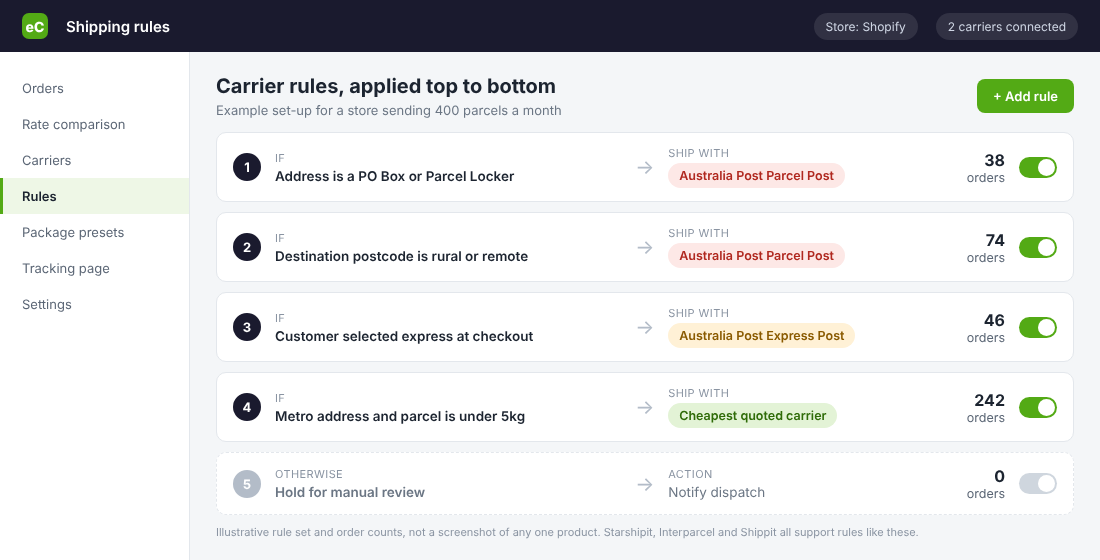
- Build four rules, in this order. PO Box or Parcel Locker address goes to Australia Post. Rural postcode goes to Australia Post. Customer paid for express goes to Express Post. Everything else under 5kg goes to the cheapest quoted carrier.
- Turn on tracking emails. Use one branded tracking page for both carriers so the customer never has to care who delivers.
- Run a test batch. Send 30 parcels through the new carrier before you move real volume. More on that below.
Once the rules are live, review your free shipping threshold. A lower average freight cost changes the maths, and you may be able to drop the threshold or keep it and bank the margin.
The 30-parcel test (do this before you move volume)
Never switch a main carrier on a quote alone. A rate card tells you the price. Only real parcels tell you about the service.
- Send 30 parcels through the new carrier over two weeks: 10 same city, 15 interstate metro, 5 to large regional centres.
- Record four numbers for each: days from pickup to delivery, number of tracking scans, final invoiced cost including every surcharge, and any customer contact about the delivery.
- Compare against 30 matching Australia Post parcels from the same fortnight.
- Set a pass mark before you start. For most stores: at least $2 cheaper per parcel all-in, no more than one day slower on average, and no more than one “where is my order” ticket in the batch.
A word on timing. It is 11 November. Black Friday is on 27 November and Christmas cut-offs follow straight after. Do not change how your orders ship in the next six weeks. Request your quotes now, while account managers are keen to sign new senders for the new year, and run the 30-parcel test in the second half of January. If your peak plan is not locked in yet, our Black Friday shipping guide covers the carrier checks to make this week.
The compound effect: why two carriers beat one
Each piece of this is small on its own. Together they change your freight line.
Knowing your band tells you which parcels Australia Post is overcharging you for. The scorecard finds a carrier that can take those parcels. The rules engine makes the choice automatic, so nobody on your team has to think about it at the packing bench. And the test proves the saving is real before you bet your reviews on it.
Run the numbers on a store sending 400 parcels a month, half of them metro to metro around 3kg. Moving those 200 parcels at a saving of $4.60 to $6.30 each is $920 to $1,260 a month, or roughly $11,000 to $15,000 a year, straight to profit.
There is a second payoff that does not show up in the P&L until you need it. When Sendle closed, the stores with a second carrier already connected could reroute orders the same day. Everyone else was opening new accounts while orders piled up. As Interparcel CEO Steve Zammit put it at the time: “If one carrier goes down, you don’t panic. You switch.”
Australia Post alternatives: quick answers
What is the cheapest alternative to Australia Post?
For metro to metro parcels between 1kg and 5kg, CouriersPlease and Aramex are usually the cheapest direct options, with reported rates from about $7.46 to $12 before GST and fuel. For parcels under 500g staying in your own city, Australia Post on a high MyPost Business band is often cheaper.
Is Sendle still operating in Australia?
No. Sendle stopped accepting bookings on 11 January 2026 and entered creditors’ voluntary liquidation on 25 February 2026. Some of its old web pages are still online, so check the date on any article that recommends it.
Can couriers deliver to PO Boxes and Parcel Lockers?
Generally not. PO Boxes and Parcel Lockers are Australia Post facilities. Keep an Australia Post account and route those addresses to it automatically.
How many parcels do I need to get a courier account?
It varies by carrier and depot, and there is no single published minimum. Aramex will take one-off sends without an account. If you send fewer than about 50 parcels a month, start with a booking platform, then go direct once your volume gives you something to negotiate with.
Your next step
Do three things this week, and none of them touch your live orders. Write down your MyPost Business band. Split last month’s parcels into same city, interstate and rural. Then request quotes from two alternatives on your three most common parcel sizes, with every surcharge listed.
Inside eCommerce Circle, freight cost per order is one of the Profit numbers we review with every member, because it is one of the few costs you can cut without selling a single extra unit. If you want to see exactly where your store is being capped, take the free More Orders Scorecard. It takes two minutes and shows you which of the 10 P’s to fix first. Or, if you would like to see how we work with founders, start in Connect.
Sources, checked 11 November 2026: Australia Post, MyPost Business Postage and Rates Guide (July 2026), fuel surcharge page and eCommerce Report 2026; HotSnail and Parcelo on the 1 July 2026 Australia Post price changes; SmartCompany, “Australia Post’s massive new fuel surcharges eat into business margins” (March 2026); Startup Daily and Wikipedia on the Sendle closure and liquidation; ACS Information Age, “880% increase: Sendle competitors step up” (27 January 2026); retailbiz, “Aramex, Interparcel move to support retailers following Sendle shutdown” (13 January 2026); Zappy, Sydney to Melbourne courier rates (2026); Easyship, Australia Post Alternatives (January 2026); Aeros Couriers on the CouriersPlease network (April 2026); Starshipit and Shopify pricing and carrier pages. Courier rates are indicative and change often. Confirm current pricing with each carrier before you decide.