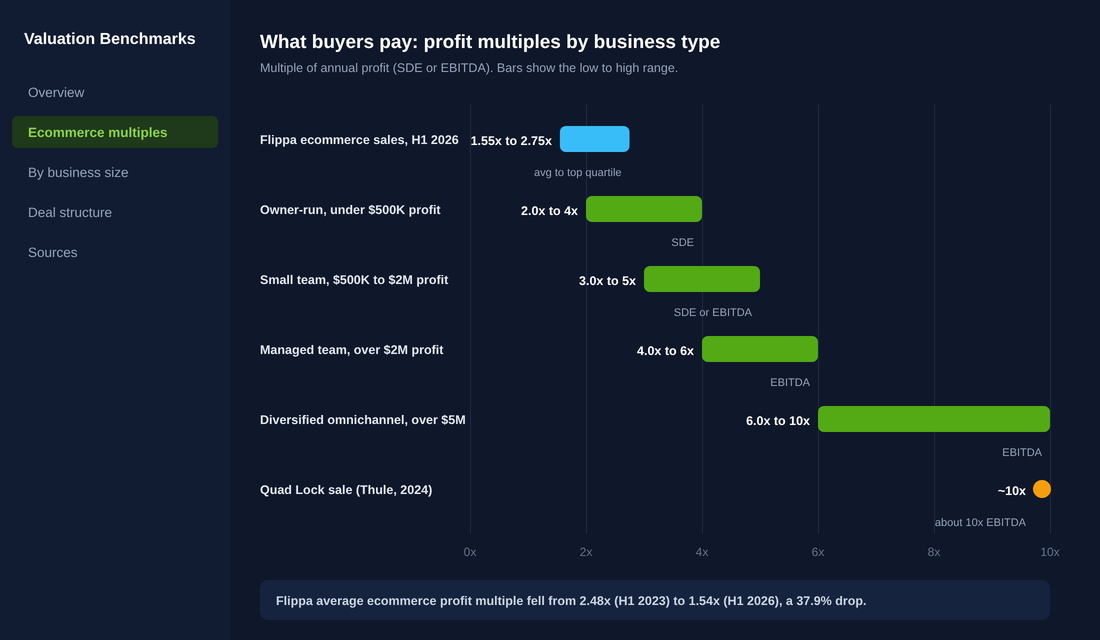
Most small Shopify stores sell for about 2 to 4 times their seller’s discretionary earnings (SDE), with inventory added on top. Flippa’s sold-deal data puts the average ecommerce sale closer to 1.55 times annual profit, so where you land depends on how much of the business needs you to run it.
That gap between “my store is worth 5x profit” and “a buyer offered 1.5x” is where most founders get hurt. You hear a big number at a conference, you run your own maths, and then the first real offer lands at a third of what you expected.
The good news is that the multiple is not fixed. Two stores with identical profit can sell for very different prices, and the difference comes down to a short list of things you can fix 6 to 12 months before you ever talk to a buyer. This guide walks through how buyers actually value an ecommerce business, the exact SDE maths, what moves your multiple, and the Australian tax rules that decide how much of the sale price you keep.
How Buyers Actually Value an Ecommerce Business
Three methods get used, and which one applies depends on your size and your profit.
- SDE multiple. SDE is your net profit plus your own pay plus legitimate one-off and personal add-backs. It is the standard for owner-operated stores and anything under roughly $5 million revenue. Think of it as the total cash one owner-operator buyer would take home.
- EBITDA multiple. Earnings before interest, tax, depreciation and amortisation, after paying a market-rate manager. Buyers move to this once the business runs under a management team, typically above $1 million EBITDA.
- Revenue multiple. Used for high-growth brands or when profit is low or lumpy. Flippa’s H1 2026 data shows the average ecommerce revenue multiple at just 0.51x, so a $2 million revenue store is not worth $2 million.
The multiple has also been falling. According to Flippa’s H1 2026 ecommerce valuation data, the average ecommerce profit multiple peaked at 2.48x in H1 2023 and sat at 1.54x by H1 2026, a 37.9% drop. The revenue multiple fell from 1.12x to 0.51x over the same stretch. If a founder friend sold in 2021 for 4x, that was a different market.
Here is the part most guides skip. Marketplace averages include a huge number of tiny, owner-dependent listings. Brokers who work with established brands quote higher bands, which is why you will see both “1.55x” and “3x” described as normal. Both are true. They describe different businesses.
The SDE Maths: Your Number in 15 Minutes
Start with your last 12 months of profit, not a forecast. Buyers price trailing twelve months, and they rebuild your P&L themselves, so inflated add-backs cost you credibility on everything else.
The formula from Eightx’s SDE guide is simple: pre-tax profit, plus owner compensation, interest, depreciation and amortisation, plus non-recurring and discretionary personal expenses.
Here is a worked example for a made-up Aussie store with about $1.1 million in revenue:
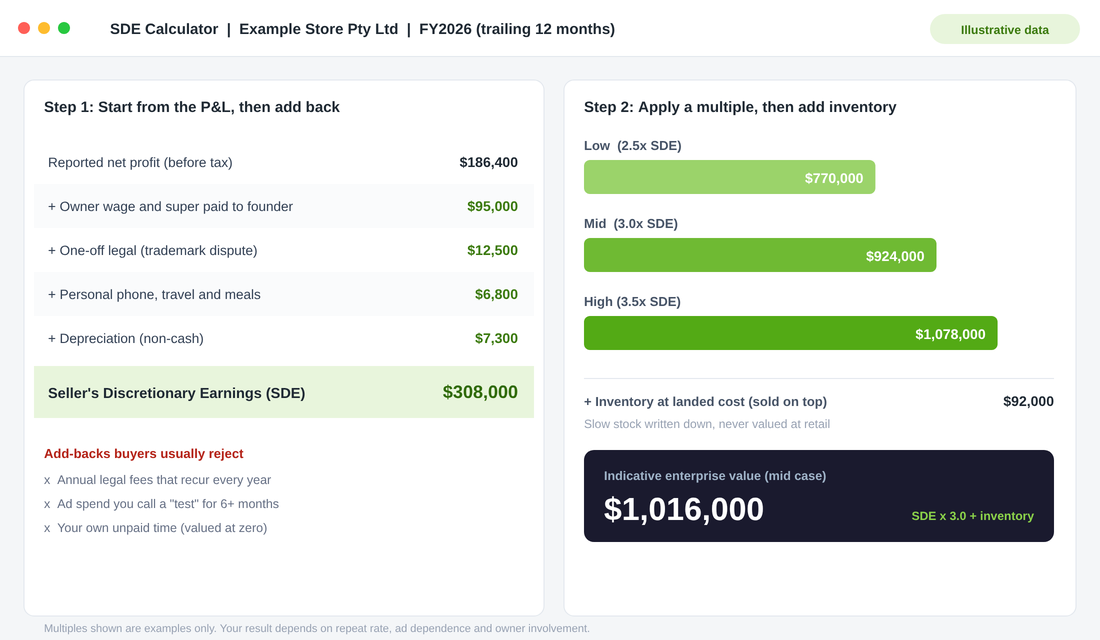
- Reported net profit before tax: $186,400
- Owner wage and super: $95,000
- One-off legal cost (a trademark dispute): $12,500
- Personal phone, travel and meals run through the business: $6,800
- Depreciation: $7,300
- SDE: $308,000
At 2.5x, 3.0x and 3.5x, that is $770,000, $924,000 and $1,078,000. Inventory is usually priced on top at landed cost, so $92,000 of clean stock takes the mid case to about $1.016 million.
What buyers accept and reject as add-backs:
- Usually accepted: owner salary and payroll tax, owner super and health costs, documented personal expenses, genuine one-off legal or consulting, non-operating family payroll.
- Often challenged: marketing “tests” that you can prove ended.
- Typically rejected: recurring personal travel, legal fees that show up every year, and ad spend that has run for six months or more as part of your normal mix.
- Always rejected: your own unpaid time. Buyers value it at zero, because they will have to replace it.
One test I give coaching members: if an add-back has no receipt, no explanation and no end date, drop it yourself before the buyer does. A contractor you paid every month for two years and labelled “one-off” will make the buyer doubt every other number you give them.
Your gross margin feeds straight into this number, so if profit looks thin, start with what a good ecommerce gross margin looks like before you worry about the multiple. The Profit section of the Scorecard checks exactly this.
What Multiple Can You Realistically Expect?
Here are the bands brokers quote for Shopify and ecommerce brands, from Ecommerce Fastlane’s breakdown of selling a Shopify store:
- Owner-run, under $500K profit: 2.0x to 4.0x trailing 12-month SDE
- Small team, $500K to $2M profit: 3.0x to 5.0x
- Managed team, over $2M profit: 4.0x to 6.0x EBITDA
- Diversified omnichannel, over $5M: 6.0x to 10.0x or more
Empire Flippers lists on a monthly multiple, usually 30 to 50 times monthly profit. A 40x monthly multiple works out to about 3.3x annual profit. Flippa’s average of 1.55x and top quartile of 2.75x sit at the lower end because they include so many small listings.
Two real examples show the spread.
The Cruiser Store, an Australian automotive ecommerce brand. Per Flippa’s Shopify valuation write-up, it sold for $2.2 million AUD on $3.5 million AUD annual revenue and a 24% profit margin, about 2.6x profit. That works out to roughly $840,000 in annual profit, and the founder built the brand in 30 months. The cited strengths were customer retention, return on ad spend and founder independence.
Quad Lock, the Melbourne phone mount brand. Co-founder Rob Ward told the Add To Cart podcast that Thule bought the business for a reported $500 million after it grew past $200 million in revenue and about $50 million in EBITDA. That is roughly 10x EBITDA. Ward’s lessons are useful at any size: leave growth on the table for the buyer, build leadership depth so the business runs without the founders, and get governance and clean books in place before the deal, not during it.
You will not be selling Quad Lock. But the principle is identical at $300K profit: buyers pay more for a business that runs without you and has somewhere left to grow.
The 7 Things That Move Your Multiple
This is where the 1.5x stores and the 4x stores separate. Each factor is something a buyer checks in due diligence.
1. Repeat purchase rate
Buyers look at this first. The ecommerce average sits around 28%, and 35% to 40% reads as strong. If you are below average, you have a retention problem a buyer will price in. Our guide to repeat customer rate benchmarks and fixes covers how to lift it, and every point you add shows up in your multiple.
2. Channel concentration
If more than 40% of revenue or supply depends on one source, buyers apply a discount. For most Aussie stores the single biggest risk is Meta ads. Flippa’s data lists diversified traffic across organic, email, direct, social and paid as a multiple-lifter, and heavy paid dependence as a compressor. Buyers also check ad account history, so a Meta account that was suspended last year will come up.
3. Owner dependence
If you work 45 hours a week in the business, the buyer is buying a job, not an asset. The aim is to reduce your weekly hours steadily over 12 months, with a documented handover for every task you used to do. A library of 25 standard operating procedures is the fastest way to prove the business does not live in your head.
4. Supplier concentration
One supplier making 46% of your cost of goods is a single point of failure. Buyers will contact your suppliers directly during due diligence. Get written terms in place, and where you can, qualify a second source for your top five products.
5. Clean, reconciled financials
Separate personal and business spending at least 12 months out. Reconcile Shopify payouts to your accounting software, keep GST clean, and have a P&L that matches your tax returns. Flippa also flags a clean Shopify Payments history of 12 months or more as a positive signal.
6. Documented operations and a lean app stack
Fulfilment, customer service, ad reporting and supplier orders should all exist as written steps. Cut apps you do not use. A tidy stack signals a business that is easy to take over.
7. Brand strength
Direct traffic, branded search, email list size, social following and organic mentions all tell a buyer the brand does some of the selling by itself. A store that only converts when you pay Meta looks like rented revenue.
4 Valuation Mistakes Aussie Founders Make
- Quoting a revenue multiple. “Stores sell for 1x revenue” is how people get hurt. Flippa’s average ecommerce revenue multiple is 0.51x, and profit is what buyers price.
- Using this year’s best month. Buyers use trailing twelve months. One huge Black Friday does not fix a flat year, and they will see through a forecast.
- Selling after a growth spike with no history. A buyer wants to see the number hold. A store that doubled in the last four months looks like an ad-spend experiment, not a brand.
- Hiding problems. Supplier issues, chargebacks and a past ad account ban all come out in due diligence. Disclose early and price it in, because a late surprise usually costs far more than the issue itself.
Your Pre-Sale Valuation Readiness Checklist
Use this as a scorecard. Score one point for each “yes” and see where you land.
- Trailing 12-month P&L reconciles to your tax return and your Shopify payouts
- Every add-back has a receipt, a reason and an end date
- Repeat purchase rate is at or above 28%, and trending up
- No single traffic channel is above 40% of revenue
- No single supplier is above 40% of cost of goods
- You work fewer hours each quarter than the last
- At least 20 core processes are documented
- Inventory older than 180 days is written down to realistic value
- A named person can run fulfilment and support without you
- You have 12 months or more of clean payments history
Scoring: 8 to 10 means you are close to market-ready. 5 to 7 means 6 to 12 months of work will lift your multiple. Below 5, treat the next year as preparation, not selling.
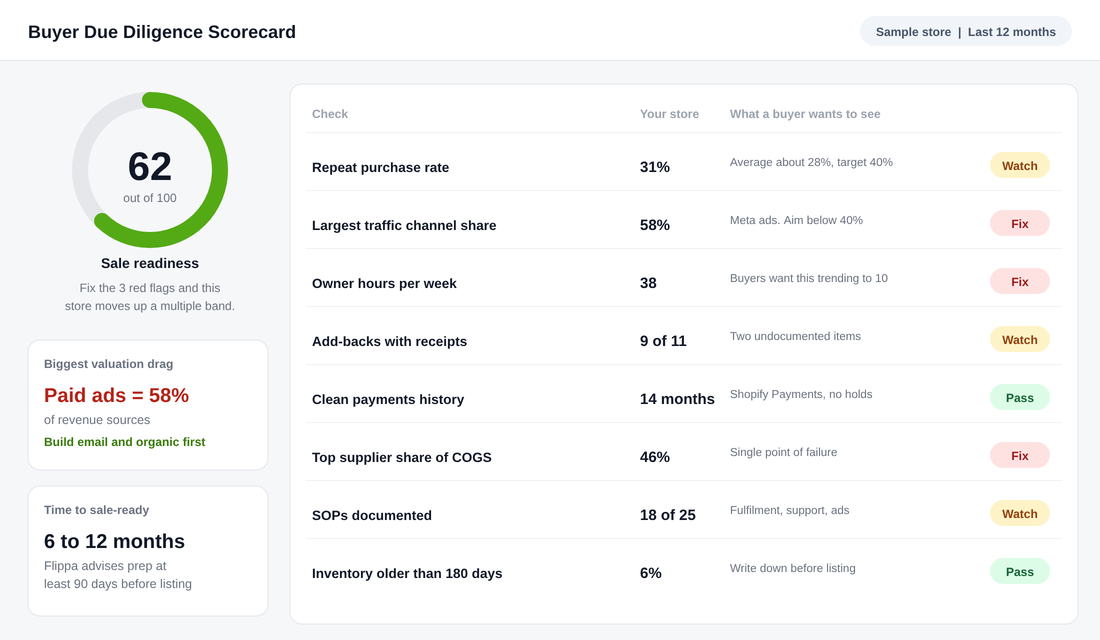
Flippa recommends starting preparation at least 90 days before you list, but that is the minimum. If your score is low, 6 to 12 months is more realistic. Our exit readiness playbook goes deeper on the 12-month timeline.
Deal Structure: The Headline Price Is Not What You Receive
Founders fixate on the multiple and ignore the structure. A $1 million headline price can mean very different cash in your bank.
- Cash at close. Roughly 25% to 40% of consideration in a typical deal is not cash at close. Aggregator-style deals commonly pay 60% to 75% upfront.
- Earnouts. Payments over 12 to 24 months that depend on future performance. Tie any earnout to a metric you can verify from outside, such as gross revenue, rather than net profit the buyer controls.
- Inventory. Added at landed cost on top of the multiple. Slow-moving stock should be written down, not valued at retail price.
- Handover. Expect to stay on for 30 to 90 days or more to transfer supplier relationships, ad accounts and know-how.
Ask every buyer for the cash at close figure in writing before you compare offers. A lower headline price with more cash upfront often beats a higher price paid over three years.
The Australian Tax Side: What You Keep After the Sale
This is where a lot of Aussie founders leave money on the table, so it is worth a conversation with your accountant well before you list. I am not a tax adviser, so treat the following as the outline and confirm it against current ATO guidance.
Small business CGT concessions can reduce or remove the capital gain on a sale. As summarised by Lawpath and Moore Australia, you generally need aggregated turnover under $2 million, or net CGT assets of $6 million or less, and the asset must be an active business asset. The four concessions are:
- 15-year exemption: the whole gain can be disregarded if you held the asset continuously for 15 years and you are 55 or older and retiring or permanently incapacitated.
- 50% active asset reduction: cuts the gain on active assets held at least 12 months by half, and can stack with the general 50% CGT discount for individuals and trusts.
- Retirement exemption: a lifetime limit of up to $500,000. If you are under 55, the exempt amount generally has to go into a complying super fund.
- Rollover: defers the gain if you reinvest in a replacement active asset.
Your business structure matters here, because whether you hold the business in a company, a trust or as a sole trader changes which concessions apply and how the sale is taxed. Our business structure guide is a good place to start, and a fractional finance person can build this into your plan. See the fractional CFO roadmap for how that works.
Tools to Get Your Number Fast
You do not need to pay a broker to find out where you stand.
Flippa’s free valuation tool gives you a rough range and shows what comparable stores have sold for. To set it up:
- Pull your trailing 12-month net profit from Xero or MYOB, plus your revenue and inventory value.
- Work out your SDE using the add-back table above.
- Enter revenue, profit, age of the business, traffic sources and platform in the valuation tool.
- Compare the range with your own SDE multiples from the bands above.
- Repeat each quarter. Track the number as a KPI, the same way you track revenue.
Use the output as a sanity check, not an offer. Real buyers will rebuild your numbers and discount anything they cannot verify.
The Compound Effect: Why 12 Months of Prep Beats Any Negotiation
Look at what happens when you fix the factors above together, not one at a time.
Say your store earns $308,000 SDE and sells at 2.5x, or $770,000. You lift repeat rate from 22% to 35%, bring your largest channel below 40% of revenue, document your processes, and cut your weekly hours from 38 to 15 over a year. A buyer sees a more transferable, more stable business and pays 3.5x. Same profit, now $1,078,000.
That is $308,000 more from the same store. And fixing the same things also lifts your profit, because better retention lowers acquisition cost, diversified channels cut ad spend, and documented processes cut errors. You get paid twice: once while you run the business, and again when you sell it.
It is also the same list you would work through if you never plan to sell. A business a buyer would want is simply a better-run business.
Your 90-Day Starting Plan
- Weeks 1 to 2: Calculate trailing 12-month SDE and write down every add-back with its receipt.
- Weeks 3 to 4: Reconcile payouts, GST and the P&L to your tax return, and separate personal costs from the business.
- Weeks 5 to 8: Score yourself on the 10-point checklist and pick the three lowest items.
- Weeks 9 to 12: Start the fixes: second supplier quotes, an email flow to lift repeat rate, the first 10 SOPs.
- Every quarter: Recalculate your number and track it next to revenue and profit.
Inside eCommerce Circle, building a store that is worth more is one of the core pillars we work on with every member. If you want to see exactly where your store is being capped, take the free More Orders Scorecard. It takes two minutes and shows you which of the 10 P’s to fix first.