Black Friday shipping in Australia comes down to three decisions you make before the sale starts: which carrier is your primary and which is your backup, what delivery date you promise each zone, and how many parcels your team can pack in a day. Get those right and the sale runs quietly. Get them wrong and you spend Cyber Monday answering “where is my order?” emails instead of selling.
Black Friday 2026 lands on 27 November. That is four weeks away. Most Shopify founders are still arguing about discount percentages while the thing that actually decides whether a Black Friday customer buys again, the delivery, has no owner and no plan.
This guide is the plan we walk coaching members through. It covers carrier risk, delivery promises by zone, capacity maths, customer communication and a dated checklist you can copy. If you want the wider sale strategy, start with our Black Friday Australia 2026 dates and deadlines guide. This post is only about getting the parcel from your shelf to the doorstep on time.
Why Black Friday shipping decides whether customers come back
Black Friday is the biggest test your fulfilment has all year, and the carriers are being tested at the same time as you. Australia Post delivered more than 111 million parcels in November and December 2025, its busiest peak season on record, and it expects a similar peak this year (SBS).
The Black Friday to Cyber Monday weekend itself was even more concentrated. Australia Post reported its busiest delivery day in history, with more than 5.8 million parcels processed in a single day, parcel volumes up 6.3% year on year, and around $1.5 billion spent online across the four days (SMBtech, December 2025). Globally, Shopify merchants did $14.6 billion in sales over the same weekend, up 27%, with Australia ranked the third top-selling country behind the US and UK (Shopify).
That is the environment your parcels are travelling through. Delays are not a rare event. In 2019, Shippit reported that one in five Black Friday deliveries arrived late after a 72% jump in online orders, and one provider delivered only 64% of its parcels on time (Inside Retail). Volumes are far higher now.
Here is why that matters for profit. A Loqate survey of 1,028 Australians found that 27% would not buy from a retailer again if a package missed the holidays (GBG, November 2021 survey). It is an older survey, so treat the exact number as a guide, but the behaviour is consistent with what we see in stores.
Run the numbers on your own store. Say you take 1,000 Black Friday orders at a $95 average order value, and 8% arrive late. That is 80 late orders. If 27% of those customers never return, you lose about 22 repeat customers. At one extra order each, that is roughly $2,000 in second-order revenue, before you count refunds, reshipping and the support hours. It is an illustration, not a forecast, and your own late rate decides the result.
Now compare that to what you paid to acquire those customers at Black Friday CPMs. Late delivery turns your most expensive customers of the year into your least loyal ones.
Step 1: Audit your carrier setup before the sale, not during it
Start with the question most founders skip: if your main carrier stopped working tomorrow, what would you do? It is not a hypothetical. Sendle, a carrier popular with small online businesses, halted all Australian pickups and delivery bookings from 11 January 2026, cancelled pickups scheduled from 12 January, and told merchants that parcels already in transit might not arrive (Power Retail). Stores with a single carrier and no backup had to find a new one overnight.
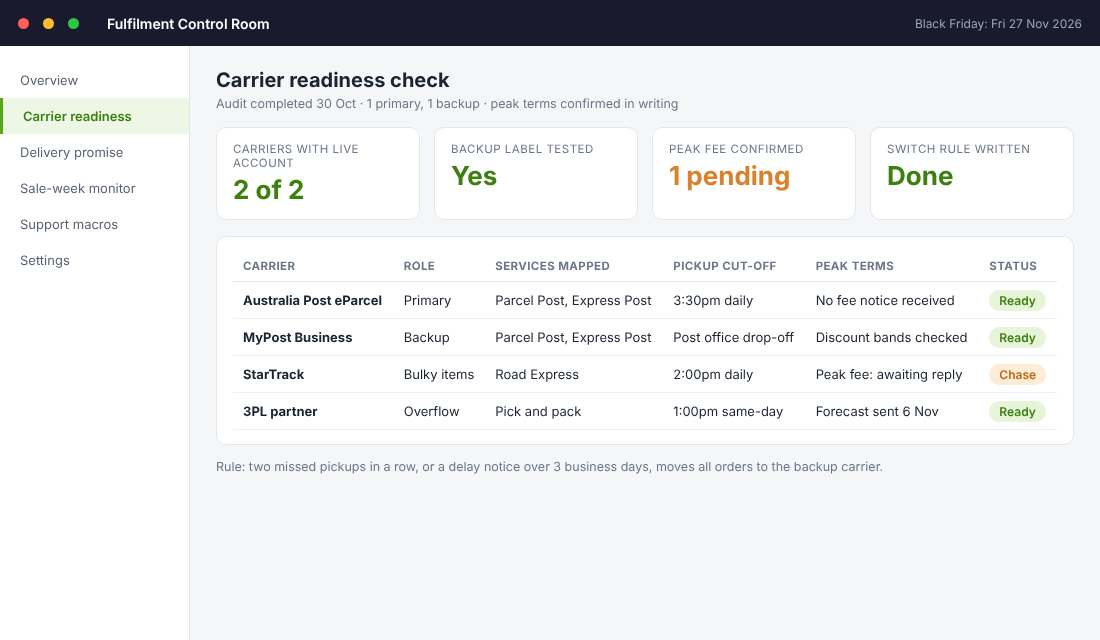
Do this audit in one sitting this week:
- List every carrier and service you use. Include which products or zones each one handles, who your account contact is, and the contract or terms that apply.
- Name a primary and a backup. The backup needs a live account, tested labels and a working Shopify connection before 27 November. A backup you open on the day is not a backup.
- Read the peak terms. StarTrack’s terms allow a Peak Fee on items lodged during high-demand periods with 30 days’ notice. It applied no Peak Fee in 2024 (Australia Post), but check what your carrier has published for this year, and ask your account rep in writing.
- Check your cut-off for handover. Know what time the driver collects or the post office takes drop-offs, because a parcel scanned on Monday morning is not a Friday parcel.
- Price the whole basket. Compare your rate card at your actual parcel weights. Our carrier rate card guide shows how to build one.
Which Australia Post service fits your volume
For most small stores the realistic choice is between Australia Post’s MyPost Business and an eParcel contract. In general, MyPost Business suits smaller senders with no contract, label printing through the portal and discount bands based on weekly spend. eParcel is contract based and tends to be more cost effective once you ship around 200 or more parcels a month, with a minimum annual volume commitment (PluginHive comparison). Confirm the current terms and discount bands directly with Australia Post, because published figures vary between sources and change on 1 July each year.
Tool setup: connect a backup carrier in Shopify in about 30 minutes
Whichever carrier you choose as backup, set it up like this:
- Open the carrier’s business portal (for example MyPost Business) and create the account. Add your sender address and pickup details.
- In Shopify, go to Settings > Shipping and delivery and open your general shipping profile. Check the origin location matches where you really pack.
- Install the carrier’s Shopify app or a connector such as PluginHive’s Australia Post app, then authorise the account and map Parcel Post and Express Post services.
- Create one real test order, buy a label, print it on your label printer and scan the barcode. Check weight, dimensions and the sender address print correctly.
- Write the switch rule down: “If the primary carrier misses two consecutive pickups or the delay notice exceeds 3 business days, switch all orders to the backup.” Put it in your SOP so anyone on the team can act on it.
Step 2: Set a delivery promise by zone, then add a buffer
Most Aussie stores publish one delivery estimate for the whole country. That is the quickest way to miss a promise, because delivery in Sydney metro and delivery to Perth, Darwin or Hobart are different jobs.
Australia Post’s own 2026 Christmas guidance shows the spread. Interstate parcels have a 21 December cut-off for most states, but Tasmania runs 16 to 21 December, Western Australia 14 to 18 December and the Northern Territory 14 to 17 December. Items sent from South Australia, Tasmania and the Northern Territory first travel to another state, so add two business days for Express and five business days for Standard and Economy (SBS). Regional and remote addresses need a few extra days on top.
A simple promise formula
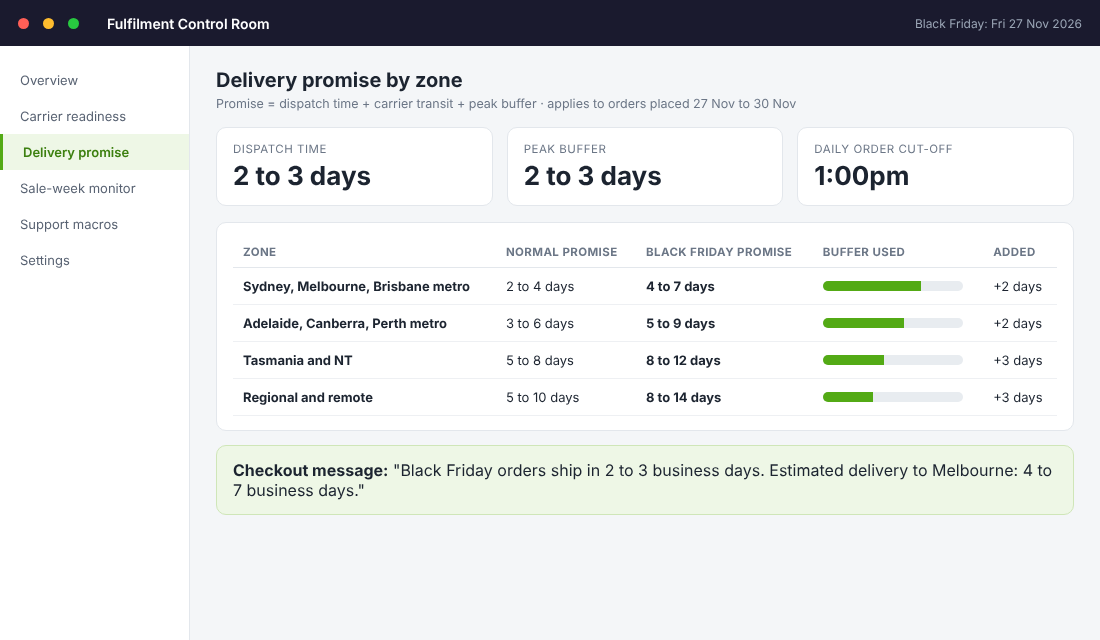
For every zone, your promise is: dispatch time + carrier transit time + peak buffer.
- Dispatch time: how many business days from payment to scan. During Black Friday week, be honest. If you normally ship same day, promise 2 to 3 business days.
- Carrier transit time: pull it from your carrier for each zone, not from your memory.
- Peak buffer: add 2 to 3 business days for metro and more for WA, NT, TAS and regional addresses.
| Zone | Normal promise | Black Friday promise | Why |
|---|---|---|---|
| Sydney, Melbourne, Brisbane metro | 2 to 4 days | 4 to 7 business days | Highest volume lanes carry the biggest queues |
| Adelaide, Canberra, Perth metro | 3 to 6 days | 5 to 9 business days | Longer line haul and extra handling |
| Tasmania, NT | 5 to 8 days | 8 to 12 business days | Parcels route via another state first |
| Regional and remote | 5 to 10 days | 8 to 14 business days | Extra legs to the final delivery depot |
These are example ranges to adapt, not carrier commitments. Replace them with your own carrier’s published transit times plus your dispatch time.
Under-promise, then beat it. A customer told “arrives in 5 to 9 days” who receives the parcel on day 6 is happy. The same customer told “2 to 4 days” who receives it on day 6 writes to support.
For the Christmas side of this, with the full cut-off table and a pre-Christmas shipping banner, use our Christmas cut-off playbook. Black Friday orders often turn into Christmas gifts, so the two promises have to agree.
Step 3: Make your shipping offer survive 4x order volume
Black Friday changes your shipping economics, and a free shipping threshold that works in July can lose money in November. Discounted orders have thinner margin, so the same shipping cost takes a larger bite.
Before you set the offer, rebuild your numbers with the discounted price. Our free shipping threshold guide covers the full method. For Black Friday the short version is:
- Recalculate contribution margin after the discount. If a 30% off product leaves you $18 of gross profit and shipping costs $11, your free shipping offer eats most of it.
- Raise the threshold, not the discount. A threshold that sits about 20% above your current average order value nudges customers to add one more item without a bigger markdown.
- Offer a slower free option and a paid fast option. Free standard shipping with a clear date range, plus Express at a fair price, protects margin and gives urgent buyers a way to pay for speed.
- Exclude the hard zones if they lose money. If remote addresses cost three times your average, say so at checkout with a flat rate instead of absorbing it silently.
The Black Friday discount calculator gives you the break-even number for the discount itself. Run shipping through the same maths before you publish the offer.
Step 4: Do the capacity maths for your pack bench or 3PL
Most Black Friday shipping failures are not carrier failures. They are the order sitting in your own warehouse for four days because nobody planned for the volume.
Pack capacity formula
Daily orders x minutes per order / 60 = pack hours needed per day.
Example: you normally ship 40 orders a day and expect 4x on peak days, so 160 orders. At 4 minutes per order from pick to labelled parcel, that is 160 x 4 / 60 = 10.7 hours of work a day. One person doing a 7.5 hour shift cannot finish. You need roughly 1.5 people on the bench, or a lower minutes-per-order through better setup.
To estimate your own peak, use the targets from our BFCM target maths post and multiply by the share of orders landing on Friday to Monday.
Cut minutes per order before you add people
- Pre-build your top 10 SKUs and bundles. Kit the packaging and inserts the week before. Bundles that take 90 seconds to pack beat ones that take four minutes of hunting.
- Standardise cartons. Use two or three box sizes, not nine. It also helps with cubic weight, which we cover in the carrier rate card guide.
- Batch by carrier and service. Print and pack all Express orders together, then standard, so pickup bags are ready when the driver arrives.
- Stock the consumables. Order tape, labels, mailers and thermal label rolls for double your expected volume now. Suppliers run short too.
- Set a daily cut-off. For example, orders paid before 1pm ship the same day. Anything after rolls to tomorrow, and the checkout message says so.
If you use a 3PL, ask for their written Black Friday cut-off, their expected dispatch SLA during the sale, and their surcharges. Our 3PL costs guide shows what Aussie stores really pay and which line items to challenge. Send them your forecast by 6 November so they can roster staff.
Step 5: Tell customers the truth in four places
Customers forgive a delay they were told about. They do not forgive one they discovered. Communicate the promise in four places, with the same dates every time.
- Announcement bar and homepage: “Black Friday orders ship within 2 to 3 business days. Order by 14 December for Christmas delivery to most of Australia.”
- Product page and cart: a short delivery estimate by postcode, or a clear table under the add to cart button.
- Checkout: show the delivery range on each shipping method so there are no surprises at payment.
- Order confirmation and shipping emails: repeat the date range, add the tracking link, and explain what happens if the parcel is delayed.
Your shipping policy should match. If the policy says 3 to 5 days and the banner says 7 to 12, one of them is wrong, and the customer will quote the shorter one back to you.
Get ahead of the where-is-my-order flood
“Where is my order?” (WISMO) tickets spike a few days after the sale, when customers who expected speed start refreshing tracking pages. Reduce them before they start:
- Send a branded tracking email the moment the label is created, and another when the parcel is out for delivery.
- Put a tracking page link in your header or footer, and add a canned reply for support with the zone-by-zone date ranges.
- Send a proactive delay email if a parcel has had no scan for 3 business days, before the customer writes in.
- Offer a clear remedy for confirmed delays, such as a discount on the next order, so support can resolve it in one message.
The Shop app already tracks parcels for buyers. Shopify counted more than 136 million packages tracked in the Shop app around BFCM 2025, and the count now includes non-Shopify merchants’ orders (Shopify), so many of your customers will see updates there as well as in your emails. Make sure your tracking numbers upload quickly.
What bigger Australian retailers publish (and what to copy)
You do not need to guess what a sensible cut-off looks like. Large retailers publish theirs. Based on Canstar’s 2025 roundup, Myer set a standard delivery cut-off of midnight on 15 December for metro and regional addresses, with express metro by midnight on 16 December. Chemist Warehouse ran standard metro delivery to midnight on 16 December with express metro by 2pm on 22 December. Spotlight set standard metro and regional delivery by 17 December, with big and bulky items earlier on 11 December (Canstar).
Notice three patterns you can copy. They publish different dates by service level. They set earlier dates for awkward items. And they all stop promising Christmas delivery at least a week before 25 December, which gives them room if the network runs behind. Those are 2025 dates, so check each brand’s current page before you use them as a benchmark.
Compare that with a typical small Shopify store that says “order by 22 December” on the banner and has no buffer. The big retailers have the data and the carrier contracts and they still leave a week of slack. You should too.
How the five steps work together
Each step covers a different failure point. The carrier audit protects you from a network failure. The zone promise protects you from an overpromise. The offer maths protects margin. The capacity maths protects dispatch time. The communication protects trust when something still goes wrong.
Skip one and the others carry the load badly. A great backup carrier does not help if the checkout promises 2 days. A beautiful tracking email does not help if the order sat on the bench for five days. The stores that have a quiet Black Friday week are not lucky. They put dates in the diary and owners against each task.
Treat the shipping plan as part of your sale offer. A discount gets the click. The delivery decides whether the customer ever clicks again.
Template: your Black Friday shipping checklist, with dates
Copy this into your project tool and assign an owner to every line. Dates work back from Black Friday on Friday 27 November 2026.
| By when | Task | Owner |
|---|---|---|
| Fri 30 Oct | Carrier audit done, primary and backup named, peak terms confirmed in writing | Ops lead |
| Fri 6 Nov | Forecast sent to 3PL or warehouse, packaging and consumables ordered for 2x expected volume | Ops lead |
| Fri 13 Nov | Backup carrier test label scanned, zone delivery promises written, shipping policy updated | Ops lead + founder |
| Fri 20 Nov | Banner, product page, cart and checkout messages live, support macros loaded, top SKUs pre-kitted | Marketing + support |
| Wed 25 Nov | Stock count reconciled, pickup times confirmed with the carrier, staff roster locked | Ops lead |
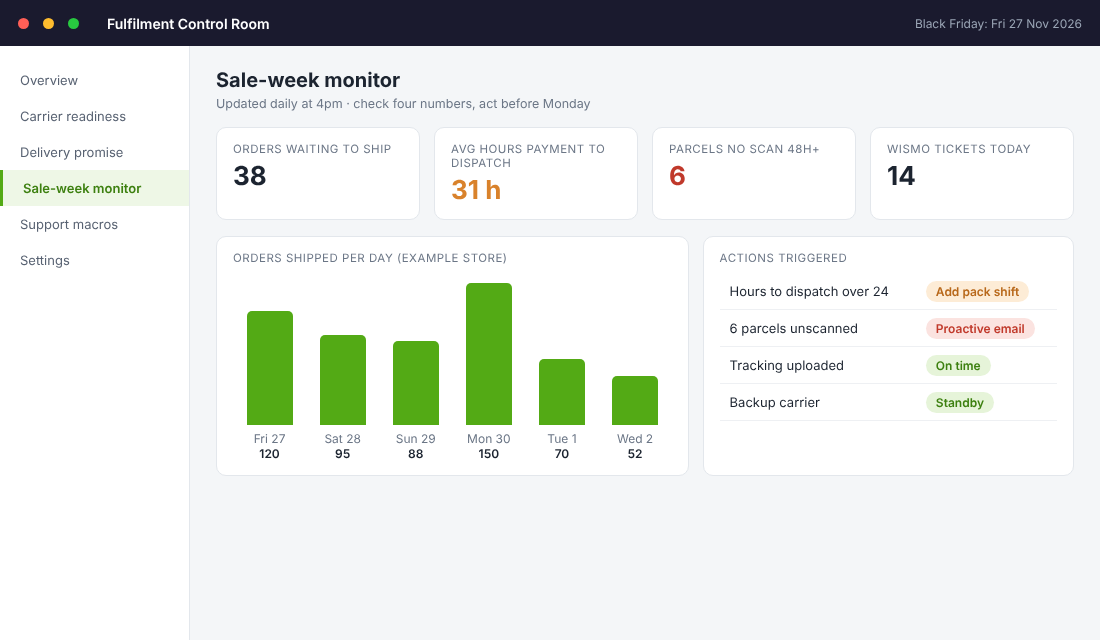
| Fri 27 Nov to Mon 30 Nov | Daily check: orders unfulfilled over 24 hours, carrier scan delays, WISMO tickets, tracking uploaded | Ops lead |
| Tue 1 Dec to Fri 11 Dec | Chase unscanned parcels, send proactive delay emails, review late rate by zone | Support |
| Mon 14 Dec | Final Christmas cut-off banner change, based on carrier cut-offs minus your buffer | Founder |
Track four numbers each day of the sale: orders waiting to ship, average hours from payment to dispatch, parcels with no scan after 48 hours, and WISMO tickets. If any of them is trending the wrong way on Friday afternoon, you still have time to add pack hours or switch carrier on Monday.
Your next step
Do the carrier audit today. It takes under an hour, it is the part you cannot fix in the middle of the sale, and it forces the other decisions.
Inside eCommerce Circle, fulfilment and delivery promises are part of the Practice and Protection pillars we work on with every member. If you want to see exactly where your store is being capped, take the free More Orders Scorecard. It takes two minutes and shows you which of the 10 P’s to fix first.