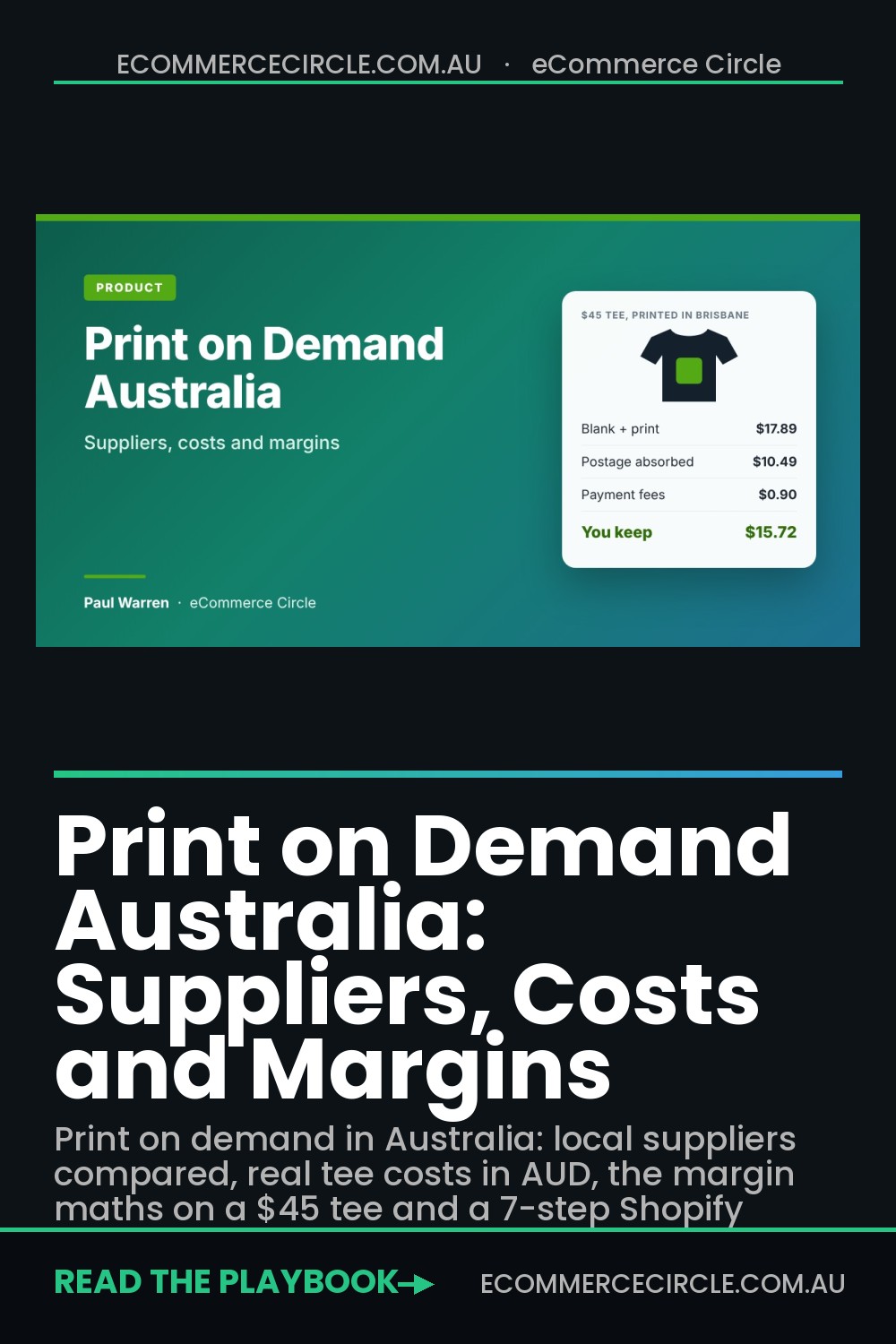
Print on demand in Australia works like this: you list a design, a customer buys it, and a printer in Brisbane or Melbourne prints, packs and posts that single item under your brand. A locally printed AS Colour tee costs about $17.89 before postage, so a $45 tee leaves you roughly $26 if the customer pays shipping and closer to $16 if you offer free shipping.
Most people who start a print on demand store get the order of operations backwards. They spend three weeks on designs and a logo, pick whichever app has the most reviews, price a tee at $35 because that feels fair, and then switch on Meta ads. Six weeks later they have 40 orders, a $1,900 ad bill and no idea why the bank balance went down.
The stores that make it work do the boring part first. They choose a printer that prints inside Australia, they know their landed cost per item to the cent, and they price for a margin that can carry the cost of winning a customer. Then they design. That order is the difference between a side project that pays for itself and one that quietly drains $500 a month.
This guide gives you the suppliers that print locally, the real costs we could verify on 12 November 2026, the margin maths on a $45 tee, the Australian rules that apply to you, and a seven-step Shopify setup you can finish this week.
What print on demand is, and who it suits
Print on demand (POD) is a fulfilment model, not a business model. You hold no stock. The printer holds blank garments, mugs, posters and tote bags, and decorates one unit each time an order lands. You pay the printer the base price plus postage, and you keep the difference between that and what your customer paid.
It is a big and fast-growing category. Precedence Research puts the global print on demand market at US$16.44 billion in 2026 and forecasts US$118.85 billion by 2035, which is growth of about 25% a year. Grand View Research has Asia-Pacific growing at 24.8% a year. StoreLeads data quoted by Printful shows about 315,000 Shopify stores running a POD app, roughly one in ten active stores.
That last number matters more than the market size. One in ten Shopify stores means you are not early, and a generic slogan tee is competing with hundreds of thousands of other generic slogan tees.
POD suits you if:
- You already have an audience. A podcast, a sports club, a local venue, a creator account, a community group. The demand exists and you need a low-risk way to serve it.
- You are testing designs before buying stock. Twenty designs printed on demand tell you which three deserve a bulk run.
- You sell a wide range with thin demand per design. Art prints, niche hobby designs and personalised gifts where holding stock of every variant would be silly.
POD does not suit you if your plan is cold traffic from paid ads to a commodity design. The maths in the next two sections shows why.
The Australian suppliers that print locally
Where the item is printed decides your delivery time, your postage cost and whether your customer gets hit with a wait that makes them regret buying. An order printed in Latvia or North Carolina and posted to Perth is a two to three week experience. An order printed in Brisbane is a few days.
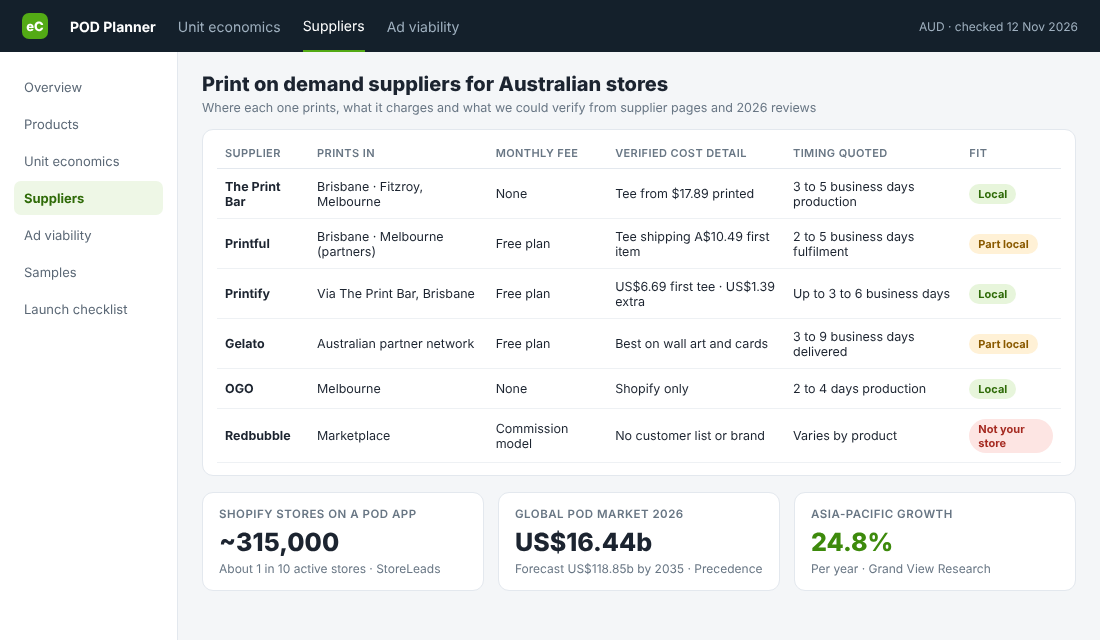
These are the options that print inside Australia, with what we could confirm from their own pages and current reviews.
| Supplier | Prints in | Fees | What we could verify |
|---|---|---|---|
| The Print Bar | Brisbane and Fitzroy, Melbourne | No monthly fee, no minimum | Trading since 2012. AS Colour Mens Staple tee from $17.89 with one digital print. Production 3 to 5 business days. Native Shopify connection through its Partner Portal. |
| Printful | Partner facilities in Brisbane (apparel) and Melbourne (other products) | Free plan, paid plan optional | Bills in AUD. Tee shipping listed at A$10.49 for the first item (June 2026 rate card). Apparel fulfilment window 2 to 5 business days before transit. |
| Printify | A marketplace of printers, including The Print Bar in Brisbane | Free plan, paid plan for lower base prices | Print Bar shipping within Australia US$6.69 for the first tee and US$1.39 for each extra. Delivery quoted at up to 3 to 6 business days. |
| Gelato | A network of Australian print partners | Free plan, paid plan optional | Strong on wall art, cards and calendars. Reviews quote 3 to 9 business days delivered, depending on the product. |
| OGO | Melbourne | No subscription | Shopify only. Production quoted at 2 to 4 business days, then 2 to 5 days delivery to metro areas. |
Two things to know before you choose.
The global apps do not print everything here. When Printful announced its Australian partners in July 2020 it said one facility handled tees and hoodies and the other handled posters and mugs, with everything else shipped from overseas. That split still exists. Before you list a product, check its fulfilment location in the app. An embroidered cap and a tee in the same cart can ship from two countries, and your customer pays for (and waits on) both.
A marketplace is a different deal from your own store. Redbubble, which started in Melbourne, lets you upload a design and takes care of everything else, including the traffic. You also get no customer list, no brand and no control over price. Its parent company Articore reported $354.5 million in marketplace revenue for FY26, down 6.5% on the year before. It is a useful place to test whether a design sells. It is not where you build an asset.
For most Aussie stores selling mainly to Australian customers, our recommendation is plain: start with a printer that prints in Australia on AS Colour blanks, and add a global app later only if you get real demand from overseas.
What one printed tee really makes you
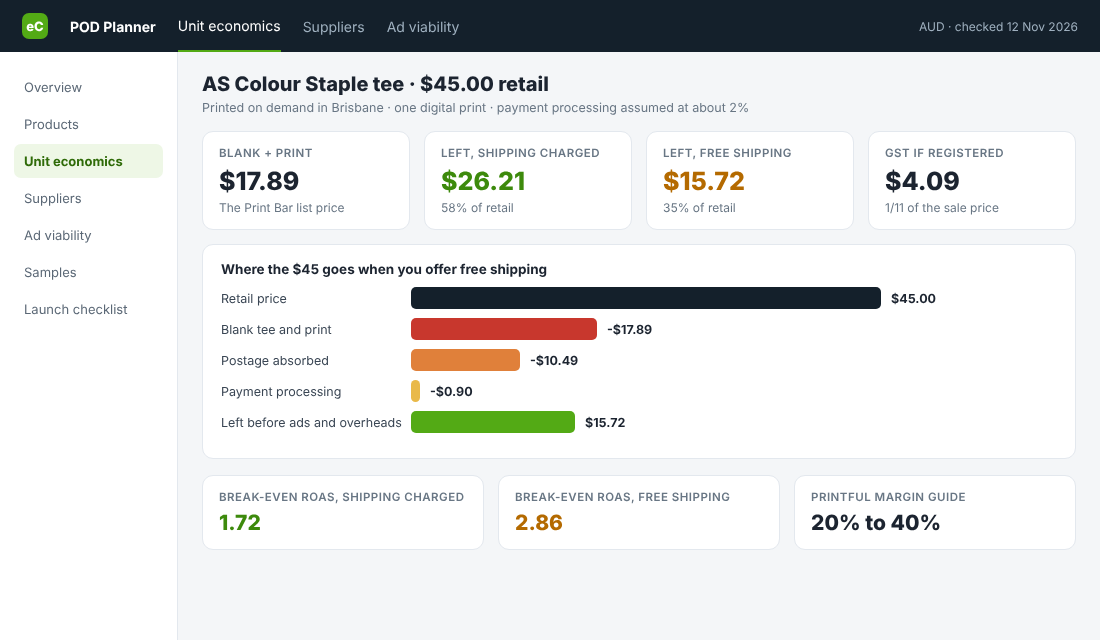
Here is the unit maths most POD guides skip. We have used The Print Bar’s published price for an AS Colour Mens Staple tee with one digital print ($17.89) and an assumed payment processing cost of about 2% of the sale.
| Line | Customer pays shipping | You offer free shipping |
|---|---|---|
| Retail price | $45.00 | $45.00 |
| Blank tee and print | $17.89 | $17.89 |
| Postage you absorb | $0.00 | $10.49 |
| Payment processing (about 2%) | $0.90 | $0.90 |
| Left before ads and overheads | $26.21 (58%) | $15.72 (35%) |
That 35% lines up with what the industry says about itself. Printful tells its own sellers to aim for a 20% to 40% profit margin, with basics at the low end and niche or premium products above it.
Now compare that to a store that buys stock. A healthy product brand usually runs a gross margin north of 60% after freight in. POD starts 10 to 25 points below that, before you have spent a dollar on marketing. You are paying the printer for convenience, and the price of that convenience is most of your room to advertise.
Three more costs sit outside the table:
- GST. Once your business turns over $75,000 a year you must register, and one eleventh of every Australian sale goes to the ATO (offset by the GST credits on your supplier invoices). On a $45 tee that is $4.09 of the sale price.
- Reprints. A misprint, a wrong size sent, a parcel lost in the post. Budget 2% to 3% of orders until your own numbers tell you otherwise.
- Samples. You pay for every sample you order, and you should order one of everything you sell.
If you want the fee side in detail, our breakdown of Shopify Payments fees in Australia shows what each plan charges per order.
Why paid ads break most POD stores
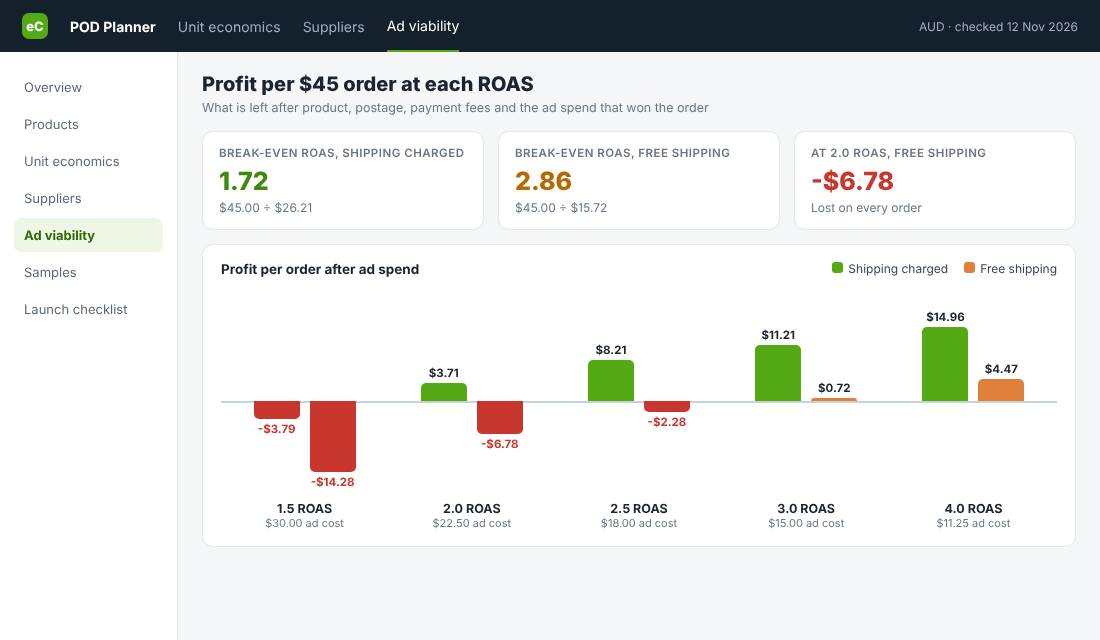
Your break-even ROAS is your selling price divided by what is left after product, postage and payment costs. It tells you the return on ad spend at which an order makes exactly nothing.
- Customer pays shipping: $45 divided by $26.21 gives a break-even ROAS of 1.72.
- Free shipping: $45 divided by $15.72 gives a break-even ROAS of 2.86.
Put that against a real ad account. At a 2.0 ROAS you are spending $22.50 to win each $45 order. With shipping charged you keep $3.71 an order. With free shipping you lose $6.78 on every sale, and the more you sell the faster you lose it.
Even the biggest player in the category lives with this. Articore, with all its scale and brand recognition, reported a gross margin of 49.6% in FY26 and kept 28.6 cents of each marketplace dollar after paid acquisition. If the company that owns Redbubble keeps less than 30 cents in the dollar after paying for customers, a new store with no brand should not plan on beating it in month one.
So the channel plan for a POD store is the reverse of a typical product brand:
- Start with traffic you do not rent. Your existing audience, organic short video, search, community groups, email. Our guide to getting your first sale on Shopify walks through that sequence.
- Lift the order value before you buy traffic. A two-tee bundle or a tee plus tote takes a $45 order to $80 while the extra postage on the second item is small (US$1.39 through The Print Bar on Printify). The margin dollars per order nearly double.
- Only then test paid. Work out your number first with the break-even ROAS formula, and set your campaign target above it, not at it.
The Australian rules that apply to a POD store
You never touch the product, and you are still the seller. Under Australian Consumer Law the business that sold the item is responsible for it, whoever printed and posted it.
- Faulty or wrong items are your problem to fix. A misprint, a design that cracks after one wash, or the wrong size sent all give the customer a right to a remedy. You cannot point them to the printer, and a “no refunds” line in your policy does not change that.
- Change of mind is your call. The law does not force you to refund someone who ordered the wrong size or went off the colour. Most POD printers will not take change-of-mind returns either, since the item was made to order. Decide your rule, write it clearly on the product page and in your returns policy, and stick to it.
- Get an ABN before you sell, and watch the GST line. The ATO registration threshold is $75,000 in turnover. Overseas-printed items sent to Australian customers add their own GST and customs questions, which is one more reason to print locally.
- Do not print what you do not own. Band logos, sports teams, film quotes and cartoon characters are someone’s trade mark or copyright. Redbubble has been taken to the Federal Court more than once over designs its sellers uploaded, including by the Hells Angels. Printers will also cancel orders and close accounts over it.
- Say where it ships from and how long it takes. A made-to-order tee takes longer than a tee off a shelf. Put the production time and delivery estimate on the product page so the wait is expected.
POD has a lot in common with dropshipping on the legal side. If you are weighing the two models, our dropshipping in Australia guide covers the margins and laws for stocked third-party products.
Setting up print on demand on Shopify in 7 steps
This walk-through uses Printify with The Print Bar as the print provider, because it gives you Australian printing, AS Colour blanks and a free plan. The steps are near identical if you connect The Print Bar directly through its Partner Portal, or use Printful or Gelato.
- Install the app and connect your store. In the Shopify App Store, add Printify, create a free account and approve the connection. This takes about five minutes.
- Filter the catalogue to Australian printing. In the Printify catalogue, open a product (the AS Colour Staple Tee is the safe first pick) and choose The Print Bar as the print provider. Check the provider location says Brisbane, Australia before you go further.
- Upload artwork at print size. Export your design as a PNG with a transparent background at 300 DPI at the real print dimensions. A phone screenshot stretched to A3 prints as a blur.
- Order samples before you publish. Order every design on every garment colour you plan to sell, sent to your own address. Check print placement, colour on dark fabric, sizing against the size chart, and count the business days from order to letterbox. That number goes on your product page.
- Set your price from the margin, not from a competitor. Use the formula in the checklist below. Enter the retail price in Printify so it flows through to Shopify.
- Match your Shopify shipping rates to what the printer charges. In Shopify, go to Settings, then Shipping and delivery, and create a shipping profile for your POD products. Set the Australian rate to cover the printer’s first-item charge, and decide whether a free shipping threshold sits above a two-item order.
- Place a live test order. Buy from your own store with a real card. Confirm the order appears in Printify, goes to production without manual approval (or with it, if you prefer to check each one), and that the tracking email reaches the customer under your brand name.
Then photograph your samples on real people. Mockup images are fine for launch week, and every store in your niche is using the same ones. Your own photos are the cheapest way to look like a brand and not an app.
When to move a winner off print on demand
POD is the testing ground. It should not be where your bestseller lives forever.
The Print Bar’s own price list shows the gap. A single digital print costs $11 per item in decoration. Screen printing costs $4.84 per item, with a 25 unit minimum and a 14 to 21 business day turnaround. On their published pricing, that takes a printed AS Colour Staple tee from $17.89 to roughly $12, a saving of about $6 a unit before any volume discount on the blank.
On a $45 tee with shipping charged, that moves your margin from 58% to about 71%. On 100 units that is close to $600 back in your pocket for the same sales.
Use a simple rule so the decision is never emotional:
- Under 10 units a month for a design: leave it on POD or retire it.
- 10 to 25 units a month: leave it on POD and promote it harder.
- More than 25 units a month for two months running: order a bulk run in your top three sizes, hold it at home or with a 3PL, and keep the slow sizes on POD.
That hybrid setup is how the better merch brands run. Stock for the winners, POD for the long tail and for new designs. Our checklist on what to sell online in Australia has the seven checks to run before you put money into stock.
Your print on demand launch checklist
Copy this into a doc and work through it top to bottom.
The pricing formula
- Landed cost = base product and print + postage you absorb + payment processing
- Minimum retail price = landed cost divided by 0.55 (this keeps at least 45% for you before ads)
- Break-even ROAS = retail price divided by (retail price minus landed cost)
- If your break-even ROAS is above 2.5, do not run paid ads to that product on its own. Bundle it or raise the price.
The supplier scorecard (score each out of 5)
- Prints your core product inside Australia
- Base price and postage for your top product, in AUD
- Days from order to letterbox on your own sample
- Print quality on a dark garment after three washes
- Reprint policy for misprints and lost parcels
- Branding options: packing slip, neck label, plain packaging
Before launch
- ABN registered and business name checked
- Every design is your own work or properly licensed
- Samples ordered, worn, washed and photographed
- Production and delivery time written on each product page
- Returns policy covers faults (always) and change of mind (your rule)
- Shopify shipping profile matches the printer’s charges
- Live test order placed and tracking email received
- Bundle or two-item offer built to lift order value
- A named list of where your first 100 visitors come from, with no paid ads in it
How the pieces fit together
Each part of this looks small by itself. Together they decide whether the store makes money.
Local printing shortens delivery and cuts postage, which protects your reviews and your margin. Knowing the landed cost lets you price at 45% or better. That margin gives you a break-even ROAS you can beat. A bundle lifts the dollars per order so paid traffic becomes an option. Samples and your own photos make the store look like a brand. And the 25-units rule moves your winners to bulk pricing, which hands you another 10 to 15 points of margin on the products that matter most.
Skip the first step and every step after it gets harder. That is why the founders who do well with POD tend to look slow in week one and well ahead by month three.
Inside eCommerce Circle, Product is the first of the 10 P’s we work through with every member, because a product that cannot carry its own margin will not be saved by better ads. If you want to see exactly where your store is being capped, take the free More Orders Scorecard. It takes two minutes and shows you which of the 10 P’s to fix first. Or, if you would like to see how we work with founders, start in Connect.
Sources, checked 12 November 2026: The Print Bar published pricing, services and partner program pages; Printify shipping rates page for The Print Bar; Printful print on demand Australia page, print on demand statistics report (citing Precedence Research, Grand View Research and StoreLeads) and July 2020 announcement of its Australian partner facilities; PodVector summary of Printful shipping rates (June 2026 update); Avada and Do Dropshipping reviews of Australian print on demand suppliers (2026); Small Caps, “Articore Group returns to profitability in FY26 as gross margin hits record” (28 August 2026); ATO GST registration guidance; ACCC consumer guarantees guidance. Supplier prices, plans and delivery times change often and some sources quote different delivery windows. Confirm current pricing with each supplier and time your own sample order before you launch. This is general information, not legal or tax advice.