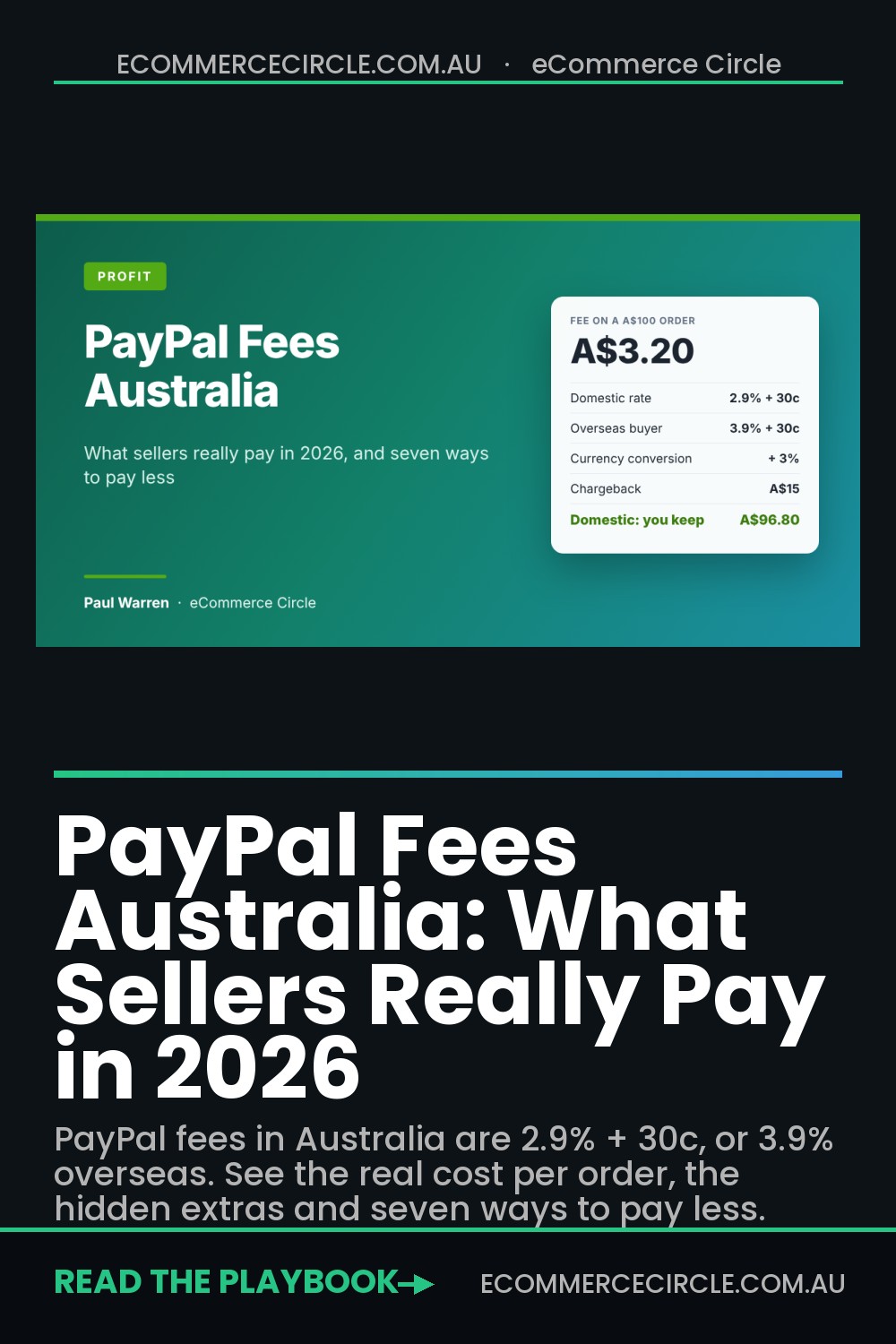
PayPal charges Australian sellers 2.9% plus 30 cents on every domestic sale, and 3.9% plus 30 cents when the buyer is overseas. On a A$100 order that is A$3.20 gone before currency conversion, refunds or chargebacks, and those extras can push the real cost past 7%.
Most store owners know the headline rate and nothing else. They switch PayPal on the day they launch, never open the fee report, and assume it costs about the same as cards. It does not. On a Shopify Basic plan, a A$100 PayPal sale costs you 60% more in fees than the same sale on a Visa.
The stores that handle this well do two things. They treat PayPal as a paid conversion tool with a known price, and they check once a quarter that the price is still worth paying. This guide gives you every current rate, the maths on real orders, the fees that catch sellers out, and a 20-minute audit you can run today. All rates were checked against PayPal’s Australian fee page on 16 November 2026.
PayPal Fees in Australia: The Short Answer
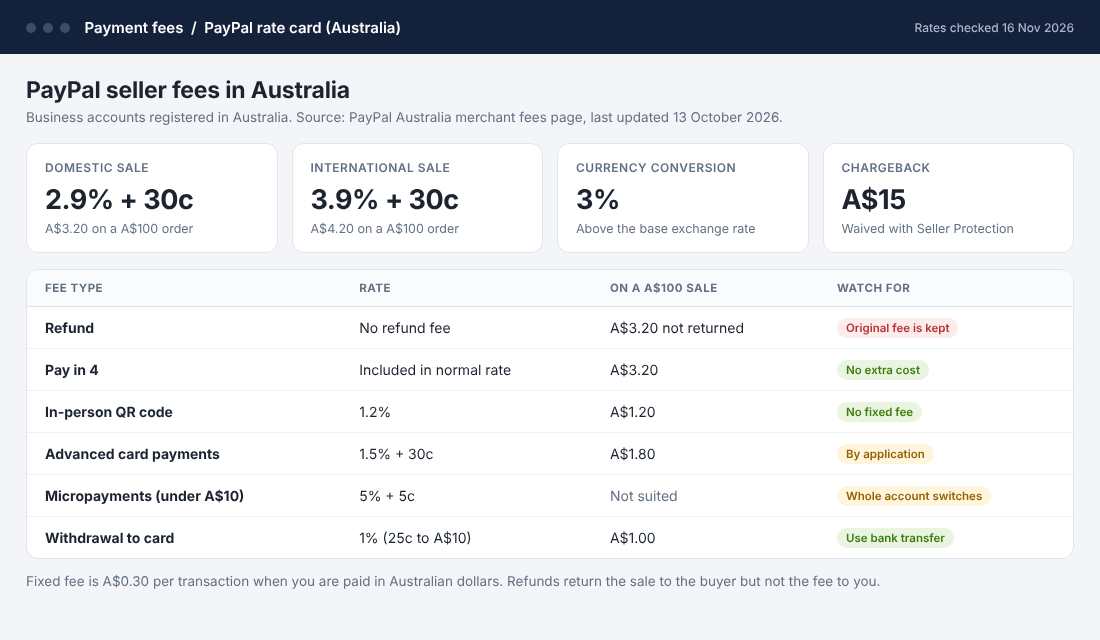
These are the rates on PayPal Australia’s merchant fees page, last updated 13 October 2026. They apply to business accounts registered in Australia.
| What you are charged for | PayPal fee | On a A$100 sale |
|---|---|---|
| Domestic sale (buyer in Australia) | 2.9% + A$0.30 | A$3.20 |
| International sale (buyer overseas) | 3.9% + A$0.30 | A$4.20 |
| Currency conversion (when PayPal converts for you) | 3% above the base exchange rate | About A$2.90 more |
| In-person QR code sale | 1.2% | A$1.20 |
| Card payment through Advanced Credit and Debit Card Payments | 1.5% + A$0.30 | A$1.80 |
| Chargeback on a card-funded payment | A$15 flat | A$15, plus the sale |
| Refund | No refund fee, but the original fee is not returned | A$3.20 lost |
| Pay in 4 (buy now, pay later) | Included in your normal rate | A$3.20 |
Three things in that table surprise people. The fixed 30 cents hurts small orders far more than large ones. Refunds are not free, because PayPal keeps the fee from the original sale. And the 3% currency conversion margin is often bigger than the processing fee it sits on top of.
What PayPal Really Costs on a Real Order
A percentage plus a fixed fee means your true rate changes with your order size. The smaller your average order, the worse PayPal looks.
| Order value | PayPal fee (domestic) | Effective rate | Same order on Shopify Payments, Basic plan |
|---|---|---|---|
| A$30 | A$1.17 | 3.9% | A$0.81 |
| A$60 | A$2.04 | 3.4% | A$1.32 |
| A$100 | A$3.20 | 3.2% | A$2.00 |
| A$250 | A$7.55 | 3.0% | A$4.55 |
The comparison column uses Shopify’s online card rate of 1.7% plus 30 cents on the Basic plan, as listed on Shopify’s Australian pricing page. On Grow it is 1.55% and on Advanced 1.35%, so the gap widens as you move up plans.
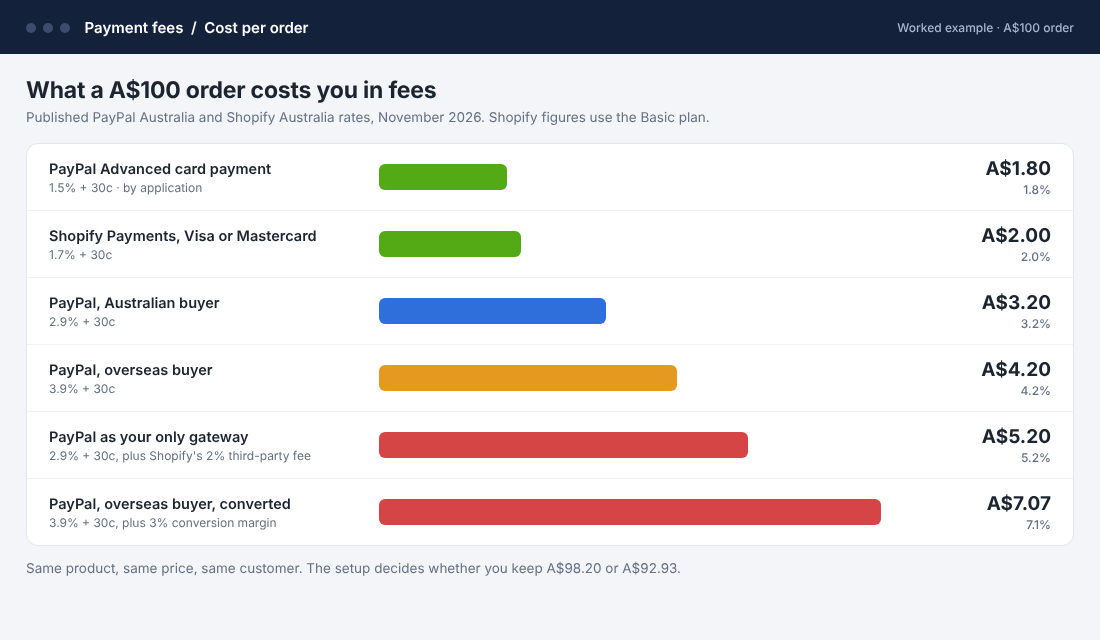
Now add an overseas buyer. A A$100 order from a customer in New Zealand or the US costs A$4.20. If that customer pays in their own currency and PayPal converts it to Australian dollars for you, the 3% conversion margin takes roughly another A$2.90. You keep about A$92.90 of a A$100 sale. That is a 7.1% cost on one order.
A worked month for a typical store
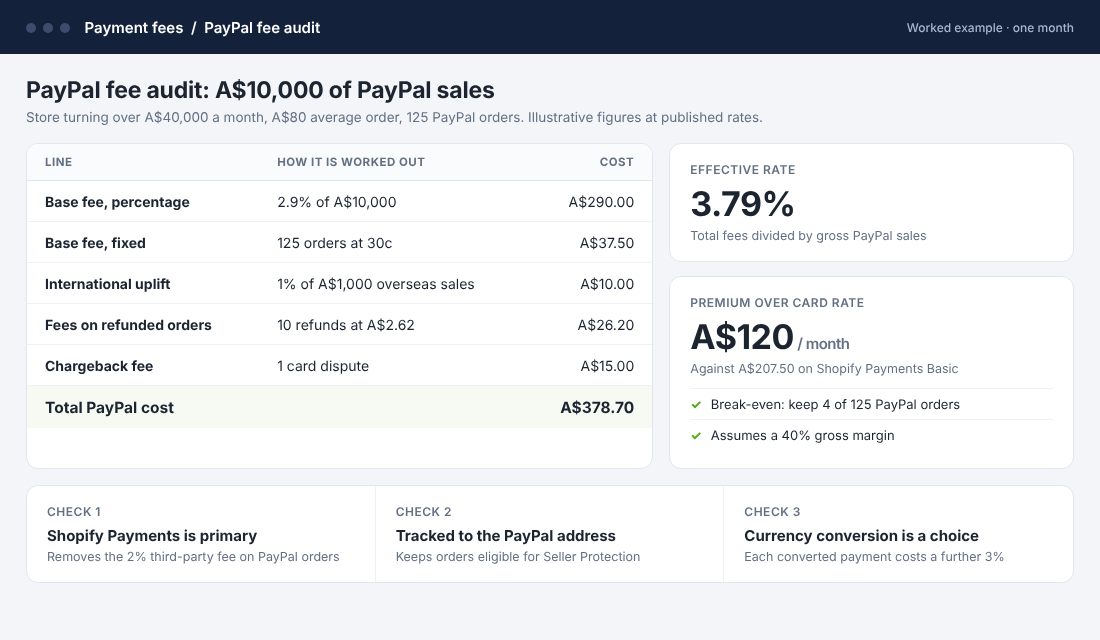
Take a store turning over A$40,000 a month with an A$80 average order. That is 500 orders. Say a quarter of buyers choose PayPal at checkout. That is 125 orders and A$10,000 in PayPal sales. Swap in your own share when you run this, because it varies a lot by audience.
- Base fees. 2.9% of A$10,000 is A$290. Add 125 fixed fees of 30 cents, which is A$37.50. Total A$327.50.
- International uplift. If 10% of those sales come from overseas, the extra 1% on A$1,000 adds A$10.
- Refunds. If 8% of PayPal orders are refunded, that is 10 orders. PayPal keeps the A$2.62 fee on each one, so A$26.20 goes on sales you no longer have.
- One chargeback. A$15, on top of losing the order value.
That is A$378.70 for the month, or 3.8% of your PayPal sales. The same A$10,000 through Shopify Payments on Basic would have cost A$207.50 in processing. Over a year, this store pays about A$4,500 in PayPal fees, and roughly A$1,440 of that is the premium for the PayPal button alone.
The Fees That Catch Sellers Out
The headline rate is the fee everyone budgets for. These four are the ones that turn up later in the bank reconciliation.
Refunds: PayPal keeps the fee
PayPal’s fee page is blunt about this. There is no fee to issue a refund, but the fees you originally paid to receive the payment are not returned to you. That applies to full and partial refunds.
So a returned A$100 order costs you A$3.20 plus your outbound shipping, your return shipping if you cover it, and the time. A fashion store with a 20% return rate is paying PayPal fees on a fifth of sales it never keeps. If returns are a big line for you, tighten the policy first. Our Shopify returns policy guide covers what Australian Consumer Law lets you do.
Currency conversion: 3% you never see
PayPal does not show conversion as a separate fee line. It builds a 3% margin into the exchange rate it gives you. A handful of cases are charged at 4%, including refunds made more than a day after the original payment when a conversion is involved.
If you sell to the US or UK and let PayPal convert every payment as it lands, you are paying 3.9% plus 30 cents plus 3%. On A$5,000 a month of overseas PayPal sales, the conversion margin alone is about A$150.
Chargebacks: A$15 unless you qualify for Seller Protection
When a buyer disputes a card-funded PayPal payment through their bank, PayPal charges a A$15 chargeback fee. The fee is waived if the transaction is eligible for PayPal Seller Protection.
Eligibility is where sellers slip. For a physical product you need to ship to the address shown on the PayPal transaction details page, and hold proof of shipment or delivery with a tracking number you can verify online. Two exclusions matter for Australian stores:
- Guest checkout is not covered. For sellers registered in Australia, payments that do not come from a buyer’s PayPal account, including guest checkout and standard card payments, are ineligible.
- “Not as described” claims are not covered. Seller Protection covers unauthorised transactions and items not received. A buyer saying the product was not what they expected is a different claim, and you argue that one on the evidence.
Untracked letter post to save A$4 on shipping can cost you the whole order. If disputes are a regular event in your store, work through our chargeback defence guide.
Withdrawals to a card
Moving your PayPal balance to a debit card costs 1% of the amount, with a minimum of 25 cents and a maximum of A$10. PayPal’s fee page lists no charge for a standard transfer to your linked Australian bank account. Use the bank transfer. And get the BSB and account number right, because a failed transfer is A$5.
PayPal on Shopify: When You Pay Twice
This is the single most expensive PayPal mistake we see, and it takes five minutes to check.
Shopify charges a third-party transaction fee on sales that go through a payment provider other than Shopify Payments. In Australia that fee is 2% on Basic, 1% on Grow and 0.6% on Advanced. There is one exemption, and Shopify’s help centre spells it out: if you use Shopify Payments as your primary payment provider, PayPal transactions are exempt.
So there are two very different stores:
- Shopify Payments on, PayPal as an extra button. A A$100 PayPal sale costs A$3.20. No Shopify transaction fee.
- PayPal as the only gateway on a Basic plan. The same sale costs A$3.20 to PayPal and A$2.00 to Shopify. That is A$5.20, or 5.2%.
The second setup is common in stores that opened years ago, or that had a Shopify Payments application knocked back and never tried again. On A$10,000 a month it is an extra A$200 a month for nothing.
How to check: in your Shopify admin go to Settings, then Payments. If Shopify Payments is not activated at the top of that page, you are paying the third-party fee on every PayPal order. Activate it, keep PayPal as an additional method, and the fee stops. Our breakdown of Shopify Payments fees in Australia covers the card side of this in full.
On WooCommerce or a custom site there is no platform fee to worry about, but there is a different opportunity. PayPal’s Advanced Credit and Debit Card Payments product lists a domestic rate of 1.5% plus 30 cents for cards, subject to application and approval. If PayPal is already your card processor at 2.9%, ask about it.
You Can No Longer Surcharge PayPal
For years some Australian stores added a small fee at checkout when a buyer chose PayPal. That door has closed.
The Reserve Bank’s surcharging reforms took effect on 1 October 2026 for eftpos, Mastercard and Visa. PayPal, American Express and UnionPay are not designated networks, but the RBA’s surcharging FAQ says they have also decided to remove surcharging, and notes that PayPal’s no-surcharge rule took effect from 5 October 2026.
If you still have a payment-method fee app or a line in your checkout script that adds 1% or 2% for PayPal, remove it this week. Then decide how to absorb the cost. You have three legitimate options:
- Price it in. The RBA is clear that businesses can reflect payment costs in their overall prices. A 1% lift across the catalogue is invisible to buyers and covers the PayPal premium several times over.
- Raise the free shipping threshold. Moving it from A$79 to A$89 can lift average order value enough to cover the fee.
- Discount cheaper methods. The RBA also says you can still offer discounts for particular payment methods. Few online stores bother, but it is allowed.
If you have not reviewed your pricing since the change, our guide to the surcharge ban walks through the margin maths.
Is PayPal Worth the Fee? What the Buyer Data Says
Here is the case for paying the premium. Treat the numbers with one caution: most of them come from PayPal’s own research.
The PayPal eCommerce Index 2026 surveyed 1,012 Australian consumers and 410 businesses through research firm Fifth Quadrant in late 2025. It found:
- 30% of Australians name PayPal as their preferred way to pay online, ahead of credit cards on 23% and debit cards on 18%.
- 60% use PayPal for online purchases, level with credit cards on 56% and debit cards on 61%.
- 72% have abandoned an online purchase, and 31% of those say it was because their preferred payment method was not available.
- 76% say they are concerned about paying on a site where PayPal is not offered.
- Average monthly online spend fell to A$881, down 29% from A$1,247 a year earlier. Shoppers are more careful, so every reason to hesitate at checkout costs more.
Even if you halve PayPal’s own figures, the direction is hard to argue with. A large share of Australian buyers look for that button, and some leave when it is missing.
The break-even is lower than you think
Go back to the worked store. The PayPal premium was A$120 a month on A$10,000 of PayPal sales. At a 40% gross margin, you need to keep just A$300 of sales to earn that back. That is about 4 orders out of 125.
Put plainly: if removing PayPal would lose you more than 3 in every 100 PayPal buyers, keeping it is the cheaper choice. For most consumer brands that is an easy call. The fee is the price of a conversion tool, and it is a fair one.
The stores where it is not an easy call are low-margin, low-order-value ones. On a A$30 order at a 25% margin, a 3.9% effective rate eats close to a sixth of your gross profit. If that is you, know your gross margin by product before you decide which payment methods to show.
Two Australian examples
Total Tools. The trade tool retailer, with more than 60,000 products, added PayPal Pay in 4 on top of its existing PayPal checkout. PayPal’s case study reports that Pay in 4 orders ran 43% to 63% higher in average order value than standard PayPal orders across the quarters measured. Ecommerce manager Brandon Soo said there were “no changes to the integration of the product itself”. The lesson for a smaller store: Pay in 4 costs you nothing extra, so if PayPal is already on, the instalment messaging should be too.
Farmer’s Pick. The Melbourne business that sells rescued “imperfect” produce works with more than 60 farms. Co-founder Josh Ball told PayPal’s Australian newsroom in June 2025: “Once we integrated PayPal, our conversion rate surged.” That is a founder’s account in a PayPal publication, not an audited test, so read it as a signal. For a newer brand that shoppers have not bought from before, a payment method they already trust removes one reason to hesitate.
Pay in 4 deserves its own line. PayPal says it is included in your normal checkout fee, you are paid upfront, and the buyer pays no interest. That makes it far cheaper than a dedicated buy now, pay later provider. We compared the two in our Afterpay fee breakdown.
Seven Ways to Pay Less in PayPal Fees
You cannot negotiate the standard rate as a small store. You can stop paying more than the standard rate, which is what most stores are doing.
- Make Shopify Payments your primary provider. This removes Shopify’s 2%, 1% or 0.6% third-party fee from every PayPal sale. It is the biggest saving on this list.
- Stop PayPal converting your currency by default. If you sell in US dollars, hold the balance in US dollars and use it to pay US-dollar suppliers and subscriptions, or move it through a multi-currency account with a lower margin. Every dollar you do not convert through PayPal saves 3%.
- Offer exchanges and store credit before refunds. A refund forfeits the original fee. An exchange keeps the sale and the fee you already paid still relates to revenue.
- Ship tracked to the PayPal address, every time. It keeps you eligible for Seller Protection, which waives the A$15 chargeback fee and can save the order value.
- Ask about the micropayments rate if you sell items under A$10. It is 5% plus 5 cents, by application. On a A$5 digital download the standard fee is 44.5 cents and the micropayments fee is 30 cents. It only wins below about A$12 an order, and it applies to your whole account, so do the sums first.
- Use the QR code rate in person. At markets and pop-ups, PayPal QR code payments are 1.2% with no fixed fee. Keying the order into your online store instead costs more than double.
- Ask for custom pricing once you are large. PayPal’s fee page invites Advanced card users to contact sales about interchange-plus pricing. If PayPal volume is in the hundreds of thousands a year, make the call.
The 20-Minute PayPal Fee Audit
Run this once a quarter. You need your PayPal business login and your store admin.
- Download the month. In PayPal, open Activity, go to the reports area and download last month’s activity as a CSV. You want the Gross, Fee and Net columns.
- Work out your effective rate. Total fees divided by total gross sales. If it is above 3.5%, something other than the standard rate is in play.
- Split domestic from international. Filter by buyer country or currency. Any payment in a currency other than Australian dollars is a conversion candidate.
- Count the refunds. Add up the fees on refunded orders. That is money spent on sales you did not keep.
- Check for chargebacks. Each A$15 fee is a signal. Look at whether the order was shipped tracked, and to which address.
- Check the Shopify side. Settings, then Payments. Confirm Shopify Payments is activated and PayPal sits under additional payment methods. Then open your latest Shopify bill and look for third-party transaction fees.
- Compare the premium to the benefit. PayPal sales multiplied by the rate gap to your card rate gives the monthly premium. Divide by your gross margin to get the sales you need PayPal to save. If that is under 5% of PayPal orders, keep it and move on.
A tool that does the bookkeeping part for you
If you use Xero, PayPal fees are a common source of messy books, because payouts land net of fees and refunds. A2X connects PayPal to Xero and posts each period as a summary that separates sales, fees and refunds. The setup is five steps:
- Create an A2X account and connect your PayPal business account when prompted.
- Connect Xero and choose the organisation.
- Map each transaction type to an account: sales to revenue, PayPal fees to a merchant fees expense account, refunds to a refunds or contra-revenue account.
- Set the PayPal fees account as its own line in your profit and loss so you can see it every month, not buried in cost of sales.
- Review the first summary against your PayPal CSV before you let it post automatically.
On tax: PayPal fees on business sales are generally a deductible expense. Do not assume the fee includes GST you can claim back. Check PayPal’s tax documents or ask your accountant how to code it on your BAS.
How the Pieces Fit Together
PayPal is not expensive or cheap on its own. It is a conversion tool with a price, and the price depends on how you have set it up.
The setup decides the rate. Shopify Payments as primary keeps you at 2.9% plus 30 cents, not 4.9%. Your currency settings decide whether overseas orders cost 3.9% or 6.9%. Your shipping habits decide whether a dispute costs you nothing or the order plus A$15. Your returns policy decides how much fee you pay on sales that come back.
Each of those is a setting you choose once. Get all four right and PayPal costs about 1.2 points more than cards on the share of buyers who want it, which the buyer data says is well worth paying. Get them wrong and the same button costs you 5% to 7% on those orders, and it never shows up as a line you would notice.
So this week, do two things. Check Settings, then Payments in your store. Then download last month’s PayPal activity and work out your effective rate. If the number starts with a 3, you are fine. If it starts with a 4 or higher, this article has just found you money.
PayPal Fees Australia: Common Questions
What are PayPal fees in Australia in 2026?
PayPal charges Australian business accounts 2.9% plus A$0.30 for domestic sales and 3.9% plus A$0.30 for international sales. Currency conversion adds 3% above the base exchange rate, and a card chargeback costs A$15 unless Seller Protection applies.
How much does PayPal take from a 100 dollar sale?
A$3.20 on a domestic sale and A$4.20 on an international one. If PayPal also converts the payment from another currency, expect to lose about A$7.10 in total.
Does PayPal refund its fee when I refund a customer?
No. PayPal does not charge a fee to issue the refund, but it keeps the fee from the original transaction. This applies to full and partial refunds.
Can I add a surcharge for PayPal payments?
No. PayPal’s no-surcharge rule took effect in Australia from 5 October 2026, in line with the Reserve Bank’s removal of card surcharges. You can build the cost into your prices or offer a discount for other payment methods.
Is PayPal more expensive than Shopify Payments?
Yes, for most stores. Shopify Payments charges 1.7% plus 30 cents on Basic for standard online cards, against PayPal’s 2.9% plus 30 cents. The gap is 1.2 percentage points on Basic and larger on higher plans.
Does Pay in 4 cost sellers extra?
No. PayPal says Pay in 4 is included in your normal PayPal checkout fee, and you are paid in full upfront while the buyer pays in four instalments.
Do I pay Shopify a fee on PayPal sales as well?
Only if Shopify Payments is not your primary payment provider. In that case Shopify adds 2% on Basic, 1% on Grow or 0.6% on Advanced to every PayPal order.
Inside eCommerce Circle, Profit is one of the 10 P’s we work through with every member, and payment fees are one of the first places we find margin that nobody was watching. If you want to see exactly where your store is being held back, take the free More Orders Scorecard. It takes two minutes and shows you which of the 10 P’s to fix first. Or if you would like help working through your numbers, start in Connect.