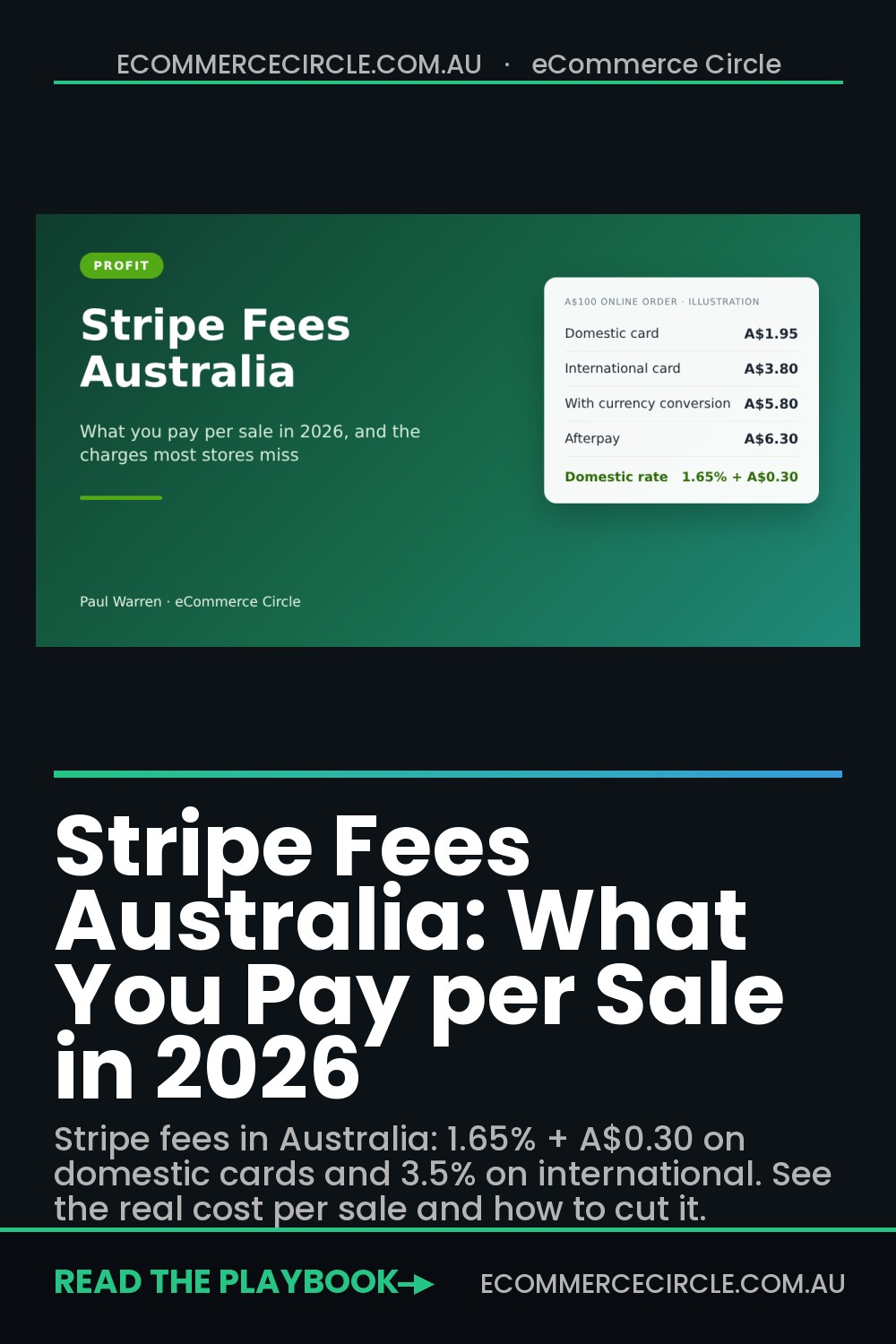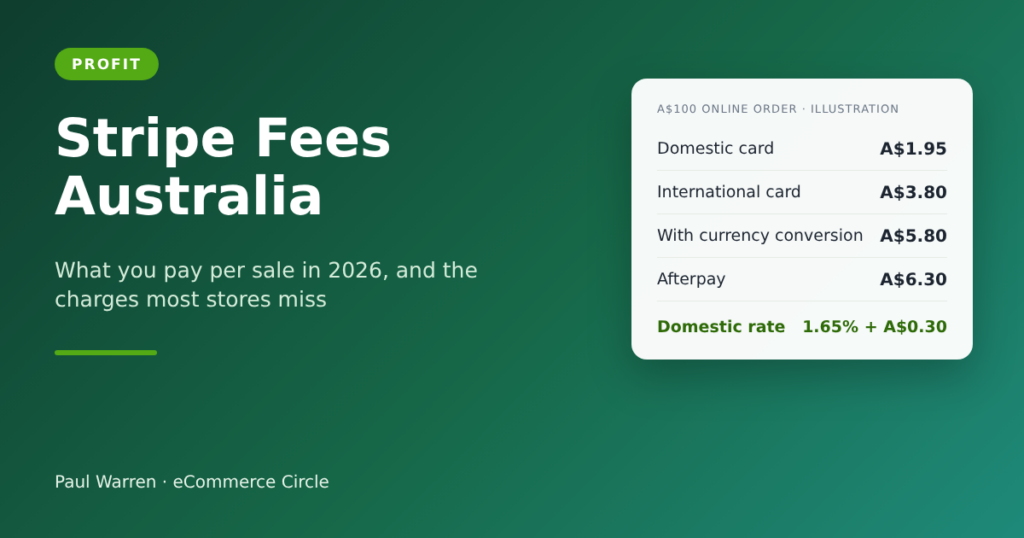
Stripe charges Australian businesses 1.65% + A$0.30 for each online payment on a domestic card and 3.5% + A$0.30 on an international card, with a further 2% when the payment needs currency conversion. There is no setup fee and no monthly fee, and the listed rates include GST.
Those are the figures on Stripe’s Australian pricing page, checked on 19 November 2026. Two of them are new or about to change. The domestic rate dropped from 1.70% on 1 October 2026, and the international rate falls to 2.80% on 1 April 2027.
Most store owners stop reading there. They plug 1.65% into a spreadsheet and move on. Then the monthly statement shows something closer to 2.5% or 3% of sales, and nobody can explain the gap.
The gap is not a mystery. It is the 30 cents on small orders, overseas cards, buy now pay later, refunds and disputes. This guide walks through each one with the maths, so you can work out what Stripe costs your store per sale and where to trim it.
General information only, not financial advice. Fees change, so confirm the current rate on Stripe’s own page before you make a pricing decision.
Stripe Fees in Australia at a Glance
Here is the standard pricing for an Australian Stripe account. Custom pricing exists for businesses with large volume, but standard pricing is what almost every small and mid-sized store pays.
| Payment type | Stripe fee (standard pricing) |
|---|---|
| Domestic cards and wallets, online | 1.65% + A$0.30 |
| International cards, online | 3.5% + A$0.30 (2.80% + A$0.30 from 1 April 2027) |
| Currency conversion | +2% on top of the card fee |
| In person with Stripe Terminal, domestic | 1.65% + A$0.10 |
| Tap to Pay on a phone | +A$0.15 per authorisation |
| PayTo and BECS Direct Debit | 1% + A$0.30, capped at A$3.50 |
| Afterpay | 6% + A$0.30 |
| Zip | 5.49% + A$0.30 |
| Klarna | 4.99% + A$0.55 |
| Alipay and WeChat Pay | 2.9% + A$0.30 |
| Dispute received | A$25.00 each |
| Setup, monthly and closure fees | None |
Card fees and the buy now pay later fees are from Stripe’s main pricing page and its local payment methods page. Apple Pay and Google Pay are charged at the card rate, so a domestic wallet payment costs the same 1.65% + A$0.30.
One detail matters more than it looks. Stripe’s notice about the October change lists Visa, Mastercard, American Express, eftpos, UnionPay and JCB as covered by the same standard rate. So a domestic Amex payment costs you the same as a domestic Visa payment. That is not true everywhere. Shopify’s Basic plan lists Amex at 2.9% + 30c on its Australian pricing page.
What Stripe Costs on a Single Order
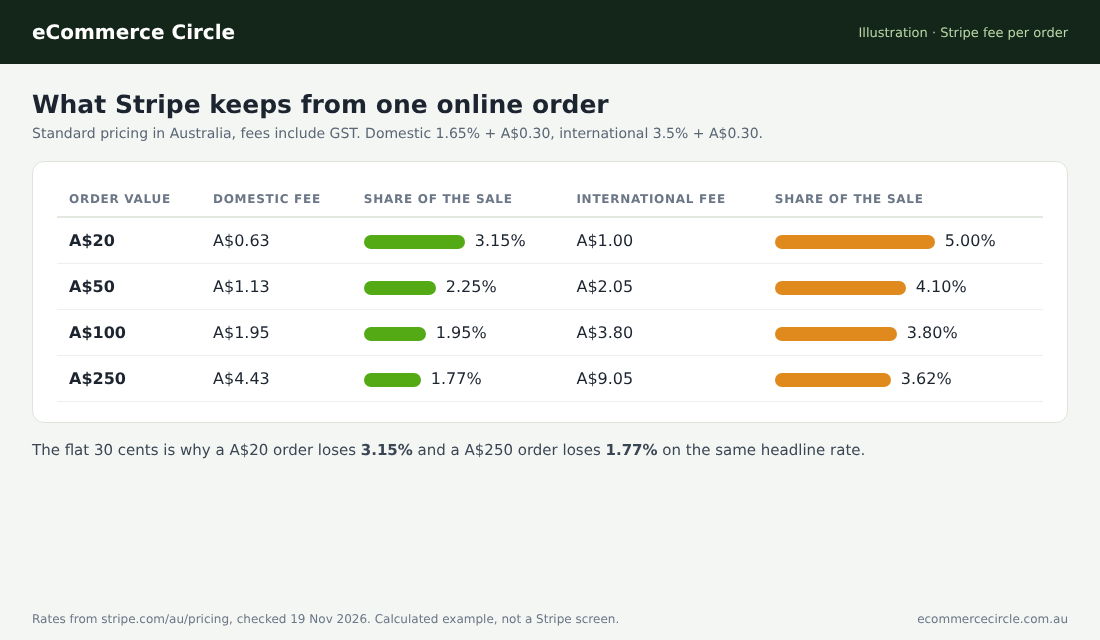
The percentage gets the attention. The 30 cents does the damage on small baskets.
| Order value | Domestic card fee | Share of sale | International card fee | Share of sale |
|---|---|---|---|---|
| A$20 | A$0.63 | 3.15% | A$1.00 | 5.00% |
| A$50 | A$1.13 | 2.25% | A$2.05 | 4.10% |
| A$100 | A$1.95 | 1.95% | A$3.80 | 3.80% |
| A$250 | A$4.43 | 1.77% | A$9.05 | 3.62% |
Read the first row again. On a A$20 order the fixed 30 cents is almost half the fee. A store selling A$20 items pays nearly twice the effective rate of a store selling A$250 items, on the same price list.
What to do with that:
- Know your average order value first. Your real card rate is 1.65% plus 30 cents divided by your AOV. At A$60 that is 2.15%. At A$150 it is 1.85%.
- Lift the basket before you chase a lower rate. Moving AOV from A$50 to A$70 cuts your effective card rate from 2.25% to 2.08% without a single negotiation. Our guide to average order value benchmarks and fixes covers the levers.
- Watch low-priced add-ons sold as separate orders. A A$9 sample pack sold on its own costs you 45 cents in fees, which is 5% of the sale.
The October 2026 Rate Cut and What Changes in April 2027
Stripe did not cut its rate out of generosity. The Reserve Bank of Australia lowered the caps on interchange fees, which are the wholesale fees card issuers charge, and Stripe passed the saving through. Stripe sets out the detail in its notice on Australian card pricing.
- 1 October 2026: domestic cards went from 1.70% + A$0.30 to 1.65% + A$0.30 online, and from 1.70% + A$0.10 to 1.65% + A$0.10 on Stripe Terminal.
- 1 April 2027: international cards go from 3.50% to 2.80%, online and in person.
- Who gets it: businesses on standard pricing, automatically. If you are on custom pricing, your own agreement applies and you need to ask your account team.
The RBA’s conclusions paper sets the new caps: 0.3% for consumer credit cards, 8 cents or 0.16% of the transaction for debit and prepaid cards, and a first-ever cap of 1.0% on foreign-issued cards from 1 April 2027.
Be honest about the size of the domestic saving. Five basis points on A$24,000 of domestic card sales is A$12 a month. Worth having. It will not change your business.
The April 2027 change is the bigger one for stores that sell overseas. On A$5,000 a month of international card sales, the drop from 3.5% to 2.8% is A$35 a month.
You can no longer surcharge to recover it
The same reform ended card surcharges. From 1 October 2026 you cannot add a surcharge to debit or credit card payments, and Stripe switched off surcharge support on that date. Renaming it a “service fee” that only applies when someone pays by card does not get around the rule.
So the processing fee is now a cost you price in. If you have not rebuilt your margin model since October, start with our guide to protecting margin after the surcharge ban.
The Fees That Push Your Real Rate Above the Headline
These five items are where a 1.65% store becomes a 2.6% store.
1. International cards and currency conversion
A card issued outside Australia costs 3.5% + A$0.30, more than double the domestic rate. If the customer pays in a currency that has to be converted to Australian dollars for your payout, Stripe adds 2%.
That makes a A$100 order from a New Zealand or US customer paying in their own currency cost A$5.80 in fees. Tourists and expats count too. The fee follows where the card was issued, not where the parcel goes.
Stripe does offer payouts in US or New Zealand dollars to avoid conversion, but its support page says this is open to a limited number of businesses, needs a USD or NZD account held at a bank in Australia, and carries a 1% payout fee with a minimum of US$10 or NZ$15.
2. Buy now pay later
Afterpay through Stripe costs 6% + A$0.30. Zip is 5.49% + A$0.30 and Klarna is 4.99% + A$0.55. On a A$100 order that is A$6.30, A$5.79 or A$5.54, against A$1.95 on a card.
That does not make it a bad deal. It makes it a deal you need to measure. We covered the test in Afterpay for Shopify: is the merchant fee worth it.
3. Refunds
When you refund an order, Stripe does not charge a refund fee on card payments. It also does not give the original fee back. Stripe’s refund policy is plain about it: processing and currency conversion fees from the original charge are not returned.
So a refunded A$100 order still costs you A$1.95, plus the freight both ways. A store with an 8% refund rate is paying card fees on 8% of sales it never kept.
4. Disputes
Each dispute, which is a chargeback, costs A$25 the moment it arrives. If you respond to it manually there is a second A$25 fee, and you get that one back only if you win. Stripe’s optional Smart Disputes service takes 30% of the disputed amount on disputes you win.
Two disputes a month is A$600 a year before you count the lost stock. If that is you, read our guide on stopping payment fraud and chargebacks.
5. Add-on products
Stripe’s core payments have no monthly fee, but several extras do carry their own charge. The ones stores most often switch on without noticing:
- Billing for subscriptions: 0.7% of billing volume on pay as you go.
- Post-payment invoices: 0.4% of the transaction, capped at US$2.00 per invoice.
- Custom domain for a hosted checkout page: US$10.00 a month.
- Managed Payments, where Stripe acts as merchant of record: 3.5% per transaction on top of payment fees.
A Worked Example: A Store Turning Over 30,000 Dollars a Month
This is an illustration, not a real merchant. It uses Stripe’s published rates and a payment mix that is plausible for an Australian store with some overseas customers.
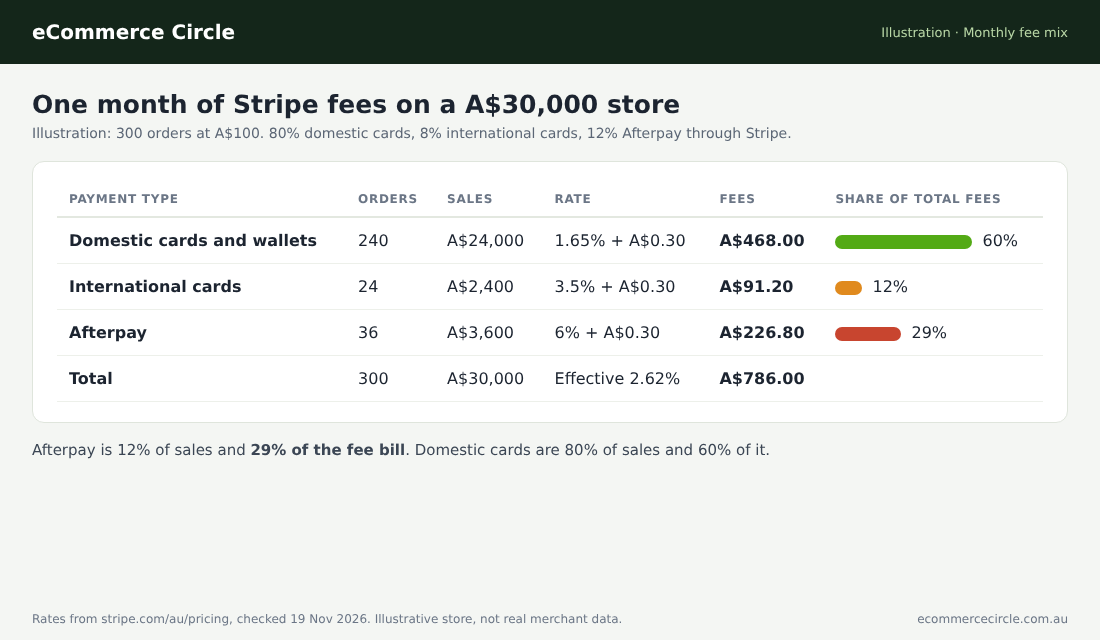
The store takes 300 orders a month at A$100 each. 80% are paid with domestic cards and wallets, 8% with international cards in Australian dollars, and 12% with Afterpay through Stripe.
| Payment type | Orders | Sales | Fees |
|---|---|---|---|
| Domestic cards and wallets | 240 | A$24,000 | A$468.00 |
| International cards | 24 | A$2,400 | A$91.20 |
| Afterpay | 36 | A$3,600 | A$226.80 |
| Total | 300 | A$30,000 | A$786.00 |
The effective rate is 2.62%, not 1.65%. Nothing went wrong. That is simply what the mix costs.
Now add an 8% refund rate. Stripe keeps the fees on those 24 refunded orders, about A$63. Measured against the A$27,600 the store kept, the effective rate is 2.85%. One dispute in the month adds another A$25.
Three things stand out:
- Afterpay is the biggest lever. It is 12% of sales and 29% of fees. If it is not lifting conversion or basket size enough to pay for itself, it is the first thing to test.
- International cards cost A$91 on A$2,400. From 1 April 2027 the same sales will cost A$74.40, a saving of A$16.80 a month with no action from you.
- The October cut saved this store A$12 a month. Real, but small next to the other two.
Stripe vs Shopify Payments, Square and PayPal
Here is what a A$100 online order on a domestic Visa or Mastercard costs across the processors Australian stores most often compare. All rates were checked on each provider’s Australian pricing page in November 2026.
| Provider | Published online rate | Fee on a A$100 order |
|---|---|---|
| Stripe | 1.65% + A$0.30 | A$1.95 |
| Shopify Payments, Basic plan | 1.7% + A$0.30 | A$2.00 |
| Shopify Payments, Grow plan | 1.55% + A$0.30 | A$1.85 |
| Shopify Payments, Advanced plan | 1.35% + A$0.30 | A$1.65 |
| Square Online | 2.2% | A$2.20 |
| PayPal, standard domestic | 2.9% + A$0.30 | A$3.20 |
Sources: Shopify, Square and PayPal Australia’s merchant fees page. Square has no fixed fee, which makes it cheaper than Stripe on orders under about A$55 and dearer above that.
If you are on Shopify, this is mostly academic
Shopify Payments is the default processor for Australian Shopify stores. If you use a third-party payment provider instead, Shopify adds its own transaction fee of 2% on Basic, 1% on Grow and 0.6% on Advanced, on top of whatever that provider charges.
That extra fee wipes out any saving from a slightly lower card rate. For most Shopify stores the right comparison is between Shopify plans, which we break down in Shopify Payments fees in Australia.
Where Stripe fits
Stripe is the natural choice when your store runs on WooCommerce, BigCommerce, Squarespace, Wix or a custom build, or when you sell subscriptions, invoices or payment links outside a storefront.
PayPal is a different question. It costs more per sale, but some buyers will not check out without it. We ran those numbers in PayPal fees in Australia.
What Australian Businesses Really Pay for Cards
It helps to know whether Stripe’s rate is good or bad against the wider market. The Reserve Bank has published the numbers.
- Small merchants on single-rate plans pay an average of 1.4% of the transaction value to accept cards. Small merchants on unblended plans pay 0.9%, and large merchants pay about 0.6%. (RBA conclusions paper, March 2026.)
- About 75% of merchants are on single-rate or blended plans, and only 19% of small merchants are on unblended plans.
- Merchant service fees across Australia add up to roughly A$7 billion a year.
- Before the ban, consumers paid an estimated A$1.6 billion of the A$1.8 billion in card surcharges each year. 85% of small merchants did not surcharge at all. (RBA, impact and implementation chapter.)
Those averages blend in-store and online payments, and in-store debit is the cheapest kind of card payment there is. Online payments cost more everywhere, so 1.65% + 30 cents for a pure online store is a fair market rate, not a rip-off.
The gap between 1.4% and 0.6% is the real lesson. Bigger businesses pay less because they negotiate. Stripe says custom pricing is available for businesses with large processing volume. If you are processing several million dollars a year on standard pricing, ask.
How Two Australian Brands Use Stripe
Both of these come from Stripe’s own customer stories, so read them as vendor case studies.
Bellroy, Melbourne
Bellroy sells wallets and bags to customers in more than 160 countries. According to Stripe’s case study, Bellroy moved 100% of its traffic to Stripe on a Black Friday when its previous provider went down, and finished the full implementation about eight weeks later.
The reported results are about revenue, not fees. Adding Afterpay in Australia gave an early conversion lift of 5% to 7% with larger carts. Turning on a new payment method went from months to 15 minutes. And 44% of Australian checkouts used Link, Stripe’s saved-details checkout.
The lesson for a smaller store: a payment method that costs 6% can still pay for itself if it lifts conversion by 5% or more. You only know if you measure it.
Videopro, Brisbane
Videopro has sold AV equipment since 1980 and runs three stores plus an online shop on BigCommerce. Stripe’s story says Videopro switched a few months after its 2022 site rebuild because its previous provider was inflexible. The case study gives no numbers. It reports better cash flow and fewer payment-related support questions.
For a retailer selling high-ticket gear, that fits the maths above. On a A$2,000 order the 30 cents is irrelevant and the percentage is everything.
How to Find Your Real Stripe Rate in 15 Minutes
You do not need an app for this. The Stripe Dashboard has a fee report that shows every charge with its fee and the country of the card.
- Log in to the Stripe Dashboard and open Reports.
- Select Payment fees.
- Set the date range to the last full calendar month and export the transaction-level report as a CSV.
- Open it in Google Sheets or Excel. Total the fee column and divide by total sales. That is your effective rate.
- Filter the Card country column. Rows where it is Australia are on the 1.65% rate. Everything else is on the international rate.
- Add a pivot table by payment method to see what Afterpay, Zip or Klarna cost you as a share of total fees.
Stripe itself recommends this export for working out what the 2026 and 2027 rate changes mean for your account.
Write the effective rate down. It is one of the numbers that belongs on your monthly dashboard next to gross margin and ad spend.
The Stripe Fee Audit Checklist
Run this once a quarter. It takes about half an hour with the export open.
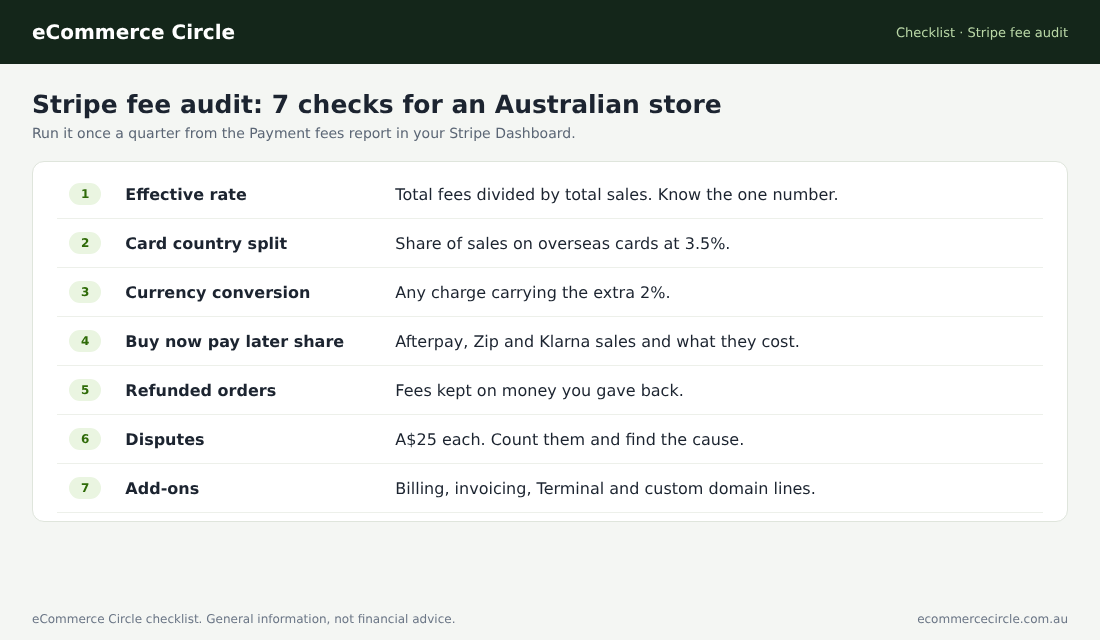
- Effective rate. Total fees divided by total sales. If it is above 2.5%, keep going down the list.
- Card country split. What share of sales is on overseas cards? Above 10%, model the April 2027 saving and check whether you are also paying conversion.
- Currency conversion. Find every charge with the extra 2%. If you price in USD or NZD, ask whether charging in Australian dollars would cost you fewer sales than the 2% costs you in fees.
- Buy now pay later share. Compare conversion rate and AOV on those orders against card orders. If there is no lift, hide the option on low-margin products or raise the minimum order.
- Refunded orders. Multiply refunded sales by your effective rate. That is fee money spent on revenue you gave back. It belongs in your returns cost.
- Disputes. Count them at A$25 each. More than one a month means a fraud or fulfilment problem worth fixing.
- Add-ons. Look for Billing, invoicing, Terminal and custom domain lines you no longer use.
- PayTo for big tickets. At 1% + A$0.30 capped at A$3.50, a A$1,000 order costs A$3.50 by PayTo against A$16.80 by card. Worth offering if you sell high-value or wholesale orders.
How It All Adds Up
Each of these fees is small on its own. Together they decide whether payment processing costs you 1.9% of sales or 3%.
On A$360,000 a year that difference is close to A$4,000. That is not a rounding error. It is a part-time contractor, a month of ad testing or a better product photographer.
The order of work matters. Start with the effective rate so you know the size of the problem. Then fix the mix: basket size, buy now pay later, overseas cards. Only then think about switching processors, because the mix usually costs more than the difference between providers.
And price the fee in. With surcharging gone, payment processing is a cost of goods sold line like freight and packaging. Stores that treat it that way set prices that hold their margin. Stores that ignore it find out at tax time.
Stripe Fees Australia: Common Questions
Does Stripe charge a monthly fee in Australia?
No. Stripe says it does not charge setup fees, monthly fees or closure fees on standard pricing. You pay per successful transaction. Some optional products, such as a custom checkout domain, do have a monthly charge.
Do Stripe fees include GST?
Stripe’s Australian pricing page states that the listed card, buy now pay later, PayTo and BECS fees include GST. Ask your accountant how to treat the GST component in your BAS.
How long do Stripe payouts take in Australia?
Stripe’s documentation lists an initial settlement time of 2 business days for Australian accounts.
Does Stripe refund the fee when I refund a customer?
No. There is no extra refund fee on card payments, but the processing fee from the original charge is not returned.
Can I pass Stripe fees on to customers?
Not as a card surcharge. Surcharging on debit and credit cards ended in Australia on 1 October 2026. You can build the cost into your prices.
Is Stripe cheaper than PayPal in Australia?
On published rates, yes. A A$100 domestic online order costs A$1.95 on Stripe and A$3.20 on PayPal’s standard 2.9% + A$0.30 rate.
Inside eCommerce Circle, Profit is one of the core pillars we work on with every member. If you want to see exactly where your store is being capped, take the free More Orders Scorecard. It takes two minutes and shows you which of the 10 P’s to fix first.