A Shopify chargeback is a forced refund your customer’s bank pulls from your payout, plus a $25 AUD dispute fee on Shopify Payments, and you win it back only by submitting clear evidence inside a short deadline (usually 7 to 21 days). Most stores lose chargebacks not because they were in the wrong, but because they answered late, sent the wrong proof, or never answered at all.
Here’s the uncomfortable truth we see in coaching sessions every week. A founder gets the “chargeback opened” email, feels a jolt of panic, and then either ignores it because the order was only $89, or fires off an angry paragraph to the bank. Both lose.
The brands that keep chargebacks under control do two boring things well. They answer every dispute with a tidy, labelled evidence pack, and they fix the handful of upstream gaps (vague descriptors, slow shipping updates, hidden returns policies) that cause most disputes in the first place. This guide shows you how to do both, with an evidence checklist you can copy at the end.
What a Shopify Chargeback Actually Costs You
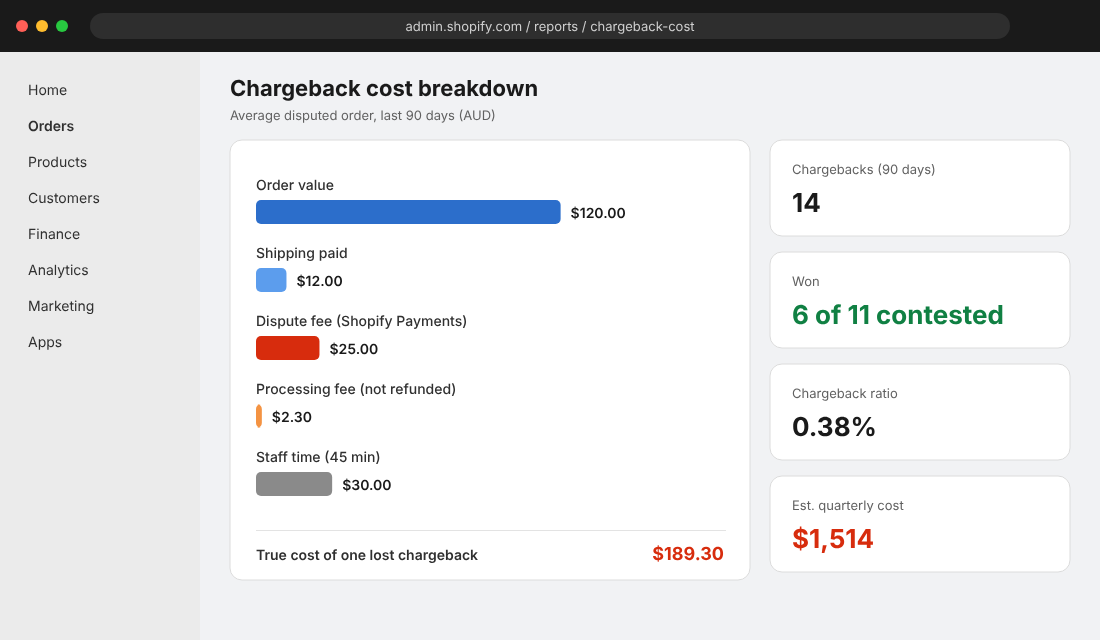
A chargeback is never just the order value. When a customer disputes a charge with their bank, Shopify Payments immediately holds the disputed amount from your payout and adds the dispute fee. According to Shopify’s chargeback documentation, the fee for Australian stores is $25 AUD, and it’s returned to you only if you win.
Now stack up the hidden costs:
- The product itself. In a fraud or “item not received” case you usually don’t get the goods back.
- Shipping and packaging you already paid for.
- Payment processing fees on the original sale, which are generally not refunded.
- Your time. Gathering evidence for one dispute can take 30 to 60 minutes if your systems are messy.
- Account risk. Too many disputes and your payment provider starts holding reserves or reviewing your account.
The LexisNexis True Cost of Fraud Study puts the total cost to US ecommerce merchants at $4.61 for every $1 lost to fraud once you add labour, replacement goods and fees. Australian numbers won’t be identical, but the principle holds. A $100 chargeback can easily cost you $300 or more.
Quick maths for your store: take your average order value, add your average shipping cost and $25, then multiply by the number of chargebacks you had last quarter. That figure is your real chargeback bill, and it usually surprises people.
Why Chargebacks Are Rising for Australian Stores
If you feel like disputes have crept up, you’re not imagining it. The AusPayNet 2025 Australian Payment Fraud figures show $854 million in card fraud on Australian-issued cards for the year to June 2025, and roughly 87% of that was card-not-present fraud. That’s online shopping. The good news is that the overall fraud rate fell to 71.8 cents per $1,000 spent, down from 77.6 cents the year before. The bad news is that online stores carry most of the remaining risk.
Then there’s “friendly fraud”, where a real customer disputes a real purchase. They forgot what the charge was, their partner bought it, or they simply want the item and the money. Juniper Research estimates friendly fraud makes up 22% of chargebacks in 2026, rising to 28% by 2031. And the MRC 2026 Global eCommerce Payments and Fraud Report found 64% of merchants saw first-party misuse increase.
There’s a third driver nobody likes to admit: our own stores. A confusing bank descriptor, a returns policy buried in the footer, or a three-week delivery window with no tracking update all push a frustrated customer straight to their bank instead of your inbox.
The four chargeback types you’ll actually see
Card schemes use dozens of reason codes, but for a typical Shopify store almost every dispute falls into one of four buckets:
| Reason (what the bank says) | What usually happened | Can you win it? |
|---|---|---|
| Fraudulent / unrecognised | Stolen card, or customer didn’t recognise the descriptor | Yes, if you have matching address, IP and delivery proof |
| Product not received | Parcel lost, slow, or delivered to a mailroom | Yes, with carrier tracking showing delivered to the right address |
| Product not as described / defective | Quality, sizing or expectation gap | Sometimes, with product page screenshots and your returns offer |
| Credit not processed / subscription cancelled | Customer believes a refund or cancellation was promised | Yes, if your policy and communication history are clear |
Knowing the bucket tells you exactly which evidence to gather, which is the single biggest lever on your win rate.
How the Shopify Chargeback Process Works (Step by Step)
Here’s the timeline from the moment a dispute lands. Shopify’s own help centre is the source for the deadlines.
- The customer contacts their bank. Card scheme rules generally give cardholders months, not days, to raise a dispute, so a chargeback can arrive long after the sale.
- Shopify notifies you. You get an email and a banner on the order in your Shopify admin. The disputed amount and the $25 AUD fee are held from your balance.
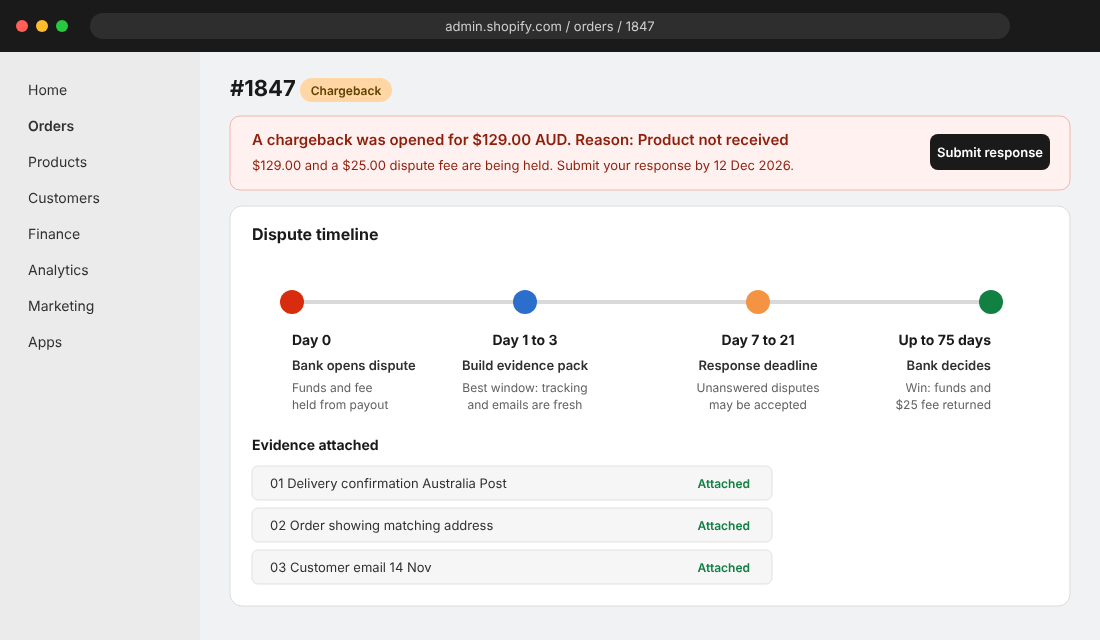
- You build your response. Shopify says you have a “limited time, usually 7 to 21 days”. The exact due date is shown on the order. Miss it and many chargebacks are accepted automatically.
- Shopify submits your evidence to the bank. You can save drafts, but once you click submit you can’t add more.
- The bank decides. According to Shopify, this “can take up to 75 days after you submit.”
- Outcome. If you win, the money and the $25 fee come back. If you lose, both are gone.
Two practical rules fall out of this. First, respond inside 72 hours, not on day 20. Evidence like tracking pages and customer emails is easier to grab while the order is fresh. Second, one strong submission beats a long one. The bank’s reviewer is skimming. Put your best proof first.
How to Win a Shopify Chargeback: The Evidence That Works
According to the Chargebacks911 2026 Chargeback Field Report, merchants won 44.6% of the chargebacks they contested. That’s close to a coin flip, which tells you something important. Plenty of disputes are winnable, and the difference between winning and losing is usually the quality of the evidence, not the facts of the case.
Shopify’s guidance is to lead with your strongest proof, such as delivery confirmation with signature or carrier tracking showing delivered status at a matching address. Here’s how we brief members to build each response.
Step 1: Write a three-sentence summary first
Before any attachments, write a short, calm summary the reviewer can read in ten seconds:
“The customer ordered [product] on [date] using the billing and shipping address [suburb, state]. The order was delivered to that address on [date], confirmed by Australia Post tracking [number]. The customer did not contact us before raising this dispute, and our returns policy (accepted at checkout) offers a 30-day return.”
No emotion, no accusations. Facts and dates.
Step 2: Match evidence to the reason code
- Fraud / unrecognised: matching billing and shipping address, AVS and CVV results from the order’s risk panel, customer IP location, previous successful orders from the same customer, and any email exchange after purchase.
- Not received: carrier tracking screenshot showing “delivered”, the delivery address matching the order, signature or photo-on-delivery if available.
- Not as described: screenshots of the product page as it appeared at the time (images, size chart, description), your returns policy, and any offer you made to exchange or refund.
- Credit not processed: your refund policy, the date and terms the customer agreed to, and the full email or chat history.
Step 3: Label everything clearly
Name each file the way a reviewer thinks: “01 Delivery confirmation Australia Post”, “02 Order showing matching address”, “03 Customer email 14 Nov”. Shopify specifically recommends labelling each item. A reviewer who has to guess what an image shows will usually side with the cardholder.
Step 4: Know when to accept
Not every dispute is worth fighting. If the parcel genuinely went missing, or the customer has a fair point and you’d have refunded them anyway, accepting quickly saves you time. Your energy is better spent on the disputes where you have clean proof.
Step 5: Contact the customer (carefully)
For friendly fraud, a polite email often resolves things: “We noticed a dispute on order #1234 for [product]. Is there anything we can help with?” If the customer realises their mistake, they can withdraw the dispute through their bank. Never pressure them, and don’t issue a separate refund while a chargeback is open, or you risk paying twice.
The Upstream Fixes That Prevent Most Chargebacks
Winning disputes is good. Not getting them is better. The Chargebacks911 field report also found that net recovery across all chargebacks issued was just 10.7%, because so many are never contested or are lost. Prevention is where the real money is.
Here are the fixes we prioritise with eCommerce Circle members, roughly in order of impact.
1. Make your bank descriptor recognisable. If your business name is “Smith Holdings Pty Ltd” but your store is “Coastal Linen Co”, customers see a strange name on their statement and call it fraud. In Shopify, go to Settings > Payments > Shopify Payments > Manage and set your statement descriptor to your store name. Add your website or phone number in the shortened descriptor if there’s space.
2. Send proactive shipping updates. “Where is my order?” turns into “item not received” when customers hear nothing. Send a dispatch email with tracking, an out-for-delivery message, and a delivered confirmation. Shopify’s built-in notifications cover most of this.
3. Put your returns policy where people can see it. Link it on product pages, in the cart, and in the order confirmation email. A customer who knows they can return easily will email you rather than call the bank. Our guide to online store terms and conditions covers what to include under Australian Consumer Law.
4. Answer support emails fast. A 48-hour reply window is a chargeback trigger. Customers who feel ignored escalate. Aim for a same-day first reply, even if it’s just “We’re on it.”
5. Review high-risk orders before you ship. Shopify’s fraud analysis flags orders with mismatched addresses, multiple card attempts, or proxy IP addresses. Our walkthrough on what to do with a Shopify high risk order explains how to read the indicators and when to cancel.
6. Use signature on delivery for high-value orders. For orders above a threshold you set (for many stores, $300 or more), the extra few dollars for signature buys you a near-certain win if a “not received” dispute appears.
7. Check whether chargeback protection is available to you. Shopify Protect covers eligible Shop Pay orders against fraudulent and unrecognised chargebacks. Availability varies by country and changes over time, so read our Shopify Protect guide and check your admin before relying on it.
Real Australian Brands That Cut Chargebacks
You don’t have to take our word for this. Two well-known Australian fashion brands have published results.
Lorna Jane. The Brisbane activewear brand runs on Shopify and was battling a legacy risk-scoring system that declined too many good customers. After moving to pre-authorisation fraud screening with Riskified, Lorna Jane reports authorisation rates rising from about 82% to between 95% and 98%, chargebacks falling by 98% (from a rate of around 0.30%), and the cost of fraud dropping by 54%.
Forever New. The Melbourne womenswear label was manually reviewing transactions across customer service and warehouse teams. According to a Merchant Risk Council member release, automating that review cut chargebacks by more than 84% without hurting approval rates.
Both sets of figures are self-reported by the vendor, so treat them as directional. But the lesson is clear: neither brand won by arguing harder with banks. They won by stopping bad orders and false declines before money changed hands. You can apply the same thinking at a smaller scale with the free tools already inside Shopify.
Tool Setup: Auto-Flag Risky Orders with Shopify Flow
Shopify Flow is free on most current Shopify plans and is the quickest way to stop risky orders shipping before someone checks them. Here’s a simple workflow that we set up with members in about ten minutes.
- Install Shopify Flow from the Shopify App Store if it isn’t already in your admin under Apps.
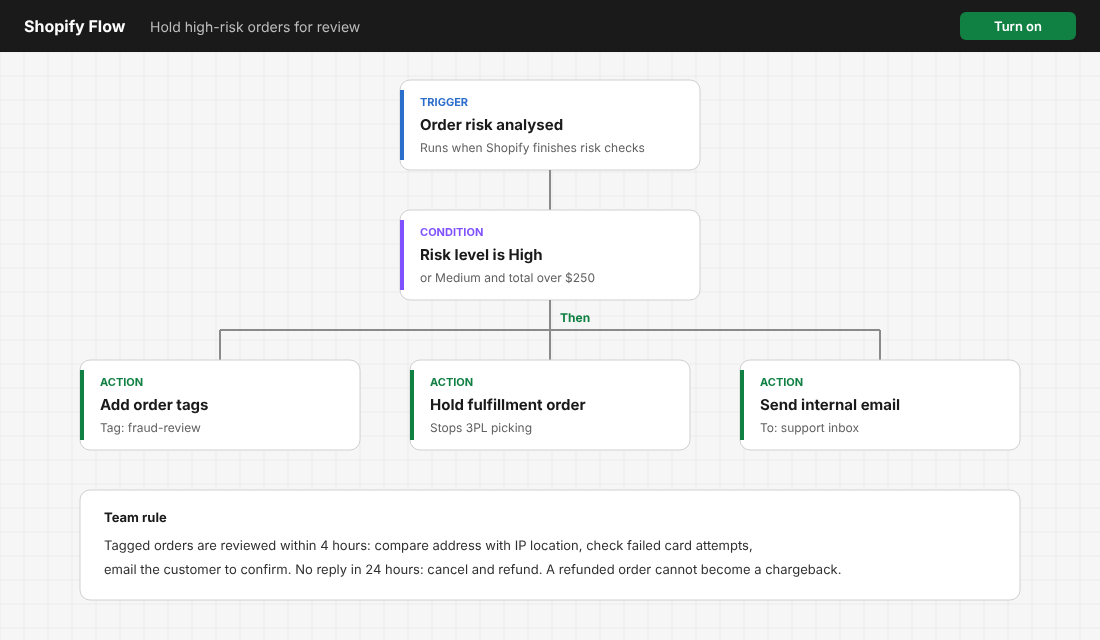
- Create a new workflow and choose the trigger Order risk analysed. This fires once Shopify has finished assessing the order.
- Add a condition: order risk level is equal to High. If you want to be more cautious, add an “or” branch for Medium risk orders over a set value, for example total price greater than $250.
- Add the action “Add order tags” and use a clear tag such as
fraud-review. - Add the action “Hold fulfillment order” (or, if your plan or 3PL doesn’t support holds, an internal email or Slack notification to whoever packs orders).
- Add a notification to your support inbox with the order number, so a person reviews it the same day.
- Turn the workflow on and test it with a past high-risk order if you have one.
Then write a one-page rule for your team: tagged orders get checked within four hours. Check the address against the IP location, look for multiple failed card attempts, and email the customer to confirm if anything looks off. If the customer doesn’t respond in 24 hours, cancel and refund. A refunded order can’t become a chargeback.
If you’re on a 3PL, make sure the fraud-review tag stops the order syncing. Most Australian 3PL integrations let you exclude tagged orders. Our Shopify Payments fees guide also explains how disputes and refunds flow through your payouts, which helps when you reconcile.
Watch Your Chargeback Ratio Before the Card Schemes Do
Your chargeback ratio is the number of disputes divided by the number of transactions in a month. For most small Shopify stores, a healthy target is under 0.5%, and ideally well below that.
Why it matters: Visa’s Acquirer Monitoring Program (VAMP) watches merchants whose combined fraud and dispute ratio gets too high. According to Checkout.com’s summary of VAMP, the merchant “excessive” threshold dropped to 1.50% from 1 April 2026 for most regions, applying to merchants above a minimum count of fraud and dispute reports. Most small stores won’t hit the minimum count, but your payment provider runs its own monitoring well before the schemes get involved. A rising ratio can mean payout holds or a rolling reserve.
How to track it: once a month, filter your Shopify orders by chargeback status to count that month’s disputes, divide by total orders, and note the reason codes. Two months of rising disputes in the same category points straight at the upstream fix you need.
How It All Fits Together
Chargebacks feel like random bad luck, but they behave like a system. Each piece you put in place reduces the load on the next.
A recognisable descriptor and clear shipping updates stop most “unrecognised” and “not received” disputes before they start. A visible returns policy and fast support replies catch the unhappy customers and send them to you, not their bank. Shopify Flow catches the genuinely risky orders before they leave your warehouse. And for the few disputes that still slip through, a labelled evidence pack submitted within 72 hours gives you the best shot at winning the money and the $25 fee back.
Run all four layers and you’ll find chargebacks drop from a weekly headache to an occasional admin task. More importantly, your payment provider sees a clean ratio, which keeps your payouts flowing during peak season when you need the cash most.
Your Shopify Chargeback Evidence Checklist
Copy this into your support SOP and work through it for every dispute.
Within 24 hours of the notification
- ☐ Note the reason code and the response due date in your task list
- ☐ Check whether the customer has emailed or messaged you about the order
- ☐ Decide: fight, or accept (accept if the parcel is genuinely lost or the complaint is fair)
Gather the evidence (match to reason code)
- ☐ Order page screenshot showing billing and shipping addresses match
- ☐ Fraud analysis panel showing AVS and CVV results and IP location
- ☐ Carrier tracking screenshot showing “delivered” at the order address
- ☐ Signature or photo-on-delivery, if available
- ☐ Product page screenshot (images, size guide, description) as at order date
- ☐ Returns and refund policy, plus proof it was linked at checkout
- ☐ Full customer email, chat and phone note history
- ☐ Previous successful orders from the same customer, if any
Build and submit
- ☐ Three-sentence factual summary at the top
- ☐ Strongest proof first
- ☐ Every file labelled with a number and plain description
- ☐ No emotional language or accusations
- ☐ Submitted at least 5 days before the deadline
After the decision
- ☐ Log the outcome, reason code and order value in your chargeback tracker
- ☐ Identify the upstream fix (descriptor, shipping comms, policy, fraud check)
- ☐ Review your monthly chargeback ratio
Get Help Making Your Store Harder to Rip Off
Inside eCommerce Circle, protecting your margin from chargebacks, fraud and refund leaks is one of the core Protection pillars we work through with every member. If you want a coach to look at your store, your policies and your numbers with you, have a chat with our team. Or start with the free More Orders Scorecard: it takes two minutes and shows you which of the 10 P’s to fix first.