Open your Shopify customer export and sort by suburb. If you sell into Sydney or Melbourne, somewhere in your top 20 postcodes you will find Box Hill, Glen Waverley, Parramatta, Harris Park, Cabramatta, Bankstown or Dandenong. You already have customers from Australia’s biggest migrant communities. You have just never spoken to them as anyone other than “the Australian market”.
What’s in This Article
Most founders treat multicultural marketing as a big-brand thing. A Woolworths Lunar New Year aisle, an SBS ad in seven languages, a bank sponsoring Diwali at Federation Square. Too expensive, too political, too easy to get wrong. So they do nothing, run every campaign in one voice to one imagined customer, and quietly leave a third of the country on the table.
The brands that get this right are not running translation projects. They are reading their own order data, picking one community where their product already fits, and showing up on that community’s calendar with the right gift at the right time. A Melbourne candle brand found out a Chinese social app was quietly sending it $600 baskets. A chocolatier sells a $169 praline tower every February. A beauty retailer built a whole category around shades it used to ignore. None of that needed a multicultural agency. It needed a founder who looked at the numbers. This playbook shows you how.
Why “The Australian Market” Is Now a Third Overseas-Born
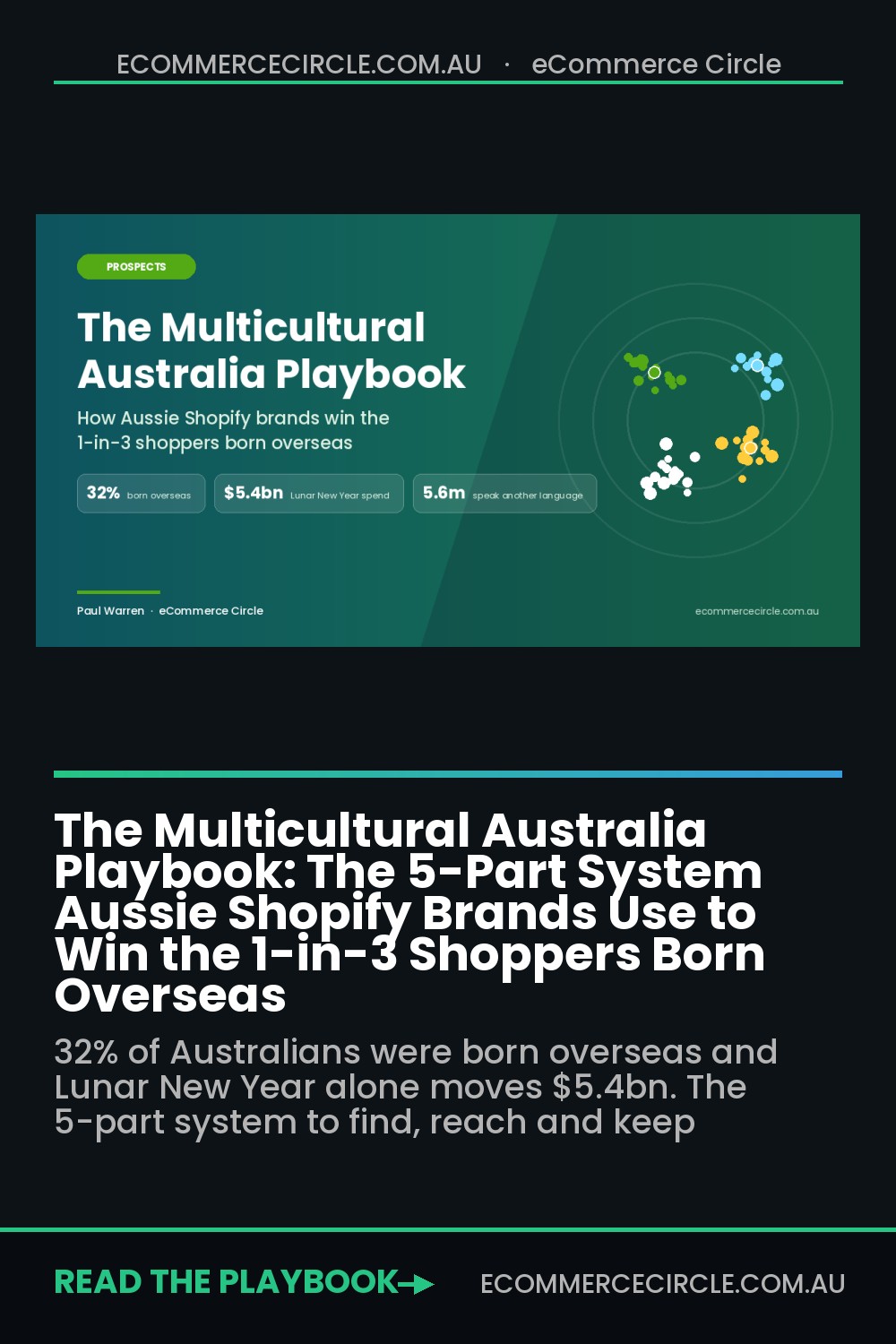
Start with the size of the thing, because most founders underestimate it by half. At 30 June 2025 the ABS counted 8.8 million Australian residents born overseas. That is 32 per cent of the population, the highest share since 1891, up from 24.2 per cent in 2005. India narrowly overtook England as the top overseas birthplace for the first time, with both groups around 971,000 people. Indian-born residents alone grew by 522,000 in a decade.
Go one generation wider and the picture changes again. The 2021 Census found 48.2 per cent of Australians have at least one parent born overseas. More than 5.6 million people use a language other than English at home: Mandarin (685,000), Arabic (367,000), Vietnamese, Cantonese and Punjabi (239,000, up 80 per cent in five years). Around 852,000 said they speak English not well or not at all. That last number matters if your entire checkout, shipping policy and returns page exist only in English.
Now the spend. ANZ card data shows Lunar New Year 2025 lifted customer spend 4.1 per cent to $5.1 billion across the festival window, and ANZ forecast $5.4 billion for the 2026 Year of the Horse period. The fastest-growing categories were digital goods (up 52 per cent), stationery (up 27 per cent) and household cleaning and repair services (up 18 per cent). Books, beauty and travel all spiked. That is not a niche. That is a second Christmas that lands in February, and most Shopify stores run no campaign for it at all.
Here is the reframe that matters for a founder: this is a Prospects problem, not a Promotion problem. You do not need a new ad channel first. You need to know who is already buying from you, which community your product naturally fits, and what their year looks like. Everything else follows from that. The Prospects section of the free More Orders Scorecard checks exactly this: whether you actually know who your buyer is, or whether you are guessing.
Part 1: Run the Cultural Signal Audit on Your Own Data
Before you touch a campaign, find out what your store is already telling you. This takes 90 minutes with a Shopify export and a spreadsheet, and it settles the argument about whether multicultural marketing is “for a brand like yours”. Export all customers with orders (Customers, Export, All customers, CSV). You want four columns: default address suburb, postcode, total spent and number of orders.
Now overlay the ABS. Every suburb in Australia has a free QuickStats page (search “ABS QuickStats” plus the suburb name) showing the share of residents born overseas and the top languages used at home. Tag each of your top 40 suburbs by revenue with its dominant non-English language group. When Box Hill, Glen Waverley, Chatswood and Hurstville cluster together, you have a Mandarin and Cantonese signal. When Harris Park, Parramatta, Tarneit and Wyndham Vale cluster, that is Hindi, Punjabi and Gujarati. Cabramatta, Springvale and Footscray point to Vietnamese. Bankstown, Lakemba, Auburn and Broadmeadows lean Arabic-speaking.
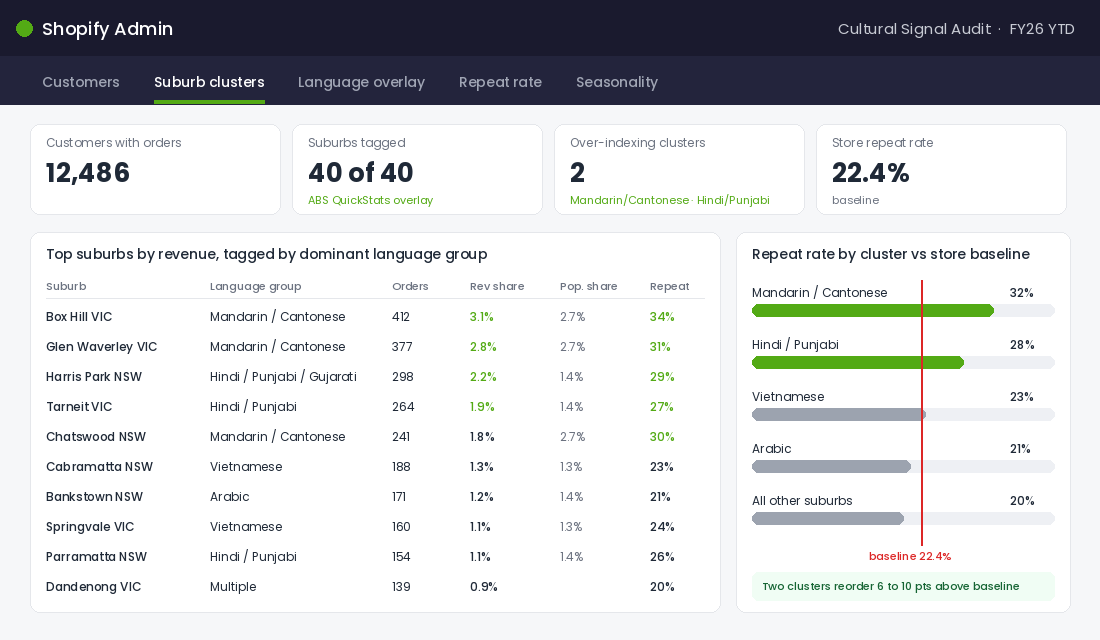
Then look at three numbers per language cluster, not just revenue:
- Revenue share versus population share. If Mandarin-speaking suburbs are 6 per cent of your orders but 2.7 per cent of the national population, you are already over-indexing. Something about your product fits. Find out what.
- Repeat rate by cluster. A community that reorders at 34 per cent when your store average is 22 per cent is telling you they trust you and would respond to being spoken to directly.
- Seasonality by cluster. Plot each cluster’s orders by week. If one spikes in the fortnight before Lunar New Year or Diwali without you running anything, that is a gifting occasion you are accidentally serving.
Add a second data source most founders never look at: referrers in Shopify Analytics and GA4. Light + Glo, a Melbourne candle and fragrance brand, only found out RedNote (Xiaohongshu) was sending it customers when a man drove across the city to its warehouse store and spent $600. Co-founder Suji Sanjeevan asked where he heard about the brand; he told her most of the Chinese-speaking community in Australia goes to that app to find gifts. She had never heard of it. The signal was sitting in her order data the whole time.
This audit is the same discipline we teach in the customer segmentation playbook, applied to one more dimension. Segment first, then market. Never the other way round.
Part 2: Pick One Community and Pass the Three-Question Fit Test
The single biggest mistake is trying to be multicultural in general. “Diverse Australia” is not a segment. A Punjabi family in Tarneit, a Vietnamese-Australian couple in Springvale and a student from Chengdu in Carlton share almost nothing about what they buy, where they discover brands, or when they gift. Pick one community from your audit and go deep. Add a second next year.
Run each candidate community through three questions before you commit budget:
- Does my product already have a role in their year? Chocolate, tea, whisky, skincare, homewares and children’s clothing all slot into Lunar New Year gifting. Sweets, gold-toned homewares, lighting and new outfits slot into Diwali. Dates, gift hampers and modest fashion slot into Ramadan and Eid. If you sell garage storage, the fit is weaker and you should pick a different lever, like the language of your checkout, rather than a festival campaign.
- Is the community big enough where I ship cheapest? Your audit already told you. If 70 per cent of your Mandarin-cluster orders are within Melbourne metro, you can run a suburb-targeted campaign with same-week delivery and a gift note, which is a real advantage over an overseas seller.
- Can I show up credibly? Credible means a real person from that community reviewing your product, a correctly written greeting, and a gift format that matches how gifts are actually given. It does not mean a red banner and a stock photo of lanterns.
Two brands show what “credible” looks like at very different scales. Adore Beauty’s Global Shades initiative started because an employee, Shanthi Murugan, wrote to the founder saying she could not buy foundation for her own skin tone on the site she worked for. The retailer went to its suppliers for their full global shade ranges, built a dedicated Global Shades category and set a target of 2,600 shades across 350 complexion products. Murugan’s own line on it is the whole strategy in one sentence: here are people begging for the privilege of spending their money with you.
Koko Black, the Melbourne chocolatier, takes the gifting route. Its 2026 Year of the Horse range ran in store and online until 17 February with a 48-piece Lunar Lantern at $169, a nine-layer praline tower wrapped in gold foil that doubles as a decorative piece, an 8-piece Lucky Lunar box at $36.90 and a 25-piece Lunar Gift Box at $81.90. Every Lunar New Year purchase ships with a complimentary red envelope (hóng bāo). That last detail is the tell. They understood that the envelope is part of the gift, not packaging.
Notice what neither brand did. Neither translated its whole website or hired an agency for a national campaign. One fixed a product gap, the other built a seasonal range with one culturally correct detail. Pick your lever with the same restraint.
Part 3: Build the 12-Month Cultural Calendar Before You Need It
If your marketing calendar runs Valentine’s, Mother’s Day, EOFY, Father’s Day, BFCM and Christmas, you are planning for one version of Australia. Add a second layer. These are the occasions that move money in the communities you identified, with the 2026 to 2027 dates most relevant to a store planning now. Lunar and religious dates shift every year, so confirm them each January, but the shape of the calendar holds.
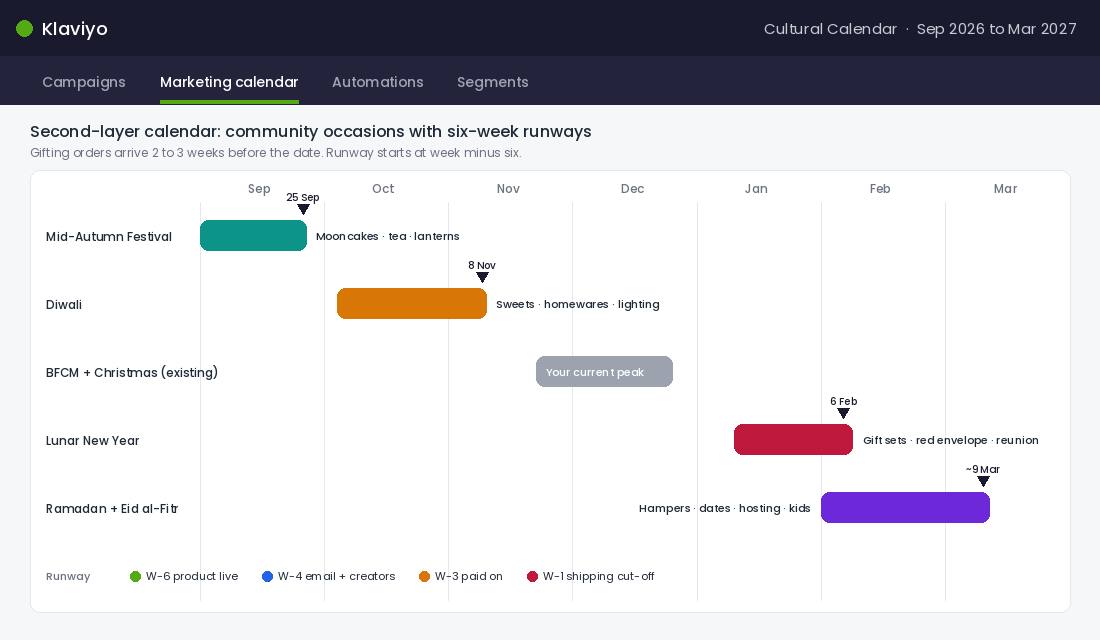
- Mid-Autumn Festival (25 September 2026). Mooncakes, tea, lanterns, family gifting. Koko Black now runs a dedicated mooncake collection for it. Campaign window: early September.
- Diwali (8 November 2026). The festival of lights for Hindu, Sikh and Jain families. New clothes, sweets, gold-toned homewares, candles, lighting, gifts for the home. The Indian diaspora in Australia now numbers more than 900,000, up from around 80,000 in 1996, and Woolworths and Coles have already started in-store Diwali displays. Campaign window: mid-October. It lands three weeks before BFCM, so build it into your peak plan rather than bolting it on.
- Lunar New Year (6 February 2027, Year of the Goat). The big one. A 15-day celebration where families clean the house, buy new outfits in red and gold, give red envelopes and gift food, drink, beauty and homewares. ANZ’s data shows household cleaning products spike here too, not just gifts. Campaign window: the second week of January, which is exactly when most Aussie stores are asleep after Christmas.
- Ramadan and Eid al-Fitr (Ramadan expected to begin around 8 February 2027, Eid around 9 March 2027). A month of fasting ending in a major gifting and hosting celebration. Dates, hampers, tableware, modest fashion, children’s gifts. Campaign window: two weeks before Ramadan, then a second push in the final ten days before Eid.
- Local festivals. Lower commercial weight, but the Ryde Diwali Fair, Cumberland’s Diwali street festival and the Burwood Lunar New Year Festival are where community media, councils and local creators converge. Useful for a pop-up or sampling partnership.
Two planning rules. First, gifting orders arrive early. Lark Distilling’s Fire Horse Edition single malt, with label art by Sydney artist Chris Yee, was in market well before 17 February 2026 because the buyer needs it in hand for the reunion dinner, not the day after. Plan a six-week runway: product live at week minus six, email and creator content at minus four, paid at minus three, last-order shipping cut-off communicated at minus one. Second, use the same peak-season buyer map thinking you apply to November. The person buying a $169 Lunar Lantern for their in-laws is a different buyer from the one buying a $36.90 box for the office. Write to both.
Part 4: Fix Language and Channels in the Right Order
Here is where founders overspend. They hear “multicultural” and immediately imagine translating 400 product pages and hiring a WeChat agency. Do it in this order instead, and stop at whichever step the data says is enough.
Step one: translate the trust pages, not the catalogue. Remember the 852,000 people who said they do not speak English well. What they need translated is not your product poetry. It is shipping times, returns, sizing, payment options and the gift note field. Shopify’s own Translate & Adapt app is free and will auto-translate up to two languages, with unlimited manual translations on top. Setup takes an afternoon:
- Install Translate & Adapt from the Shopify App Store, then go to Settings, Languages, and add your target language (Simplified Chinese, Hindi, Vietnamese, Arabic) as a published language.
- Open the app, select the new language, and auto-translate. Be deliberate: you only get two auto-translated languages per store for life, and removing one does not reset the limit, so pick the community from your audit, not a hunch.
- Then hand-fix the pages that carry risk: shipping policy, returns, size guide, gift note, checkout microcopy and your top ten product pages. Pay a native speaker on Airtasker or Upwork for two hours to review them. Machine translation gets you 80 per cent; the review gets you credibility.
- Turn on the language selector in your theme (Online Store, Themes, Customise, Header) so a visitor can switch in one tap. Shopify will serve the translated content on a language-specific URL, which Google indexes separately, so you also pick up in-language search.
Step two: meet them on the channel they already use. For Chinese-speaking Australians, that is RedNote, an Instagram-style app with more than 300 million monthly users globally and, by early 2025, more than 700,000 monthly users in Australia. It has no English interface, which is exactly why it is uncrowded. As Katrina Hall of multicultural agency MultiConnexions put it, if your target audience is young, affluent Chinese women, no other platform comes close. You do not need your own account to start. Light + Glo’s first move after that $600 warehouse visit was to hire one strategist and one blogger to build its profile, then time a Lunar New Year candle launch to the platform. Direct messages started arriving before the product went live.
For Indian-Australian communities, WhatsApp groups, community Facebook groups (search your suburb plus “Indian community”), Punjabi and Hindi radio, and Instagram creators who post in Hinglish do the same job. For Vietnamese and Arabic-speaking communities, Facebook remains dominant, and SBS in-language audio is a paid option most founders never consider. NRMA’s Lunar New Year insurance offer ran on WeChat, on a dedicated Chinese-language landing page, in Chinese news apps like Sydney Today and at the Burwood festival. You will not match that budget, but you can copy the structure: one offer, one landing page in language, one community channel, one physical touchpoint.
Step three: use the targeting you already pay for. Meta lets you target by language (set at ad set level under Detailed targeting, then Languages) and by suburb radius. Combine “Chinese (Simplified)” or “Vietnamese” with a 5 km radius around your top three cluster suburbs and a creative that uses a correctly written greeting. Google Ads lets you target by language the same way. Push your first-party Klaviyo segments of past buyers from those suburbs into a lookalike and you have a warm seed audience for a fraction of what broad targeting costs.
Part 5: Get the Gift, the Greeting and the Range Right
Every channel decision above is wasted if the thing that arrives at the door is wrong. Small details separate a brand that gets reordered from one that gets screenshotted and mocked in a family group chat.
The gift format. For Lunar New Year, pairs and even numbers are lucky; four is not (it sounds like “death” in Mandarin and Cantonese). Red and gold packaging reads as celebratory; white and black read as funeral. A red envelope included with the order, as Koko Black does, is worth more than a 10 per cent discount. For Diwali, sweets and items for the home beat personal items, and a gift is often given to the household rather than a person, so a “for the family” bundle at a higher price point outperforms a single-item offer. For Eid, gifts for children and hosting items (tableware, dates, hampers) lead.
The greeting. Get it checked. “Happy Chinese New Year” excludes Vietnamese, Korean and Malaysian customers who celebrate Lunar New Year too; use “Lunar New Year” unless you are speaking to one community specifically. Write the greeting in the language properly and have a native speaker confirm it. Add it to the gift note options in your Shopify cart so the buyer can select it rather than type it.
The range. Look at your catalogue through the community’s eyes. Adore Beauty’s lesson was that “Australian shades” skewed Anglo and left people of colour out of the picture. Ask the equivalent question for your category. Do your size charts fit? Do your recipe ideas assume a Sunday roast? Does your skincare range address concerns that are common in South Asian or East Asian skin? Do your “Australian-made” claims, which matter enormously to Chinese-Australian buyers of vitamins, skincare and baby products, appear in the translated pages? Fix the gap first, then market the fix.
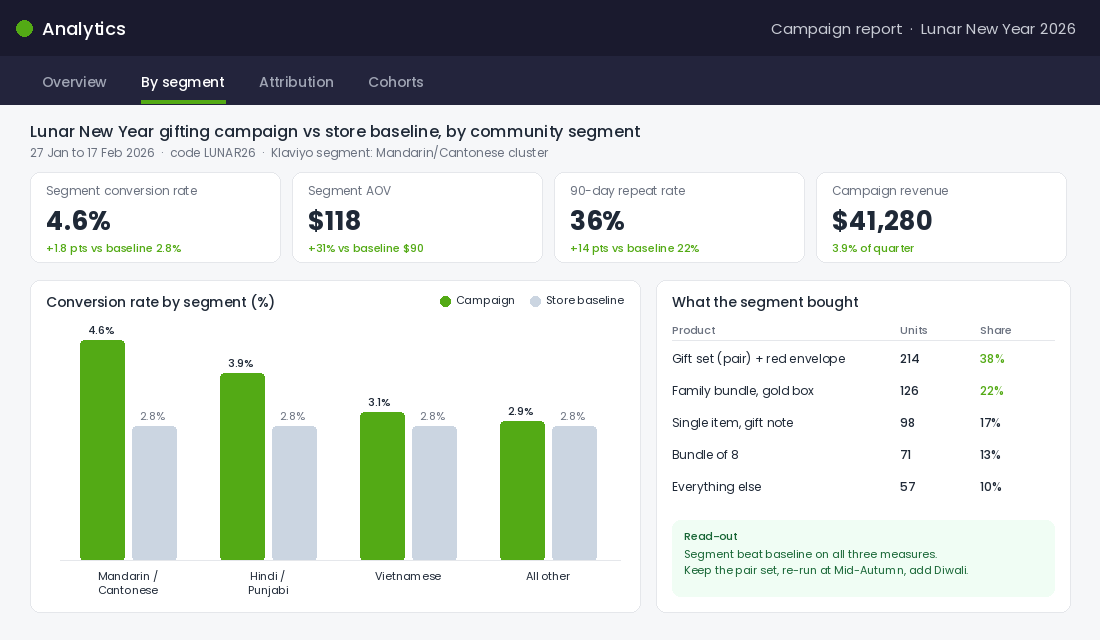
The measurement. Tag every community campaign with its own discount code, UTM and Klaviyo segment, and report three things: conversion rate against store baseline, average order value against baseline, and 90-day repeat rate. ANZ saw beauty, books and stationery spike during Lunar New Year; your job is to find out whether your version of that spike is real and whether those customers come back at Mid-Autumn or Diwali without being paid to. If they do, you have built a second peak season that your competitors are not even running.
The Compound Effect: A Second Peak Season Nobody Else Is Running
Each part on its own is a small win. Together they change the shape of your year. The audit tells you which community already trusts you. The fit test stops you spreading thin. The calendar gives you three or four extra revenue moments in the months when Aussie ecommerce is flattest: January and February after Christmas, September before BFCM. The channel work puts you in front of buyers where CPMs are a fraction of Meta broad targeting because almost no Shopify brand is there. And the gift, greeting and range work turns a first order into a family recommendation, which in tight-knit communities is the only marketing channel that really compounds.
Consider the alternative. The overseas-born share of Australia is now within half a point of the all-time record. The Indian-born population grew at nearly twice the rate of every other group over the past two years. Lunar New Year spend rose 4.1 per cent last year and was forecast to rise 5.4 per cent this year. These are not trends you can wait out. The brands that build the second calendar now will own those occasions the way Cadbury owns Easter. The ones that keep running one voice to one imagined Australian will keep wondering why their January is dead.
The Multicultural Australia Checklist
Work through this in order. Most founders can complete Parts 1 and 2 in a week and have a first campaign live inside six.
- Audit (week 1). Export customers, tag your top 40 suburbs by ABS language group, and calculate revenue share, repeat rate and seasonality per cluster. Check GA4 referrers for RedNote, WeChat or community sites you have never heard of.
- Fit test (week 1). Pick one community. Answer the three questions: does my product have a role in their year, are they concentrated where I ship cheapest, and can I show up credibly. If any answer is no, pick a different lever or a different community.
- Calendar (week 2). Add Mid-Autumn, Diwali, Lunar New Year and Ramadan/Eid to your marketing calendar with six-week runways and gifting cut-off dates. Confirm lunar dates each January.
- Language (week 2 to 3). Install Translate & Adapt, publish one language, hand-fix shipping, returns, sizing, gift note and top ten products, and pay a native speaker to review. Turn on the language selector.
- Channel (week 3 to 4). Choose one community channel (RedNote, WhatsApp and community Facebook groups, in-language radio or SBS) and one paid layer (Meta or Google language plus suburb targeting seeded with your first-party segment). Recruit one creator from the community.
- Gift and range (week 4 to 5). Build one culturally correct gift bundle with the right numbers, colours and an included envelope or card. Add an in-language greeting to your gift note options. Fix one range gap.
- Measure (ongoing). Unique code, UTM and Klaviyo segment per campaign. Report conversion, AOV and 90-day repeat against store baseline. Keep what beats baseline, cut what does not, add a second community next year.
Inside eCommerce Circle, knowing exactly who your buyer is, and which buyers you are quietly ignoring, is the Prospects pillar we work on with every member before a dollar goes into ads. If you want to see where your store is being capped, take the free More Orders Scorecard. It takes two minutes and shows you which of the 10 P’s to fix first.