You know your cost of goods to the cent. You know your blended ROAS to two decimal places. Ask you what it costs to get one order off the shelf and into a satchel, and the answer is usually a shrug and a guess.
What’s in This Article
That blind spot is expensive. On a store doing 4,000 orders a month, the difference between a warehouse running at 5.90 an order and one running at 4.10 an order is 86,400 dollars a year. Same products. Same customers. Same carriers. The only thing that changed is how the work is organised inside four walls.
Most Aussie founders who pack in-house have never measured it, so they never fix it. They hire another casual when orders spike, watch the wages line climb, and quietly assume that is just what growth costs. It is not. Picking productivity in most manual warehouses sits at 60 to 80 picks per hour, while well-slotted ecommerce operations run 80 to 120 and the best push past 150. That is not a technology gap. Most of it is layout, sequencing and discipline.
This is the six-lever system we work through with founders who pack their own orders, and with those about to sign a 3PL contract and want to know what a fair rate actually looks like. Work the levers in order. Each one makes the next one cheaper.
Start With the Number Almost Nobody Can Produce: Cost Per Order
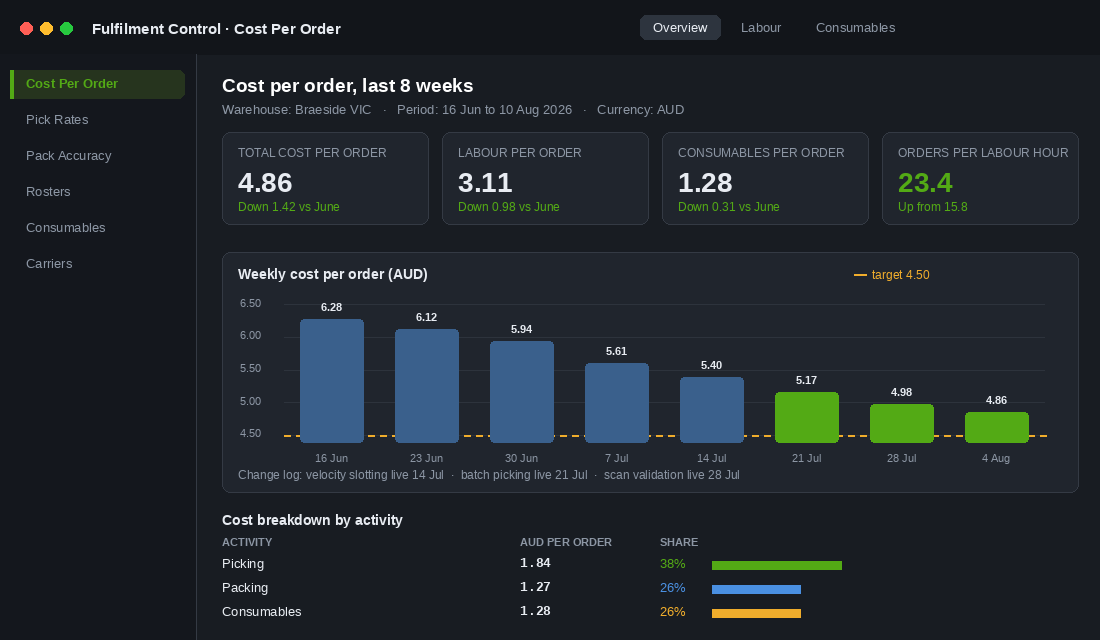
You cannot cut what you have not counted. Before you touch a shelf, spend ninety minutes building one number: fully loaded cost per order, in AUD, for last month.
The formula is deliberately simple. Add every dollar that touched the order between the sale and the carrier collection, then divide by orders shipped.
- Labour. Every hour anyone spent picking, packing, printing labels, restocking pick faces or handling returns rework. Include your own hours at a realistic rate. Include on-costs: superannuation, workers compensation and payroll tax where it applies.
- Consumables. Satchels, cartons, void fill, tape, thermal labels, tissue, stickers, inserts, gift notes. Everything that leaves the building with the parcel.
- Occupancy. The share of rent, power and racking depreciation attributable to pick and pack space, not bulk storage.
- Rework. Reships, refunds and support time caused by wrong or missing items. This is the line most founders forget and it is usually the ugliest.
Do not include freight. Freight is a carrier negotiation, and it moves for different reasons. Mixing it in hides whether your warehouse is improving.
Now you have a benchmark to argue with. Published 2026 rate guides put US third-party pick and pack at roughly 2.75 for the first item and 50 cents for each additional item, with survey averages around 3.20 per B2C order. Australian quotes land higher because Australian labour costs more. The minimum casual rate under the Storage Services and Wholesale Award is 33.85 an hour from 1 July 2026, against a full-time base of 27.08. If your in-house number is sitting at 6 or 7 dollars an order, you are not paying too much for staff. You are buying too few orders per hour from them.
Track two ratios alongside the dollar figure: orders per labour hour and cost per order, weekly, on one chart. If they are not on a wall or a dashboard someone looks at every Monday, nothing you read below will stick.
Lever One: Slot the Shelves by Velocity, Not by Category
Walk into most founder-run warehouses and the stock is arranged the way the website is arranged. All the candles together. All the tees together. All the 250ml together. It feels tidy and it is the single biggest reason your pickers are walking twelve kilometres a shift.
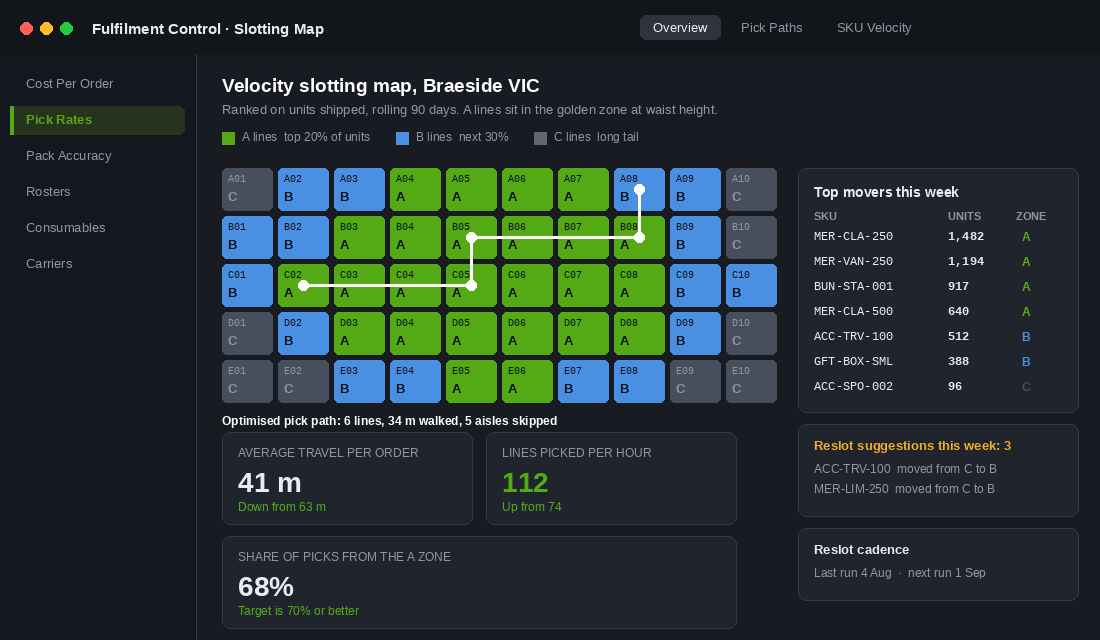
Warehouses do not sell categories. They sell units. Reorganise the pick face by how often a SKU is touched.
- Pull 90 days of line-item data. In Shopify admin go to Analytics, then Reports, then Sales by product variant SKU. Export to CSV and sort by units sold, not revenue. Units drive picks. Revenue does not.
- Split into A, B and C. A lines are the top 20 percent of SKUs by units, which will usually be 70 to 80 percent of your picks. B is the next 30 percent. C is the long tail.
- Put A lines in the golden zone. Between mid-thigh and shoulder height, in the bays closest to the pack bench. No bending, no ladders, no reaching over other stock.
- Push C lines to the back and up high. Slow movers can cost a picker twenty seconds each. That is fine when it happens four times a day.
- Slot affinity pairs together. If your bundle SKU and its refill sell together 60 percent of the time, they belong within arm’s reach of each other, not in different aisles.
Optimising pick paths and slotting this way cuts travel distance by up to 30 percent, and travel is where most of a picker’s shift disappears. Reslot monthly. Your range moves, seasons shift, and a bay map that was right in March is wrong by September.
One practical warning for Aussie brands running a spring or Father’s Day push: do the reslot before the campaign lands, not during it. Moving stock while volume is climbing is how you create a week of “cannot find it” pick exceptions.
Lever Two: Batch the Picks So You Walk the Aisle Once, Not Six Times
The default in almost every small warehouse is discrete picking: one order, one lap, one parcel. It is simple, it is easy to teach, and it is the most expensive method available to you once you pass roughly 80 orders a day.
Look at your order profile first, because it decides the right method.
- Mostly single-line orders? Use batch picking. Pull 20 to 40 orders of the same SKU in one trip, then sort at the bench. Brands with a hero product and a few variants can often cut picking time in half here alone.
- Mostly two to five line orders? Use cluster picking with a trolley holding 8 to 12 totes. One lap of the A zone fills a dozen orders at once.
- Large, complex or wholesale orders? Use zone picking with a handover. One person owns the A zone, another owns B and C, totes move between them.
The rule of thumb: your picking method should change every time your daily order volume roughly triples. What worked at 40 orders a day is actively costing you money at 400.
Sequence the pick list by bay location, not by order number or by the order the customer typed things into the cart. This is a five minute fix in most warehouse or shipping platforms and it is the highest return five minutes in this article. A pick list that reads A03, A07, B02, C11 walks a straight line. A pick list that reads C11, A03, B02, A07 walks the same aisle four times.
Once batching is running, expect to land in the 80 to 120 units per hour band that is realistic for ecommerce piece picking. The practitioner range published by ASCM for each-picking is 60 to 100 lines per hour, with best-in-class operations at 250 or more once voice or pick-to-light is added. You do not need that gear. You need to stop walking in circles.
Lever Three: Build the Pack Bench Like a Cockpit
Picking gets all the attention. Packing is where the seconds quietly bleed, because every reach, every turn and every hunt for the tape gun happens on every single order.
Time yourself packing ten orders with a phone stopwatch. Most in-house benches come in at 90 to 150 seconds an order. A properly set up bench does the same job in 45 to 70. At 4,000 orders a month and a loaded casual rate near 40 dollars an hour once on-costs are counted, saving 50 seconds an order is roughly 26,000 dollars a year.
- Everything used on every order sits within arm’s reach without stepping. Tape, satchels in the two most-used sizes, thermal printer, void fill, scanner. If the packer takes a step, you have designed it wrong.
- Consumables live in gravity-fed or angled bins. Flat stacks mean two hands and a peel. Angled bins mean one hand and a grab.
- One printer per bench, thermal, no toner. Shared printers create a queue, and queues create walking. A 4×6 direct thermal unit removes label ink from your consumables line entirely.
- Standardise to three carton sizes and two satchel sizes. Every extra size is a decision, and decisions cost three to five seconds each. Fewer sizes also means better volume pricing.
- Put the bin, the recycling and the exception tray at the bench. A packer should never have to leave the station to deal with a problem order. They flag it, park it, and keep moving.
Bellroy dispatches from its own Australian warehouse within two working days, and The Oodie quotes one to three business days before Australia Post takes over. Neither promise is possible if the bench is improvised. Dispatch speed is a merchandising asset, and we cover how to turn it into conversion in the delivery promise playbook. The bench is where that promise is either kept or broken.
Lever Four: Scan Before You Seal, Because Eyes Are Not a Control
Here is the number that changes how founders think about accuracy. Industry average pick accuracy sits at 97 to 99 percent, best-in-class operations run 99.5 percent or better, and world-class hits 99.9. Meanwhile the fully loaded cost of a single mispick is estimated at 30 to 75 dollars or more once you count the replacement item, the return freight, the support time and the discount you hand over to keep the customer.
Run the maths on your own store. At 4,000 orders a month and 98 percent accuracy, that is 80 wrong parcels a month. At 45 dollars each, that is 43,200 dollars a year walking out the door in satchels. Getting to 99.6 percent takes it to 8,640. Nothing else in this article pays back that fast.
You do not fix accuracy with a talk about being careful. Careful is not a control. Scanning is.
How to Set Up Pack Validation in Starshipit
Starshipit is the Aussie and Kiwi shipping platform most local Shopify brands land on, and its Packing Validation feature turns the bench into a checkpoint. Every line has to be scanned before the order can be completed and a label printed.
- Get barcodes onto every variant first. In Shopify, the barcode field sits on each product variant. If your supplier prints an EAN or UPC, use it. If not, generate your own codes from your SKU and print labels on a small thermal unit. This step is the one people skip and it is the one that makes the rest work.
- Connect Shopify to Starshipit so orders and line items sync automatically.
- In Starshipit, open Settings, then Workflows, then Packing Validation, and switch it on.
- Set the scan rule to every item, not one per order. Scanning one line and assuming the rest is where two-line mistakes hide.
- Lock the override behind a supervisor PIN and log which station used it. If overrides are free, they become the workaround within a fortnight.
- Review the exception log every Friday. Repeated scan failures on the same SKU usually mean a missing barcode or two variants that look identical on the shelf, which is a slotting problem, not a people problem.
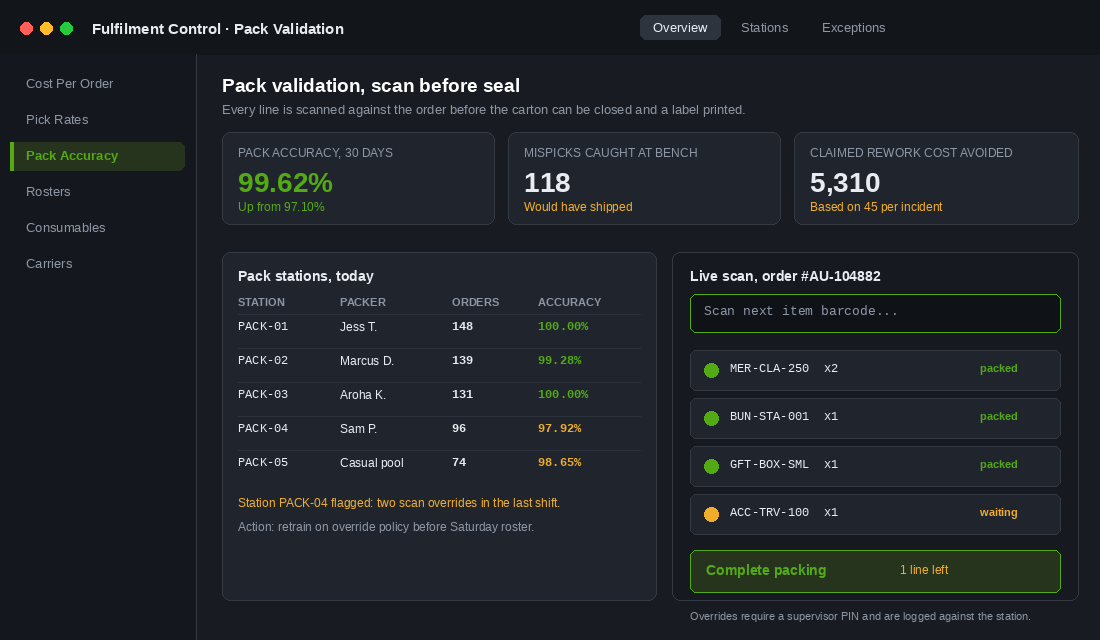
Give it a fortnight and you will find your accuracy was worse than you believed. That is the point. The errors were always happening. Now they get caught at the bench instead of in a customer’s kitchen, which also takes real load off support. If your inbox is full of “where is my order” and “this is the wrong size”, pair this with the support deflection playbook.
Lever Five: Buy Consumables Like a Buyer, Not Like Someone Doing a Hardware Run
Consumables are usually a quarter to a third of in-house cost per order, and they are almost always bought reactively. Someone notices the satchels are low on a Thursday, orders two boxes at retail pricing, and pays freight on a small parcel. Repeat 40 times a year.
Treat packaging like stock, because it is.
- Cost every component per unit. Not per box. Per satchel, per metre of tape, per sheet of tissue. You cannot see waste at box level.
- Rationalise the range. Most brands running eight pack sizes can get to five with no customer impact. Fewer sizes means larger buys, better pricing and faster decisions at the bench.
- Buy a quarter at a time on a forecast. Take your units forecast, apply your average items per order, and order once. Pallet pricing on satchels is routinely 30 to 40 percent below carton pricing.
- Measure void fill, do not eyeball it. Paper and air pillows are the easiest place to give away a dollar an order without noticing. Set a fill standard per carton size and train to it.
- Audit the freebie inserts. Every sticker, card and sample has a cost per order. Some earn their keep in repeat rate. Most were added two years ago and never reviewed.
Set a target consumables cost per order and put it on the same weekly chart as labour. When the two numbers sit side by side, packaging decisions stop being aesthetic and start being commercial.
Lever Six: Staff to the Curve, Not to the Average
Ecommerce order volume is lumpy. Monday is heavy because the weekend piled up. Payday weeks spike. A single email send can double a Tuesday. Staffing to the monthly average guarantees you are overstaffed half the time and drowning the other half.
Build a simple staffing model with three inputs.
- Orders per labour hour, measured not guessed. Take last month’s shipped orders divided by total warehouse hours. Most in-house teams start somewhere between 12 and 18. Working the levers above should get you above 22.
- Daily order forecast by day of week. Use a 13-week rolling average per weekday, then overlay your campaign calendar. If a send goes out Tuesday 7am, Tuesday and Wednesday need cover.
- A cut-off you actually defend. Publish a dispatch cut-off, staff to clear everything before it, and stop the drift where the team packs until 7pm because orders kept arriving.
Divide the forecast by orders per labour hour and you get the hours needed. Build the roster from that, not from habit. Keep a trained casual pool for the top of the curve. At 33.85 an hour for a casual under the award, a well-planned four hour shift beats a badly planned eight hour one every time.
Who Gives A Crap runs warehouses across Melbourne, Sydney, Brisbane, Adelaide, Perth and Hobart with hundreds of staff picking and packing, and its subscription model deliberately reduces the number of separate pick events per customer per year. That is the same principle at a different scale: shape demand so the warehouse handles fewer, larger, more predictable jobs. If you are weighing up whether to split stock geographically, we walk through the trigger points in the second node test. And if peak is the pressure point, the peak season staffing playbook covers hiring and training ahead of November.
The Returns Bench: The Hidden Half of Your Cost Per Order
Rework showed up as a line in the cost per order formula, and then most founders quietly leave it at zero because nobody logs it. That is a mistake worth thousands. A return is not one touch. It is a receive, an inspect, a decision, a restock or a write-off, a refund, and usually a support conversation. Six touches on an order you already paid to pick and pack once.
Time it properly for one week and the number will surprise you. A typical unbarcoded, unsystematised returns bench runs 6 to 12 minutes per return, which at a loaded warehouse rate lands somewhere between $4 and $9 of labour before you count the inbound freight you subsidised. On an apparel brand running a 25 to 30% return rate, that is a bigger line than your consumables.
Three changes get most of it back. First, give returns a dedicated bench with its own scanner and its own bins, rather than letting them pile up at the pack station and interrupt outbound flow. Mixing the two is why Monday afternoons feel chaotic. Second, scan the return in against the original order the moment it lands, so the refund decision is made once with the item in hand instead of twice across a support thread. Third, put a grading standard on the wall: A goes straight back to the pick face, B goes to a seconds bin, C is written off on the spot. Ambiguity is what creates the shelf of undecided stock every warehouse has in a corner.
Then treat the return reason codes as free product research rather than admin. Size, colour, quality, and “not as described” point at four completely different fixes, and only one of them lives in the warehouse. Reducing the return rate is worth more than processing returns faster, which is the argument the returns reduction playbook makes in detail.
Add one line to the weekly scorecard: returns processed per labour hour. Target 8 or better once the bench is set up properly. If you are under 5, the bottleneck is almost always that the decision and the refund are happening at different times, by different people, on different screens.
When to Stop Packing In-House: The Break-Even Maths
Every founder packing their own orders eventually asks the same question, usually at the worst possible moment in November. The six levers exist partly so you can answer it with a number instead of a feeling.
Run the comparison on total cost, not the headline rate. A 3PL quote of $3.20 first item plus 55 cents per additional is not the number you pay. Add storage per pallet or per bin per week, receiving and putaway on inbound, the account management or platform fee, returns handling priced separately, and the pick-and-pack premium most contracts apply on peak weeks. Your in-house number needs the same honesty applied: labour including your own hours at a real rate, consumables, the occupancy share, rework, and the software you would keep either way.
Then look at the three things the spreadsheet does not capture. Volume shape, because a 3PL absorbs a Tuesday email spike without you rostering anyone. Founder hours, because 12 hours a week in a warehouse is 12 hours not spent on merchandising or acquisition. And risk concentration, because one warehouse with one lease and one team is a single point of failure exactly like the ones the continuity work is meant to eliminate.
The pattern we see repeatedly sits around this shape. Under roughly 1,500 orders a month, in-house usually wins on cost if you have worked the six levers, because a 3PL’s fixed fees spread across too few orders. Between 1,500 and 4,000, it becomes a genuine toss-up decided by your order profile and how much your own time is worth. Above 4,000 orders a month, the 3PL almost always wins unless you have a genuinely unusual product or a heavy customisation step at the bench.
Whichever way you land, do the levers first. A founder who moves to a 3PL without knowing their true cost per order has no basis to negotiate and no way to tell whether the contract is working six months in. Get the number, then go shopping. The 3PL playbook covers how to run that tender properly, and if you are heading into a stocktake before peak, the stocktake playbook is the natural next step.
Why These Six Levers Compound
Run individually, each lever is worth 10 to 20 percent. Run in sequence, they multiply, because each one removes the constraint that was capping the next.
Slotting shortens the walk. A shorter walk makes batching viable, because a trolley of twelve totes is only worth pushing if the A lines are clustered. Batching floods the bench, which is only survivable if the bench is designed properly. A fast bench tempts people to rush, which is exactly when scan validation stops the errors that a fast bench would otherwise create. Fewer errors means less rework labour, which lifts orders per labour hour again. Higher orders per labour hour means the staffing model needs fewer hours for the same curve, and consumables buying gets more predictable because volume is more predictable.
A realistic outcome for a 3,000 to 6,000 order per month brand working all six over a quarter: cost per order down 25 to 35 percent, orders per labour hour up 40 to 60 percent, and pack accuracy from somewhere near 97 to somewhere near 99.5. That is not a hypothetical. It is what happens when walking, deciding and re-doing all get removed at once.
It also changes a strategic conversation. Once you know your true cost per order, a 3PL quote stops being a leap of faith and becomes a comparison. Some brands discover outsourcing is cheaper than they thought. Others discover their own operation is already better than the quote and the real answer is to keep it in-house and invest in racking. Either way you are deciding with a number instead of a feeling, which is the whole point of the 3PL playbook.
The Pick and Pack Scorecard: Your Weekly One-Pager
Copy this into a spreadsheet and fill it in every Monday for the previous week. Seven lines, five minutes, and it will surface a problem long before it shows up in your P and L.
- Orders shipped. The denominator for everything else.
- Total warehouse labour hours. Including your own, including returns rework.
- Orders per labour hour. Target above 22 for a mixed range, above 30 for a hero-product brand. Below 15 means slotting or method is wrong.
- Labour cost per order. Hours times loaded rate, divided by orders.
- Consumables cost per order. Quarterly spend divided by quarterly orders, updated monthly.
- Pack accuracy. Orders shipped minus orders with a picking or packing error, divided by orders shipped. Target 99.5 percent or better.
- Same-day dispatch rate. Orders placed before cut-off that shipped the same day. Target 95 percent or better.
Add a single note field each week: what changed. Reslot, new picking method, new casual started, new packaging supplier. When cost per order moves, you want to know why, and memory is not a reliable record.
Run this from now until the last week of November and you will walk into peak with a warehouse that can absorb a doubling of volume without a panicked hiring round. Start it in October and you will be trying to change the wheels while the car is moving.
Inside eCommerce Circle, fulfilment cost per order is one of the core pillars we work on with every member, because it is one of the few levers that lifts profit without needing a single extra visitor. If you want a second opinion on yours, let’s talk.