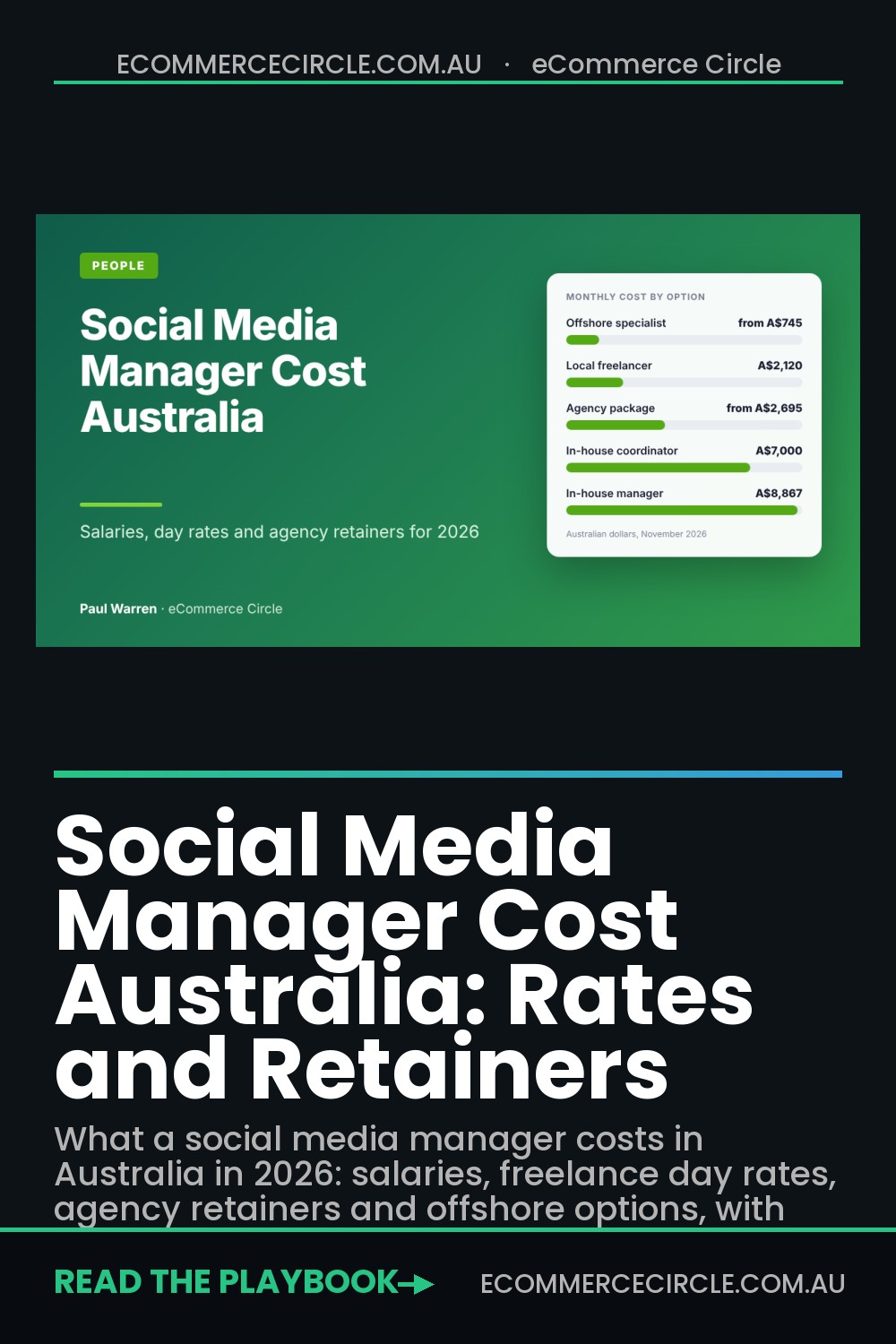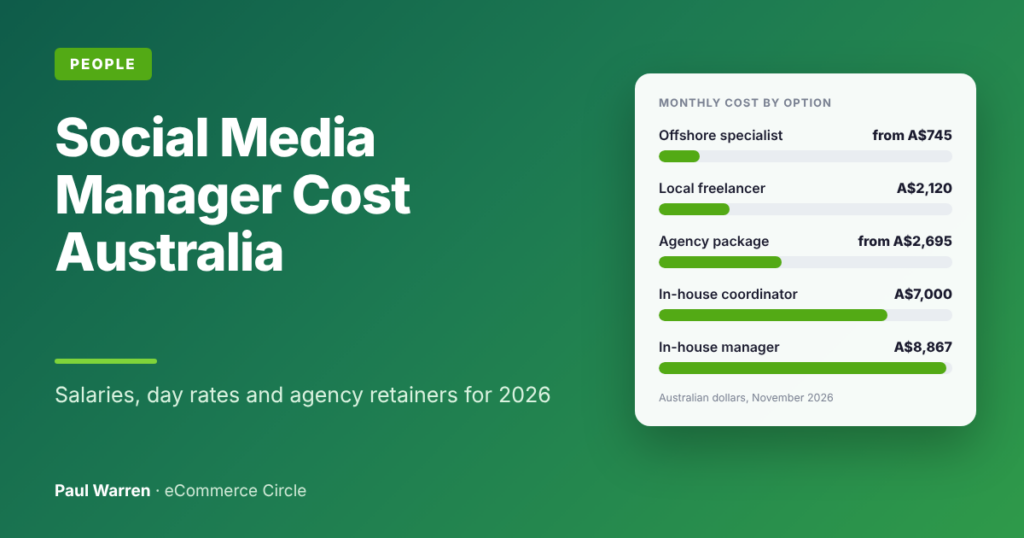
A social media manager in Australia costs between about A$750 and A$8,900 a month in 2026, depending on who you hire. An offshore specialist sits at the bottom of that range, a local freelancer or agency package lands between A$1,000 and A$6,000, and a full-time in-house manager costs about A$106,000 a year once super is added.
Most store owners get this decision wrong in one of two ways. They pay an agency A$2,500 a month for “content” with no number attached to it, or they hand Instagram to the newest person on the team and wonder why nothing changes.
The owners who get value from the spend do it differently. They price the job in hours first, pick the cheapest hiring option that can cover those hours properly, and tie it to a sales number they check every month. This guide gives you the 2026 rates for each option, the hours the job really takes, and the maths to decide if it is worth paying for at all.
What a Social Media Manager Costs in Australia at a Glance
Here are the five ways an Australian online store can staff social media, with what each one costs. Every figure is sourced further down the page.
| Option | Typical cost | What you get |
|---|---|---|
| Offshore social media specialist | A$745 to A$1,790 a month, full time | Scheduling, basic design, replies. Needs a clear brief |
| Local freelancer | A$450 to A$1,000 a day, or A$1,000 to A$8,000+ a month | Strategy and content from one experienced person |
| Agency package | From about A$1,000 a month. A$2,695 to A$5,907 for 3 to 5 posts a week | A team, a process and a monthly report |
| In-house coordinator | A$70,000 to A$80,000 salary, about A$7,000 a month with super | A junior on your brand full time |
| In-house manager | A$85,000 to A$105,000 salary, about A$8,867 a month with super | Strategy, content and community owned by one person |
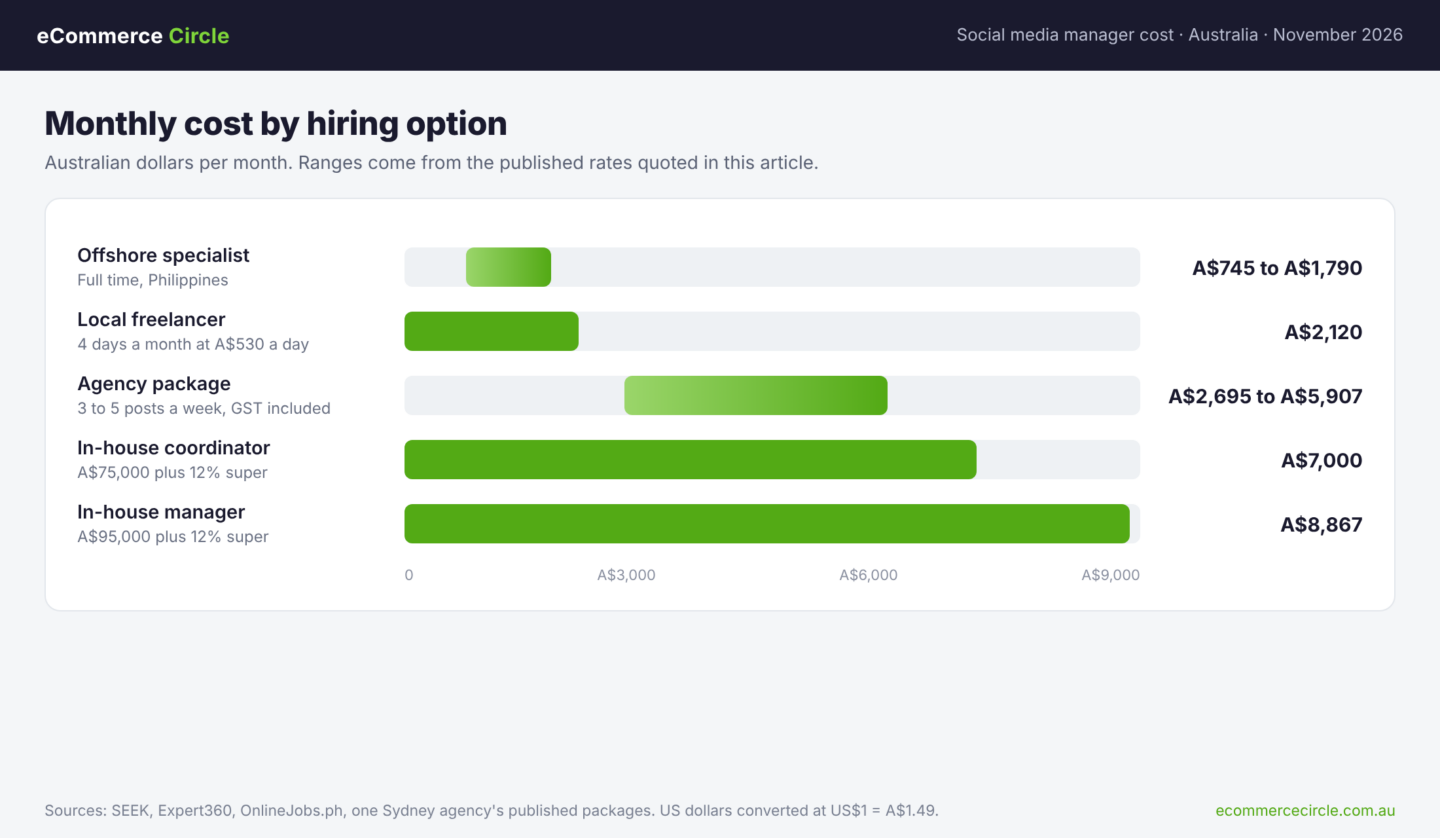
Two things stand out. The gap between the cheapest and dearest option is more than ten to one, and the price tells you very little about what gets produced. A A$2,500 retainer can buy three posts a week or twelve, so you need to price the work, not the title.
In-House: Salary Is Only Part of the Bill
SEEK puts the average social media manager salary in Australia at A$85,000 to A$105,000 (refreshed 1 November 2026). A social media coordinator sits at A$70,000 to A$80,000, and SEEK’s range for content creators is A$80,000 to A$85,000.
PayScale reads lower. Its Australian social media manager page shows an average of A$29.49 an hour, with total pay running from A$46,000 to A$93,000 across 139 salary profiles (updated 25 October 2026). The difference makes sense: SEEK reflects advertised roles, while PayScale leans on self-reported pay from people early in their careers.
Salary is not what the hire costs you. Add the 12% super guarantee and a A$95,000 manager becomes A$106,400 a year. Then count the hours you really get.
- Paid hours: 52 weeks at 38 hours is 1,976 hours.
- Hours worked: take out four weeks of annual leave and about ten public holidays and you are left with 1,748.
- Cost per hour worked: A$106,400 divided by 1,748 is about A$61 an hour, against A$48 an hour of base pay.
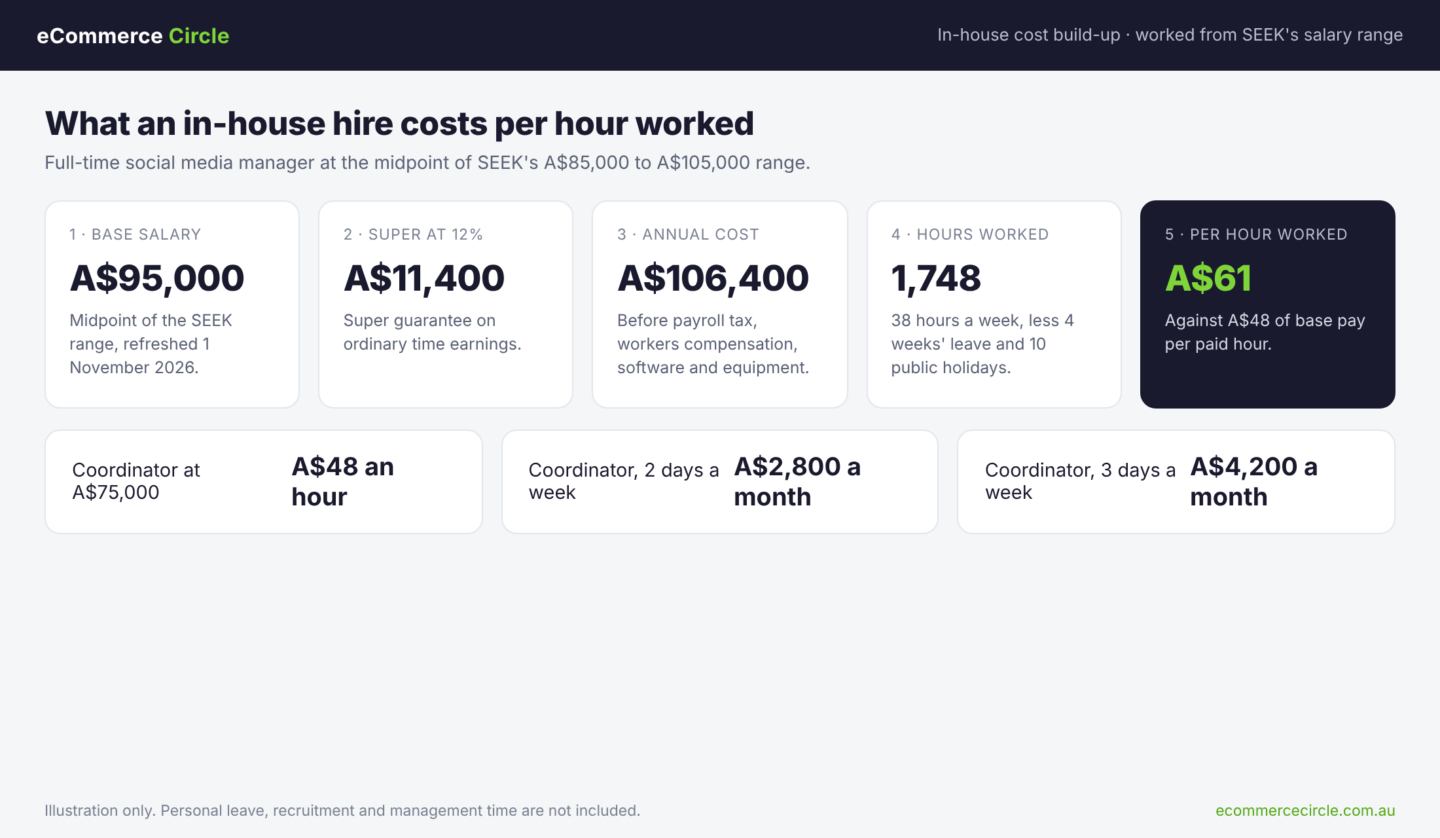
That A$61 is before payroll tax (if your wages are over your state’s threshold), workers compensation, software, a phone, and the time you spend managing them. It is an illustration built from SEEK’s midpoint, not a quote, but the gap between base pay and real cost holds for any hire.
The option most stores overlook is part time. A coordinator on A$75,000 pro rata costs about A$2,800 a month for two days a week, or A$4,200 for three, with super included. That is agency money for someone who sits inside your business, knows the product and can film in your warehouse.
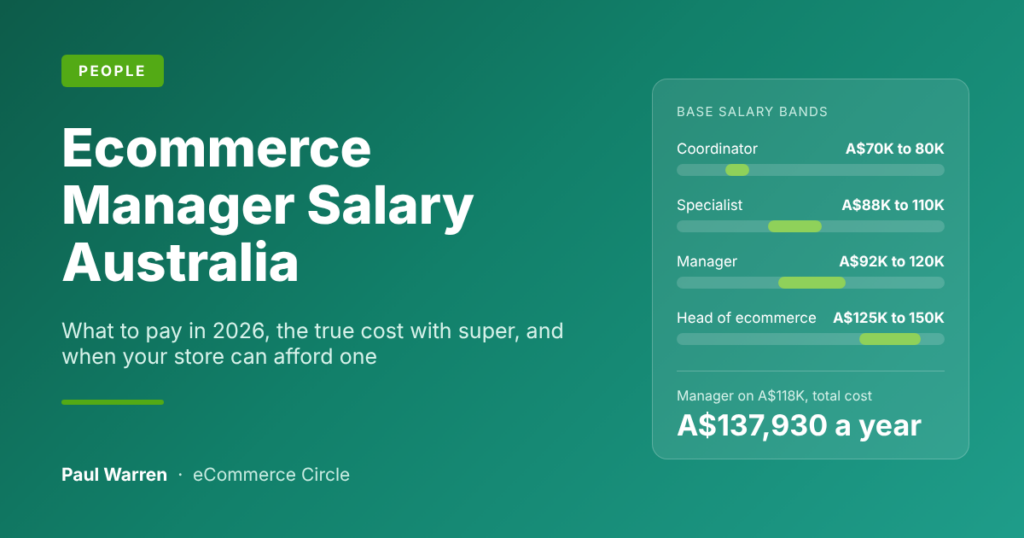
If you are weighing a broader role, the ecommerce manager salary guide runs the same sums for the person who would manage this hire.
Freelancers: Day Rates and Monthly Retainers
Good freelancers price by the day or by the month, not by the post. Expert360’s marketplace shows freelance social media managers in Australia charging A$450 to A$1,000 a day, with an average of about A$530, and monthly retainers from A$1,000 to more than A$8,000. Expert360 notes those rates are indicative and that each freelancer sets their own.
Sked Social, an Australian-made scheduling tool, publishes a pricing guide for social media freelancers. It puts 2026 hourly rates at 40 to more than 200 dollars and retainers at 500 to more than 5,000 dollars a month. Its examples include an 800 dollar package for eight posts a month and a 2,500 dollar retainer for an ecommerce brand. The guide does not name its currency, so treat those as a range, not a quote.
Here is what the day rate buys you. Four days a month at the A$530 average is A$2,120. That covers a monthly plan, one shoot day, a batch of edited posts and a report. It will not cover daily replies to comments and messages, so decide up front who owns the inbox.
Three checks before you sign a freelancer:
- Ask for a store like yours. Engagement on a café’s page proves nothing about selling skincare online. Ask for one product brand they have worked on and what happened to revenue from social.
- Agree the deliverables in writing. Posts, videos, stories, reply hours and reporting date, each with a number.
- Check how they are engaged. A contractor who works set days only for you can look a lot like an employee. Super can be payable to contractors paid mainly for their labour. Read contractor or employee first and confirm with your accountant.
Agencies: What a Package Buys
Agency pricing is the hardest to compare because most agencies do not publish it. The ones that do give you a useful anchor.
- The floor. Gold Coast agency iOnline says you should not expect social media management for less than A$1,000 a month from an Australian agency, and that full packages cost considerably more.
- A published package. Sydney agency Quantum lists a Basic package at A$2,450 plus GST a month for three posts a week, and a Standard package at A$5,370 for five posts a week with comment and message replies. There is a three-month minimum, and extra work is billed at A$199 plus GST an hour. With GST that is A$2,695 and A$5,907 a month.
- Paid social is a separate job. BFJ Digital puts paid social management at A$1,500 to A$8,000 a month, with ad spend on top. Rocket Agency says its paid social campaigns typically start at A$4,500 a month plus media.
That last point catches a lot of owners. A “social media” quote can mean organic posting, Meta ads management, or both. They are different skills with different price tags. Ask which one you are buying before you compare two quotes.
Do the per-post sum as well. Three posts a week is about 13 a month. At A$2,450 before GST, each post costs you about A$188. At A$199 an hour, the same budget buys about 12 hours of agency time a month. Neither number is wrong. You just need to know it before you judge the result.
If you are registered for GST you claim the GST back, so compare agencies on the ex-GST price and employees on the with-super price.
Offshore: The Cheapest Hours, With a Catch
Offshore is where the hourly price drops hardest. OnlineJobs.ph, the largest Filipino job board, publishes a salary guide from its own database. Full-time social media marketing roles pay US$500 to US$650 a month at entry level and US$700 to US$1,200 for experienced workers.
At US$1 to A$1.49, that is roughly A$745 to A$1,790 a month for full-time hours. Upwork lists social media managers at median rates of US$14 to US$35 an hour, or about A$21 to A$52.
The catch is the brief. An offshore specialist can schedule, resize, caption, reply to common questions and pull a weekly report. They cannot film your product, feel what your customer in Geelong finds funny, or decide what the brand should say this month. You still have to supply the raw footage and the plan.
The model that works for small stores is a split: you or a local freelancer set the monthly plan and shoot the content, and the offshore specialist does the editing, scheduling and replies. Our comparison of VA hiring platforms covers where to find them.
How Many Hours the Job Really Takes
Before you choose an option, size the job. Most brands post less than you think. The 2026 Rival IQ benchmark report, which samples 150 companies in each industry, found the median brand posts 3.7 times a week on Instagram, 3.0 times on Facebook and 2.0 videos a week on TikTok.
Replies matter as much as posts. In Sprout Social’s Q3 2026 survey of 2,250 consumers, 68% expected a brand to respond within 24 hours and 24% expected a reply within one to two hours. An Emplifi survey of more than 1,600 US and UK consumers found 57% had contacted a brand through its social account for customer service.
Here is a working estimate for a small store running 16 feed posts and 8 short videos a month. The time per task is our own allowance, so swap in your numbers.
| Task | Volume | Hours a month |
|---|---|---|
| Feed posts and carousels | 16 at 45 minutes | 12 |
| Short videos | 8 at 2 hours | 16 |
| Comments and messages | 30 minutes a day | 15 |
| Monthly content plan | 1 session | 3 |
| Monthly report | 1 report | 2 |
| Total | 48 |
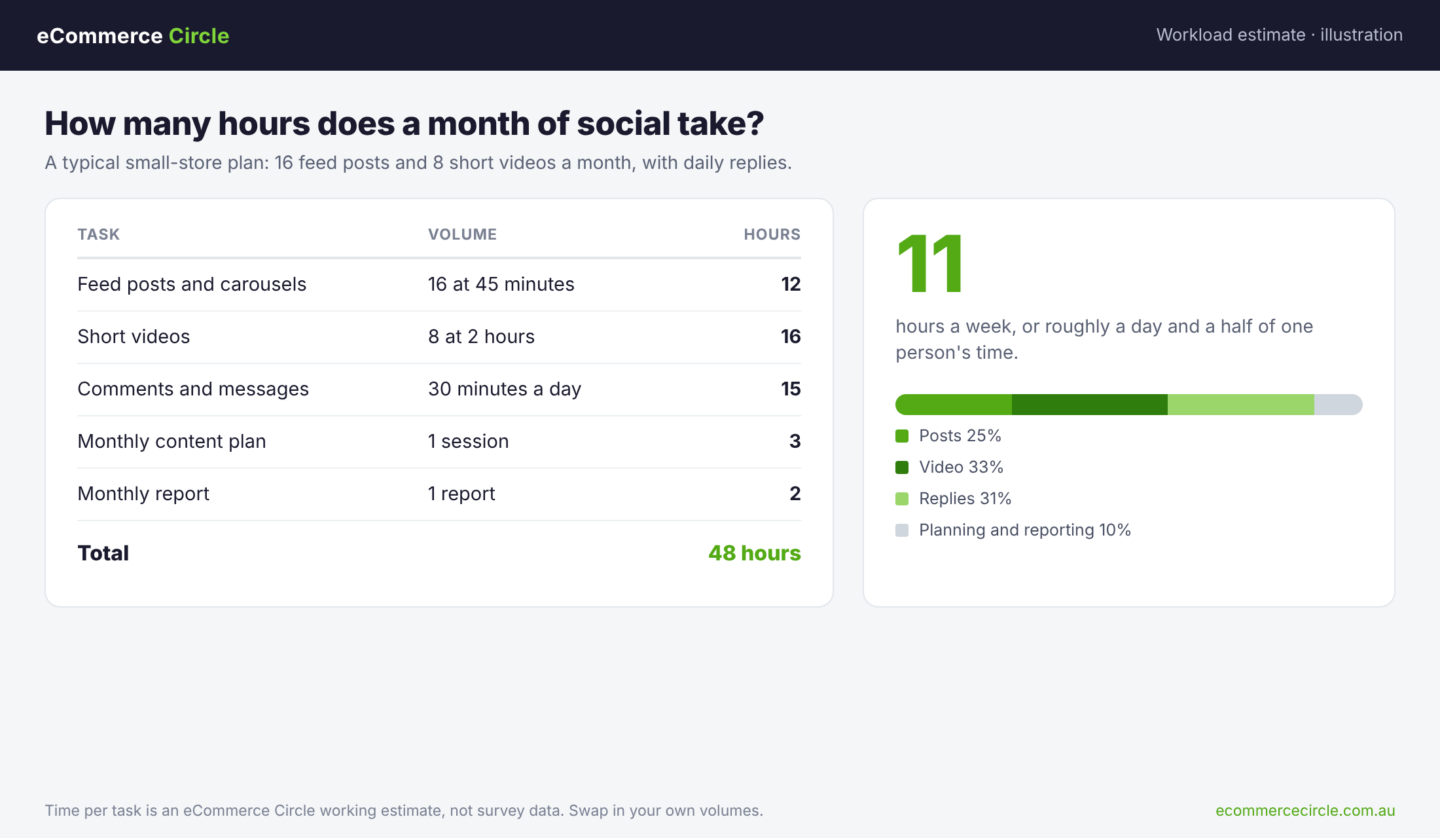
Forty-eight hours a month is about 11 hours a week. That is not a full-time job. It is a day and a half.
Now price it against each option:
- In-house at A$61 an hour: 48 hours costs about A$2,930 a month. A full-time manager gives you 146 hours a month, so you need three times this workload to fill the role.
- Freelancer at A$530 a day: 48 hours is six days, or A$3,180.
- Agency at A$199 an hour: 48 hours would be A$9,552, which is why agency packages are built around fewer posts and lighter replies.
- Offshore: a full-time specialist covers all 48 hours with time to spare, as long as someone local feeds them footage.
Is It Worth Paying For? Run the Numbers First
The audience is there. DataReportal’s Digital 2026 report counts 21.0 million social media user identities in Australia, equal to 77.7% of the population. Ads on Facebook reach 17.7 million people here and Instagram 15.2 million.
Australians shop with it too. We Are Social’s summary of the same research says six in ten Australians use social platforms to research brands, close to the share who use search engines.
Organic reach is the problem. Rival IQ’s median Instagram engagement rate fell from 0.36% to 0.30% per post in the 2026 report. TikTok sits at 2.01%. On an Instagram account with 10,000 followers, 0.30% is 30 likes, comments and saves a post.
So do the break-even before you hire. Take a store doing A$50,000 a month at a 55% gross margin with a A$90 average order (an illustration, not a benchmark):
- A freelancer on four days a month costs A$2,120.
- Divide by the gross margin: A$2,120 ÷ 0.55 = A$3,855 in extra sales needed each month just to cover the fee.
- Divide by the average order: about 43 extra orders a month.
- As a share of revenue, that is 7.7% growth from social before you make a dollar.
Forty-three orders a month from organic posts alone is a big ask for most stores. It gets realistic when the same person’s work also feeds your ads with fresh creative, answers pre-sale questions in the DMs and gives your emails better content. Hire for all four jobs and measure all four.
As a rule of thumb we use with members, stage the spend to your revenue:
| Monthly revenue | Sensible option | Budget |
|---|---|---|
| Under A$20,000 | Do it yourself with a free scheduler | 3 to 4 hours a week of your time |
| A$20,000 to A$60,000 | Offshore specialist or a freelancer for 2 days a month | A$750 to A$1,100 |
| A$60,000 to A$200,000 | Freelancer retainer, agency package or a part-time coordinator | A$2,000 to A$4,500 |
| Over A$200,000 | In-house coordinator or manager, with specialists for ads | A$7,000 and up |
Those bands are our judgement, not survey data. If the option you want costs more than about 5% of monthly revenue, wait or go a tier down. The People section of the More Orders Scorecard checks whether your team spend matches your stage.
How Two Aussie Brands Staff Social
Kulani Kinis. The Australian swimwear brand started with organic sales and gifted product. In a SmartCompany partner feature from April 2024, founder Alex Babich described a team split in two: a brand content side that makes the material and a marketing side that publishes and promotes it. He said TikTok was “where our customer base was”, and that after the site was tuned for TikTok traffic, sales rose 91% and traffic 160% that year. Those are the company’s own figures.
The lesson for a small store is the split, not the headcount. Making content and distributing it are two jobs. One person can do both at your size, but brief and measure them separately.
Princess Polly. The Gold Coast-founded fashion brand shows where this ends up. Inside Retail reported in March 2025 that global performance director Kim Zorn grew the performance team from one person to 19 over eight years, and from four major channels to more than 25. She called the US TikTok Shop launch the most impactful project of the year.
Nobody starts with 19 people. They start with one person on four channels and add a role each time a channel pays for it. That is the order to copy.
Do It Yourself First: Free Scheduling in Meta Business Suite
If you are under A$20,000 a month, do not hire yet. Batch the work into one session a week and schedule it. Meta Business Suite is free and covers Facebook and Instagram.
Setup, following Hootsuite’s October 2026 walkthrough:
- Open your Facebook Page and click Meta Business Suite in the left menu. On a phone, install the Meta Business Suite app.
- Check your Instagram account is connected under Settings, so one post can go to both.
- Click Create post and choose Facebook, Instagram or both.
- Add your photo or video and write the caption. The preview shows on the right.
- In the Schedule section, switch on Set date and time. Click Active times to see when your followers are usually online.
- Click Schedule. The post now sits in your Planner, where you can drag it to another day.
You can schedule from 20 minutes to 29 days ahead, so one two-hour session can load a fortnight of posts.
When you add TikTok, Pinterest or a second person, move to a paid scheduler. Buffer has a free plan for three channels with ten scheduled posts on each, and paid plans from 5 dollars a channel a month (Buffer shows no currency code, so read that as US dollars). Sked Social starts at about US$58 a month on annual billing for three users and six profiles, with a 14-day trial. Confirm both at checkout.
The habit matters more than the tool. Once you have run this weekly session for two months, you have a brief you can hand to anyone on the rate card above.
The Hiring Checklist: 9 Questions Before You Sign
Copy this into the brief and get every answer in writing.
- Scope. Organic posting, paid ads management, or both?
- Volume. How many feed posts, videos and stories a month, on which platforms?
- Raw content. Who shoots it, how often, and who pays for product and props?
- Inbox. Who replies to comments and messages, within how many hours, on which days?
- Approval. How many rounds of changes, and how many days ahead do you see the posts?
- Ownership. Do you own the files, the logins and the scheduled content if you part ways?
- Reporting. Which numbers arrive each month? Ask for revenue and orders from social, not just reach.
- Term. Minimum term, notice period and what happens to unused hours.
- Price. Ex-GST fee, what counts as extra, and the hourly rate for extras.
If a provider cannot answer question 7, keep looking. Followers do not pay your suppliers.
How the Pieces Fit Together
Each part of this guide feeds the next. The hours estimate tells you how big the job is. The rate card tells you who can cover those hours for the least money. The break-even tells you how many orders that person has to bring in. The checklist turns all three into a brief.
Run them in that order and the hire looks after itself. A store at A$40,000 a month ends up with an offshore specialist and a founder who films once a fortnight. A store at A$150,000 ends up with a part-time coordinator and a freelancer for shoot days. Neither one is paying A$5,000 a month for posts nobody can tie to a sale.
Skip a step and you get the usual result: a retainer that started as “let’s try it for three months” and is still running two years later.
Social Media Manager Cost FAQ
How much does a social media manager cost per month in Australia?
Between about A$745 and A$8,867 a month in 2026. Offshore specialists cost A$745 to A$1,790, local freelancers and agencies A$1,000 to A$6,000 for most small-store scopes, and a full-time in-house manager about A$8,867 a month with super.
How much do freelance social media managers charge per hour?
Expert360 lists Australian freelancers at A$450 to A$1,000 a day, which is roughly A$60 to A$130 an hour over a 7.6-hour day. Upwork’s median rates, which include overseas freelancers, are US$14 to US$35 an hour.
Is it cheaper to hire in-house or use an agency?
For a workload under about 50 hours a month, a freelancer, a small agency package or a part-time coordinator is cheaper. A full-time manager at about A$106,400 a year only makes sense when you can fill around 146 hours a month.
Do I pay GST and super on a social media manager?
Agencies and GST-registered freelancers add 10% GST, which you claim back if you are registered. Employees are paid 12% super on top of salary, and super can also apply to some contractors. This is general information, not tax or employment advice, so check your situation with your accountant.
Where to Start
Price the hours, pick the cheapest option that can cover them well, and attach an order target to the fee. That is the whole method.
Inside eCommerce Circle, People is one of the 10 P’s we work on with every member, because the wrong hire at the wrong stage is one of the fastest ways to burn cash. If you want to see exactly where your store is being capped, take the free More Orders Scorecard. It takes two minutes and shows you which of the 10 P’s to fix first.