Most Aussie Shopify founders are sitting on the highest-converting channel in their stack and barely using it. They run Klaviyo for email, send a campaign every Tuesday, panic about deliverability twice a quarter, and treat the SMS toggle in Klaviyo like an optional extra. Then they wonder why their repeat purchase rate has been stuck at 27% for nine months.
What’s in This Article
Here is the uncomfortable truth. SMS open rates are running near 95% in 2026. Email is sitting at 35 to 40% on a good day. Yet for most brands doing under $300k a month, SMS makes up less than 5% of their owned channel revenue. That is not a discipline problem. That is a setup problem.
This is the playbook we walk through with every member inside eCommerce Circle when SMS is the next 15 to 25% revenue lift hiding in their store. Six stages, real Aussie compliance rules, and the five flows that drive almost half of all SMS revenue for brands that do this right.
Stage 1: Build a List That Actually Belongs to You
The opt-in is where 80% of brands lose. They bolt SMS onto their existing email pop-up as a second checkbox, get a 2% conversion lift, and call it done. Then they wonder why their SMS list is one tenth the size of their email list two years later.
Mature DTC brands run their SMS list at 40% or more of their email list size. That is not a vanity ratio. It is the reason their owned-channel revenue keeps compounding while everyone else is hostage to Meta.
Three list-building patterns we use that work in 2026:
- Two-step welcome flow with an SMS-only gate. Email pop-up first, then a second screen offering a bigger discount or early access if they drop their mobile. The reader has already said yes once. The second yes is much easier to get.
- SMS-first offer at the cart. A small banner above the checkout button, text JOIN to a short code for free shipping over $80. This catches high-intent traffic that ignores pop-ups.
- Post-purchase SMS opt-in on the thank you page. Buyers who just paid you are 5 to 7 times more likely to opt in than cold visitors. Most brands forget this real estate exists.
Pair this with a tight cart drawer experience and the math works fast. Inside our cart drawer framework, the SMS opt-in lives between the upsell tile and the checkout button. List growth accelerates without hurting AOV.
Stage 2: The Spam Act 2003 Rules Most Brands Get Wrong
This is the part that scares founders out of SMS for the wrong reason. The rules are clear, they are not onerous, and the fines are real. ACMA can hit a single breach with fines up to $220,000, and repeat offenders up to $2.1 million. Worth getting right.
Three things every Aussie SMS programme must include:
- Express consent at opt-in. A pre-checked tick box does not count. The reader must knowingly agree to receive marketing SMS from your brand by name, not just from “our partners”. Capture the timestamp, source, and IP. Klaviyo does this automatically if you use their SMS sign-up form.
- Sender identification on every send. Your legal entity name plus your ABN, or a link to a page on your store with that info. “Reply STOP to opt out” is not enough on its own.
- A working unsubscribe inside 5 business days. Reply STOP must remove the subscriber. If you ignore this, ACMA will hear about it within weeks.
Inferred consent is real. If a customer bought from you in the last two years and gave you their mobile to track shipping, the Act lets you message them about products related to that purchase. Stretch it past that and you are exposed.
Klaviyo’s Australia compliance settings do most of this for you. The brands that get fined are the ones running cold lists they bought from a “lead vendor” or scraping competitor websites. Do neither.
Stage 3: The Five SMS Flows That Drive 45% of SMS Revenue
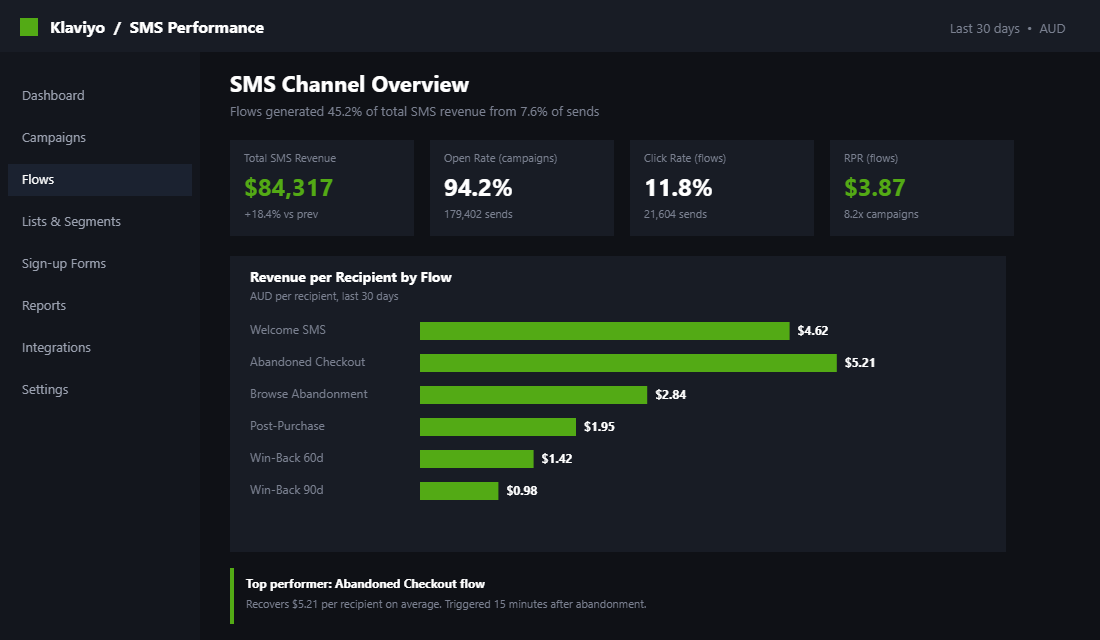
Here is the single most important number in this article. SMS flows account for just 7.6% of total SMS sends, but drive 45.2% of total SMS revenue. Flows generate roughly 8 times the revenue per recipient that campaigns do. If you only do one thing from this article, build the flows first.
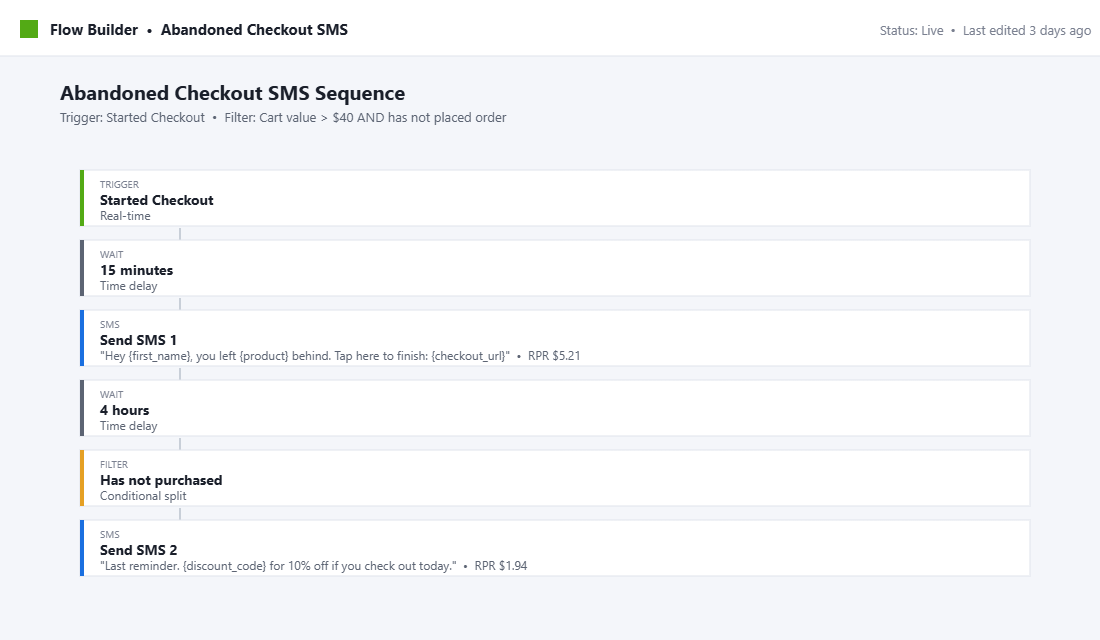
The five flows that move the needle, in priority order:
- SMS Welcome (Send 1). Triggers immediately after the SMS opt-in. Delivers the discount code with a short, conversational greeting. Click rates on this single message regularly hit 18 to 25%.
- Abandoned Checkout SMS (Send 1, 15 minutes). Fires 15 minutes after checkout abandonment, while purchase intent is still hot. SMS abandoned cart messages convert at 15 to 20%, compared with 10.7% for email. Recovered revenue runs around $5.60 per message sent for brands that get the timing right.
- Browse Abandonment SMS (24-hour delay, segmented). Only fires for subscribers who viewed a product 3 or more times in 14 days. Tight segmentation keeps the unsubscribe rate low and the relevance high.
- Post-Purchase Thank You + Shipping Update. A short, branded message at order confirmation, then a shipping update with the tracking link. This double-touch builds trust and lifts the post-purchase opt-in rate for downstream marketing SMS.
- Win-Back SMS (60-day, 90-day, 180-day). Three timed messages aimed at lapsed buyers. Pair the SMS with the email of the same name from your existing flow. SMS pulls the inbox-fatigued ones back.
If your store is doing $80k a month or more, these five flows alone will typically add 8 to 12% to your top line inside 60 days, before you send a single campaign.
Stage 4: SMS Campaigns. When, What, and Who NOT to Send
Campaigns are the supporting cast. Send 4 to 8 per month, never more than 2 in a week, and never to your full list. The SMS unsubscribe rate is 5 to 10 times higher than email when you over-send. Treat the channel like a scarce resource and it stays one.
A working monthly cadence for an Aussie brand:
- Week 1: A new collection or restock alert to engaged buyers in the last 90 days. Excludes anyone who bought in the last 14 days.
- Week 2: A high-conversion offer (free shipping, gift with purchase, sample) to subscribers who clicked an email in the last 30 days but did not buy.
- Week 3: A “soft” content message with a link to a useful piece (sizing guide, founder story, behind the scenes). No pitch. This is the trust deposit before the next ask.
- Week 4: A scarcity or seasonal offer to your engaged 90-day segment. Always with an end date, always with a reason.
Tie SMS into your broader segmentation strategy. The segments that earn the most revenue per send are the same ones we cover in the Klaviyo segmentation playbook. When SMS layers on top of those segments, performance compounds.
Stage 5: Segmentation. Never Send to Everyone
The brands burning out their SMS list are the ones blasting every send to their full audience. Six segments to set up day one in Klaviyo:
- Engaged 30-day: clicked or opened a message in the last 30 days. Your highest-RPR audience.
- Engaged 90-day: clicked or purchased in 90 days. The fallback for bigger sends.
- VIP buyers: ordered 3 or more times. Earlier access, smaller discount, more product.
- Lapsed 60+: no activity in 60 days. Win-back content only.
- Recent buyers (last 14 days): suppress from sales SMS, send shipping and post-purchase content only.
- High AOV: suppress from low-margin discount campaigns. Send curated, full-price launches instead.
If you have already built RFM segments in Klaviyo, use the same scoring layer for SMS. Recency and frequency matter more for SMS than for email because the channel is intrusive. Earn the right to be in the inbox.
Stage 6: The Numbers That Tell You It Is Working
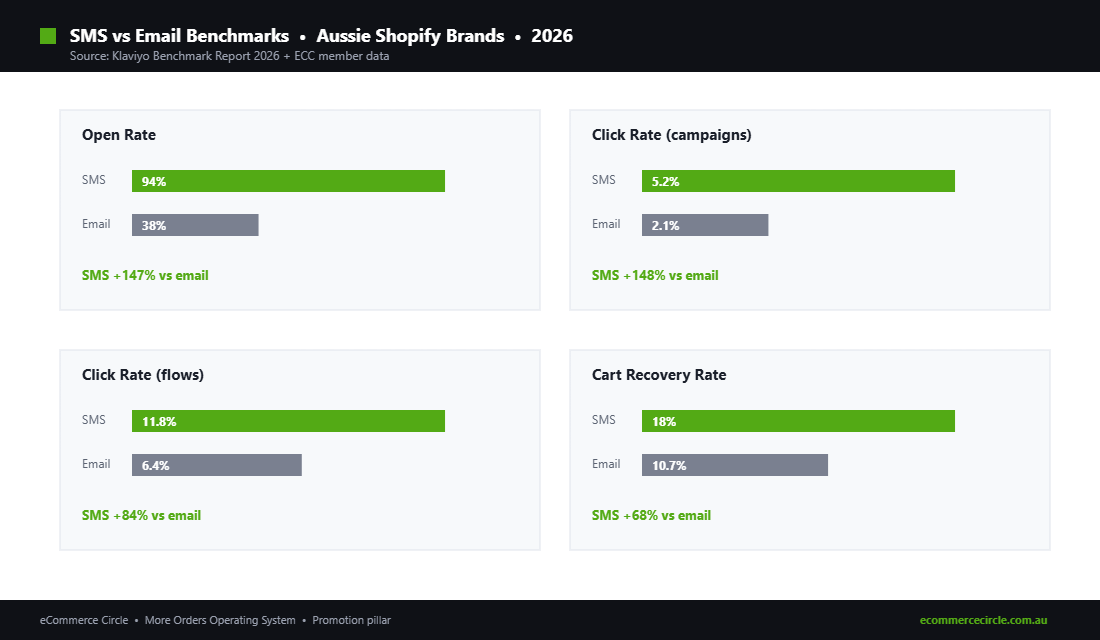
You do not need a Triple Whale dashboard to read SMS performance. Five numbers, checked every Monday morning:
- Open rate: 90% or higher. If it is below 80%, your shortcode setup is broken or your list is stale.
- Click rate (campaigns): 4 to 6%. Top performers hit 8 to 10%.
- Click rate (flows): 8 to 12%. Top 10% of flows exceed 16%.
- Revenue per recipient (RPR): $0.50 to $1.50 for campaigns, $2 to $5 for flows. The top decile of flows runs above $5 RPR.
- Unsubscribe rate per send: under 1%. Above 2% means you are sending too often or to the wrong segment.
A real benchmark to anchor on. Frances Valentine, a US fashion brand, reported a 21.8x ROI from Klaviyo SMS in just 8 weeks after consolidating email and SMS in one platform. The lift came almost entirely from flows, not campaigns. Same playbook works for Aussie brands at the $1m to $5m range.
The Compound Effect
SMS done well is not a separate channel. It is a force multiplier on every other owned channel you run. The opt-in lifts your email list quality (mobile-verified subscribers click 30% more in email too). The flows recover revenue your email sequence misses by hours. The campaign cadence keeps your list warm so when you do run a launch, the deliverability advantage shows up in your Klaviyo email metrics as well.
The brands compounding this right have the same pattern. SMS list at 40% of email list. Five core flows running. Four to eight campaigns a month, segmented. A weekly Monday check-in on the five numbers above. Inside 90 days, that adds 15 to 25% to total email and SMS revenue, with margins that look better than any paid acquisition channel you have ever tested.
You do not need a new agency for this. You need a tight setup and a discipline to actually use the channel. Most founders skip the discipline and wonder why their numbers look like everyone else’s.
SMS Benchmarks Aussie Shopify Stores Should Actually Hit
If you do not know what good SMS performance looks like, you cannot tell whether your program is fixed or just running. Here are the numbers a well-run Klaviyo SMS program should hit in 2026, drawn from the operator data we see across eCommerce Circle members and Klaviyo’s own benchmarks for AU stores.
Browse Abandonment SMS: click rate 7 to 12 percent, conversion rate 3 to 6 percent, revenue per recipient 35 to 70 cents. Cart Abandonment SMS: click rate 12 to 22 percent, conversion rate 8 to 15 percent, revenue per recipient $1.20 to $3.50 — far above the $0.80 to $2.00 you see on email-only flows. Welcome SMS: click rate 18 to 30 percent in the first message, conversion rate 5 to 10 percent across the sequence. Post-purchase SMS for review or upsell: click rate 6 to 10 percent, lifts repeat purchase rate by 4 to 8 percent over the next 60 days.
The KPIs to watch weekly: opt-out rate (keep under 3 percent per send), spam complaint rate (under 0.1 percent — Twilio and Klaviyo will throttle you above that), and revenue per active subscriber per month (aim for $4 to $8 once the program is mature). If your opt-outs are spiking above 3 percent, the issue is almost always cadence or relevance, not the channel.
The Tool Stack Most Aussie Stores Need (and What to Skip)
You do not need a separate SMS platform on top of Klaviyo. Klaviyo’s native SMS is now mature enough to run cart, browse, welcome, and broadcast SMS in one place — which dramatically reduces attribution headaches. Pair it with these tools to cover the full stack: Justuno or Privy for SMS opt-in pop-ups (aim for 4 to 8 percent capture rate on cold traffic), Triple Whale or Lifetimely for cross-channel attribution so SMS gets the credit it deserves rather than the click giving credit to last-touch ads, and Hotjar to watch what subscribers actually do post-click.
Things to skip: standalone SMS platforms that do not integrate cleanly with your email automation (you will end up double-messaging the same customer); generic mass-send tools that cannot do behavioural triggers; and any tool that promises “AI-powered SMS” without showing you the prompts or the segmentation logic underneath. For more on building the right tech foundation, read our take on the Platform pillar and how it interacts with the Performance discipline in the More Orders Operating System.
Inside eCommerce Circle, SMS is one of the first revenue levers we audit when a member is hitting an email plateau. If you want a second opinion on yours, let’s talk.