If your Shopify store does $40K a month, you are watching roughly $93K walk out the door every single month before they hit “complete order”. That is what 70.22% cart abandonment actually costs an Aussie DTC brand at scale. The number sounds abstract until you do the maths on your own funnel, and then it becomes the single biggest line item you are not getting paid for.
What’s in This Article
Here is the problem. Most Aussie founders we work with have an abandoned cart email turned on inside Shopify or Klaviyo, and they assume the job is done.
One email. Maybe a 10% discount slapped on it. Sent four hours after the cart was abandoned. Recovery rate sitting at 2 to 4%. They think email is “working”.
That is not abandoned cart recovery. That is leaving 80% of the recoverable revenue on the table. The brands that recover 15 to 25% of lost carts (and yes, that is achievable) are running a layered system.
Browse abandonment, abandoned cart, abandoned checkout, SMS, segmentation. Seven touchpoints, not one. This article is the architecture map.
The $93K Problem: Why “Just Turn On Abandoned Cart” Loses You Money
Baymard Institute tracks 50 separate cart abandonment studies. The blended average has been remarkably stable: 70.22% of carts are abandoned, and that figure has only moved 0.65 percentage points in five years.
On mobile, where most of your Aussie traffic now lives, abandonment hits 80.02%. Desktop sits at 66.41%. If you sell on Instagram, TikTok, or any social channel, you are running closer to the mobile number than the desktop one.
The leading cause has not changed in six years either. 48% of shoppers cite “unexpected extra costs at checkout” (shipping, taxes, fees) as the reason they bail. Another 25% are just browsing or comparing. The point is, the cart abandonment problem is half a checkout architecture problem and half an email and SMS recovery problem. Fix one without the other, and you cap your recovery at single digits.
The Baymard estimate of recoverable revenue across US and EU stores sits at $260 billion. We have run the same maths on Aussie Shopify stores doing $1M+ a year and the recoverable line item is consistently $80K to $250K. That is the prize. Most stores capture less than 15% of it.
The Five-Layer Recovery Architecture
Before we get into individual emails, you need to see the system. There are five recovery layers, and they fire at different points in a shopper’s journey. Most stores run one of them (the middle one). The brands hitting 20%+ recovery run all five.
- Layer 1: Browse Abandonment. Shopper viewed a product page (or three) but never added to cart. Fires 4 to 24 hours later.
- Layer 2: Added to Cart. Shopper clicked “add to cart” but never started checkout. Fires 1 hour after, then 24 hours.
- Layer 3: Started Checkout. Shopper entered an email at checkout but did not pay. Fires 1 hour, 24 hours, 72 hours.
- Layer 4: SMS Companion. Mirror flow on SMS for subscribers, fires 30 to 60 minutes after abandonment.
- Layer 5: Paid Retargeting. Meta and Google ads to anyone who hit a product page but did not buy. Fires inside 48 hours.
Each layer catches a different segment of dropouts. A shopper who never made it to “add to cart” never enters your Layer 2 flow. A shopper without an email address never enters Layer 2 or Layer 3. The layered system is the only way to actually catch the majority of your lost revenue.
Layer 1: Browse Abandonment (The Layer Aussie Brands Skip)
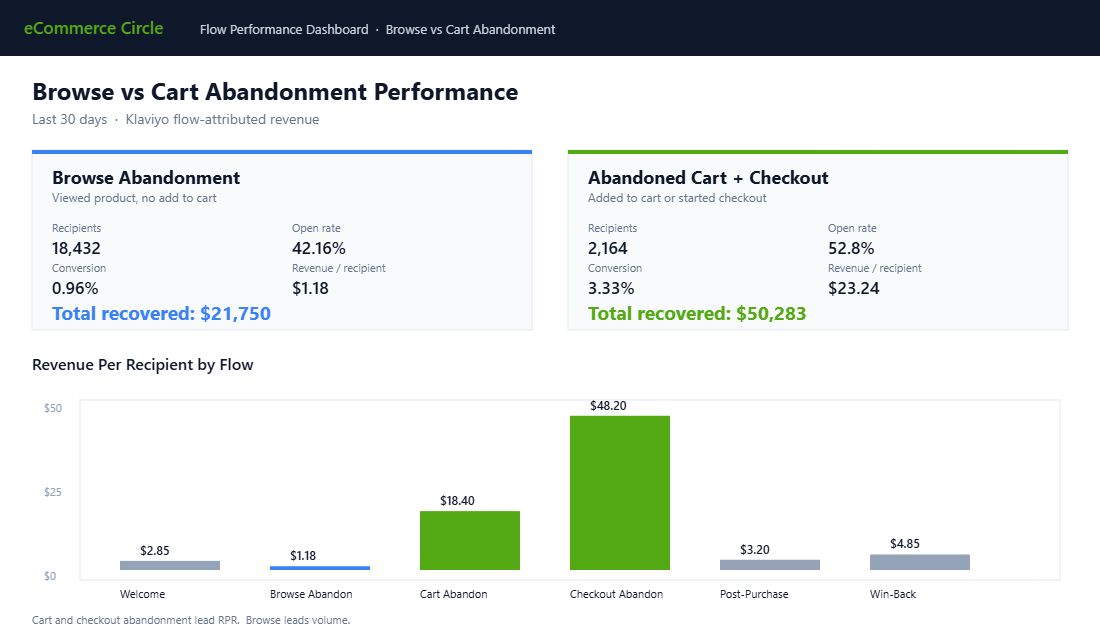
Browse abandonment is the highest-volume, lowest-converting layer. The benchmark conversion rate sits around 0.59 to 0.96%. The open rate is solid at 42.16%. So why bother? Because the volume is 5 to 10x your cart abandonment volume.
If 100 people add to cart, roughly 700 to 1,000 viewed a product page without adding. The aggregate revenue from browse abandonment often matches or beats cart abandonment for mid-size Shopify stores.
The trigger is “Viewed Product” in Klaviyo (with a filter for “has not started checkout” and “has not placed order”). You need an identified email address to fire it, which is why your popup and your account flow matter. If your welcome flow is doing its job, you have email coverage on 25 to 40% of your traffic, and that is who Layer 1 hits.
The browse abandonment email is not a hard sell. It is a curiosity tap. “Still thinking about [Product Name]?” with the product image, three reasons people choose this product (social proof, not features), and a soft CTA back to the PDP. No discount. Discounts in browse abandonment train shoppers to abandon for the discount.
Layer 2 and 3: The 7-Email Cart Recovery Architecture
This is the heart of the system. Layer 2 (Added to Cart) and Layer 3 (Started Checkout) are different flows in Klaviyo, but they share the same architecture and almost identical timing.
The reason you split them: a “Started Checkout” shopper is roughly 3x more likely to convert than an “Added to Cart” shopper, so the messaging is different. Started Checkout is closer to buying. Added to Cart is closer to browsing.
Here is the seven-email architecture across both flows, with timing and the angle each email needs to play.
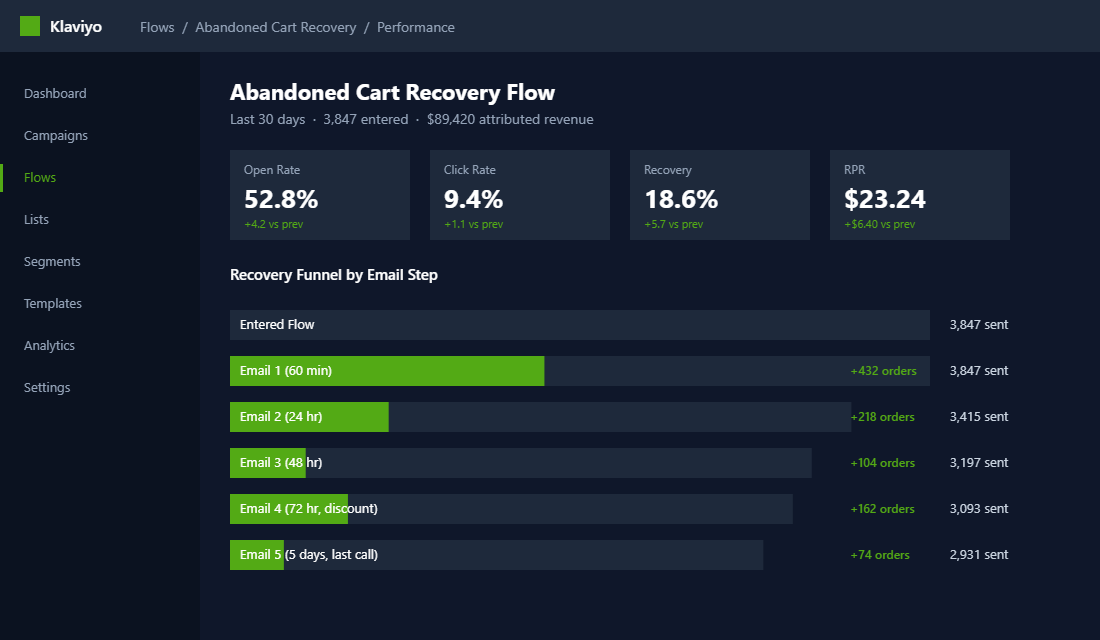
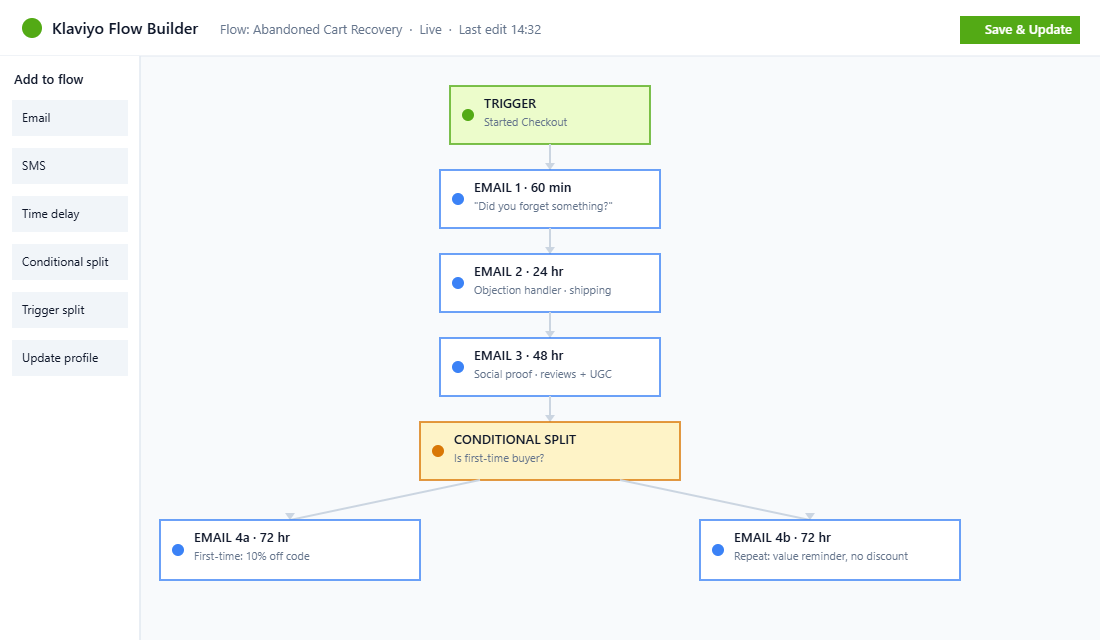
- Email 1 (60 minutes after abandonment): The Reminder. No discount. Subject line is “Did you forget something?” or “Your [Product] is waiting”. Single CTA back to cart. Klaviyo data shows sending inside 60 minutes lifts recovery to around 15%.
- Email 2 (24 hours): The Objection Handler. No discount yet. Address the top reason people abandon: shipping cost, returns policy, sizing, payment options. Pick the one objection your data flags as biggest.
- Email 3 (48 hours): The Social Proof. Reviews, UGC, ratings, a 30-second video of the product in use. Still no discount. You are stacking credibility.
- Email 4 (72 hours): The Soft Discount. Now you offer 10% off, free shipping, or a small bonus. Time-bound (24 hours). Only fire to first-time buyers or shoppers without a discount in their session.
- Email 5 (5 days): The Last Call. “Cart expires tomorrow” or “We saved your [Product] for one more day”. Single CTA. Same incentive as Email 4 or slightly stronger.
- Email 6 (Started Checkout only, 30 minutes): The Help Email. Plain text, founder voice. “Hi, I noticed you got to checkout and something stopped you. Was it shipping, payment, sizing? Hit reply.” Highest response rate of any email in the flow.
- Email 7 (Started Checkout only, 7 days): The Alternative. “Here are three other [products] in your size/range/colour” with internal links. Some shoppers abandon because they want a different option. Give them one.
Klaviyo benchmark data on three-email sequences is brutal in one direction. A three-email flow generates $24.9M in tracked recovery revenue versus $3.8M from single emails. That is a 6.5x lift just from sending more emails.
The reason most founders run one email is they are scared of “annoying” the subscriber. The data says abandoners want to be reminded, they just want the reminder to be useful. That is what the objection and social proof emails do.
Layer 4: The SMS Companion (Where the Real Money Lives)
Here is the stat that matters. SMS has a 98% open rate against email at 20 to 25%, and 90% of texts are read within 3 minutes of receipt. Now look at what happens when you stack SMS on top of email for cart recovery: the combination recovers 15 to 25% of abandoned carts, which is 2 to 3x the recovery of either channel alone. SMS adds an incremental 8 to 15% on top of what email already captures, because it reaches the shoppers who ignore email.
The SMS companion flow is not a copy of your email flow. It is shorter, sharper, and runs on different timing. Two texts maximum.
- SMS 1 (30 to 60 minutes after abandonment): “Hey [First Name], your cart at [Brand] is still waiting. Tap here to finish: [short link]. Reply STOP to opt out.”
- SMS 2 (24 hours, only if no purchase): “[First Name], 10% off your cart for the next 4 hours: code SAVE10. [short link]. Reply STOP to opt out.”
The 30 to 60 minute window matters. Send too soon and it feels invasive (one study found texts inside 30 minutes actually reduce conversion). Send too late and they have moved on. You can build this directly inside Klaviyo (SMS module) or pair Klaviyo Email with a dedicated SMS tool like Attentive or Postscript.
Our coverage of the full Shopify SMS playbook walks through the compliance and consent piece in detail.
One more thing on SMS. Aussie consumer law is tighter on SMS marketing than email. You need express consent (a tick box that defaults to unticked), a clear opt-out in every message, and an identifiable sender. Treat SMS consent as a separate field on your popup, not the same one as email.
Layer 5: Segmentation (The Discount Gate That Saves Your Margin)
The single biggest mistake in cart recovery is firing a 10% discount at every abandoner. You bleed margin on shoppers who would have bought anyway and you train your repeat buyers to abandon their cart for a code. The fix is a segmentation layer that controls who sees a discount and who does not.
Build these four segments inside Klaviyo and use them as conditional splits inside your cart flow. (If you have not built your segments yet, our 7-segment Klaviyo playbook is the prerequisite.)
- First-time buyer (no order history): Gets the discount at Email 4 if not converted by then. They need the push.
- Repeat buyer (1 to 4 orders): No discount. The reminder, objection handler, and social proof emails are enough. Protect your margin.
- VIP (5+ orders or top 10% LTV): No discount. A founder-voice plain text email at Email 4 instead, offering personal help. VIPs respond to attention, not coupons.
- Already has a discount in session: Skip the discount track entirely. They are abandoning for a different reason and you have already given them money.
The conditional split is the single biggest profit move you can make on a generic abandoned cart flow. We have seen contribution margin lift 4 to 7 points on recovered revenue from this one change. The recovery rate stays the same. The profit per recovered order goes up.
The Deliverability Layer: Why Recovery Flows Hit Spam First
Seven emails and two texts is a lot of volume aimed at people who have never bought from you. Gmail and Outlook treat exactly that profile as your highest-risk sending, which is why your cart flow is the first thing they throttle.
When placement slips, the revenue drop looks like a copy problem. It is not. A cart email sitting in the spam folder recovers zero dollars no matter how good your subject line is.
Check three numbers every Monday inside Klaviyo or Omnisend. A flow open rate under 35%, a spam complaint rate above 0.08%, or a bounce rate above 1% all mean a placement problem is building. Google Postmaster Tools shows you the domain reputation underneath those numbers.
Gmail starts actively penalising senders at 0.30% complaints. Treat 0.10% as your hard ceiling and you will never get near the cliff.
- Authenticate before you scale volume. SPF, DKIM and a DMARC record are non-negotiable now. Without all three, high-frequency flows to cold profiles get filtered inside weeks.
- Send flows from a subdomain. Run campaigns and flows from something like mail.yourbrand.com.au so a bad promo send does not poison your root domain reputation.
- Set a sunset rule. Any profile with no email open in 120 days and no order in 180 days comes off campaign sends. Keep them eligible for cart flows for another 60 days, because live cart intent overrides a stale engagement score.
- Suppress the dead weight, do not delete it. Suppressed profiles stay available for a win-back sequence later, and they stop dragging your inbox rate down today.
- Render test in Litmus. Apple Mail and Gmail apps account for the bulk of Aussie opens. A cart email that breaks on iOS dark mode kills your click rate before deliverability even matters.
One warning on the SMS side. Postscript and Attentive both let you push hard on frequency, and carrier filtering in Australia is far less forgiving than email. Two texts per abandonment event is the ceiling, and never before 9am or after 8pm in the recipient’s own state.
The Tech Stack: What Actually Sits Behind This
You do not need a complicated stack. You need three things wired correctly.
- Klaviyo (or Mailchimp/Omnisend if you are early stage). Klaviyo is the Aussie DTC standard for a reason. The Shopify integration is deeper, the segmentation engine is the strongest in the category, and the SMS module means you can run Layers 2 to 4 in one tool. Pricing starts around $45 AUD/month for 500 contacts and scales with list size.
- Shopify’s native abandoned checkout (turn it off). Once Klaviyo is live, switch off Shopify’s built-in abandoned checkout email. Otherwise you double-fire and confuse attribution. Settings > Checkout > Abandoned checkout emails > Untick “Automatically send abandoned checkout emails”.
- A reliable identification source. Klaviyo cookies only fire when you have an identified email. Your popup, your checkout pre-fill, your account creation, and your “Subscribe and save 10%” widget all feed this. If your identification coverage is below 25% of traffic, your cart flows are firing on 25% of the potential audience. Fix identification before you tune timing.
Setup time for the full architecture (Layers 1 to 4): about 12 to 15 hours of focused work for someone who knows Klaviyo. If you are doing it yourself, budget 25 hours over a fortnight. Or have a Klaviyo specialist build it in a single sprint and you hand them brand guidelines and a product catalogue.
Getting Consent Right Under the Spam Act 2003
Cart recovery is the flow most likely to get an Aussie store in trouble with ACMA, because you are emailing addresses that were typed into a checkout field, not a subscribe box. Those are two different things legally.
The Spam Act 2003 gives you two paths. Express consent is a person actively ticking a box or entering an email into something clearly labelled as marketing. Inferred consent comes from an existing business relationship, which usually means they have actually bought from you.
A shopper who abandoned checkout has not bought anything. Your inferred consent argument on that address is thin, so build express consent into the moment of capture instead.
- Turn on the Shopify checkout marketing opt-in and make the label specific. “Email me about my order and offers from [Brand]” beats a vague newsletter tick.
- Capture email at the popup, not the checkout. A properly built popup gives you unambiguous express consent before the shopper ever reaches the cart. Our 6-trigger popup architecture covers how to capture at 6 to 9% of traffic without wrecking the on-site experience.
- Identify yourself in every message. Trading name, ABN and a real physical address in the footer. Not a PO box, not just a support email.
- Honour unsubscribes inside 5 working days and keep the link live for at least 30 days. Klaviyo does this automatically, a custom Shopify Flow email may not.
- Keep SMS consent as its own field. Email consent is not SMS consent, and the penalties are per message, not per campaign.
Store the consent record. Klaviyo timestamps the source of every subscription, and that timestamp is your evidence if a complaint ever lands.
The Compound Effect: What 12 Months of This Looks Like
Here is the maths on a store doing $80K AUD/month in revenue with a 2% conversion rate (so 4,000 visitors a month convert into 80 orders at $1,000 AOV, hypothetically).
- Carts abandoned per month: roughly 187 (70% of the 267 that started checkout).
- Single-email recovery (the default): 4% recovery = 7 orders = $7,500/month recovered.
- Layered system recovery (Email + SMS + Browse): 22% recovery on cart, plus browse capture = 41 cart orders + 12 browse orders = $53,000/month recovered.
- Monthly delta: $45,500 in recovered revenue you were not capturing.
- Annualised: $546,000. From email and SMS flows you already pay for.
That is not a hypothetical. We have run this exact comparison with members in eCommerce Circle who came in with a single abandoned cart email turned on and walked out 60 days later with the seven-email architecture, SMS layer, and browse abandonment flow live. The delta has been between 4.5x and 11x on flow-attributed revenue, depending on traffic mix and average order value.
Prove the Flow Is Incremental With a Holdout Group
Here is the uncomfortable question nobody asks about cart recovery. How many of those recovered orders would have happened anyway?
Klaviyo attributes an order to the flow if the shopper clicked or opened inside the attribution window, which defaults to 5 days for email and 24 hours for SMS clicks. Plenty of shoppers open the email, ignore it, then come back through a Google search two days later. Klaviyo still claims that revenue.
GA4 on last non-direct click will show you a much smaller number for the same orders. Neither tool is lying. They are measuring different things, and the gap is usually 30 to 50%.
The fix is a holdout. Hold back 5 to 10% of abandoners from the flow entirely, run it for 60 to 90 days, then compare the purchase rate of the holdout group against everyone who got the seven emails. The difference is your true incremental lift.
Imagine you run a 60-SKU skincare brand doing $150K AUD a month. You get 900 abandonments monthly, so a 10% holdout is 90 people. If 4.1% of the holdout buys anyway and 21.3% of the treated group buys, your incremental recovery is 17.2 points, not the 21.3 your dashboard is reporting.
That number changes decisions. It tells you what the flow is actually worth and it tells you whether Email 4’s discount is buying orders you already had.
On the day-to-day metrics, stop staring at open rate. Two numbers run this flow.
- Placed order rate per email. Healthy cart flow emails sit at 2 to 5% each. Under 1.5% on Email 1 means a timing or identification problem, not a copy problem.
- Revenue per recipient (RPR). This is the only metric that lets you compare Email 3 against Email 5 fairly. Aussie DTC benchmarks land around $2.50 to $5.00 AUD for Email 1 and $0.80 to $1.80 by Email 5.
- Discount take-up rate. If more than 60% of recovered orders use the code, your discount gate is leaking and your margin is going with it.
- Unsubscribe rate per email. Anything over 0.5% on a single flow email means that email is doing more damage than the revenue justifies. Cut it.
Review these monthly, not weekly. Cart flow volume for a store under $200K AUD a month is too small to read reliably over seven days, and you will end up chasing noise.
Your 30-Day Implementation Plan
If you want to build this yourself over the next four weeks, here is the order to do it in. Doing it out of order will either burn you out or leave the whole system underperforming.
- Week 1: Audit and identification. Check your popup conversion rate, your checkout pre-fill, your Klaviyo identification coverage. Fix any leaks. Turn off Shopify’s native abandoned checkout email if Klaviyo is running.
- Week 2: Build Layer 2 and Layer 3. Seven-email cart and checkout flows, with the conditional split on first-time buyer status. Write the emails in plain text first, then design.
- Week 3: Build Layer 1 (browse abandonment) and Layer 4 (SMS). Two-text SMS sequence, browse abandonment with no discount.
- Week 4: Segmentation and reporting. Build the four segments (first-time, repeat, VIP, has-discount). Set up a weekly recovery dashboard tracking open, click, placed order, revenue per recipient.
If you want a one-page reference, our cart recovery system fits on a single A4 page: five layers, seven emails, two SMS, four segments, three metrics. Pin it above your desk for the first 90 days while you watch the numbers move. After that it becomes muscle memory.
One Last Thing: Cart Recovery Does Not Fix a Broken Checkout
If 48% of shoppers abandon because of unexpected costs, no email flow in the world will recover the structural issue. Cart recovery is the second line of defence. The first line is making your checkout transparent: shipping cost shown on the cart drawer, free shipping threshold communicated on the PDP, payment options (Afterpay, Klarna, PayPal, Apple Pay) all visible above the fold. Our 7-point Shopify checkout optimisation audit covers what to fix before you start tuning recovery flows.
The order matters. Fix checkout first, then recovery flows compound on a less leaky funnel. If you build recovery flows on a broken checkout, you are working twice as hard for half the result.
The Bottom Line
Abandoned cart recovery is not one email. It is five layers of touchpoints that catch shoppers at different stages of intent, hit them on multiple channels, and respect the difference between a first-time buyer and a VIP.
Top performing Aussie DTC brands recover 15 to 25% of abandoned carts. Most run a single email and recover 3 to 5%. The difference between those two numbers is the difference between flow revenue being a rounding error and flow revenue being a top-three channel.
Inside eCommerce Circle, abandoned cart recovery is one o