Here is the pattern we see in almost every Shopify ad account we audit. The founder is pouring 80 or 90% of the budget into cold prospecting, chasing strangers who have never heard of the brand, and treating retargeting as an afterthought: one tired “10% off” ad pointed at “everyone who visited the site”. That single ad gets shown to people who bought yesterday, people who abandoned a $400 cart, and people who bounced off the homepage in three seconds. All the same message. All the same offer.
What’s in This Article
That is backwards. The warmest, cheapest, highest-intent buyers you will ever reach are the people who already raised their hand. They clicked. They browsed. They added to cart. Retargeted visitors are 70% more likely to convert than people seeing you for the first time, and retargeting can lift conversion rates by up to 150% versus cold campaigns. Yet most Aussie founders spend more time agonising over a cold creative than they do building the audiences that actually pay the bills.
This playbook fixes that. It is the 5-audience system we use to turn window shoppers into buyers, recover abandoned carts, and stop torching budget on people who already paid. No dark patterns, no spraying the same ad at the whole funnel. Just a tight, profitable retargeting engine that quietly compounds underneath your prospecting.
Why Retargeting Is the Cheapest ROAS in Your Account
Cold prospecting is hard and getting harder. You are paying to interrupt someone who does not know you, does not trust you, and was not shopping. Retargeting is the opposite. You are talking to someone who was already in your store, often with their wallet half open. The intent is already there. You are just removing the friction that stopped them the first time.
The numbers back it up hard. Retargeting campaigns deliver an average return on ad spend of around 4.2x, and ecommerce retargeting specifically averages closer to 8:1. Retargeting click-through rates run roughly 10 times higher than standard display ads. And it directly attacks your biggest leak: 72% of shoppers abandon their cart, but around 26% of those abandoners come back when a retargeting ad reminds them. That is real revenue you have already paid to acquire, sitting one nudge away from converting.
This is exactly why so much smart Aussie spend goes here. Frank Body, the Melbourne skincare brand that has grown past $30m in revenue, treats search and social retargeting as its mid-funnel workhorse, pushing the majority of budget into performance marketing on Meta. They even split the playbook by market: brand awareness in the US, where they are newer, and brand consideration plus retargeting in Australia, where people already know the name. Same brand, different funnel stage, different message. That distinction is the whole game.
The 5-Audience System
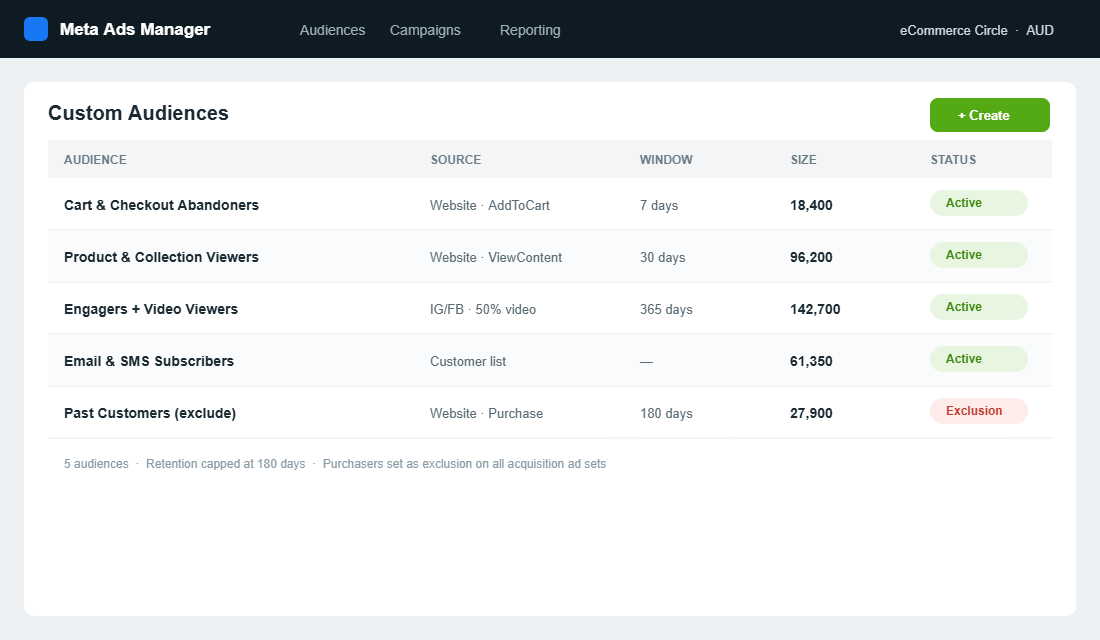
Stop thinking about “retargeting” as one audience. It is at least five, each with different intent, and each deserves its own message and budget. Here is the ladder we build for every client, from hottest to coolest.
Audience 1: Cart and Checkout Abandoners (the money audience)
These are people who added to cart or started checkout and did not finish. Highest intent in the entire account. They told you the exact product they want and the exact price they were willing to pay. Build this as a 7-day window so the message stays urgent while the desire is fresh.
This audience should pair with your email and SMS recovery flow, not replace it. Run the paid ad alongside your abandoned cart recovery flow so the customer gets a coordinated nudge across channels. The ad does not need to scream a discount. Often a simple “still thinking it over?” with a strong review and free-shipping reminder does more than a 15% code that trains people to abandon on purpose.
Audience 2: Product and Collection Viewers (warm, not committed)
People who viewed a product or collection page but never added to cart. They are interested but not convinced. This is where objection-handling creative earns its keep: address the hesitation that stopped them. Sizing worries, quality doubts, “will it actually work for me”, delivery time to regional Australia. A 14 to 30 day window works well here.
This is also the perfect slot for a pre-sell or advertorial-style ad rather than a hard product push. If they were not ready to buy on the product page, sending them back to the same page rarely helps. Send them to a story instead. Our advertorial playbook covers exactly how to build those pages.
Audience 3: Engagers (your owned and earned warm pool)
Anyone who engaged but may not have hit the site yet: video viewers (think 50%-plus watch time), Instagram and Facebook profile engagers, and your email and SMS subscribers uploaded as a custom audience. This pool is large and cheap, and it is increasingly important as pixel signal degrades. When the tracking goes dark, engagement audiences built inside Meta become some of your most reliable warm targeting.
The Oodie, one of Australia’s most-studied ad accounts, leans on exactly this. They test dozens of creatives a week and concentrate spend around gifting seasons, then aggressively retarget past buyers and engagers for the next occasion: Christmas, then Mother’s Day, then Father’s Day. The brand stays in front of a warm pool that already loves the product and just needs a reason to buy again.
Audience 4: Past Customers (your most profitable retarget)
People who have already bought from you. The cheapest sale you will ever make is the second one. Use this audience for replenishment reminders on consumables, genuine cross-sells, and win-back ads for customers who have gone quiet. Match the message to where they are in their lifecycle, not a generic “we miss you”.
The trick is that past customers belong in two places at once: as a target for repeat-purchase campaigns, and as an exclusion from your acquisition and abandoned-cart ads (more on that next). Keep those jobs separate or you will waste money showing “first order 10% off” to your most loyal repeat buyer.
Audience 5: The Exclusions (the audience that saves your budget)
This is the one almost everyone skips, and it is the difference between a profitable retargeting account and a leaky one. Missing exclusion pairings waste 20 to 40% of retargeting spend. Every retargeting ad set needs a clear “do not show this to” list.
- Exclude recent purchasers (180 days) from abandoned-cart and acquisition ads, so you stop paying to convert people who already converted.
- Exclude cart abandoners from your broad product-viewer ads, so each person only sits in their hottest, most relevant audience.
- Exclude current customers from any “new customer” offer, which protects your margin and your brand.
Match the Message to the Funnel Stage
The fastest way to waste retargeting budget is to show the same creative to all five audiences. Intent is different at every rung of the ladder, so the message has to change with it. Here is the simple rule: the hotter the audience, the more direct the ask.
- Cart abandoners: direct and reassuring. The exact product, a top review, free-shipping or easy-returns reminder, clear call to finish.
- Product viewers: objection-handling. Tackle the specific doubt with social proof, a demo, or an advertorial that reframes the product.
- Engagers and video viewers: proof and story. User-generated content, founder story, before-and-afters that build trust before the ask.
- Past customers: relevant and personal. Replenishment timing, a complementary product, or a loyalty perk, never a first-order discount.
One more thing on creative: warm audiences burn out faster than cold ones because the pool is smaller. Refresh your retargeting creative every two to three weeks and watch frequency. When the same person has seen the same ad seven times, you are no longer persuading, you are annoying.
How to Set It Up in Meta (Step by Step)
Meta is where most Aussie brands run the bulk of their retargeting, so here is the practical build. Do this once and your audiences keep refreshing automatically.
- Confirm tracking first. In your Shopify Meta integration, make sure both the Pixel and the Conversions API (CAPI) are firing. CAPI is no longer optional. It is how you recover the signal that browser tracking now loses.
- Build the source audiences. In Ads Manager, go to Audiences, then Create Custom Audience, then Website. Create separate audiences for: all visitors (30 days), product viewers (14 to 30 days), add-to-cart (7 days), checkout started (7 days), and purchasers (180 days).
- Upload your owned lists. Create custom audiences from your email and SMS subscribers, and from Instagram and Facebook engagers and video viewers. These hold up even when pixel data is thin.
- Set the exclusions. On each retargeting ad set, scroll to Exclude Custom Audiences and add the purchasers list to abandoned-cart and acquisition ad sets. This single step is where most accounts find their wasted 20 to 40%.
- Mind the window. Meta caps custom audience retention at 180 days, which is plenty for both targeting and exclusions. Shorter windows for hot audiences, longer for purchasers.
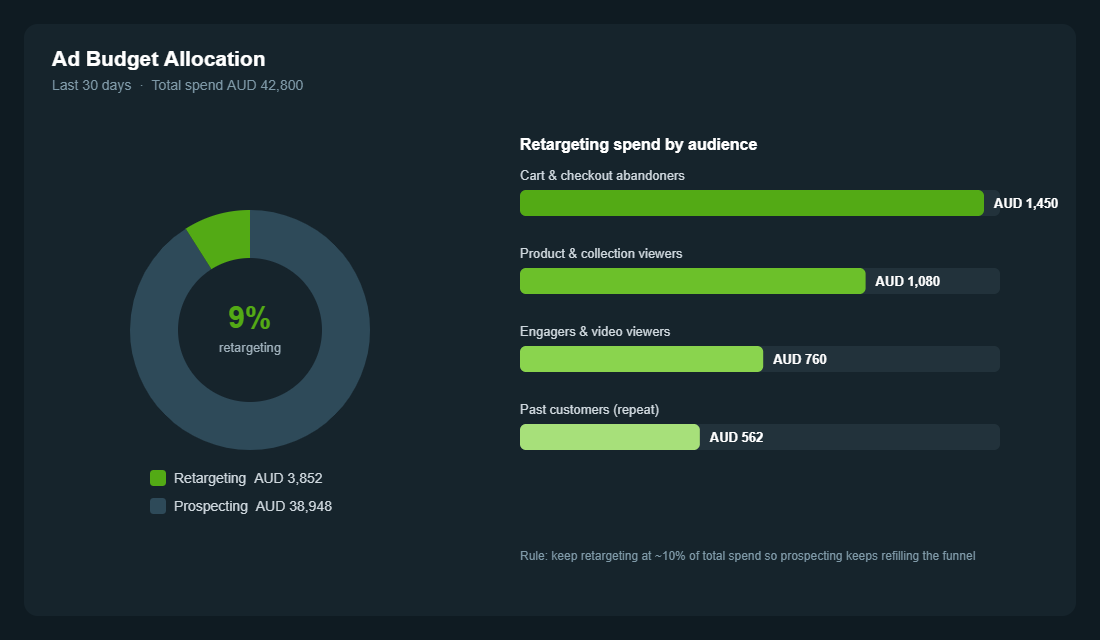
- Cap the budget. Keep total retargeting spend at roughly 10% or less of your ad budget. Retargeting only works because prospecting keeps filling the funnel. Overspend here and you are just paying to harvest a pool you are no longer refilling.
Mirror the same logic on Google with remarketing audiences and Performance Max signals, and layer in Shopify Audiences if you are eligible. The platform changes but the system does not: define the warm pools, sequence the message, and exclude the people who already bought.
Measure It Honestly (Don’t Trust the Platform ROAS)
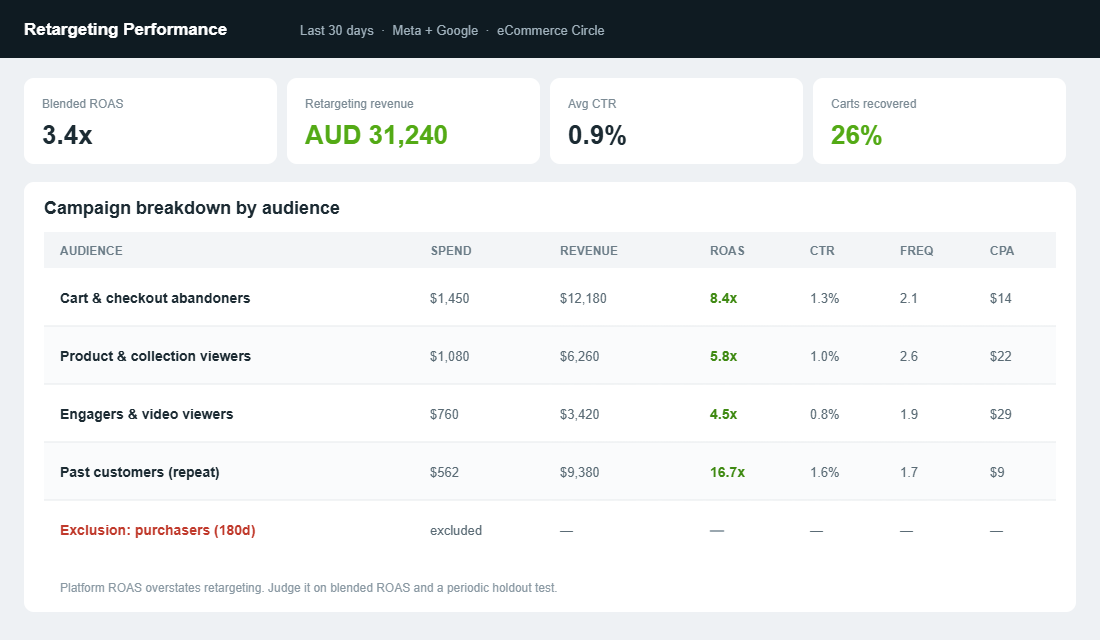
Here is the uncomfortable truth about retargeting: the platform will always make it look like a hero. Retargeting ads claim credit for sales that would have happened anyway, because you are advertising to people already on their way to buying. A reported 8x ROAS on a retargeting campaign is not 8x of incremental profit. A chunk of those buyers were coming back regardless.
That does not mean retargeting is fake. It means you measure it at the account level, not the campaign level. Watch your blended ROAS: total revenue divided by total ad spend across every channel. If you scale retargeting and blended ROAS does not move, you are just shifting credit around, not creating new sales. The honest test is an occasional holdout: pause a retargeting audience for a week and watch whether overall revenue actually drops.
Three Retargeting Mistakes That Quietly Drain Profit
Even founders who run retargeting lose money to the same handful of errors. We see these in nearly every audit, and they are all fixable in an afternoon.
Mistake one: the discount reflex. Leading every retargeting ad with a code teaches shoppers to abandon on purpose because they know a discount is coming. Save the offer for the final touch, and only for the audiences that genuinely stalled. For product viewers and engagers, proof and story usually outperform a price cut, and they protect the margin you worked hard to build into your pricing.
Mistake two: ignoring frequency. Retargeting click-through rates already sit low at around 0.9% in ecommerce, and they fall further the more times a person sees the same ad. A warm pool is small, so frequency climbs fast. If someone has seen one creative ten times, you are paying to irritate a future customer. Set a frequency cap, rotate creative, and let the audience breathe.
Mistake three: one window for everything. A 180-day catch-all audience treats a person who abandoned a cart this morning the same as someone who glanced at your homepage five months ago. Intent decays. Build tight windows for hot audiences and reserve the long windows for purchasers and exclusions, so your spend always lands on the people closest to buying.
The Compound Effect
Retargeting is not a campaign you launch. It is a system that runs underneath everything else. Your prospecting fills the top of the funnel. Your site captures intent. Your five audiences catch every visitor at the exact moment and message that fits where they are. Your exclusions make sure not a dollar gets wasted on someone who already paid. And your blended ROAS keeps the whole thing honest.
When those pieces work together, your cost per acquisition drops without touching your prospecting budget, because more of the traffic you already paid for actually converts. That is the quiet leverage the best Aussie brands have figured out: they do not just buy more strangers, they convert more of the warm ones. With around 48% of marketers increasing retargeting budgets as privacy changes reshape targeting, the brands that build this engine properly now will own the warm audience while everyone else keeps overspending on cold.
Your Retargeting Setup Checklist
Run your account against this. If you cannot tick every box, you have found your next profit lever.
- Tracking: Pixel and Conversions API both firing from Shopify.
- Audience 1: Cart and checkout abandoners (7-day window) live, paired with email and SMS.
- Audience 2: Product and collection viewers (14 to 30 days) with objection-handling creative.
- Audience 3: Engagers, video viewers, and uploaded email and SMS lists.
- Audience 4: Past customers (180 days) for cross-sell, replenishment, and win-back.
- Audience 5: Exclusions set on every ad set, especially purchasers on cold and abandoned-cart ads.
- Creative: Message matched to funnel stage, refreshed every 2 to 3 weeks, frequency watched.
- Budget: Retargeting capped at roughly 10% of total spend.
- Measurement: Judged on blended ROAS and the occasional holdout test, not platform-reported ROAS.
Inside eCommerce Circle, building a clean retargeting engine is one of the first things we work on with members, because it is the fastest way to lift profit without spending another dollar finding new customers. If you want a second opinion on yours, let’s talk.