There is a famous experiment about jam. Researchers set up a tasting table in a supermarket, sometimes with 24 flavours, sometimes with six. The big display pulled more people in, but the small one sold nearly ten times better. More choice got attention. Less choice got sales.
What’s in This Article
Your Shopify store is the 24-jam table. A shopper lands on a collection with 80 products, no idea which one is right for them, and quietly leaves to “think about it”. You did not lose them on price. You lost them on overwhelm.
A product quiz fixes exactly this. Instead of making shoppers self-diagnose from a wall of options, you ask a few smart questions and hand them a short, confident shortlist. Done well, a quiz converts 7% to 25% of the people who take it, against a typical store average of 2% to 4%. This playbook is the six-part system we use with members to build one that actually sells.
Why a product quiz is the highest-converting page you do not have yet
Let me put real numbers on it, because the gap is bigger than most founders expect. Across product recommendation quizzes, roughly 1 in 18 shoppers who finish a quiz places an order. That is about 2.75 times the conversion rate of a typical online store, on the same traffic.
It is not just more orders, it is bigger ones. Quiz-driven orders run 11% to 15% larger than non-quiz orders, and that holds true in 68% to 74% of stores that measure it. Octane AI case data puts the average order value lift from quiz completers as high as 47%, because a good quiz naturally bundles a routine or a set instead of selling a single item.
The brand examples are hard to argue with. Bike maker Trek built a product finder and saw a 200% increase in conversions. Pure Electric added a guided shopping assistant and lifted average order value by 20% while cutting support questions. One A/B test found shoppers prompted to take a quiz generated 22% more sales than those who were not.
And here is the part most founders miss. Every answer a shopper gives is zero-party data: information they handed you willingly. In a world where ad tracking keeps getting harder, a quiz is a permission-based machine for learning who your customers are and what they want next.
For Australian founders, that last point is quietly becoming the whole game. With privacy rules tightening, third-party cookies fading, and ad costs climbing, the brands that win are the ones that own a direct relationship with their customers. A quiz is one of the few on-site tools that grows conversion and your owned data at the same time, which is why it punches so far above its cost.
Part 1: Pick the one job your quiz is for
The most common mistake is building a quiz with no clear job. A quiz that tries to do everything converts no one. Before you write a single question, decide which of these your quiz exists to do.
- The product finder. Best for catalogues with genuine choice complexity: skincare, supplements, bikes, mattresses, pet food. The job is to cut overwhelm and recommend the right item.
- The routine or bundle builder. Best when products work together. The job is to lift average order value by recommending a set, not a single product.
- The gift finder. Best for seasonal and gifting-heavy ranges. The job is to help an unsure buyer who does not know your range at all.
- The fit or sizing guide. Best for apparel and footwear. The job is to reduce returns by getting the size and style right before purchase.
Pick one. The job decides the questions you ask, the results you show, and the metric you judge it on. A finder is measured on conversion, a bundle builder on average order value, a fit guide on return rate. Clarity here is what separates a quiz that earns its keep from a gimmick that sits in the footer.
Part 2: Write questions like a great salesperson, not a form
Think about how a brilliant retail assistant works. They do not hand you a clipboard. They ask two or three sharp questions, listen, and point you at the right shelf. Your quiz should feel the same way: short, human, and obviously on your side.
Keep it to four to six questions. Completion rate falls off a cliff past that, and every extra question is another exit. The questions should map to how the customer thinks about their problem, not how you organise your catalogue.
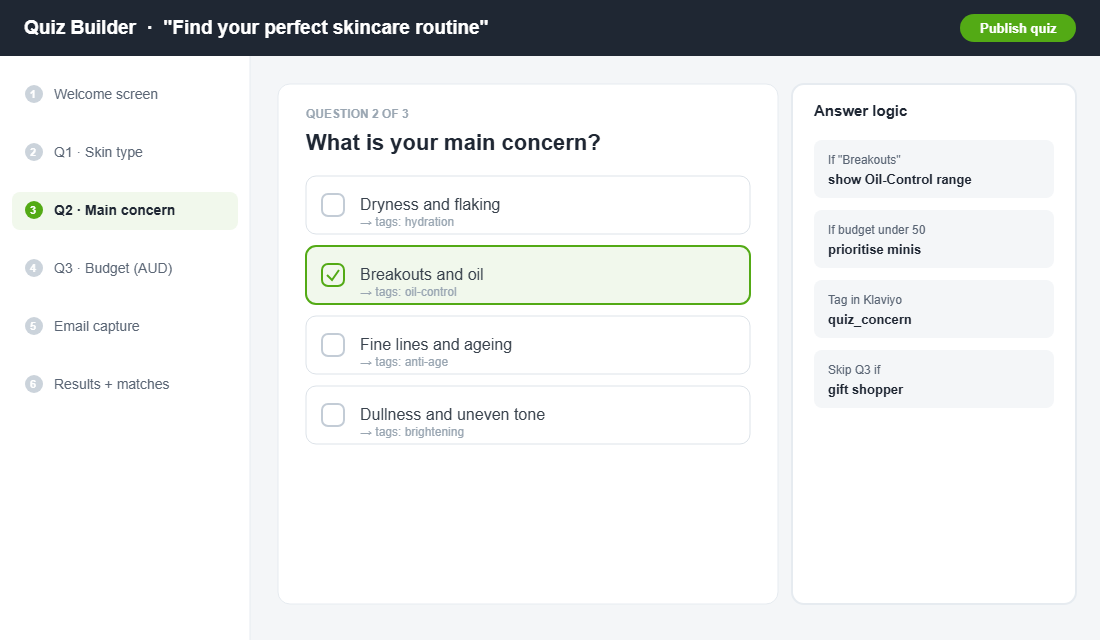
- Ask about the problem, not the product. “What is your main skin concern?” beats “Which active ingredient do you prefer?” Shoppers know their problem, not your SKUs.
- Use plain, visual answers. Buttons and images convert better than dropdowns. Let people tap, not type.
- Tag every answer. Each choice should attach a tag (oily, gift, under 50) that drives both the recommendation and the follow-up email.
- Lead with the easy question. Open with something effortless to build momentum, then ask the one that really sorts the catalogue.
This is also where customer language matters. The exact words shoppers use to describe their problem are the words your questions, results, and follow-up emails should echo. If you have not done the groundwork on that, our Shopify Customer Research Playbook is the place to start. A quiz is only as good as your understanding of the person taking it.
Part 3: Make the results page the moment of the sale
The results page is where the quiz earns or wastes everything that came before it. Get a shopper to the end and then show them a vague “here are some products you might like” and you have squandered the intent you just built. The results page has one job: make buying feel like the obvious next step.
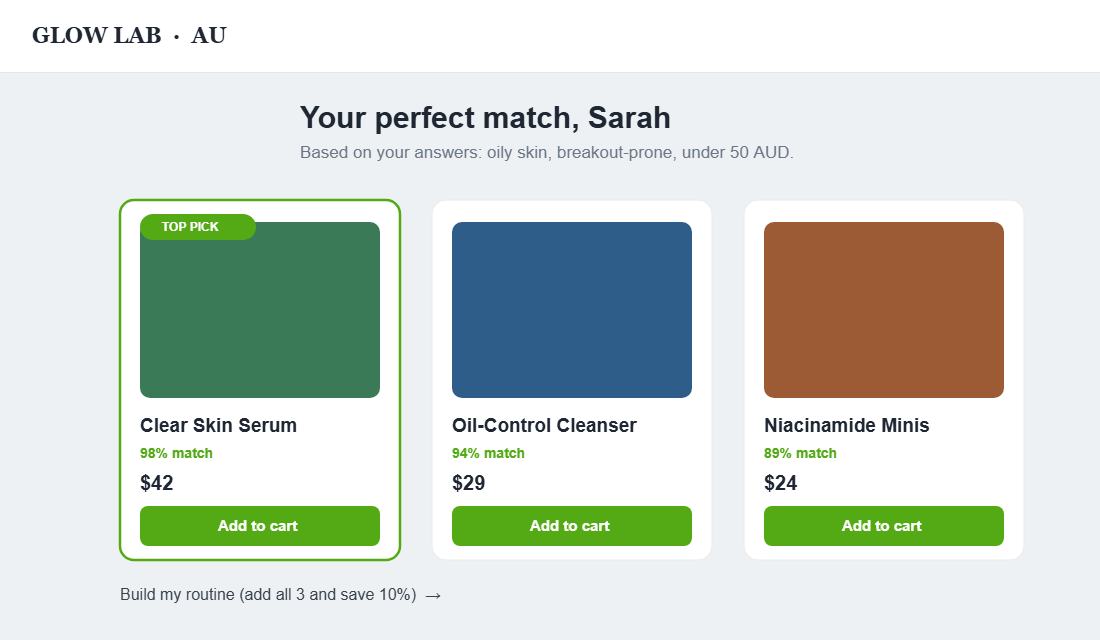
- Show a clear top pick. Lead with one hero recommendation, then two supporting options. Three is plenty. You are reducing choice, not recreating the collection page.
- Explain the why. “Based on your oily, breakout-prone skin” makes the recommendation feel earned, not random. Personalisation that shows its working converts.
- Add to cart in one tap. Let shoppers buy straight from the results. Every extra click between match and cart leaks sales.
- Offer the bundle. “Add all three and save 10%” is where the average order value lift comes from. Make the set the easy choice.
When two recommendations are genuinely close, give the shopper a fast way to weigh them up rather than sending them back to browse. The approach in our Shopify Product Comparison Playbook slots straight into a results page and keeps the decision moving forward.
Part 4: Capture the email at the right moment
A quiz is the best email capture tool on your store, and it is not close. People who will scroll straight past a generic “10% off your first order” popup will happily give you their email to see their personalised results. The exchange feels fair, because it is.
Octane AI reports opt-in rates around 42% at the results step, several times what a standard popup achieves. The reason is timing and value: you ask after the shopper has invested a minute answering questions, and right before the payoff they actually want.
- Ask just before the results. “Where should we send your results?” converts far better than gating the quiz behind an email at the start.
- Never hold results hostage. Show results regardless. Forcing an email before the payoff kills trust and completion.
- Capture SMS as an option, not a wall. Offer it, do not require it, and stay on the right side of Australian consent rules.
That captured email should drop straight into a tailored welcome sequence, not your generic list. The mechanics of that handoff are in our Shopify Welcome Email Flow Playbook, and a quiz makes every email in it sharper because you already know what the subscriber wants.
Part 5: Turn quiz answers into segmented follow-up
Here is where a quiz keeps paying you for months. Most shoppers will not buy on the spot, and that is fine. Because every answer is tagged, you can follow up with messages that speak directly to what each person told you.
This matters more than it sounds. Segmented campaigns earn more than three times the revenue per recipient of generic batch sends. A quiz hands you that segmentation automatically, on day one, without any guesswork.
- Pipe tags into Klaviyo. Push every answer tag into your email tool so each subscriber lands in the right flow.
- Match the message to the answer. The oily-skin shopper and the anti-ageing shopper should get different first emails, not the same newsletter.
- Retarget on what they told you. Use the segment to build tighter ad audiences than any pixel-based guess.
- Re-engage non-buyers. “Still deciding on your match?” with the recommended product beats a generic reminder every time.
Part 6: Read the quiz data like a growth dashboard
A quiz is not a set-and-forget app. The data it produces is some of the most useful in your whole business, and checking it weekly is what turns a decent quiz into a great one.
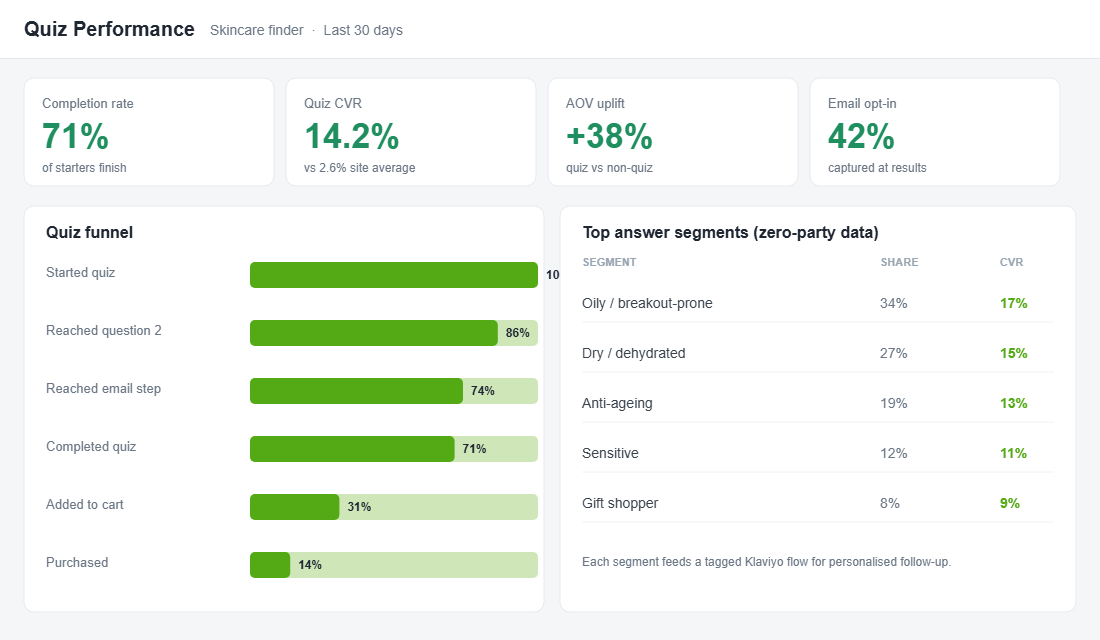
- Watch the funnel for drop-off. If completion craters at question four, that question is too hard or too nosy. Cut or rewrite it.
- Aim for 70% completion. A well-built four to six question quiz should finish around seven in ten starters. Below 50% means it is too long.
- Read the segment split. The share of shoppers in each answer segment is a live demand map for your range and your buying decisions.
- Spot the gaps. If a big segment converts poorly, you either lack the right product for them or your recommendation is off. Both are fixable.
Treat the segment data as a buying brief. If a third of your quiz takers are breakout-prone and you only stock one product for them, your customers have just told you where your next bestseller should come from.
The tool: building your first quiz in an afternoon
You do not need a developer for any of this. Apps like Octane AI (trusted by more than 5,000 Shopify stores), Shop Quiz by RevenueHunt, Quiz Kit, and Prehook all let you build a real quiz from the Shopify admin. Here is the order we set one up in, so it is live and earning the same day.
- Install the app and pick a template. Start from a finder or routine-builder template that matches the one job you chose in Part 1.
- Write four to six problem-led questions. Use buttons and images, and tag every answer as you go.
- Map answers to products. Connect tags to specific products or collections so the recommendation logic is precise, not generic.
- Build the results page. One top pick, two supports, a clear why, one-tap add, and a bundle offer.
- Add the email step before results. Connect it to Klaviyo and route each tag into its own flow.
- Place it where shoppers are stuck. Link the quiz from your main navigation, your busiest collection page, and your homepage hero, not just the footer.
Then book a recurring 20-minute slot each week to read the funnel and the segments, tweak the weakest question, and refine the recommendations. That small habit is what compounds.
The three mistakes that make most quizzes flop
Plenty of stores install a quiz and quietly give up on it a month later. Almost always, it is one of three avoidable mistakes, not the format itself. Knowing them upfront saves you the disappointment.
The first is making it too long. A quiz is not a survey. Once you push past six questions, completion drops sharply and so does the goodwill you built. If you are tempted to add a seventh question, ask whether it changes the recommendation. If it does not, cut it.
The second is hiding it. A brilliant quiz buried in the footer might as well not exist. Your most overwhelmed shoppers are on your busiest collection pages and your homepage, so that is where the entry point belongs. Treat “Take the quiz” as a primary call to action, not a novelty link.
The third is wasting the data. The single biggest miss we see is a quiz that collects rich answers and then drops every taker into the same generic newsletter. If you are not routing answer tags into segmented flows, you have built a conversion tool and thrown away the half that compounds. The follow-up is not optional, it is where a quiz quietly out-earns almost every other tactic on your store.
The compound effect: one quiz, four wins
Look at what a single well-built quiz does at once. It converts overwhelmed browsers at two to three times your site average. It lifts average order value by recommending sets instead of singles. It captures email at around 42% where a popup struggles to hit double digits. And it tags every shopper with zero-party data that sharpens your email, ads, and buying decisions for months.
No single ad, popup, or theme tweak does all four. That is why a quiz sits in the Platform pillar of the More Orders Operating System: it is on-site infrastructure that makes everything downstream work harder. Build it once and every campaign you run afterwards lands on a store that helps people decide.
Your product quiz audit: the 6-point checklist
Run your store, or your plan for one, through this. Every box you cannot tick is your next afternoon’s work.
- 1. One clear job. Is your quiz a finder, a builder, a gift guide, or a fit tool, and is it measured on the matching metric?
- 2. Short and human. Four to six problem-led questions with tappable, visual answers?
- 3. A results page that sells. One top pick, a clear why, one-tap add, and a bundle offer?
- 4. Email captured at the right moment. Asked just before results, never holding results hostage?
- 5. Segmented follow-up. Are answer tags piped into Klaviyo and driving tailored flows?
- 6. A weekly data habit. Are you reading the funnel and segments and improving the quiz each week?
Most stores have no quiz at all, which means this is one of the rare wins still sitting on the table. The brands that build one well are quietly converting their most overwhelmed shoppers at multiples of everyone else, and learning who their customers are while they do it.
Inside eCommerce Circle, guided selling and on-site discovery are part of the Platform work we do with every member, because a quiz is one of the highest-leverage, lowest-cost wins on a Shopify store. If you want a second opinion on whether one fits your range, let’s talk.