You can fix a weak product page in an afternoon. You can pause a bad ad campaign in thirty seconds. But a bad supplier decision locks you in for months, sometimes years, and it quietly decides every dollar of margin you will ever make. By the time stock leaves the factory, your profit ceiling is already set.
What’s in This Article
The numbers back this up. Around 28% of first-time global buyers hit at least one serious sourcing issue: defective stock, blown deadlines or claims that turned out to be fiction. And the classic deposit scam still runs the same script it always has. An attractive quote, a 30 to 50% deposit on a first order that is typically somewhere between $5,000 and $50,000, then excuses, then silence.
Most founders treat sourcing as a one-off Alibaba search. They message five suppliers, pick the cheapest quote, wire a deposit and hope. The brands that build real product moats treat sourcing as a repeatable system with gates, evidence and negotiating power at every step. This playbook is that system, in six steps, built for Aussie founders importing into Australia.
Step 1: Write the Spec Sheet Before You Message a Single Supplier
The single biggest sourcing mistake is starting conversations without a written specification. If you cannot describe exactly what you want, every quote you receive is measuring something different, every sample is judged on vibes, and every dispute later becomes your word against theirs.
Your spec sheet is a one to two page document that becomes the anchor for everything that follows: quotes, samples, the purchase order, and the inspection checklist. Build it once per product and version it like software.
- Materials and grades. Not “stainless steel” but “304 food-grade stainless steel, 0.5mm wall”. Vague materials are where corners get cut first.
- Dimensions and tolerances. Every measurement with an acceptable variance. A 2mm tolerance on a lid thread is the difference between a bottle that seals and a refund.
- Colours by Pantone code. “Sage green” means five different things in five factories.
- Packaging and labelling. Inner packaging, carton specs, barcode placement, and any Australian labelling requirements for your category.
- Compliance requirements. Food contact standards, electrical certification, children’s product mandates. Know what applies before you order, not at the border.
- Quality definitions. What counts as a critical, major and minor defect for this product. This becomes your inspection standard later.
One hour on this document saves you weeks of back-and-forth and gives you the paper trail that wins disputes. Suppliers also take you more seriously. A buyer with a spec sheet reads as a professional importer, not a first-timer to be tested.
Step 2: Build a Longlist of 20, Not a Shortlist of 3
First decide geography honestly. Local manufacturing buys you speed, small runs and a story customers value, but for many categories it simply is not available. Frank Green moulds its plastics in Melbourne yet still sources its vacuum-sealed stainless vessels from China, because no Australian manufacturer makes them.
Founder Benjamin Young has publicly called the local supply gap “prehistoric”. If a brand at that scale cannot fully onshore, plan your offshore process properly rather than pretending you will avoid it.
Then go wide. Twenty candidate suppliers minimum on the longlist. Alibaba with the Verified Supplier filter on is the obvious start (verification means an independent third party has inspected the factory, its production capability and its process controls on site). Add Global Sources and Made-in-China for manufacturers that barely bother with Alibaba, and the Canton Fair or a sourcing agent if the category justifies a trip.
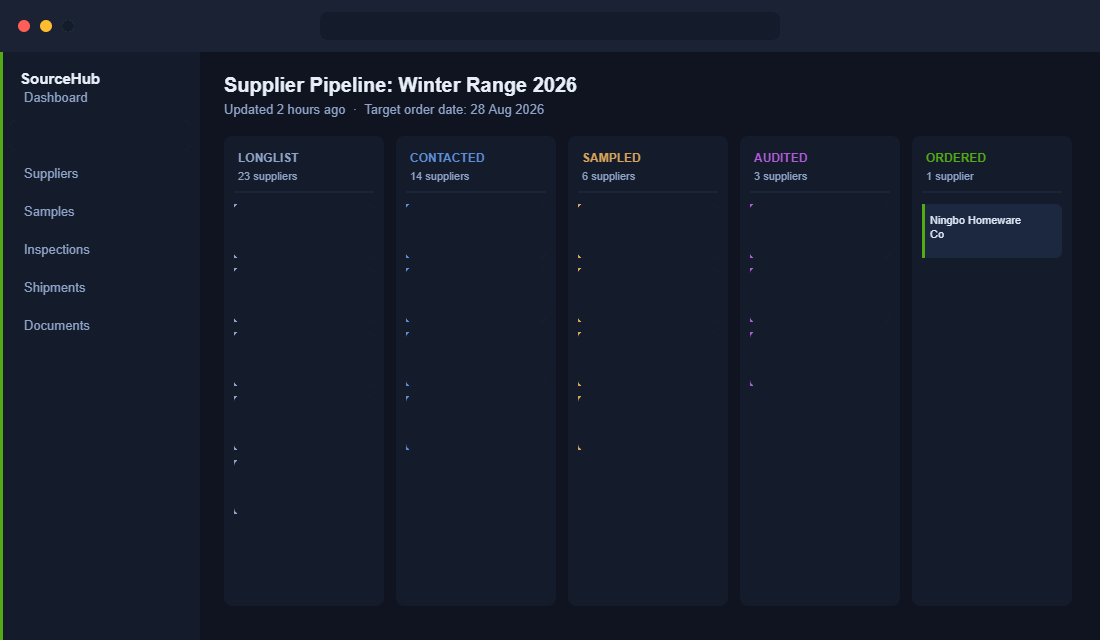
Your first filter is manufacturer versus trading company. Trading companies are not evil (they can aggregate small orders and manage difficult factories) but a 10 to 15% markup hides inside their quotes and you lose direct control of quality. Ask for the business licence and check the registered business scope. A licence that says “trading” or “import export” while the supplier claims to own the factory is your first honesty test, and plenty fail it.
This is also where operator experience shows. Melbourne luggage brand July was co-founded by Richard Li, who had spent years sourcing furniture from China before the first suitcase existed. That background shaped a hands-on approach where the founders stayed across design, manufacturing and QC rather than outsourcing the lot.
You may not have that history. The system in this playbook is how you substitute process for experience.
Step 3: Vet Hard Before Any Money Moves
Everything before this step is free. This step is where money starts moving, so it gets gates. Take your best five candidates from quoting and put them through verification before a deposit goes anywhere.
- Business licence check. Get the licence, confirm the registered name matches the name on the bank account you are asked to pay. A mismatch, or a personal account, ends the conversation. This one rule defeats most outright scams.
- Live video factory tour. Not a pre-recorded video. A live call where you name what you want to see: the production line for your product, the QC station, the warehouse. Watch for stalling.
- References that sell to your market. Ask for two customers shipping to Australia or a comparable Western market, and actually contact them.
- Third-party factory audit for bigger bets. If your first order is above roughly $15,000, a formal audit runs a few hundred dollars and checks licences, capacity, working conditions and quality systems on site.
Red flags that should end talks immediately: a price meaningfully below every other quote (quality debt you will repay with interest), any resistance to third-party inspection, deposits above 50%, pressure to pay outside the platform on a first order, and sudden “mould problems” that require more money to fix. Walk away fast. The longlist exists so you can afford to.
Step 4: Sample in Three Rounds, and Pay for Every One
Free samples create obligation and slow everything down. Pay for samples, pay for express freight, and run three deliberate rounds. Founders who skip rounds here find the missing round later, inside 5,000 units they already own.
- Round 1: the catalogue sample. Their existing product, off the shelf. You are testing baseline quality and how they handle a small transaction. Slow, sloppy or evasive here means slow, sloppy and evasive at 5,000 units.
- Round 2: the custom sample. Built to your spec sheet. Judge it line by line against the spec, in writing. Photograph every deviation and send the list back. How a factory responds to written feedback tells you more than the sample itself.
- Round 3: the golden sample. The approved reference unit. You keep one, the factory keeps one, and your inspection company gets photos of it. Production is measured against this unit, which turns “not what I expected” into “does not match the golden sample”. One is an argument, the other is a contract term.
Test samples to destruction. Drop them, freeze them, overload them, put them through the wash cycle, leave them in a hot car. July’s founders famously built their first luggage spec by interviewing hundreds of travellers and reading thousands of reviews of competitor products before committing to production. Your customers will test your product harder than you will, so get there first.
Step 5: Order Small, Inspect Always, Pay on Proof
Your first production order should be the smallest quantity the supplier will accept, even at a worse unit price. Quoted MOQ is an opening position, not a law of physics. Most factories will run half their stated MOQ at a 10 to 20% unit premium, and that premium is cheap insurance while the relationship is unproven. We covered the negotiation levers in detail in the Shopify Supplier Negotiation Playbook.
Structure payment as 30% deposit, 70% balance, with the balance explicitly conditional on passing a third-party pre-shipment inspection. That sentence in your purchase order changes the entire power dynamic. The factory’s incentive flips from “ship it and argue later” to “pass the inspection”.
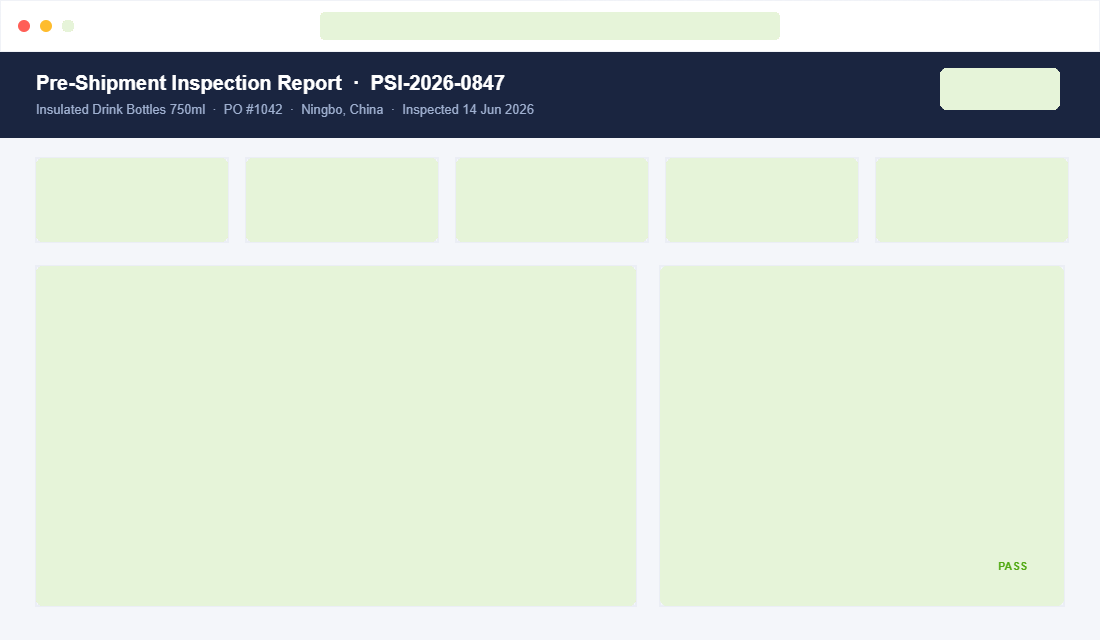
A pre-shipment inspection costs around US$250 to US$350 per batch based on QIMA’s published 2025 pricing. On a $25,000 order that is roughly 1.5% of order value to avoid the scenario where the first person to properly examine your stock is a customer. Healthy suppliers run defect rates under 1%. A batch showing 15% or more defects is not bad luck, it is a broken production process, and you want to know before the container sails, not after.
Setting up QIMA (or an equivalent like SGS or Intertek) takes about twenty minutes:
- Create an account at qima.com and load your product spec sheet and purchase order details.
- Book a pre-shipment inspection for when goods are around 80 to 100% complete, about a week before ex-factory date. The factory nominates the date; you confirm it.
- Select AQL sampling level II with 2.5 for major defects and 4.0 for minor defects. This is the standard consumer goods setting and mirrors what large retailers use.
- Upload photos of your golden sample and your defect definitions so the inspector is checking against your standard, not a generic one.
- Get the report same day, and only release the 70% balance on a pass. On a fail, the factory reworks and you re-inspect. The re-inspection fee is theirs to cover; put that in the PO too.
Step 6: Cost It Landed, Not FOB
The quote you compared suppliers on is FOB: free on board, the price to get goods onto a ship in China. It is not the price of stock in your Melbourne 3PL, and the gap between the two is where naive sourcing quietly destroys margin.
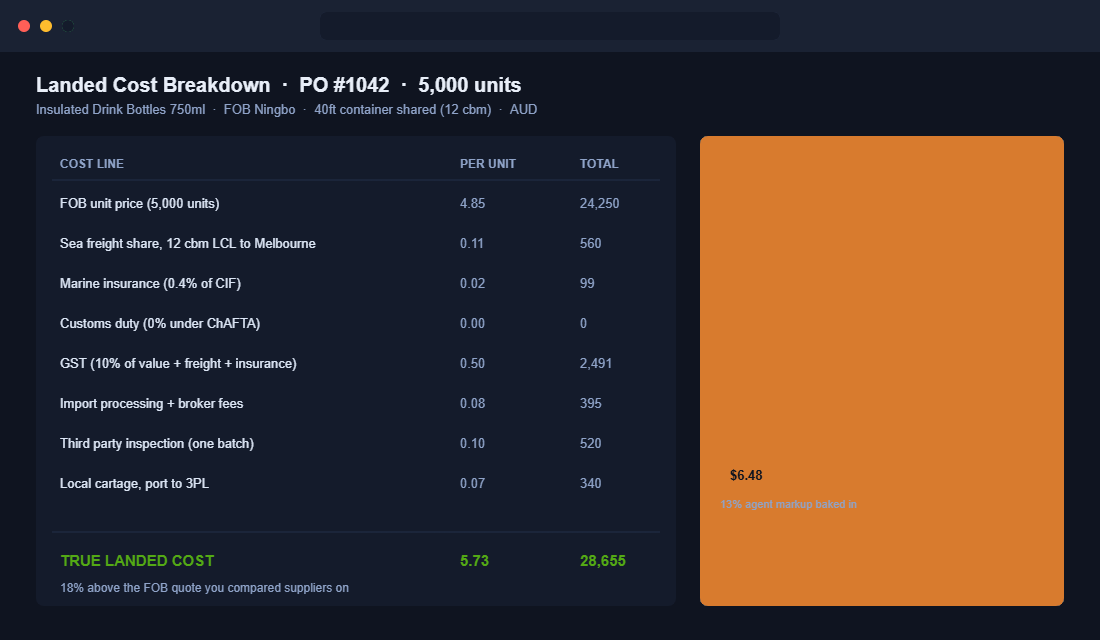
As of mid 2026, sea freight from China to Sydney, Melbourne or Brisbane runs roughly $1,485 to $1,815 for a 20ft container and $2,925 to $3,575 for a 40ft, up 22 to 25% on the previous month, which tells you how volatile this line item is. Smaller orders ship LCL at around $35 per cubic metre. Transit is 20 to 27 days port to port, so budget five to six weeks from ex-factory to your 3PL receiving stock.
Then the government takes its slice. The default customs duty is 5%, but most Chinese-origin goods enter duty free under the China Australia Free Trade Agreement, provided your supplier issues a ChAFTA Certificate of Origin. Ask for it on every shipment; plenty of founders pay 5% duty they never owed.
GST of 10% applies to the customs value plus duty plus freight and insurance, and a formal import declaration attracts an import processing charge of around $50 to $90 per consignment. None of these numbers is scary on its own.
Forgetting all of them at once is how a product that modelled at a 65% gross margin lands at 52%. If your unit economics are already tight, run the numbers through the framework in our EOFY Profit Reset before you commit to the order.
The Sourcing Calendar: Plan Backwards or Pay Retail for Panic
Every step above takes real calendar time, and founders consistently underestimate it. If you want stock received, checked and live on your Shopify store for a November peak, you are not starting in September. You are starting in June or July. Here is the realistic timeline for a first order from a new supplier.
- Weeks 1 to 2: spec and longlist. Write the spec sheet, build the 20-supplier longlist, send the same RFQ to everyone so quotes come back comparable.
- Weeks 3 to 5: quoting and vetting. Licence checks, video tours, references. Expect half the longlist to disqualify itself without you lifting a finger.
- Weeks 5 to 9: sampling. Three rounds with express freight both ways. This is the stage founders rush, and it is the most expensive place to save time.
- Weeks 9 to 13: production. Typical first-run lead time is 25 to 35 days depending on category and season. Add a buffer before Chinese New Year, when factories effectively close for two to three weeks and quality dips in the rush beforehand.
- Weeks 13 to 14: inspection and balance payment. Booked a week before ex-factory, report same day, rework window if it fails.
- Weeks 14 to 19: freight and receiving. 20 to 27 days on the water, plus customs clearance and 3PL receiving. Call it five weeks door to door if nothing goes sideways.
That is four to five months from first message to sellable stock, and your cash is out the door from week nine while revenue does not start until week nineteen. This gap, not ad performance, is what actually constrains growth for most importing brands doing $50k to $300k a month. Model it before you start, decide how much of your cash you are comfortable having on the water at once, and size the first order to that number rather than to the discount the factory dangles at the next quantity break.
Seven Red Flags That Should End a Supplier Conversation
Most sourcing disasters are visible early. The problem is founders see the warning sign, want the price to work, and talk themselves past it. Write these down and treat any one of them as a reason to pause.
- No live video walk-through. A real factory can show you the production line on a video call this week. Endless excuses usually means you are talking to a trading company.
- 100% payment upfront. The standard is 30% deposit and 70% on passed inspection. A supplier who refuses any balance-on-proof terms is shifting all the risk to you.
- Sample quality that is too good. If the sample is noticeably better than the product photos, ask for a pre-production sample pulled from the actual run.
- No test reports for regulated products. Ask for reports from a recognised lab (SGS, Intertek, Bureau Veritas) before you order, not after.
- Bank details that change by email. This is the most common payment scam in importing. Always confirm new details by phone. Our supplier payment fraud guide covers the full process.
- Vague answers on lead time. “About 30 days” with no production schedule usually becomes 60.
- Pressure to decide today. Good suppliers want repeat customers and give you time to check.
Australian Compliance to Check Before You Place the Order
A cheap product that cannot legally be sold here is the most expensive stock you will ever buy. Border seizures and ACCC recalls land on the importer, which is you, not the factory.
- Mandatory product safety standards. The ACCC enforces mandatory standards for categories including toys for children up to 36 months, button and coin batteries, baby products and some cosmetics labelling. Check Product Safety Australia before you finalise the spec.
- Electrical goods. Anything that plugs into the wall generally needs RCM marking and registration under the electrical equipment safety scheme.
- Cosmetics and chemicals. Importers of cosmetics and other industrial chemicals usually need to register with AICIS before the first shipment.
- Labelling. Country of origin, ingredients, and care or warning labels all need to be right before production, because relabelling in an Aussie warehouse costs far more than getting it right at the factory.
Build these into the spec sheet from Step 1 and your inspection checklist from Step 5. Then use our quality control playbook to make sure what arrives matches what you approved, and the landed cost playbook to confirm compliance and testing costs are in your margin maths.
The Compound Effect: Sourcing Is a Moat Nobody Can Screenshot
Run these six steps together and something interesting happens. The spec sheet makes quotes comparable, which makes the longlist meaningful. The longlist gives you walk-away power, which makes vetting honest.
The golden sample gives the inspection teeth, and the inspection makes your payment terms enforceable. Landed costing tells you which supplier actually wins on the numbers that hit your P&L.
Then it compounds. Fewer defects mean fewer refunds, better reviews and cheaper acquisition. A supplier who has passed three inspections in a row starts offering better payment terms, and 30/70 becomes 20/80 becomes open account, which transforms your cash conversion cycle.
Competitors can copy your ads and your product page in an afternoon. They cannot copy a two-year supplier relationship with a proven quality record.
That is why sourcing sits inside the Product pillar: it is one of the few compounding assets in ecommerce that is completely invisible from the outside. Once the stock lands, the Shopify Product Launch Playbook covers how to turn it into revenue.
Your Takeaway: The 10-Point Supplier Vetting Scorecard
Before any deposit leaves your account, score the supplier out of 10. One point per line. Eight or better is orderable. Seven or below means keep looking, no matter how good the price is.
- Written spec sheet exists and the supplier has quoted against it line by line
- Business licence sighted and registered scope says manufacturer, not just trading
- Bank account name matches the licence exactly, and it is a company account
- Live video factory tour completed, including your production line and QC station
- Two references shipping to Australia or a comparable market, contacted and positive
- Custom sample approved against the spec in writing, golden sample sealed by both sides
- First order negotiated below standard MOQ, even at a unit price premium
- Payment terms are 30/70 with balance conditional on a passed third-party inspection
- Pre-shipment inspection booked at AQL 2.5/4.0 with your defect definitions loaded
- Landed cost per unit calculated (freight, duty, GST, inspection, cartage) and the margin still works
Inside eCommerce Circle, sourcing and supplier negotiation sit at the heart of the Product pillar we work on with every member. If you are about to place your first big order, or your current supplier is quietly eating your margin, and you want a second opinion before the money moves, let’s talk.