You are paying more than ever for a cold click. Meta and Google costs keep climbing, and the warmest audience you own, the people already following you, mostly see a static grid post and keep scrolling. Meanwhile a Wyong marshmallow maker is selling out batches on a phone camera before the product has even cooled.
What’s in This Article
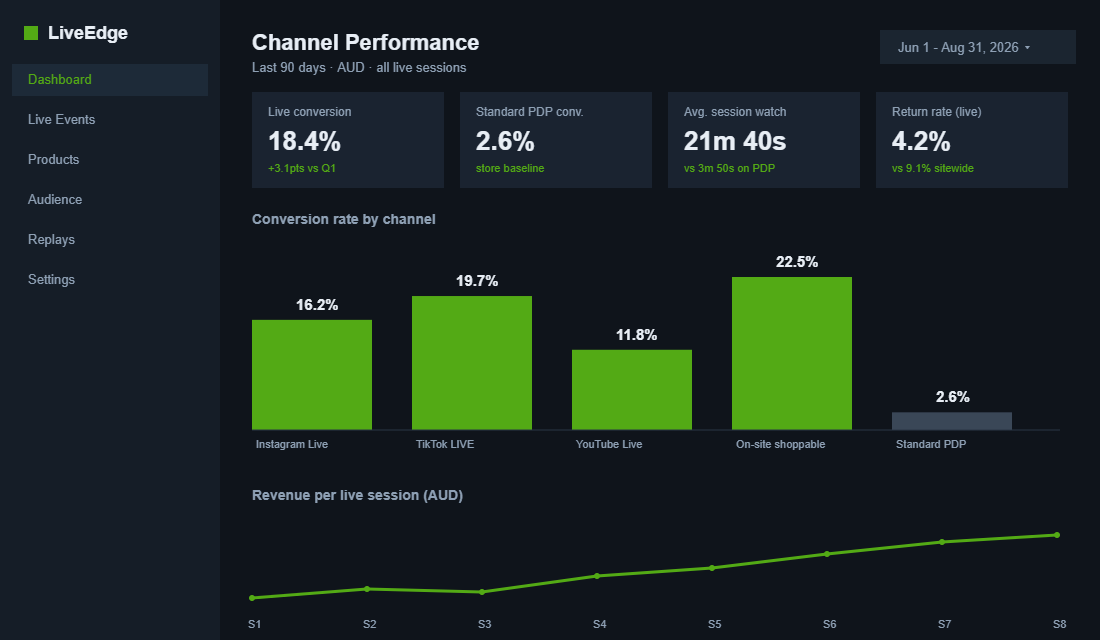
That is the gap live shopping closes. It takes your best-performing asset, a real person who knows the product, and puts them face to face with buyers who can tap “add to cart” without leaving the video. The numbers are not subtle. Standard Shopify product pages convert at 2 to 3 percent. Live shopping sessions routinely convert between 9 and 30 percent, up to 10 times higher than a normal page.
Most Aussie founders file live shopping under “that China thing” or “wait until TikTok Shop lands here properly.” Both are excuses. You do not need a new platform or a studio. You need a webcam, an offer, and a run sheet. This playbook gives you the run sheet, the channel choices, the tech, and the metrics, so live selling becomes a repeatable revenue line instead of a one-off stunt.
The Numbers That Should Make You Pay Attention
Live commerce is not a fringe experiment. The global market was worth around US$128 billion in 2024 and is forecast to push toward US$2.47 trillion by 2033, growing near 40 percent a year. Asia Pacific already accounts for roughly two thirds of that revenue. The West is earlier, which is exactly why the window is open for you.
Here in Australia, adoption sits at about 31 percent of retailers experimenting with livestream shopping. That means two in three of your competitors are not doing it yet. The brands that lean in early are reporting top-line revenue growth of up to 25 percent, and during Black Friday and Cyber Week 2025, brands running TikTok livestreams saw 84 percent year-on-year sales growth on those sessions.
The conversion story is the headline, but it is not the whole story. Live shopping also drags down your return rate. Because buyers see the product demonstrated, sized, and explained in real time, returns can fall by 40 to 50 percent, landing as low as 3 to 5 percent against a typical online rate closer to 9 percent. For a margin-tight Aussie brand paying return freight, that is real money kept.
Why Live Shopping Actually Converts
A product page is a monologue. Live shopping is a conversation. When a viewer types “does the beanie fit an adult head or is it kids sized?” and the host pulls it on and answers in ten seconds, the single biggest reason for cart abandonment, uncertainty, disappears on the spot.
Three forces stack up in a live room. Scarcity is real and honest: a live-only code that expires when the stream ends. Social proof is visible: viewers watch the “142 sold” counter tick up and the comments fill with buyers. And momentum builds because people stay. Viewers spend 15 to 30 minutes in a live session versus 3 to 5 minutes on a product page, and the longer they watch, the more they buy.
This is the same demand-quality principle we hammer on inside eCommerce Circle. You are not manufacturing urgency with a fake countdown timer. You are creating a genuine moment where the best version of your pitch meets a warm audience. That is why live buyers also tend to order bigger baskets, often 20 percent larger than the same category offline, because bundling feels natural when a host is showing you how three products go together.
Two Aussie Brands Already Doing It
You do not need a warehouse in Shenzhen to make this work. The Marshmallow Co, a confectionery brand on the NSW Central Coast, handcrafts marshmallows live on TikTok LIVE and ships the orders out from Wyong to customers around the world. The product is the show. People tune in to watch it being made, and they buy because they just watched it happen. That is live shopping stripped back to its purest form, and it is being run out of a regional Australian kitchen.
At the other end of the scale, Aussie-founded supplement brand EHP Labs generated more than US$350,000 in incremental sales during Cyber Weekend 2025 through TikTok live-selling campaigns. Same mechanic, bigger production. The lesson is that live shopping scales down to a phone on a tripod and up to a full sales event, and both ends of that range are profitable when the offer and the run sheet are right.
Pick the Channel That Fits Your Audience
You have four practical routes to market, and you should not spread yourself across all of them on day one. Choose based on where your audience already spends time and how much control you want over checkout.
- Instagram Live. Best if your following lives on Instagram. Zero setup, native reach to your followers, and you can drop product links and a code in the comments. The friction is that buyers leave the video to check out, so you lose some in the handoff.
- TikTok LIVE. The discovery engine. TikTok can put your stream in front of people who have never heard of you, which no other channel does at this cost. In Australia the full in-app TikTok Shop checkout has been slow to arrive, so treat TikTok LIVE as top-of-funnel: build the room, then drive to your site with a memorable live code.
- YouTube Live. Lower concurrent numbers but higher intent and bigger baskets. Conversion tends to sit around 8 to 15 percent, and the replay keeps selling for months because YouTube is a search engine.
- On-site shoppable live. You embed the stream on your own Shopify store using an app, and buyers check out inside the video. You own the data, the audience, and the checkout. Fewer eyeballs than social, but the highest conversion and the cleanest attribution.
The smart play for most Aussie DTC brands is a two-channel stack: run the live natively on Instagram or TikTok for reach, and simulcast or repost it on-site where the buying is frictionless. If you want the deeper social-commerce picture, our TikTok Shop Australia playbook maps how the local landscape is shaping up.
The Pre-Stream Setup: Offer, Run Sheet, Tech
A live session lives or dies before you hit “go live.” The brands that pull 18 percent conversion are not better on camera than you. They prepared better. Three things need to be locked in advance.
The offer. A live stream needs a reason to watch now, not later. That is usually a live-only discount code, a bundle that only exists during the stream, early access to a drop, or a giveaway for buyers who order during the broadcast. Make it genuinely time-boxed. If the code still works tomorrow, you have trained people to wait.
The run sheet. Decide your product order, the story for each one, and your “hero” product to anchor the session. Plan reveals and code drops at set timestamps so the energy has structure. A loose stream drifts, and viewers leave when it drifts.
The tech. You need decent light on the host’s face, a clean audio source (a $30 lapel mic beats your laptop), a stable connection, and a second person watching the comments to feed questions to the host and pin products. That second person is not optional. A host who is also reading comments will lose the room.
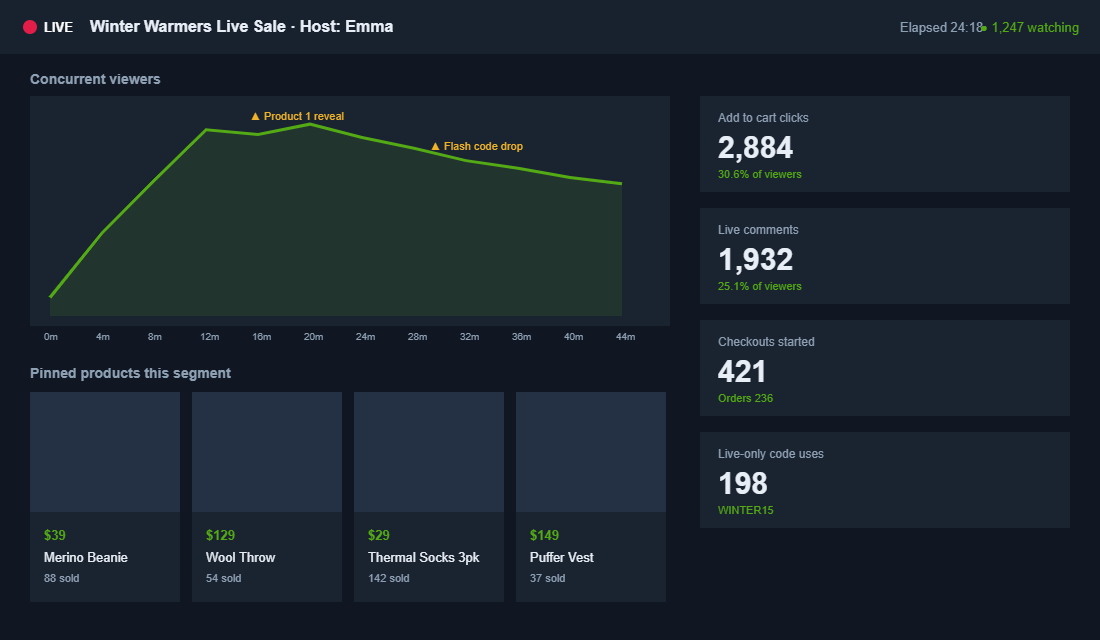
The 45-Minute Live Selling Run Sheet
This is the framework to steal. It works on any channel and keeps a session tight enough to hold attention but long enough to sell. Copy it, adjust the timings to your catalogue, and run the same shape every time so your audience learns the rhythm.
- Minutes 0 to 5, the warm-up. Go live early, greet people by name as they join, tease what is coming (“three winter bundles and a live-only code in the next 40 minutes”). Do not sell yet. You are waiting for the room to fill.
- Minutes 5 to 15, the hero. Lead with your strongest product. Demonstrate it, tell its story, answer the first wave of questions. Pin it and drop the first “add to cart” prompt.
- Minutes 15 to 30, the stack. Move through two or three supporting products, showing how they bundle with the hero. This is where average order value climbs. Call out live purchases as they happen: “Sarah just grabbed the bundle, nice one.”
- Minutes 30 to 40, the push. Drop the live-only code and set the timer out loud. Stack scarcity honestly: “this code dies when we end.” Re-show the hero for anyone who just arrived.
- Minutes 40 to 45, the close. Recap every product and price, repeat the code, thank buyers by name, and tell people where the replay will live. Announce the next stream date so today’s viewers become next week’s regulars.
Set Up On-Site Live Shopping With Amperstand
When you are ready to own the checkout, an on-site app is the move. Amperstand Live Shopping is one of the cleaner options in the Shopify App Store, with iOS and Android apps so you can stream from a phone, and reported add-to-cart rates of 30 to 35 percent with live-chat comment rates around 25 percent. Livescale, Bambuser, LiveSell and NOW Live are alternatives worth comparing. Here is the setup path.
- Install and connect. Add the app from the Shopify App Store. It syncs your product catalogue automatically, so every item you feature is already linked to a live checkout.
- Create your first event. Set a date and time, write a title and thumbnail, and select the products you will feature. The app generates a landing page and a widget you can embed on your storefront.
- Embed the widget. Drop the live block onto your homepage or a dedicated “Live” page so visitors can find and set a reminder for the event. Add a section link in your main navigation.
- Promote the reminder. Push the event to your email and SMS list and pin it in your social bios. A live session with no audience is just you talking to a wall, so treat promotion as half the job.
- Go live and interact. Stream from the mobile app, pin products as you discuss them, answer comments in real time, and let buyers check out without leaving the video.
- Review the replay. The event auto-saves as a shoppable replay on your site, which keeps converting long after you log off.
The Metrics That Tell You If It Worked
Live shopping without measurement is theatre. To treat it as a channel, you track it like one. These are the numbers that matter, and the benchmarks to hold them against.
- Conversion rate (viewers to buyers). Your north star. Anything above 5 percent beats your site baseline. Strong sessions hit 9 to 20 percent, and beauty or fashion can push higher.
- Concurrent viewers and retention. Aim to keep at least 60 percent of viewers through the first 10 minutes and 40 percent to the end. If you lose the room early, your warm-up or your offer is weak.
- Engagement rate. A healthy stream sees 15 to 25 percent of viewers commenting or reacting. Engagement predicts sales, so a quiet room is a warning sign.
- Average order value. Compare live AOV to your store average. If bundling is working, it should be meaningfully higher.
- Revenue per session and ROAS. Track gross sales minus the cost to run (host time, mic, app fee) so you know the session actually paid for itself, including the 7-day replay tail.
Build a simple post-event report you fill in after every stream. Over five or six sessions you will see which products, hosts, and timeslots your audience buys from, and the channel starts to optimise itself. This is the same performance discipline we apply to every paid and organic channel.
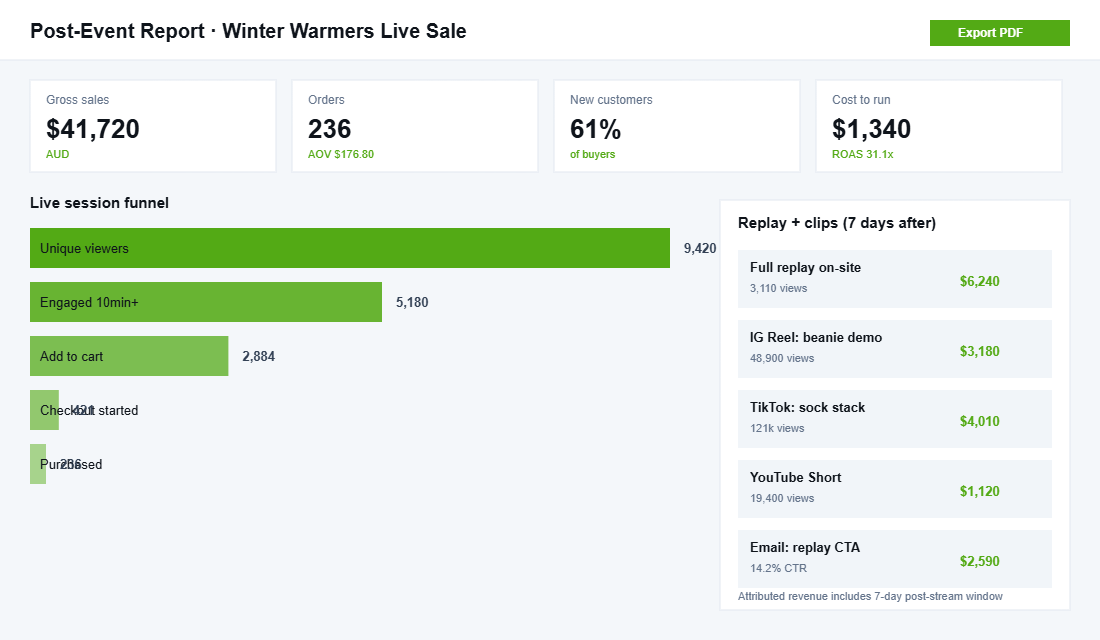
The Replay Is Where the Real Money Is
Founders judge a live stream by what sells during the broadcast. That is a mistake. A single 45-minute session is a content factory. One stream gives you the full shoppable replay, a dozen short clips for Reels and TikToks, product demo footage for your PDPs, and honest customer questions you can turn into FAQ copy.
A well-cut 30-second clip from your beanie demo can outperform the live session that produced it, because it reaches people who were never going to sit through 45 minutes. The live event captures your hot audience in real time. The clips harvest the much larger cold audience for weeks afterwards. If you want a system for turning that footage into on-site sales, pair this with our product video playbook and put the best moments on the pages that already get traffic.
Do not overlook the questions either. Every “will this shrink in the wash?” is a real objection from a real buyer. Feed those into your product copy, your email flows, and your UGC pipeline, and your whole funnel gets sharper off the back of one stream.
The Mistakes That Kill a Live Stream
Most first streams underperform for the same handful of reasons. Knowing them in advance saves you a wasted session.
- Selling from minute one. If you pitch before the room fills, you pitch to nobody. Give it five minutes of warm-up first.
- No live-only reason to buy now. Without a time-boxed code or bundle, viewers bookmark you and never come back. Urgency has to be real.
- Hosting solo. A host reading comments while demonstrating a product does neither well. You need a second person on comments and product pins.
- Featuring too many products. Ten items in 30 minutes is a blur. Pick a hero and two or three supports, and go deep, not wide.
- Treating the replay as an afterthought. If you do not cut clips and repost the session, you throw away most of the value the moment you end the stream.
- Running it once. A single stream is a test, not a channel. The results compound only if you show up on a schedule.
How It Compounds Into a Channel
Here is the shift. Your first live stream will feel clunky and might sell modestly. That is fine, because live shopping is not a tactic you try once. It is a muscle. Session two is smoother. By session five you have a hosting rhythm, a run sheet your audience recognises, a library of clips working around the clock, and a growing group of regulars who show up because they know the code drops at minute 30.
Now stack the pieces. Reach comes from streaming natively on TikTok or Instagram. Conversion comes from the on-site experience and the run sheet. Retention comes from the replay and the clips. Lower returns come from buyers seeing exactly what they are getting. And every session feeds your email, SMS, and content engine for the next one. That is not a stunt. That is a channel that gets cheaper and better the longer you run it, while your competitors are still deciding whether to bother.
Start smaller than feels impressive. One host, one phone, one strong offer, one 30-minute stream to your existing list. Run the same shape four weeks in a row and measure it honestly. That is how a webcam turns into a revenue line.
Inside eCommerce Circle, building live shopping into a repeatable channel is one of the promotion pillars we work on with members who want to lower their reliance on paid ads. If you want a second opinion on where live selling fits your store, let’s talk.