When was the last time you bought something from your own store? Not a test order through the Shopify admin with a 100 percent discount code. A real order, on your phone, with your own card, shipped to your own front door.
What’s in This Article
Most founders cannot remember. They know their dashboard cold: sessions, conversion rate, average order value, blended ROAS. But they have not sat in the seat their customers sit in every single day. They have never timed their own shipping confirmation or watched their own tracking link fail on a phone.
That gap is where repeat orders quietly die. Stord’s 2025 Mystery Shopping Report placed real orders with leading DTC brands across four industries and found that only 34 percent of orders arrived when the brand promised they would. Fewer than half arrived on time or early. These are funded, professional operations. The odds say your store has leaks too, and this playbook shows you how to find them for the cost of one product and a return postage label.
Why You Are the Worst Judge of Your Own Store
You built the store, so you cannot browse it like a stranger. You know which menu hides the size guide. You browse on a fast desktop connection, logged in, with your address autofilled and a staff discount that skips the exact moment where most customers hesitate: paying full price plus shipping.
Your customers get none of those advantages. They arrive on a phone, on mobile data, mid-scroll, with seven other tabs open. Customer experience research consistently finds that as many as 89 percent of consumers will switch to a competitor after a single bad experience. They will not file a bug report on the way out. They just never come back, and your dashboard records it as nothing at all.
The stakes are highest after the buy button. Australia Post’s 2026 eCommerce Report found 8 in 10 Aussie shoppers say the delivery experience shapes their satisfaction with shopping online, and 3 in 4 say a good delivery experience makes them shop online more. The part of your funnel you look at least is the part your customers weight most.
What a Mystery Shop Actually Is (and What the Data Says You Will Find)
Bricks-and-mortar retail has run mystery shoppers for decades: trained buyers who walk into a store, act like normal customers, and score the experience against a checklist. The best Australian retailers treat this as core discipline, not a nice-to-have. Mecca topped KPMG’s Customer Experience Excellence report for Australia in 2024 and has held a top ten spot since 2021 alongside Bunnings and Chemist Warehouse, and that consistency comes from relentlessly inspecting the experience, not assuming it.
Online, the same idea applies end to end: find the store, buy, wait, unbox, ask for help, return. When Stord ran exactly that exercise on established US brands in 2025, the results were rough. Only 1 percent of brands showed an estimated delivery date at checkout even though 58 percent of shoppers want an exact date before they commit. 40 percent made no delivery promise at all. 93 percent never sent an abandoned cart reminder, despite 42 percent of shoppers saying a reminder would bring them back. And 12 percent of products arrived damaged.
Every one of those failures is invisible from inside the Shopify admin. All of them are visible to a mystery shopper within one order cycle. That is the entire pitch: one real order, honestly scored, will tell you more about why customers do not come back than a month of staring at analytics.
The 5-Lap System at a Glance
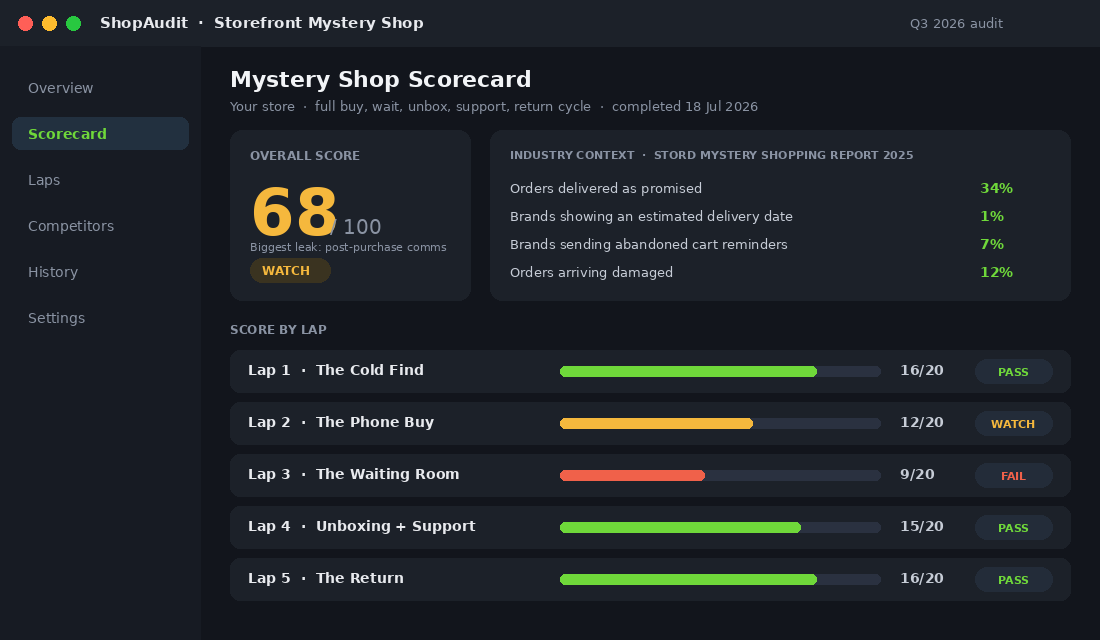
Run the shop as five laps, in order, over roughly two weeks. Each lap has five checks worth four points each, which gives you a clean score out of 100.
- Lap 1: The Cold Find. Search for your product category like a stranger and score how you show up.
- Lap 2: The Phone Buy. Complete a real purchase on a phone, on mobile data, with a real card.
- Lap 3: The Waiting Room. Timestamp every message between payment and delivery.
- Lap 4: The Unboxing and the Support Probe. Score the box, then test your own support response times.
- Lap 5: The Return. Send the item back through the normal customer flow and time the refund.
Lap 1: The Cold Find (Search Like a Stranger)
Open an incognito window on your phone and search the way a new customer would: category first, not brand. Think “mens linen shirt australia” or “natural deodorant sensitive skin”, not your store name. Note who owns the results. Are you in the organic listings, the Shopping results, the ads? Which competitors appear above you, and what do their review stars say?
Then land on your own store cold and start a five second timer. Can a stranger tell what you sell, who it is for, and why you over the next tab? Did a popup smother the screen before the page finished loading? How long did the homepage take on 4G? Slow loads and instant popups are the two most common Lap 1 failures we see, and founders never experience either because they browse on office wifi with the popup already dismissed.
Score the five checks: search visibility, load speed on mobile data, popup timing, five second clarity, and mobile navigation. If competitors outrank you at this lap, fold what you find into the deeper teardown in our Shopify competitor analysis playbook.
Lap 2: The Phone Buy (Real Money, Real Card, Real 4G)
Now buy something. Full price, real card, your home address, on mobile data. No staff discount, because the discount skips the exact psychology you are trying to test. Industry benchmarks put average cart abandonment around 73 percent, and 48 percent of abandoners blame extra costs that appeared late. You want to feel the moment those costs appear on your own store.
On the product page, check whether a stranger could answer the four pre-purchase questions without leaving: what does shipping cost, when will it arrive, what do other buyers say, and what happens if it does not work out. At checkout, look for an estimated delivery date. Stord found only 1 percent of brands show one while 58 percent of shoppers want an exact date, which makes this one of the cheapest conversion wins available in 2026.
Before you complete the purchase, run the abandonment test. Load a cart using a second email address, get to the payment step, then close the tab. If no reminder lands within four hours, you are with the 93 percent of brands leaving that revenue on the table. Then go back on your main email and finish the order, noting every payment option offered and every field you had to type that autofill should have handled.
Lap 3: The Waiting Room (What Happens After You Pay)
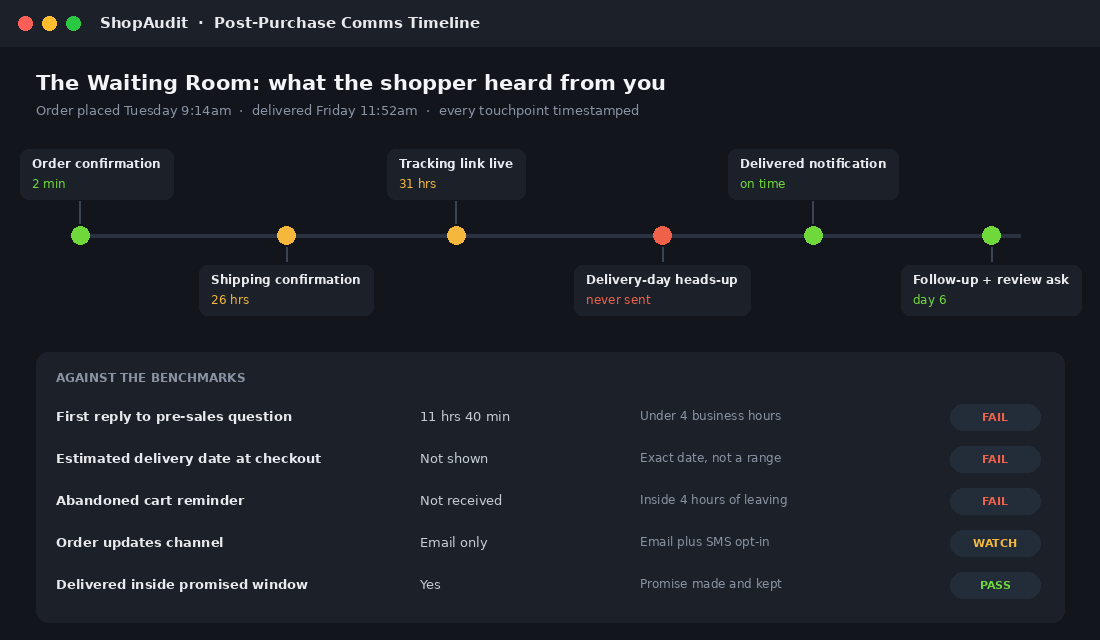
This is the lap founders skip and the lap where Stord’s report card got ugliest. From the second you pay, timestamp everything. The order confirmation should land within minutes. The shipping confirmation should land within 24 hours of the label being created, with a tracking link that actually works on a phone.
Then note what never arrives. A delivery day heads-up. An SMS option, which 56 percent of shoppers prefer for order updates while only 12 percent of brands offer it. A delivered confirmation. A follow-up that asks how it went. Every silent day in the waiting room generates “where is my order” tickets that cost around 5 dollars each to answer, and it is the single biggest driver of one-and-done customers.
If your waiting room comes back thin, the fix is already written up in our order tracking page playbook: a branded tracking page plus a six touch notification flow you can stand up in an afternoon.
Lap 4: The Unboxing and the Support Probe
When the parcel lands, film the opening on your phone before you touch anything. Score the box the way a first-time customer would: did it survive the courier, does the inside feel like your brand or like a 3PL shelf, is there an insert, a sample, or anything that invites a second order? Stord found 12 percent of products arrived damaged and only 36 percent of brands included any insert or sample at all, so the bar for standing out in an Aussie mailbox is genuinely low. If your box fails this lap, the unboxing experience playbook is the fix.
While you wait for delivery, run the support probe from your second email address. Send one pre-sales question a real customer would ask, and one “where is my order” message. Time the first useful reply, not the auto-responder. Under four business hours is a solid standard for a small team; the best Aussie operators are far quicker. LSKD, the Queensland activewear brand, uses Gorgias AI agents to hold first responses under a minute around the clock.
Read your own replies with fresh eyes too. Do they sound like your brand, or like a template from 2019? Does the answer actually resolve the question, or does it bounce the customer to a policy page?
Lap 5: The Return (Where Loyalty Is Won or Lost)
Now return the item through the normal customer flow, not by walking it to your warehouse shelf. Could you find the returns policy from the order confirmation email in under a minute? Is there a self-serve portal, or does the process start with an email chain? Who pays for the label, and how clearly is that stated before purchase?
Stord found 12 percent of brands published no returns policy at all and 10 percent charged restocking fees of up to a quarter of the item price. In Australia the baseline is higher because Australian Consumer Law guarantees remedies for faulty goods regardless of your policy, so your policy is really about change-of-mind returns. Make it findable, make it plain English, and time how many business days the refund takes to land back on your card. That number is what your customer quotes in their review.
Score the five checks: policy findability, portal quality, label clarity, refund speed, and whether anyone tried to save the sale with an exchange or store credit offer before defaulting to a refund.
Score It: The 100-Point Scorecard
Score each check 0, 2, or 4: zero if it failed, two if it happened but felt generic, four if it genuinely impressed. Five checks per lap, five laps, 100 points. Above 80 you are in strong shape and tuning details. Between 60 and 79 you have real leaks, usually in the waiting room. Below 60 you are actively paying acquisition costs to create one-and-done customers.
Do not try to fix everything. Rank the failures by cost-to-fix against impact, and take the top three. In most first runs the same three surface: no estimated delivery date at checkout, no abandoned cart reminder inside four hours, and a silent waiting room between shipping confirmation and delivery. All three are afternoon jobs, not projects.
Run the Same Five Laps on Two Competitors
Here is where the exercise turns into market research. Pick the two competitors your customers actually cross-shop, and run the identical five laps with the same scorecard. Budget a couple of hundred dollars for product you can photograph, learn from, and gift to a customer later. It is the cheapest competitive intelligence you will buy all year.
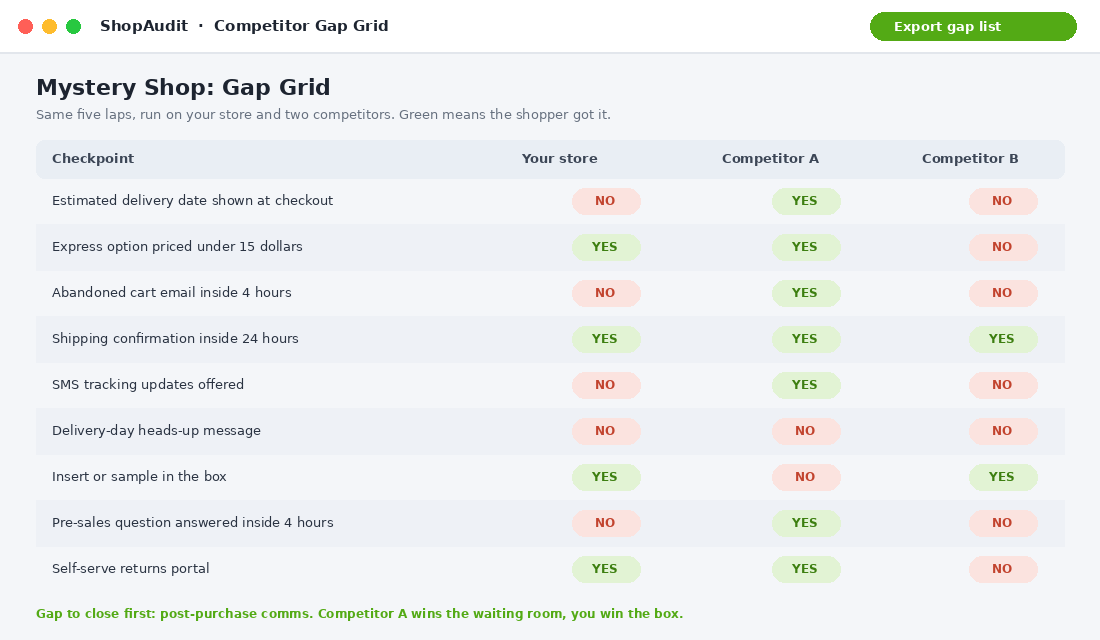
Build a gap grid: every check as a row, your store and both competitors as columns. You are looking for two lists. Gaps to close, where a competitor beats you on something shoppers notice, like showing a delivery date or answering pre-sales questions inside an hour. And gaps to exploit, where the whole category is silent and the first brand to move owns the advantage. Stord’s data says entire categories fail at delivery promises and cart recovery, so expect more open ground than you think.
The Tool: Record Every Lap With Loom
Memory is a terrible auditor, so record everything. Loom is the simplest kit for the job and the free plan covers a full mystery shop. Here is the setup:
- 1. Install Loom. Grab the Chrome extension for desktop laps and the iOS or Android app for the phone buy. The free plan includes 25 videos, which is plenty.
- 2. Record Laps 1 and 2 with your mic on. Narrate what you notice as you search, browse, and buy. The thinking-out-loud commentary is where the insights live.
- 3. Film the unboxing with your phone camera. One continuous take from sealed parcel to products on the bench.
- 4. Paste the video links into your scorecard sheet. One row per check, one link per lap, timestamps for the moments that hurt.
- 5. Run a 15 minute team review. Play the worst three moments, agree the top three fixes, assign owners and dates before the meeting ends.
Make It a Ritual, Not a One-Off
One mystery shop is a diagnosis. A quarterly mystery shop is an operating system. Book four shops a year in the calendar now, plus one extra about six weeks before BFCM, because peak season magnifies every waiting room failure you have. With online spend hitting 82.6 billion dollars in 2025, up 14 percent year on year according to Australia Post, the brands that keep winning Aussie wallets are the ones inspecting their own experience while everyone else assumes.
Rotate the details each quarter: a different product, a different postcode if you can manage it, a bundle or gift card order to test the edge cases. And every second run, hand the job to someone outside the business, a mate or your most honest customer, because by run three you will have your own blind spots about your blind spots.
Four Mistakes That Ruin a Mystery Shop
- Announcing it to the team. Tell them a shop happened after the fact, not before. You are auditing the system on a normal day, not the team on their best day.
- Using your staff account. Admin previews, discount codes, and shipping to the office all skip the exact friction you are paying to find. Real card, full price, home address.
- Judging only the website. Your site is the polished half. Stord’s data shows the report card collapses after the buy button, so weight the waiting room, the box, and the return just as heavily.
- Doing it once and filing it. A score with no fix list is trivia. Fix the top three, book the next shop, and track whether the score moves.
The Compound Effect: What Fixing the Leaks Is Worth
Take a store doing 150 thousand dollars a month. Adding an estimated delivery date at checkout and a cart reminder inside four hours are both conversion levers aimed at the biggest documented abandonment drivers, and together a 6 to 8 percent relative lift in checkout completion is a conservative outcome. That is roughly 9 to 12 thousand dollars a month you were already paying to acquire.
Then the waiting room fixes go to work on retention. When 3 in 4 shoppers say a good delivery experience makes them shop online more, a repeat rate that climbs even two points on a 28 percent base compounds every quarter after. Stack the support tickets you stop generating at 5 dollars each, and two afternoons of mystery shopping per quarter is comfortably a six figure decision over a year.
The real compounding is cultural. Once you have watched your own brand go silent for three days while a customer waits, you stop debating whether post-purchase experience matters and start shipping fixes. That mindset shift outlasts any single score.
Your 30-Day Mystery Shop Rollout
- Week 1: Set up the scorecard sheet, install Loom, then run Laps 1 and 2: the cold find and the phone buy, with the abandoned cart test from a second email.
- Week 2: Work Lap 3 and the support probe. Timestamp every message, send the two test questions, log first reply times.
- Week 3: Unbox on camera, run the return, then score all 100 points and pick your top three fixes.
- Week 4: Ship the three fixes, run Laps 1 to 3 on two competitors, build the gap grid, and book next quarter’s shop in the calendar.
You do not need permission, budget approval, or an agency to do any of this. You need one order, one return, and the willingness to see your store the way a stranger does.
Inside eCommerce Circle, experiencing your store the way your customers do is one of the core disciplines we work on with every member. If you want a second opinion on what your mystery shop turns up, let’s talk.