Every August the same thing happens in Aussie ecommerce. A founder opens last year’s November sales report, adds thirty percent, emails the number to their supplier, and goes back to working on ad creative. Freight gets treated as a shipping problem to solve later.
What’s in This Article
Three months later half of those founders are on the phone to a forwarder begging for air freight space at eight to ten times the sea rate. The other half are sitting on a container that cleared customs in January for a sale that finished in November. Same root cause. Freight was never planned as a revenue decision.
The stakes are not small. Australians spent a record $6.8 billion over the 2025 Black Friday weekend, up 4 percent year on year, with around six million shoppers taking part, according to the Australian Retailers Association and Roy Morgan. If your stock lands on 2 December you did not take part in any of it. And globally, out-of-stocks alone cost the average retailer 4.1 percent of revenue according to IHL Group research. That is not a rounding error on a store doing $200k a month.
This is the six-step system we use with members to get peak stock on the shelf on time, at sea freight prices, without the November panic.
Step 1: Build the Plan Backwards From Sell-Through, Not Forwards From Today
Most stock plans start with the wrong question. The question is not “when can my supplier ship?” It is “what date does this stock need to be sellable on my site?”
Work backwards from that date and every deadline upstream becomes a hard number instead of a hope. For a Black Friday launch on 28 November 2026, a realistic chain from a Chinese supplier into a Melbourne 3PL looks like this:
- Production: 30 to 45 days. Longer if you are tooling anything new, longer again if your factory takes Golden Week in early October.
- Sea freight Shanghai to Melbourne: 20 to 27 days FCL, 21 to 31 days for LCL. Transshipment routes through Singapore add roughly 10 days but cost less.
- Port clearance and biosecurity: 3 to 10 days. DAFF inspections on timber, food and animal-derived goods are strict and unpredictable. Assume the top of the range.
- 3PL receive and putaway: 3 to 7 days. Longer in October and November when every warehouse in the country is jammed.
- Live on site buffer: 21 days minimum. This is the number founders cut first and regret most.
Add it up and you are looking at roughly 90 days of lead time before a single unit is sellable. Counting back from 28 November puts your order-by date in the last week of August. Not September. Not “after we see how October trades”.
Two dates on the Chinese calendar will wreck this plan if you ignore them. Golden Week runs the first week of October and most factories lose seven to ten working days around it. The weeks either side are also the busiest booking period of the year out of Shanghai and Ningbo, so space tightens and rates climb at exactly the moment you have the least slack. If your production window touches early October, add ten days and book your space early.
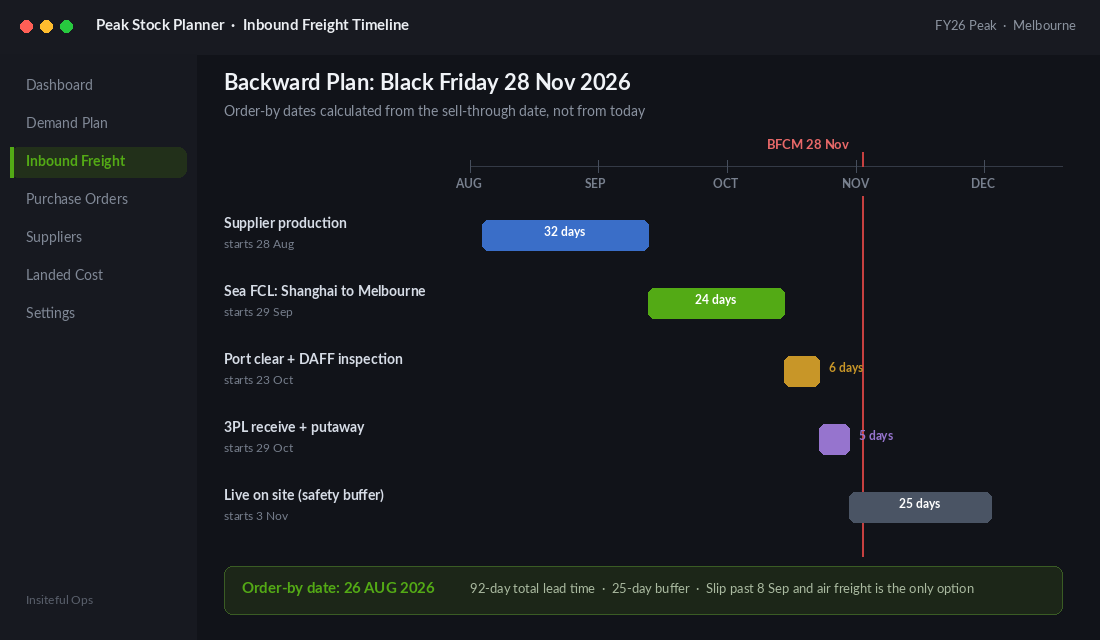
Build this once in a spreadsheet with your real supplier lead times and it becomes the calendar you run every peak. The single most useful output is one date: the day after which sea freight stops being an option.
Step 2: Price All Three Freight Modes in August, Not November
Freight is not one price. It is three prices with three timelines, and you should know all three before you commit to a purchase order quantity.
Rates move fast and they move against you at exactly the wrong time of year. In July 2026, FCL container rates into Melbourne jumped roughly 49 percent month on month to USD $4,365 to $5,335 for a 40ft container on an Oceania capacity crunch, while Drewry’s World Container Index sat at $4,255 per 40ft as at 30 July 2026. Quotes are typically only valid for two to three weeks. A rate you were shown in June means nothing in September.
Get all three quoted on the same purchase order and put them side by side:
- Sea FCL. Cheapest per unit once you fill roughly two thirds of a container. Slowest to book in peak because space sells out.
- Sea LCL. Higher per cubic metre, but you pay for what you use. Add 5 to 7 days for consolidation and deconsolidation at both ends.
- Air freight. Six to eight days door to door and commonly seven to ten times the per-unit cost of sea. Priced per chargeable kilo, so volumetric weight matters more than actual weight.
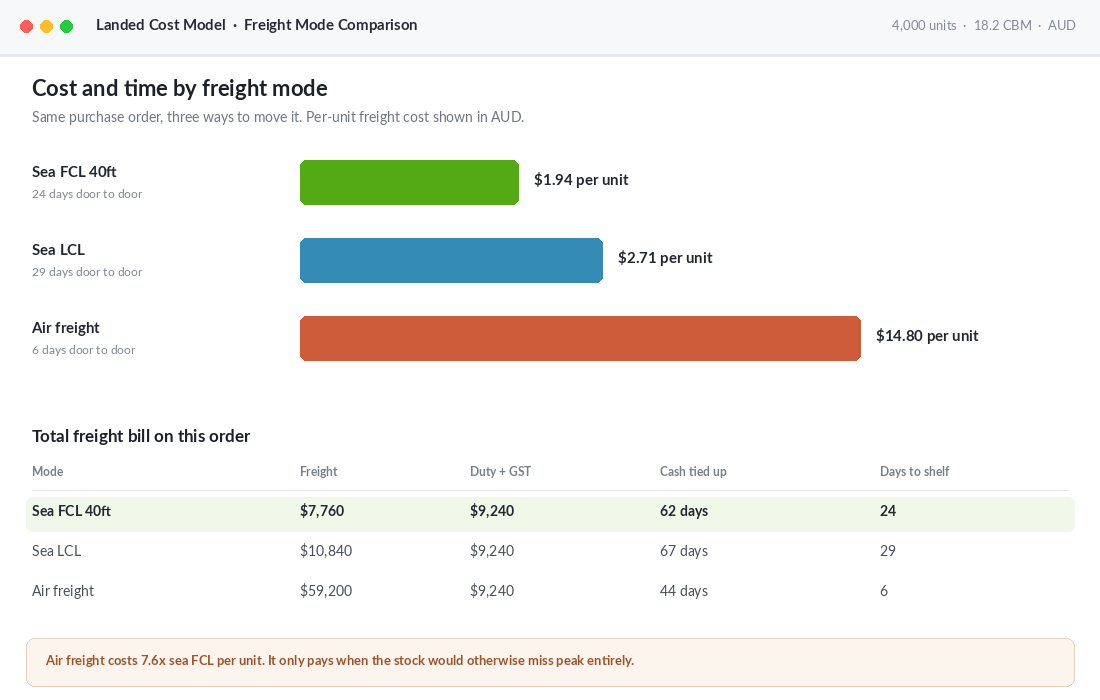
The point of doing this in August is not to pick the cheapest option. It is to know precisely what the expensive option costs, so that when a supplier slips you can make a calm decision with a number in front of you instead of a guess.
Step 3: Split the Order So One Delay Cannot Take Out Your Peak
Single-shipment peak planning is the most common unforced error we see. One factory, one container, one vessel, one arrival date. Everything you will sell in November riding on one thing going right.
Split it instead. A structure that works well for brands in the $50k to $500k a month range:
- Roughly 70 percent on the early sea shipment. Ordered in August, landing mid to late October. This is your core range and your best sellers.
- Roughly 20 percent on a second sea shipment four to six weeks later. This covers the demand signal you get from October trading, which is far more accurate than an August forecast.
- Roughly 10 percent held as an air freight option you have already priced and can trigger on a phone call. You may never use it. Pricing it is free.
The second shipment is where the real money is. By mid-October you know which colourway is running hot and which one is dead. Committing 100 percent of your peak buy in August means committing 100 percent of it blind.
How to decide what goes in the second shipment
Do not guess. Set the decision rule in August and let October data answer it. Rank every SKU by revenue in the first three weeks of October, then look at sell-through rate rather than raw units. A SKU doing 40 units a week off 300 units of cover is a very different problem to one doing 40 units a week off 900.
Anything selling through faster than your remaining weeks of cover goes in the second shipment. Anything tracking under half its forecast does not, no matter how much you personally like the product. That one rule stops more January discounting than any other habit we teach.
Splitting also protects your cash. Two smaller payments six weeks apart is a very different working capital profile to one large one, particularly when duty and GST land at the same time as the freight invoice. If your cash conversion cycle is already stretched, read our cash conversion cycle playbook alongside this one.
Step 4: Put Time Into Your Landed Cost Model
Most landed cost models stop at dollars. Unit cost, freight, duty, GST, done. That model will happily tell you air freight is a terrible idea in every scenario, which is wrong.
Add two columns and the model starts making better decisions for you:
- Days to shelf. How long from payment until the unit can be sold. Sea FCL might be 24 days on the water but 62 days from deposit to sellable.
- Cash tied up. Deposit, balance, freight, duty and GST, multiplied by the days each sits before the stock converts to revenue.
Once time is in the model the maths changes. Four thousand units on sea FCL might cost $1.94 per unit in freight against $14.80 by air. That looks like an easy call. But if the sea option lands on 5 December and the air option lands on 12 November, the sea option is not cheaper. It is $0 in peak revenue plus a warehouse full of stock you will discount in January.
Air freight is not a failure. It is an insurance product with a known premium. The failure is not knowing the premium until you are forced to buy it. For the full cost breakdown including duty, GST and the fees forwarders do not volunteer, work through our landed cost playbook.
Step 5: Write the Freight Trigger Table Before You Need It
Decisions made under pressure in November are bad decisions. So make them in August and write them down.
A freight trigger table is one page that says, in advance, exactly what you will do at each slip point. It removes the argument and the hesitation:
- Supplier confirms production complete by 26 September. Proceed with booked sea FCL. No action.
- Production slips 1 to 7 days. Proceed with sea. Buffer absorbs it. Notify the 3PL of the revised ETA.
- Production slips 8 to 14 days. Split the shipment. Send the top 5 SKUs by forecast revenue via air, the balance by sea.
- Production slips more than 14 days. Full air freight on the core range, and cut the peak offer to what will actually be on hand.
- Vessel delayed or rolled at transshipment. Trigger the air option on best sellers immediately. Do not wait for a revised ETA, they are almost always optimistic.
Send this to your forwarder and your supplier in August so nobody is surprised. Forwarders respond very differently to a client who booked contingency space in advance versus one calling in a panic in the second week of November when every pallet position out of Shanghai is already sold.
Pair the trigger table with your promotional plan. If you know by 20 October that a SKU will not land, you can build your peak offer around what you actually have rather than promising what you hoped for. That connects directly to how you structure the offer itself, which we covered in the peak offer architecture playbook.
Step 6: Track Inbound Stock the Way You Track Ad Spend
You check your ad account daily. Most founders check inbound stock when someone asks where an order is. That asymmetry costs more than the ad account ever will.
Every open purchase order needs four numbers visible in one place: units, ETA into your warehouse, weeks of cover it buys, and status against your cut-off date. Update it weekly. Fifteen minutes.
Weeks of cover is the number to watch, not units on hand. Two thousand units sounds comfortable until you notice the SKU is selling 400 a week and the replacement container is 31 days out. Cover converts stock into time, and time is what your freight decisions actually run on.
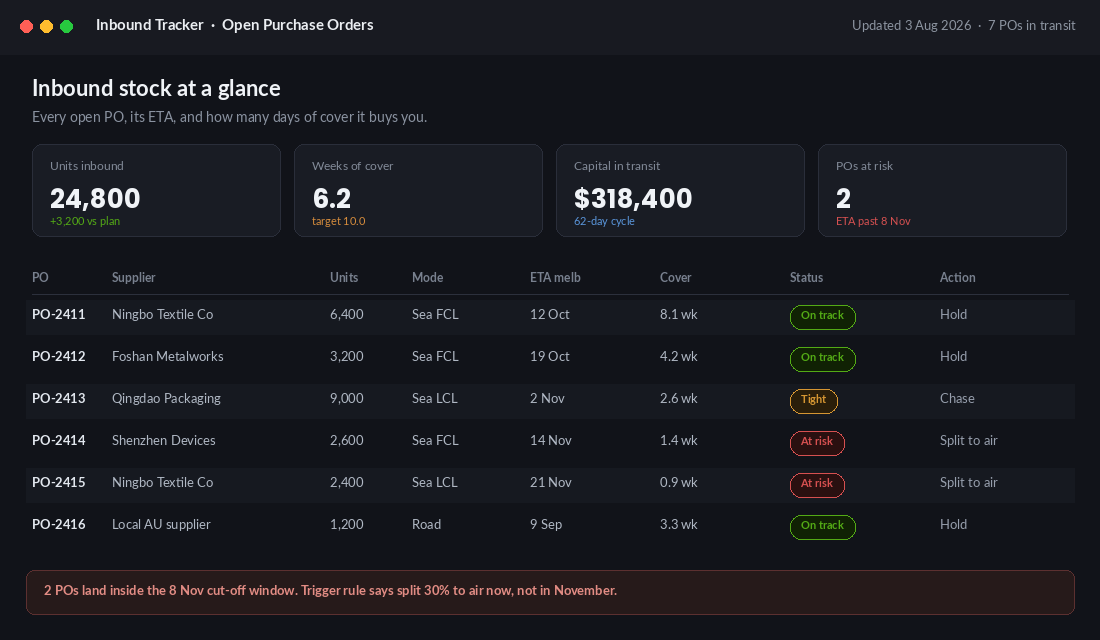
You do not need enterprise software to do this. A Google Sheet works. But if you are carrying more than about forty SKUs, a purpose-built tool pays for itself in one avoided stockout:
- Inventory Planner by Sage. The most established option for Shopify. Strong on seasonality and multi-location.
- Fabrikatör. Forecasts at SKU level from your sales history and automates purchase order creation with supplier lead times and costs attached.
- Cogsy. Good for smaller catalogues where cash-aware ordering matters more than deep forecasting.
Getting a useful setup in under an hour
- Install the app and connect your Shopify store, then let it pull at least 12 months of sales history so it can see last peak.
- Enter real supplier lead times per supplier, not per product. Use the number your supplier actually hit last time, not the one on their quote.
- Add freight transit days as a separate lead time component so you can model sea against air without rebuilding the forecast.
- Set safety stock as weeks of cover, not units. Ten weeks heading into peak, four to six weeks the rest of the year.
- Turn on a weekly replenishment email to yourself every Monday. That email is the whole point.
The Three Dates Your 3PL Will Not Volunteer
Australian warehouses run out of capacity before Australian brands run out of stock. Most founders find this out in the second week of November, when a container is sitting at the port and the 3PL cannot book a receiving slot for eleven days.
Ask your 3PL for three dates in writing, now, while they are still answering emails properly:
- Their inbound receiving cut-off for peak. The last date they will guarantee putaway within their normal service level. It is often earlier in November than you expect.
- Their peak surcharge start date. Many warehouses apply seasonal receiving and storage surcharges from late October. Budget for it rather than discovering it on the invoice.
- Their last dispatch dates by carrier. Australia Post, StarTrack and the courier networks all publish different Christmas cut-offs, and metro and regional differ by several days. These dates should drive your on-site messaging, not the other way around.
Then give them something back. Send your expected inbound volumes and ETAs by week. A 3PL that can plan labour around your container will find you a slot. One that gets surprised by a 40ft arrival will put you in the queue behind the clients who told them.
If you are dealing with a supplier whose lead times keep slipping, the conversation to have is about terms and reliability rather than unit price. Our supplier negotiation playbook covers how to open that one without damaging the relationship.
Your Inbound Freight Checklist
Print this and work it in order. It takes an afternoon, and it is the most valuable afternoon you will spend this quarter.
- Set your sell-through date and count backwards to a hard order-by date.
- Get sea FCL, sea LCL and air quotes on the same purchase order, in writing, with validity dates noted.
- Split the buy roughly 70 / 20 / 10 across early sea, late sea and a priced air option.
- Add days to shelf and cash tied up as columns in your landed cost model.
- Write the freight trigger table and send it to your supplier and forwarder.
- Confirm your 3PL’s receiving capacity and cut-off dates for October and November in writing.
- Stand up a weekly inbound review. Same day each week, fifteen minutes.
- Diarise a 20 October decision point to trigger the air option or stand it down.
Why This Compounds
Any one of these steps helps. Run all six and something bigger happens.
Backward planning gives you a real deadline. Pricing three modes early gives you options instead of ultimatums. Splitting the order turns your October sales data into a buying advantage rather than a source of regret. Putting time into the landed cost model means you can justify air freight when it is genuinely the right call, and refuse it confidently when it is not. The trigger table removes emotion. Weekly tracking means you find problems in October when they are cheap to fix.
The compounding shows up in your stock position twelve months later. Founders who run this system land peak stock on time, sell it at full price, and go into January with clean inventory and cash in the bank. Founders who do not spend December paying air freight premiums on stock they will discount in February, which is exactly how brands end up in the dead stock cycle year after year.
Aussie brands like Who Gives A Crap, which bootstrapped for nine years before raising $41.5 million, and frank green, which now sells through a large physical stockist network alongside its own site, do not treat freight as a back-office task. When you are allocating stock across your own store and retail partners at the same time, arrival dates are a commercial decision made by the people who own the revenue number.
Peak is not won in November. It is won in the last week of August, in a spreadsheet, by someone who bothered to count backwards.
Inside eCommerce Circle, supply planning is one of the core pillars we work on with every member. If you want a second opinion on your peak stock plan before the order-by date passes, let’s talk.