Right now, somewhere in Australia, a Shopify founder is on a call with their supplier committing to Q4 stock. The quantities came from a feeling. Last year sold well, Black Friday is going to be big, and the supplier offered better pricing at 500 units instead of 300. So they took the 500.
What’s in This Article
That single decision, repeated across eight or nine purchase orders between now and late September, is how a profitable brand ends up asset rich and cash poor in February. The revenue looks fine. The bank account does not.
Traditional retail solved this problem decades ago with a discipline called open-to-buy. It is not complicated, it is not software dependent, and almost no DTC founder uses it. Open-to-buy answers one question with a number instead of a vibe: how much stock am I allowed to bring in this month, given what I plan to sell and what I need on hand at the end of it. Australians spent $82.6 billion online in 2025, up 14 per cent year on year, and Black Friday alone accounted for $8 billion of that, so the upside for getting Q4 right is real. The downside of getting it wrong is that carrying cost runs 20 to 30 per cent of inventory value a year, every year, until the stock clears.
Why Gut-Feel Buying Breaks Down in Q4 Specifically
Buying on instinct works well enough for most of the year because the mistakes are small and self-correcting. Order a bit too much in March, you sell through it by May. Order too little, you place a top-up and lose three weeks of sales on one line.
Q4 removes both safety nets. The sales curve is steep and short, so a two week stockout in the middle of November is not a delay, it is permanently lost revenue. And the money moves in the wrong order. You pay deposits in August, balances in September, freight in October, and you do not see the cash come back until late November at the earliest.
IHL Group put the global cost of inventory distortion, meaning overstocks plus out-of-stocks combined, at $1.73 trillion a year, roughly 6.5 per cent of global retail sales. Around two thirds of that is lost sales from stockouts and one third is the carrying cost of stock nobody wanted. Most Aussie founders I work with are fully exposed to both sides of that number at the same time: sold out of the three lines that mattered, sitting on eleven that did not.
Open-to-buy fixes this by forcing you to spend a fixed pool of money rather than an open-ended one. The constraint is the point. When the budget is finite, the conversation shifts from “should we take the 500” to “if we take the 500, what are we not buying”.
Step 1: Build the Sales Plan Before You Build the Stock List
Everything downstream depends on this, and it is the step most founders skip because it feels like guessing. It is not guessing if you build it from last year’s actual weekly data.
Pull last year’s revenue by week from Shopify Analytics for October through January. Do not use monthly totals, they hide the shape. You need to see that the week containing Black Friday probably did four to six times a normal week, that the first ten days of December were strong, and that everything fell off a cliff around 18 December once shipping cut-offs hit.
Then build this year’s plan in four moves:
- Start with the base. Take last year’s weekly actuals as the starting shape. Not the total, the shape.
- Apply a growth factor you can defend. If your trailing six months are running 22 per cent above the same period last year, plan Q4 at 22 per cent, not 60. Shopify merchants collectively grew Black Friday Cyber Monday sales 27 per cent in 2025 to $14.6 billion, but that is the aggregate of every brand on the platform, not a forecast for yours.
- Adjust for what actually changed. New product line launching in October, add its plan separately. Lost your best performing ad account, take it down. Range you have discontinued, remove the revenue.
- Split the plan by category. Outerwear, accessories, gifting, replenishment staples. You buy by category, so you must plan by category.
The output is a table with a revenue number for each category for each month, October to January. Convert each to a cost number using your true landed cost, not your supplier invoice price. If you have not built that number properly, our Shopify landed cost playbook walks through the freight, duty and handling components most founders leave out.
Step 2: Set a Closing Stock Target for Every Month
This is the number that stops the plan being purely a sales fantasy. For every month, you decide how much stock you want left standing at the end of it.
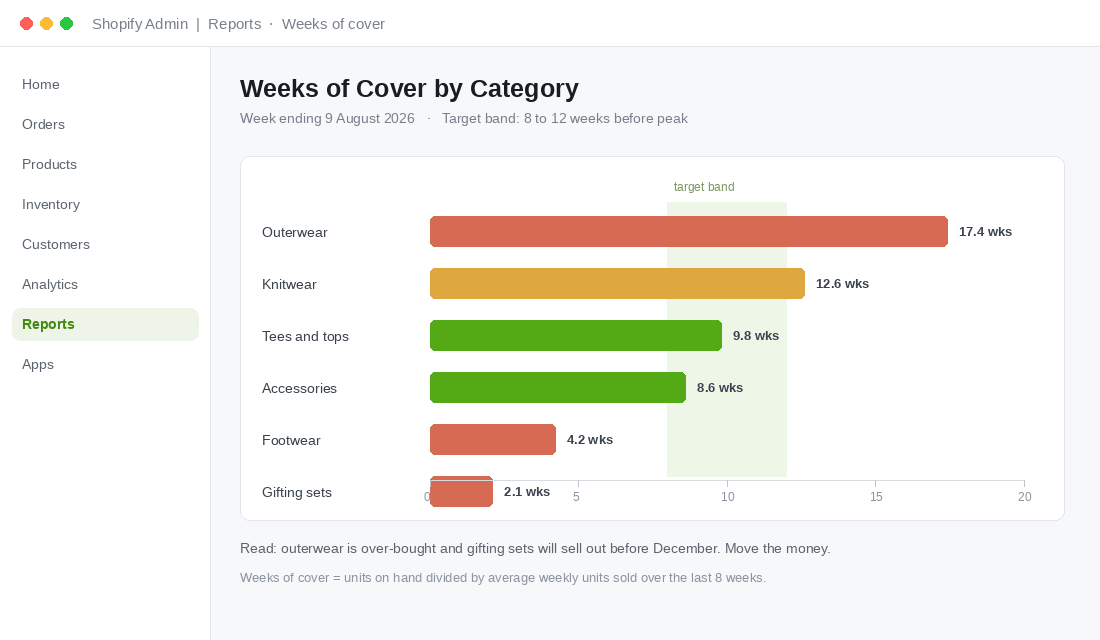
The cleanest way to set it is weeks of cover: how many weeks of forward demand your closing stock represents. If November is going to sell 400 units a week on a line and you want four weeks of cover going into December, you need 1,600 units on hand at the end of November.
Sensible targets for an Australian DTC brand buying offshore:
- End of September: 10 to 14 weeks of cover. You are loading for the peak and your next container is a long way off.
- End of October: 8 to 12 weeks. Everything you intend to sell in November should already be in the warehouse or on the water.
- End of November: 4 to 6 weeks. Enough for December, not enough to be a January problem.
- End of December: 3 to 5 weeks. You want to walk into the new year light.
Founders consistently set the December target too high because running out feels worse than being overstocked. It is not. Stock left on 31 December has already cost you the deposit, the freight, the duty and the storage, and it will almost certainly be discounted to move. Being 5 per cent short in the last week of December costs you far less than being 30 per cent long in January.
Step 3: Run the Open-to-Buy Calculation
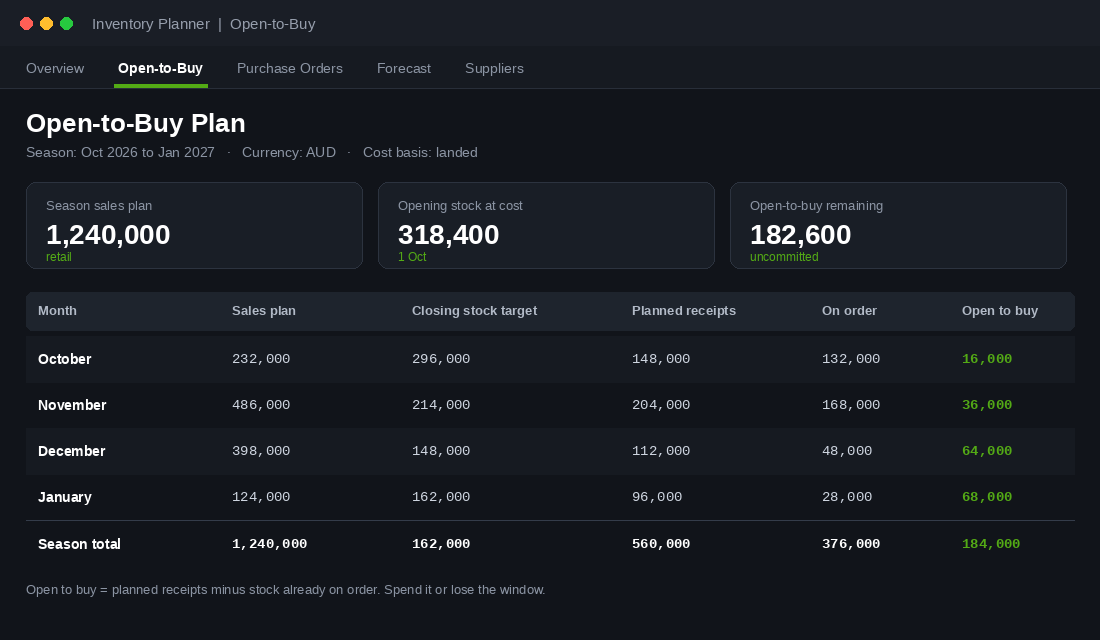
Here is the entire formula. It has four inputs and one output, and it works at category level, monthly.
- Planned closing stock (at cost, from Step 2)
- plus planned sales (at cost, from Step 1)
- minus opening stock (what you actually have on 1 October)
- minus stock already on order (purchase orders placed but not yet landed)
- equals open to buy (what you are still allowed to commit)
A worked example for a single category in November. Planned closing stock at cost is $214,000. Planned November sales at cost are $486,000. Opening stock on 1 November is $296,000. You already have $168,000 landing from an August purchase order. Open to buy is 214,000 plus 486,000 minus 296,000 minus 168,000, which equals $236,000.
That is your budget for November receipts in that category. Not a target, a ceiling. If a supplier offers a volume break that pushes you to $290,000, the answer is not “the pricing is too good to pass up”. The answer is that you need to find $54,000 of open-to-buy somewhere else, which means cutting a different category, or the deal does not happen.
Two rules keep the maths honest. First, everything is at landed cost, never at retail. Mixing the two is the single most common error and it will overstate your buying capacity by your entire gross margin. Second, a purchase order counts against the month it lands, not the month you place it. A container ordered in August that arrives on 4 November is November’s budget.
Step 4: Split the Budget by Role, Not by Excitement
Once you have a number, the temptation is to spend it on whatever the team is most excited about. That is how you end up with eleven new colourways and a stockout on the product that pays the rent.
Allocate the open-to-buy pool by the job each product does. A workable split for Q4:
- Proven sellers, 55 to 65 per cent. The lines that did the volume last Q4 and are still doing it now. Boring, and they carry the season.
- Gifting and bundles, 15 to 20 per cent. Sets, gift-ready SKUs and price-pointed entry products. These have a hard expiry date, so they need tight quantities and early landing.
- New product, 10 to 20 per cent. Enough to test properly, not enough to sink the season if it misses.
- Reserve, 5 to 10 per cent. Unallocated. This is the money you use in late October when one line is running four times ahead of plan and you can get an air freight top-up in.
The reserve is the piece everyone cuts first and regrets. Holding back even 5 per cent of the budget means you have the option to chase a winner instead of watching it sell out on 12 November. If you want a fuller framework for deciding which products deserve which share of the budget, our Shopify range plan breaks the catalogue into five distinct roles.
Step 5: Turn the Budget Into Cash Dates
An open-to-buy plan that ignores payment timing will still put you in trouble. The budget says what you can commit. The cash calendar says whether you can actually pay for it.
Map every planned purchase order against four dates: deposit paid, balance paid, freight and duty paid, stock available to sell. For an Aussie brand buying out of China, sea freight runs roughly 20 to 27 days port to port into Sydney, Melbourne or Brisbane for a full container, and you should add another 5 to 7 days for customs clearance and delivery to your warehouse or 3PL. Less than container load is slower again, typically 21 to 31 days port to port.
Work backwards from that. For stock you need selling by mid-November, with 30 days production, 25 days at sea and a week to clear and receive, your purchase order needs to be placed and deposited by roughly the first week of September. Anything later is an air freight decision, not a sea freight one.
Build in a buffer, because freight is not behaving predictably. In July 2026 full container rates into Sydney, Melbourne and Brisbane jumped around 49 per cent month on month on an Oceania capacity crunch, so quotes taken in June were not the quotes available in July. Assume your freight line will move and hold contingency for it. Our inbound freight playbook covers how to structure that buffer without over-provisioning.
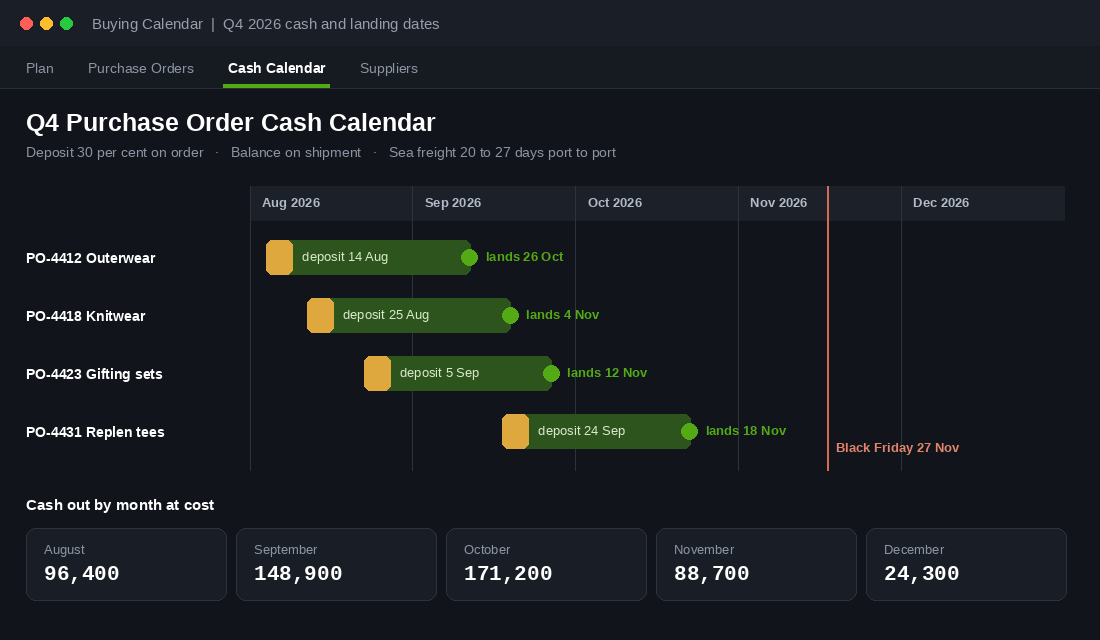
Notice the shape in that calendar. Cash out peaks in October at $171,200 while revenue peaks in late November. That gap is the reason profitable brands run out of money in the strongest quarter of their year. Knowing the size of the gap in August gives you time to arrange a facility, negotiate longer terms, or simply buy less. Finding out in October gives you no options at all.
Step 6: Reforecast Every Fortnight Once the Season Starts
An open-to-buy plan is not a document you write in August and file. It is a number you update. The plan will be wrong by the second week of October, and the point of the discipline is catching that early enough to act.
Every second Monday from 1 October, sit down for 30 minutes and do four things:
- Replace plan with actual. For weeks already gone, swap your planned sales for what actually happened, by category.
- Reforecast the rest of the season. If a category is tracking 30 per cent ahead of plan after three weeks, lift the remaining forecast. If it is 20 per cent behind, cut it. Do not average and hope.
- Recalculate open to buy. The formula gives you a new number. Categories running hot free up budget by selling through. Categories running cold have quietly eaten theirs.
- Move the money. Take budget away from the slow categories and give it to the fast ones. This is the whole payoff.
Two fortnightly reviews in October are worth more than any amount of planning in August, because by then you are working with real demand rather than an estimate of it.
The Three Numbers That Tell You the Plan Is Broken
You do not need a dashboard with 40 metrics. Three numbers, checked fortnightly, will catch almost every buying problem before it becomes a January write-down.
- Sell-through rate by category. Units sold divided by units received, for the season to date. Under 40 per cent by the end of October on a Q4 line means it is not going to clear at full price. Start planning the markdown now, not on Boxing Day.
- Weeks of cover versus target. Anything sitting more than 4 weeks above its target band is overbought and is already costing you carrying cost at 20 to 30 per cent annualised. Anything more than 2 weeks below is heading for a stockout inside the peak.
- Committed versus available open-to-buy. If you have committed more than 90 per cent of your season budget before 1 October, you have no ability to react. That is the number that should make you uncomfortable.
Setting This Up in Inventory Planner This Week
You can run open-to-buy in a spreadsheet, and plenty of good brands do. But once you are past a few hundred SKUs, the manual version breaks down because the opening stock and on-order figures go stale within days.
Inventory Planner by Sage is the most widely used option on Shopify for this, and it has open-to-buy planning built in alongside demand forecasting and automated purchase order recommendations. A realistic setup path:
- Install and connect. Add it from the Shopify App Store and let it sync your full order and product history. Give it a day to pull everything through, and connect any other channel you sell on so the demand picture is complete.
- Fix your cost data first. Set landed cost, not supplier price, on every product. If cost data is wrong, every recommendation the tool produces will be confidently wrong.
- Set lead times per supplier. Enter production days plus transit days plus receiving days as a single lead time. For a China to Australia sea freight supplier, that is realistically 60 to 75 days, not the 30 the supplier quotes.
- Build category groupings. Create the same categories you used in your sales plan so the forecast rolls up the way you buy.
- Start with replenishment, add open-to-buy second. Most brands get value fastest from the purchase order recommendations, then layer open-to-buy planning on top once the team trusts the forecast.
- Set the review cadence. Put a recurring fortnightly calendar block in from 1 October and treat it as unmovable.
Whatever you use, the tool is not the discipline. A spreadsheet you actually update every fortnight beats a subscription you log into twice.
Why This Compounds Beyond One Season
The obvious win is that you finish Q4 with less dead stock. The bigger win is what happens to the rest of the business when your buying is on a budget.
Cash frees up first. Stock you did not buy in September is cash available in February, which is when you want to be funding new product development and testing new acquisition channels rather than nursing a discount campaign to clear leftovers.
Then margin improves, because you stop discounting to fix buying mistakes. Most brands’ January and February promotions are not a marketing strategy, they are an inventory apology. Buy to a budget and those campaigns become optional, which means your full price sell-through rises across the whole catalogue.
Supplier relationships get better too. When you can tell a supplier in August exactly what you will order in September, October and November, you become the customer who is easy to plan around. That is what earns you better terms, priority in a busy production window, and flexibility when you need to chase a winner.
And the whole team starts making better calls, because “we do not have the open-to-buy for it” is a decision rule anyone can apply. It takes the negotiation out of every buying conversation and replaces it with arithmetic.
The MOQ Trap: When the Better Unit Price Is the More Expensive Decision
Your open-to-buy says $180,000. The supplier comes back with an offer: take 500 units instead of 300 and the unit cost drops from $22 to $18. That is an 18 per cent COGS saving, and on a spreadsheet it looks like free margin.
It is the single most common way a disciplined budget gets blown, because the saving is real and immediate while the cost is spread across months you have not lived yet.
Do the maths on cash per unit actually sold, not cost per unit bought.
- 300 units at $22 = $6,600 committed. You forecast selling 280 in the season.
- 500 units at $18 = $9,000 committed. You still forecast selling 280 in the season.
- The saving on units you will sell: 280 x $4 = $1,120
- The extra cash out the door: $2,400, held for months
- The 220 leftover units at $18 = $3,960 of cash sitting in a box
Then add holding cost. Storage, insurance, capital and shrinkage typically run 20 to 30 per cent of inventory value per year, so that $3,960 costs another $800 to $1,200 to hold for twelve months before you discount it to move it.
Three questions that settle it in about ninety seconds:
- Does the extra quantity fit inside my open-to-buy for that month, or am I borrowing from a category I have not bought yet?
- Is the extra volume a core replenishment line that sells all year, or seasonal? Core lines can absorb overbuy. Seasonal lines cannot, because they arrive at full price and leave at markdown.
- What is my forecast sell-through on the larger quantity? Anything under 70 per cent by end of season and the discount has already been spent.
If you want the volume, negotiate something other than quantity. Split shipments across two dates, extended payment terms, or the same price at your original quantity in exchange for a longer commitment. The levers are in the supplier negotiation playbook, and if the volume genuinely is worth taking, the inventory funding playbook covers how to pay for it without starving the rest of the buy.
Budget the Markdown Before the Season, Not After It
Almost every open-to-buy plan is built on the assumption that stock sells at full price. Almost no season ends that way. The gap between those two facts is where Q4 profit quietly disappears in January.
Build a markdown reserve into the plan from day one: 8 to 12 per cent of your total buy value for a fashion or seasonal range, 3 to 5 per cent for core replenishment lines. It is not pessimism. It is the same logic as a contingency line on any other budget.
Then set sell-through gates so you act on evidence rather than mood:
- Week 4 of the season, target 25 to 30 per cent sold. Below 15 per cent and the line is a problem, not a slow starter. Fix merchandising, imagery and placement first because a markdown cannot rescue a product nobody can find.
- Week 8, target 55 to 65 per cent sold. Below 40 per cent, take the first markdown while there is still demand in the market. A 20 per cent cut in November recovers more cash than a 50 per cent cut in February.
- End of season, target 80 to 85 per cent sold. Whatever is left is next year’s dead stock unless you have a clearance plan with a date attached.
Write the trigger and the action into the buying plan before you place the order, with a name and a date next to each gate. “We will review it” is not a plan; “Sarah checks sell-through every second Monday and any SKU under 40 per cent at week 8 goes to a 20 per cent markdown” is.
Track markdown as a percentage of gross sales and keep it under 10 to 12 per cent across the year. Inventory Planner, Cogsy and Shopify’s own sell-through report all surface the underlying numbers; the discipline is checking them on a fortnightly rhythm rather than when the warehouse tells you it is full.
Handled this way, markdown stops being a failure and becomes a planned cash-recovery tool. The clearance mechanics themselves, including bundling and liquidation options, are covered in the dead stock playbook.
Your Open-to-Buy Checklist for the Next Two Weeks
If you do nothing else before your next supplier call, do these seven things. It is a half day of work and it will change what you commit to in September.
- Export last year’s weekly revenue for October to January from Shopify Analytics, split by product category.
- Build this year’s monthly sales plan by category, using a growth rate you can justify from your trailing six months.
- Convert the plan to cost using true landed cost per unit, including freight, duty and handling.
- Set a closing stock target in weeks of cover for the end of each month, October through January.
- Calculate open to buy for each category and month: closing target plus planned sales minus opening stock minus stock on order.
- Allocate the budget by role, holding back 5 to 10 per cent as an unallocated reserve.
- Map the cash calendar so you know your peak cash out month before you sign anything.
Print it, put a number in every cell, and take it to the supplier call. The founders who walk into Q4 with a budget and walk out of it with cash are not smarter buyers. They just decided how much they were allowed to spend before anyone offered them a discount for taking more.
Inside eCommerce Circle, buying discipline is one of the core pillars we work on with every member, because it is the fastest way to turn a profitable brand into a brand with money in the bank. If you want a second opinion on your Q4 plan before the September purchase orders go out, let’s talk.