You spent six weeks finding this person. Three rounds of interviews, a paid test task, two reference calls. They signed. You felt relief for about a fortnight.
What’s in This Article
Then week three arrived and something shifted. They stopped asking questions. Their output slowed. You caught yourself redoing their work at 9pm because it felt faster than explaining it a third time. By week eight you were quietly wondering whether you had backed the wrong person.
You probably had not. The hire was fine. The onboarding was the problem. About 33% of new hires leave inside their first 90 days, and SHRM data shows 20% of all turnover happens in the first 45 days alone. In Australia, SEEK research puts the cost of one wrong hire at roughly $16,000 for a small business, which rolls up to an estimated $7.3 billion a year across the SME sector. Almost none of that money is lost during interviews. It is lost in the four weeks after someone starts.
Why Week Three Is Where Shopify Hires Break
Week one has structure built into it. There is a laptop to set up, a Shopify admin login to issue, people to meet, a welcome lunch or a welcome Zoom. Everyone is on their best behaviour and nobody expects output yet.
Week two still has momentum. They are watching, reading, shadowing. Questions are welcome because they are obviously new.
Week three is when the scaffolding disappears. The novelty is gone, the questions start to feel embarrassing, and the new hire quietly decides that asking again would make them look slow. So they guess. They guess at your refund threshold, your tone of voice, your restock cadence, your definition of urgent. Then you correct them, and they read the correction as failure.
This is not a motivation problem. It is an information problem. Research shows 70% of new hires decide whether a job is right for them inside the first month, and 29% know inside the first week. You are not being judged on your 12-month vision. You are being judged on whether week three felt survivable.
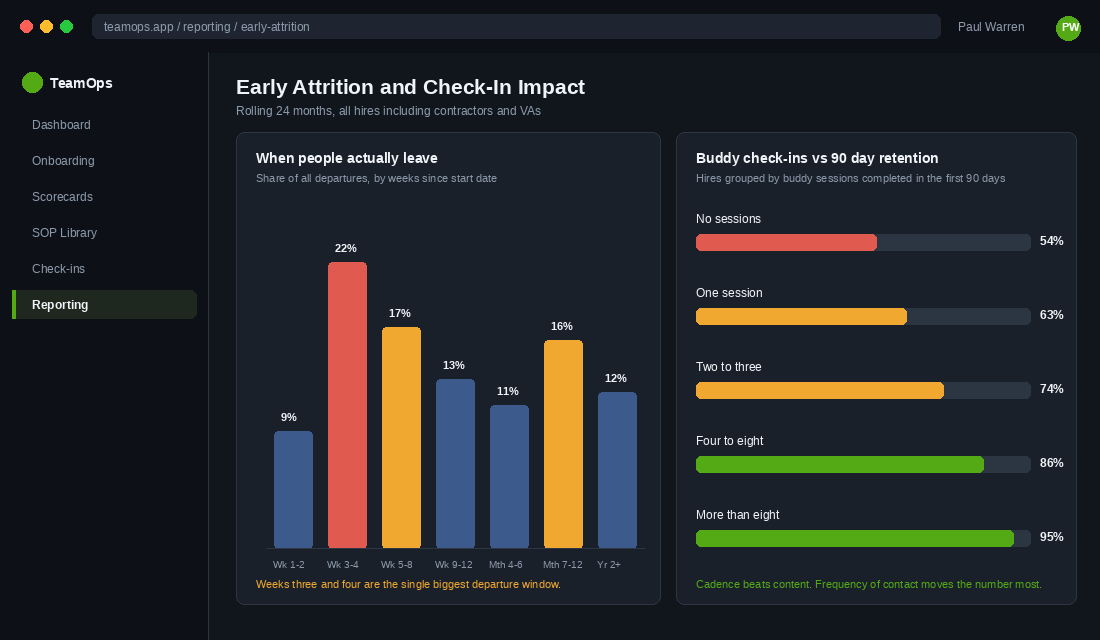
The pattern shows up in the numbers too. When you plot departures against weeks since start date across a few years of hires, the spike is not at the 12-month mark or after the first performance review. It sits in weeks three and four.
The good news is that this is fixable with process, not charisma. Structured onboarding programs lift new-hire retention by 82% and productivity by more than 70%. Yet only 12% of employees say they had a great onboarding experience, and 49% of companies run onboarding for a grand total of two weeks. The bar is on the floor. Six steps clear it.
Step 1: Run a Pre-Boarding Week Before Day One
Most Aussie founders send an offer, get a signature, then go quiet for three weeks until the start date. That silence is where second thoughts live, especially if your new hire is still working out a notice period and their current employer is now counter-offering.
Pre-boarding is the week before they start. It costs you about 40 minutes and it removes almost every day-one friction point.
- Ship the gear early. Laptop, monitor, phone, branded gear, a sample box of your best-selling product. If they are remote or a VA overseas, courier it so it lands two days before day one, not two weeks after.
- Create every login before they arrive. Shopify staff account with the right permission set, Klaviyo, Gorgias or Zendesk, Slack, Xero if relevant, the shared drive, the password manager. Nothing kills day-one energy like sitting on hold with IT.
- Send the day-one agenda. An hour-by-hour plan for their first day, including who they are meeting and what time they can log off. Uncertainty is the thing they are anxious about, so remove it.
- Send one piece of context, not twenty. Your brand story, your customer avatar, and your last quarterly update. Three documents. Not a 60-page handbook they will never open.
- Have someone from the team message them. A short note from their future buddy saying hello and offering to answer anything before day one. This is the most valuable 30 seconds in the whole process.
Atlassian, which built its distributed onboarding process out of Sydney, ships equipment ahead of the start date and assigns an onboarding buddy before day one for exactly this reason. You are not Atlassian, but you can copy the sequence in an afternoon.
Step 2: Write the 30, 60 and 90 Day Scorecard Before They Sign
If you cannot write down what good looks like at day 30, you are not ready to hire. This is the same discipline behind the hiring scorecard you use during interviews, extended past the offer letter.
A scorecard is three columns and about twelve lines. It is not a position description. Position descriptions list responsibilities. Scorecards list outcomes with numbers and dates attached.
What a real 30-60-90 looks like for a customer service hire
- Day 30. Handling all Tier 1 tickets unsupervised. First response time under 4 hours. Zero escalations that should have been resolved at Tier 1. Has completed every module in the support track.
- Day 60. Owns the full inbox including refunds up to $150 without approval. CSAT above 4.5. Has written two new SOPs for situations that were not documented.
- Day 90. Running the weekly support metrics review. Has proposed one process change that reduces ticket volume. Ready to train the next hire on Tier 1.
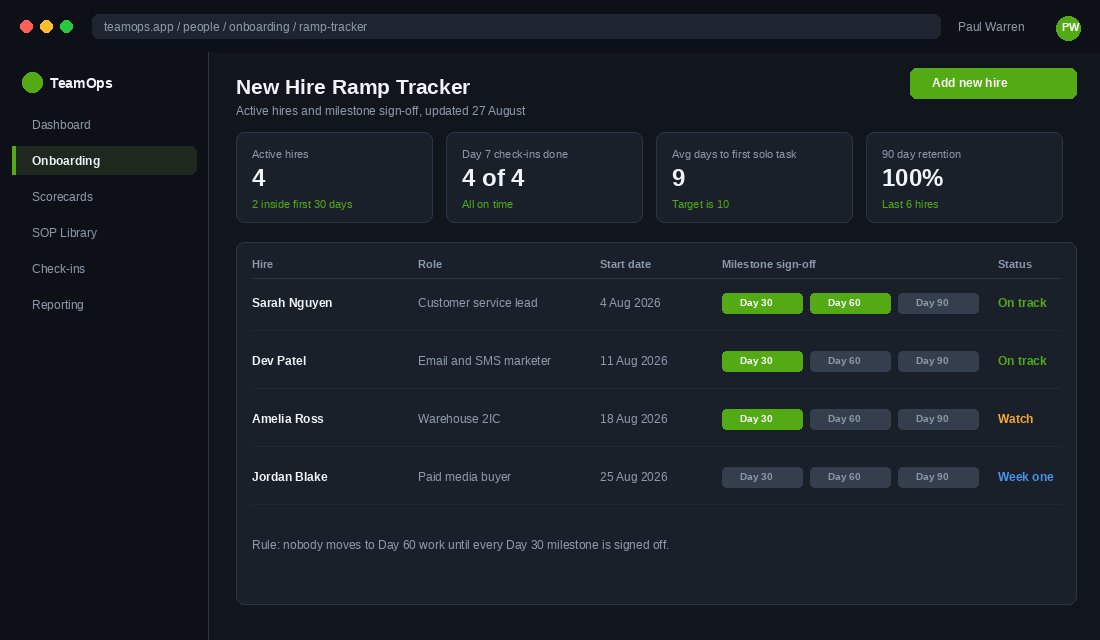
Two rules make this work. First, share the scorecard before they accept the offer, so nobody is surprised. Second, nothing moves to day 60 work until every day 30 milestone is signed off. If they are behind, you slow the ramp instead of quietly resenting them.
Track it somewhere visible. A simple ramp tracker with a row per hire and a tick per milestone is enough. What matters is that both of you can look at the same board and agree on where things stand.
Step 3: Give Them One Real Job in Week One
The most common onboarding mistake in ecommerce is drowning the new person in reading. Four days of documents, brand decks, past campaign reviews and analytics dashboards. On day five they have absorbed nothing and produced nothing, and they already feel like a passenger.
Flip it. Pick one narrow, genuinely useful task they can finish inside week one and ship.
- Customer service hire. Own the order-status queue. Nothing else. It is high volume, low risk, and it teaches them your systems faster than any document.
- Email marketer. Rebuild one existing flow email with better copy and ship it live. One email, not the whole welcome sequence.
- Paid media buyer. Audit the current ad account and present five findings on Friday. They learn the account, you learn how they think.
- Warehouse or fulfilment hire. Own pick and pack for one product category end to end for the week.
- Virtual assistant. Take one recurring weekly report off your plate completely, including the send.
The point is not the output. The point is that on Friday of week one they have done something real, you have given them feedback on something real, and the relationship is now a working relationship rather than an induction. Sixty per cent of people who quit inside three months blame missing or disorganised training. Doing beats reading.
Step 4: Assign a Buddy, Not Just a Manager
A manager evaluates. A buddy explains. New hires will not ask their manager the questions they are most embarrassed about, which are usually the questions that matter most in week three.
Microsoft ran the best study on this across 600 employees. Of new hires who met their onboarding buddy at least once in the first 90 days, 56% said the buddy helped them become productive quickly. That rose to 73% at two to three meetings, 86% at four to eight meetings, and 97% for those who met more than eight times. Buddy satisfaction with onboarding sat 23% higher at the start and 36% higher by day 90.
Read that curve carefully. It is not saying buddies are nice to have. It is saying frequency is the variable. One coffee does very little. Eight short conversations changes the outcome almost completely.
How to run this in a team of four
- Pick a peer, never a direct manager. Somebody one level across, ideally hired in the last 18 months so they remember what confusing felt like.
- Book the sessions in advance. Fifteen minutes, twice a week for the first four weeks, then weekly to day 90. Put them in the calendar on day one so nobody has to initiate.
- Give the buddy a job description. Answer dumb questions without judgement, explain unwritten rules, flag to the founder if the new person seems stuck. They are not responsible for performance.
- Pay attention to what gets asked. Every question the buddy fields is a gap in your documentation. Write it down and turn it into a module.
If you are a solo founder with contractors, your buddy can be your longest-standing freelancer or your 2IC. It just cannot be you, because you are the person they are trying to impress.
Step 5: Record the Work Once, Never Explain It Twice
Here is the maths that changes how founders think about documentation. Explaining a task live takes 20 minutes and helps one person once. Recording the same explanation takes 25 minutes and helps every future hire forever. You break even on the second hire and print time after that.
You do not need a training platform to do this. Trainual starts around 199 dollars a month for up to 50 employees, which is more tool than most Aussie stores under 20 staff need. Notion plus Loom does the job for a fraction of that, and Notion’s free tier covers small teams doing docs-based SOPs.
How to build the hub in an afternoon
- Create one Notion page called Operations Hub. Add a sub-page per function: Customer Service, Fulfilment, Email and SMS, Paid Media, Finance.
- Inside each function, create a database with four properties. Module name, Week (1 to 4), Loom link, Status (Not started, In progress, Complete).
- Record Looms as you work, not as a project. Next time you process a refund, hit record and narrate. Next time you build a flow, record it. Keep each one under 10 minutes.
- Attach one proof task to every module. Watching a video is not learning. Ask them to do the thing and paste the result in the module. That is what turns the status to Complete.
- Duplicate the database for each new hire. Now you have per-person completion tracking without paying for a training platform.
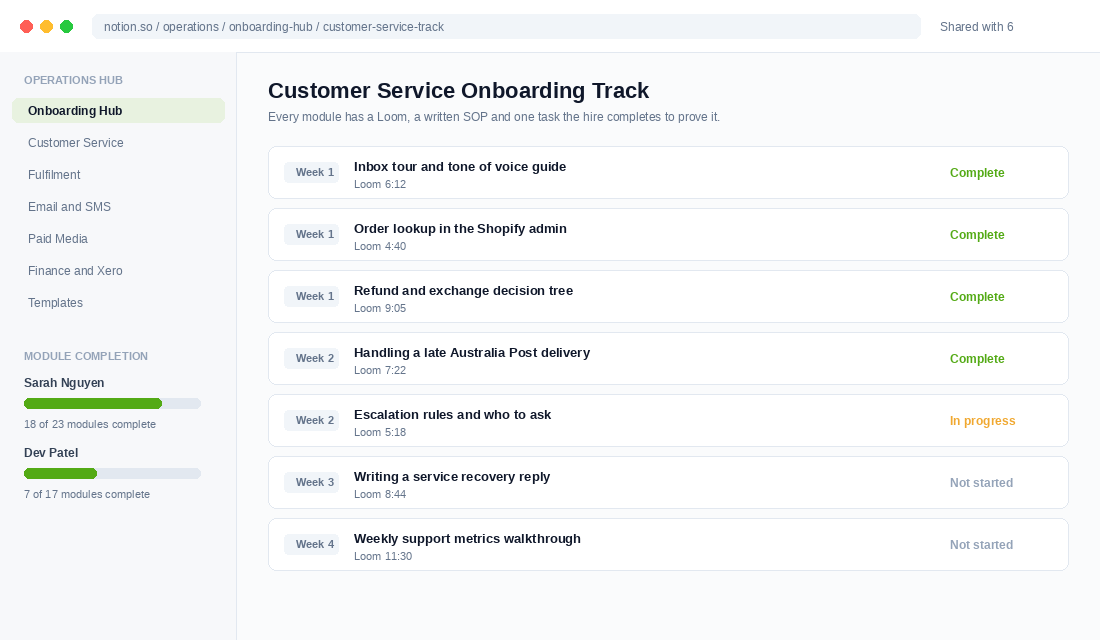
Aim for 15 to 25 modules per role, spread across four weeks. That is roughly three hours of recording spread over a month of normal work. If you already have an SOP system running, this is just a completion layer on top of it.
Step 6: Run the Four Check-Ins That Catch Problems Early
Most stores run a probation review at three months. By then the decision has already been made by both parties and the conversation is a formality. You need four check-ins, and the early ones matter far more than the late ones.
- Day 3. Ten minutes. One question: what has been more confusing than you expected? Fix the top answer that afternoon.
- Day 14. Twenty minutes. Walk the scorecard together. Are the day 30 milestones still realistic given what they now know about the role?
- Day 30. Forty-five minutes. Formal sign-off against every day 30 milestone, written down. Also ask them what they would change about the onboarding they just went through, while it is fresh.
- Day 90. One hour. Full scorecard review, confirm the role, and set the next 90 days. This is also where you decide whether they are ready to onboard the person after them.
Note the asymmetry. Two check-ins in the first fortnight, then two more across the next eleven weeks. That front-loading is deliberate, because that is where the risk sits. Companies have roughly 44 days on average to influence whether a new starter stays long term.
One more rule: write down what was said. Not for legal cover, though it helps. Because when you hire the next person you will want to know exactly which week the last one struggled, and memory will not serve you.
The 30-Day Onboarding Scoreboard
Copy this into a checklist and run it for every hire, whether they are full time in your Melbourne warehouse or a VA in Manila.
Before day one
- Gear shipped and arriving two days early
- Every login created and permission set correct
- Day-one agenda sent, hour by hour
- Three context documents sent, no more
- Buddy assigned and has already messaged them
- 30-60-90 scorecard written and shared
Week one
- One real, narrow job assigned and shipped by Friday
- Day 3 check-in completed and top confusion fixed
- Week 1 modules complete with proof tasks attached
- Two buddy sessions booked and held
Weeks two to four
- Day 14 scorecard walkthrough completed
- Buddy sessions continuing twice weekly
- Every question the buddy answers logged as a documentation gap
- Day 30 milestones formally signed off before any day 60 work begins
- Onboarding feedback captured from the new hire while it is fresh
If you cannot tick every box, do not hire yet. The tickets will still be there in a fortnight and the hire will land far better.
Why This Compounds Across Every Future Hire
Run this once and it feels like overhead. Run it three times and it becomes the most valuable asset in your business that does not appear on your balance sheet.
Here is the compounding. Your first hire generates 20 documented modules from the questions they ask. Your second hire ramps in half the time because those modules already exist, and adds another eight. Your third hire is onboarded largely by your first hire, which means you are barely involved. By your fifth hire, average days to first solo task has dropped from three weeks to nine days and your 90-day retention is close to 100%.
That changes what you are able to do commercially. Hiring stops being a scary, expensive gamble you avoid until you are drowning, and becomes a lever you can pull deliberately before peak season. Teams that can absorb people quickly can staff up for Black Friday in September instead of panicking in November.
It also changes what your business is worth. A store where the founder holds all the operating knowledge in their head is a job. A store where a documented system can take a stranger to competent inside 30 days is an asset somebody can buy.
The hire you are worried about right now is probably not the wrong person. They are just three weeks into guessing, and nobody has told them the rules.
The Cost of Getting It Wrong: What a Failed Hire Really Costs a Shopify Store
Founders underestimate this number by a factor of three, which is why onboarding never gets the time it deserves. Run it for your own store.
Say you hire a customer service and operations coordinator at $70,000 plus 12% super. The recruitment itself costs $3,000 to $8,000 if you use an agency or job boards plus your own time. Weeks one to four they are at roughly 25% productivity, weeks five to twelve at 50 to 60%. If they leave at week ten, you have paid around $16,000 in salary for the equivalent of four weeks of output, absorbed 30 to 40 hours of your own time in training, and are now back at the start with the role uncovered through the period you hired for.
Add the hidden cost: response times slip, a couple of one-star reviews land, the returns queue backs up. Most Aussie founders we work with put the true cost of a failed $70K hire at $25,000 to $35,000. A structured onboarding week costs you six to eight hours of prep and cuts early attrition by roughly half. Very few investments in a Shopify business pay back that fast.
Onboarding a Remote or Offshore Hire: The 4 Adjustments That Matter
Most Aussie Shopify teams now include at least one remote hire, often in the Philippines or South Africa, working a few hours offset from Melbourne or Sydney. The six steps still apply, but four things change.
Overlap hours are non-negotiable in month one. Lock in a minimum of three hours a day where you or the buddy are live in Slack. A remote hire who cannot get an answer for 14 hours will guess, and guessing is where week three goes wrong. Record everything with Loom, not just the SOPs. A five-minute Loom of you handling a real refund request teaches tone in a way a written procedure never will. Aim for 15 to 20 short videos in the hub before day one.
Make the scoreboard visible, not verbal. A shared Notion or ClickUp board with the 30-60-90 milestones ticked off in real time replaces the hallway feedback a remote hire never gets. Bring the check-ins forward. Run the day-3 and day-7 check-ins as video calls with cameras on, and add a 10-minute daily stand-up for the first fortnight. Remote hires who get daily contact in weeks one and two hit full productivity 2 to 3 weeks sooner than those left to the weekly rhythm.
If you are still building the systems that make remote work possible, start with the delegation playbook. Onboarding cannot fix a role that was never properly defined.
After Day 30: The Two Habits That Keep the Hire You Just Landed
Day 30 is not the finish line. The second-biggest attrition spike in ecommerce teams lands between months four and six, once the novelty wears off and the role settles into routine. Two habits carry the hire through it.
First, convert the 90-day scorecard into a standing monthly one-on-one. Same format, same 30 minutes, same three questions: what shipped, what is blocked, what do you want to own next. The “own next” question matters most. Hires who can see their next responsibility stay at roughly twice the rate of hires who cannot. The 1:1 scorecard system gives you the template.
Second, give them one system to improve, not just run. By month three the new hire has seen your returns process, your dispatch cut-off, or your review request flow with fresh eyes. Ask them to rewrite one SOP and present the before-and-after numbers. It signals trust, it improves the store, and it is the single cheapest retention lever available to a small team. Founders who run this loop report team retention in the 85 to 90% range against an ecommerce average closer to 65%. For the full picture on keeping the people you have, read the team retention playbook.
Inside eCommerce Circle, building the team that runs the store without you is one of the core pillars we work on with every member. If you want a second opinion on how your next hire lands, let’s talk.