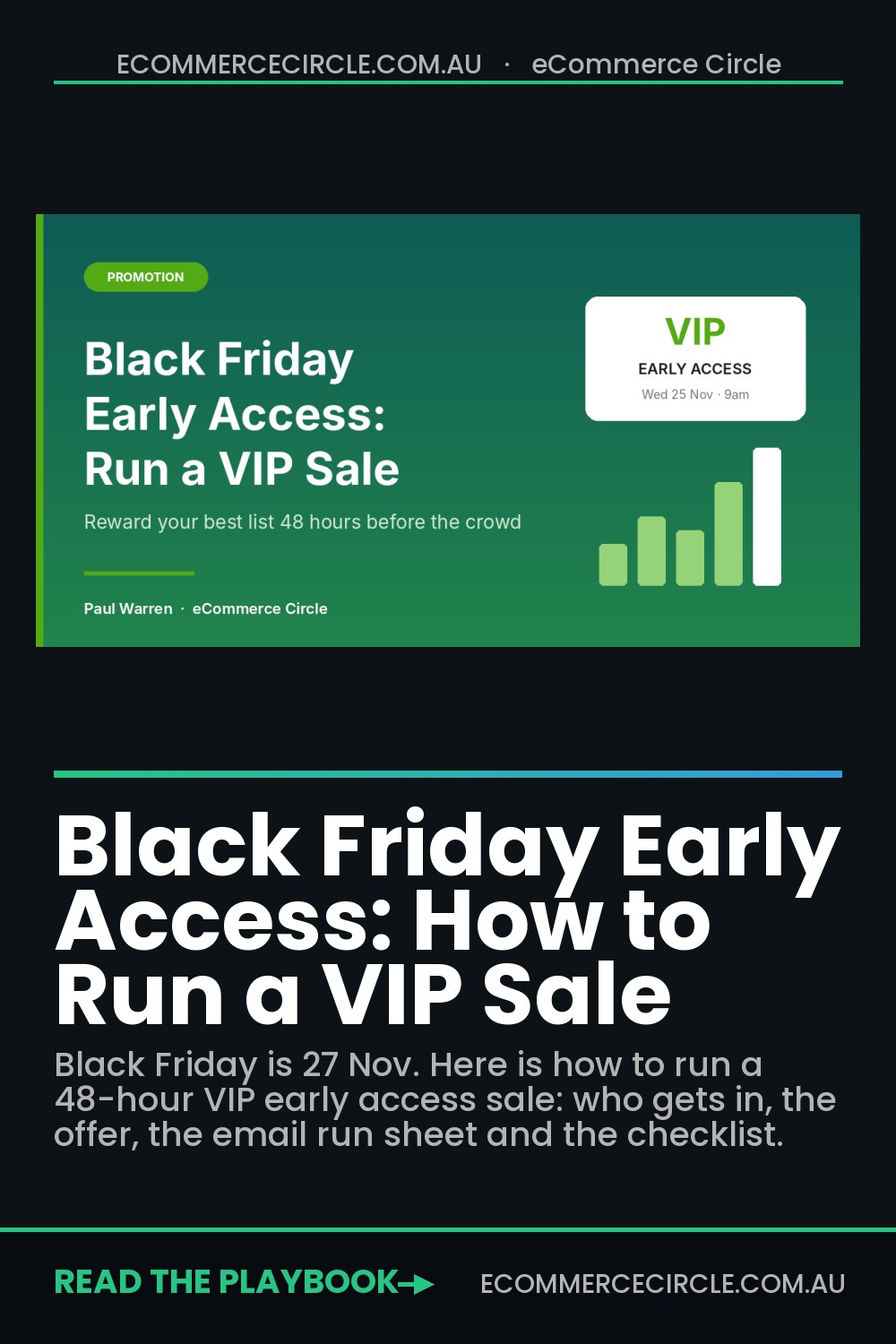
Black Friday early access works like this: you pick your best customers and subscribers, open the sale to them 24 to 48 hours before everyone else, and tell them exactly when it starts. Done properly, it pulls revenue forward, protects margin and gives you a clear read on stock before the public rush.
Most Aussie Shopify stores get this wrong in one of two ways. They send a “VIP early access” email to the entire list, which makes it a normal sale with a fancier subject line. Or they run the early window with no list-building beforehand, so the window reaches a few hundred people who were always going to buy anyway.
Black Friday lands on Friday 27 November 2026, with Cyber Monday on 30 November. Today is 5 November. That gives you 22 days, which is enough time to build a proper early access list, set up the segment and run the window. This guide is the exact run sheet.
What Black Friday Early Access Actually Is (and Is Not)
Early access is a time advantage for a defined group. That is it. It is not a bigger discount, a secret sale or a loyalty programme. The group gets in first, and the window closes when the public sale opens.
The cleanest example in the wild is POPFLEX. In Klaviyo’s published form strategy, registered shoppers get a three-hour head start on a sale, with the access details sent by email. The mechanism is specific: sign up, get the link, shop first. There is no vague “VIP” label doing the work.
That specificity matters because early access has to answer three questions in one line: who gets in, when, and what they get. If your email cannot answer all three in the first two sentences, rewrite it.
There are three versions worth running, and you should pick one rather than blending them:
- Time-only access. Same offer as the public sale, opened early. Cheapest to run, protects margin, and works well when stock is limited.
- Time plus a small extra. Early access plus a bonus such as free express shipping or a gift with purchase. Best for stores with a healthy repeat customer base.
- Exclusive product. A bundle or colourway that only the early list can buy. Best for brands with a loyal audience and a product team that can move quickly.
If you only do one thing this year, do the first. It is the lowest risk and the easiest to execute well.
Why It Works: The Numbers Behind Pulling Revenue Forward
Early access is not a nice-to-have for marketers. The data on how Australians and email lists behave around Black Friday makes a strong case.
- Australians spend an average of $531 on Black Friday alone, with national spend estimated at $4.5 billion, according to Finder research. That is a lot of wallets being opened on one weekend.
- Retailers are launching early. Finder notes many major retailers start a week or more ahead, with Myer, LG and Lenovo already showing early deals. If you wait for the 27th to say anything, you are the last voice in the inbox.
- SMS cuts through. Dotdigital’s platform data shows SMS click-through rates of 19%, against 3% for email, and BFCM weekend SMS volume rose 22% on the year before. Your early access list should include phone numbers wherever you have consent.
- VIP emails get opened. Omnisend reports one brand, SM Global Shop, hit a 65% open rate on VIP emails by segmenting repeat and high-value buyers.
- A modest list can still carry the weekend. CXL documented an outdoor clothing brand that built a 2,280-person early-bird list. In the two weeks before Black Friday that list produced $26,220 in sales, a 7.7% purchase rate and $11.50 per subscriber, roughly one third of the brand’s total BFCM-period sales. The open rate averaged over 50%.
Read that last one twice. The list was small, the sequence was four emails plus SMS, and the early window produced a third of the season. That is what a defined, warmed list does that a batch-and-blast send cannot.
Note the caveat: the CXL example is a US-style case study run in 2022, with the brand unnamed. Treat the percentages as a benchmark to beat, not a promise. Your own store will land differently depending on list quality, margin and offer.
Step 1: Decide Who Is In (Build Tier 1 and Tier 2)
The biggest early access mistake is the guest list. If everyone is “VIP”, nobody is. Build two tiers.
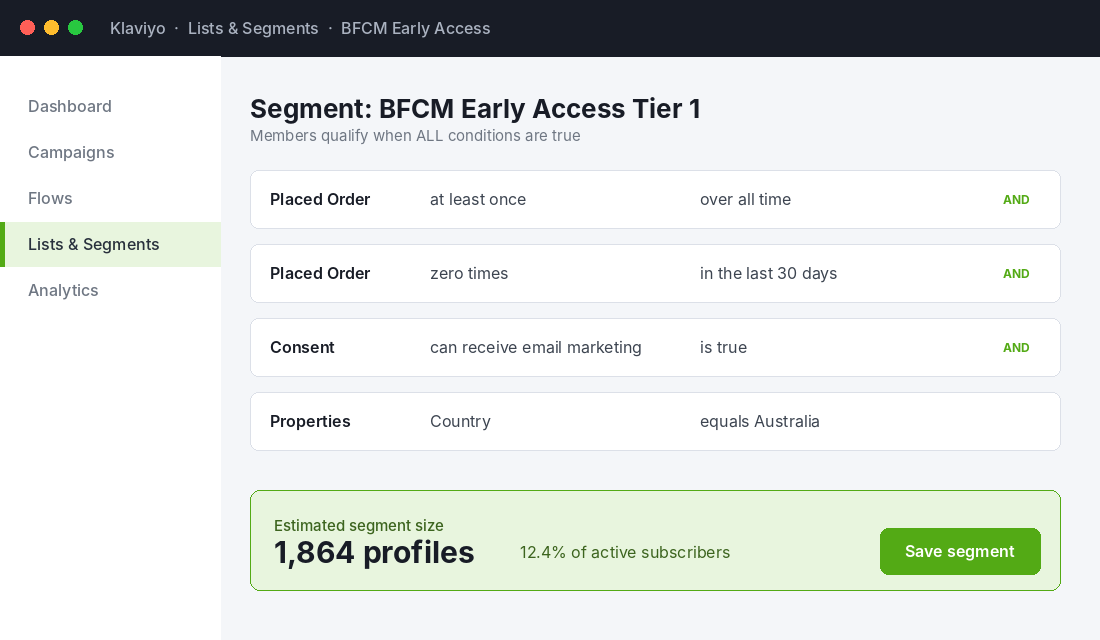
Tier 1 is your proven buyers. Customers who have ordered at least once and have not ordered in the last 30 days. They know your product, they trust the checkout, and they do not need a hard sell. These people get the earliest and best access.
Tier 2 is your early-bird signups. New and cold subscribers who opt in specifically to hear about the Black Friday sale first. This is the group you can still grow in the next fortnight, and it is where the CXL result came from.
Exclude anyone who bought in the last 30 days from the invitation if you can. They have just paid full price, and an early discount email will feel like a slap. Send them a delivery update or a small thank-you offer for next time instead.
Tool and setup: building the segment in Klaviyo. Klaviyo is the most common email platform among Shopify stores we work with, and this takes about ten minutes:
- Go to Audience, then Lists and Segments, then Create Segment.
- Add the condition: Placed Order at least once over all time.
- Add the condition: Placed Order zero times in the last 30 days.
- Add the condition: Can receive email marketing is true. Add a location condition for Australia if you ship domestically only.
- Check the estimated size and save the segment as “BFCM Early Access Tier 1”.
- Create a separate list or form called “BFCM Early Bird” for Tier 2 signups.
The same logic works in Omnisend, Shopify Email or any platform with order-based segments. If you also run SMS, create the matching segment there and confirm every profile has SMS consent before you send anything. Our guide to Black Friday SMS marketing covers the consent and timing rules.
Step 2: Build the Early-Bird List in the Next 14 Days
You cannot invite people who are not on the list, so list growth is the first job. You have until about 19 November before the invitation goes out.
Put the offer in plain words: “Get Black Friday prices 48 hours early. Join the list.” The CXL case worked because the benefit was concrete and the landing page did one job. Do not hide it behind a generic “10% off your first order” pop-up.
Five places to put the sign-up this week:
- A dedicated landing page. One headline, one email field, one optional phone field with a clear SMS consent line. Link to it from everywhere else.
- Your header announcement bar. “Black Friday early access opens 25 Nov. Get on the list.”
- Your existing pop-up. Swap the standard welcome offer for the early-bird offer until the sale ends.
- The order confirmation and thank-you page. Customers who just bought are your warmest audience for next year’s list as well as this one.
- Your Instagram bio and stories. A single link, a single date, repeated daily.
Run Meta traffic to the landing page if you have budget, but keep it small. A list-building ad at a modest daily spend is far cheaper than buying the same customers at peak Black Friday CPMs. If you want the paid side planned out, see our Meta ads for Black Friday timing plan.
Send a welcome email to every new signup straight away, even without an offer. In the CXL case, the welcome email had no offer and still generated revenue, simply because it confirmed the date and kept the store top of mind.
Step 3: Choose Your Window, Offer and Stock Rules
Your window should be short enough to feel urgent and long enough that a busy person can act. For most Australian stores, 24 to 48 hours is the sweet spot. POPFLEX’s three hours works for a brand with a very active audience and a tight stock position. Most small and mid-size stores do not have that kind of attention span on their list.
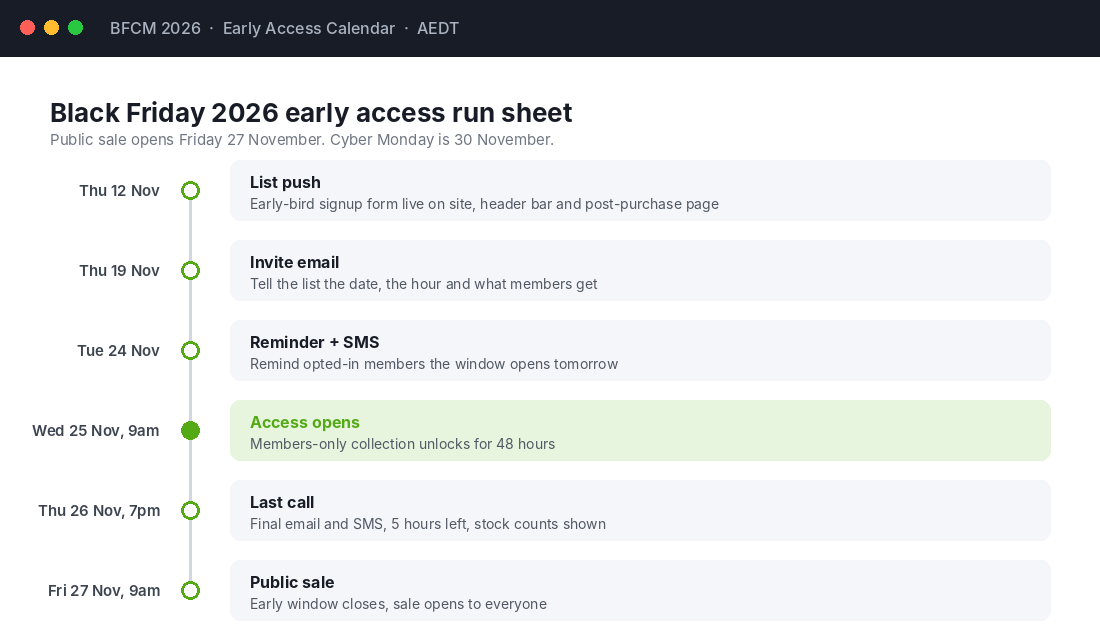
For 2026, here is a window that works for most Shopify stores shipping within Australia: opens Wednesday 25 November at 9am AEDT, closes Friday 27 November at 9am AEDT, when the public sale starts. Weekday morning opens give you a full day to fix any checkout or inventory surprises before the public weekend.
Then set your offer rules before you write a single email:
- Discount depth. Match the public offer or go slightly below it. Early access is the reward, not the discount. Check the maths in our Black Friday discount calculator first so you know your break-even.
- Stock allocation. Decide how many units of each hero product the early window can sell. Early buyers who cannot get the thing they were promised will not forgive you.
- Exclusions. Write them down now and put them at the top of the page, not in the fine print.
- Free shipping rule. Keep it the same as public, or sweeten it for early members only if the margin allows.
On exclusions: the ACCC has been enforcing here. Michael Hill, MyHouse and Hairhouse Online were fined a combined $59,400 over their 2024 Black Friday “sitewide” advertising, which the ACCC alleged excluded some products. If your sale is not truly sitewide, do not say sitewide. This is not legal advice, so check your wording against ACCC guidance before it goes live.
Step 4: Lock the Door (How to Gate the Early Window)
You have three ways to restrict access. Pick the one your theme and team can handle.
Option A: A private link (simplest). Send members a URL to a hidden collection or landing page that is not linked from your navigation. Anyone with the link can shop, so keep the window short and do not post it publicly. This is how most small stores run it.
Option B: A unique discount code. Create a code that only the early window honours, expiring when the public sale opens. Use single-use codes if you are worried about leaks. We wrote a full breakdown of the risk in our discount code leak defence guide.
Option C: Customer tags and a gated collection (most robust). Push the segment to Shopify as a customer tag, build a collection template that only shows products to customers carrying that tag, and send everyone else to a “no access” page. RetentionX documents this method, including the theme template and the no-access page. It takes longer to set up, but it stops link sharing.
If you are short on time, go with Option A or B. A simple method that you execute well beats a clever one that breaks at 9am on the 25th.
Whichever you choose, test it from a logged-out browser and a phone before you send a single email. Check that a member can reach the products, a non-member cannot and the discount applies at checkout.
Step 5: The Email and SMS Sequence
Keep it to three emails and two SMS messages. More than that and you are back to batch-and-blast.
Email 1: The invitation (Thursday 19 November). Subject line, preview text, one button. Say who it is for, when the window opens and what members get. If you want subject line ideas, our Black Friday email subject lines post has 40 tested options.
Reminder (Tuesday 24 November): email plus SMS. “Early access opens tomorrow at 9am.” Add the link. Keep the SMS under 160 characters and put the time first.
Email 2: Access is open (Wednesday 25 November, 9am). The link, the offer terms and the exact time the window closes. Show two or three hero products rather than the whole catalogue. Include stock counts if they are genuinely low.
Last call (Thursday 26 November, 7pm): email plus SMS. “Five hours left.” Send it only to members who have not purchased.
Follow-up (Friday 27 November). Exclude early buyers from the public sale blast. They have already bought, and sending them the same deal again feels sloppy. Send them a shipping update and a “thanks for being first” note.
Use a flow with a suppression condition for anyone who has placed an order since the window opened. If you want help structuring the flow, see our Klaviyo flows for Shopify guide.
Step 6: Protect Margin and Stock During the Window
Early access can quietly hurt you if you do not plan the back end. Three things go wrong most often.
- Oversell. Members buy your hero product in the first hour and you run out before the public sale. Set inventory alerts and a hard allocation per SKU. If you use Shopify, turn on “continue selling when out of stock” only for items you can actually restock.
- Discount stacking. A member uses their code plus an automatic discount plus a free shipping rule. Test every combination before launch.
- Fulfilment overload. Early orders land alongside a Black Friday shipping rush. Tell your 3PL or packing team the early window volumes in advance and confirm cut-off dates for Christmas delivery.
Use the early window as a free stock test. Whatever sells out first is what you should reorder or increase ad spend behind for the public sale. Whatever sits untouched is what to bundle or discount deeper on Friday.
Step 7: Measure It Properly
Do not judge early access on revenue alone. Look at four numbers, each compared with the public sale:
- Member conversion rate. What percentage of the invited segment ordered. The CXL benchmark is 7.7% over a two-week program, but your 48-hour number will be lower, and that is fine.
- Average order value. Early buyers often spend more because they are loyal and not hunting a clearance bargain.
- Discount cost. Revenue minus discounts, per order. You want early buyers to cost you less per dollar, not more.
- Incremental versus pulled forward. Compare total November revenue with last year. If early access simply moved sales that would have happened anyway, you gained certainty, not growth. That is still valuable, but be honest about which one you got.
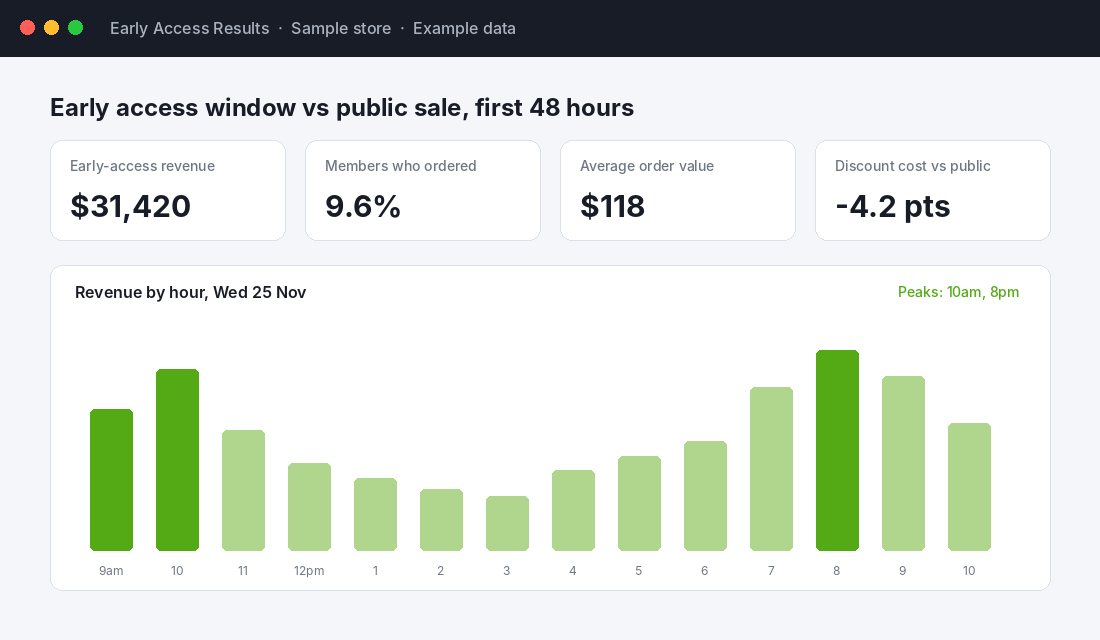
The chart above uses sample data to show the shape to expect: a spike at open, a quiet afternoon and a second spike in the evening when people are home. If your own hourly data looks like this, schedule your reminder SMS for the evening peak.
The Compound Effect: One Window, Three Wins
Early access is not one tactic. It is three working together.
First, the list. Every early-bird signup is an owned contact you did not pay Black Friday prices to reach. Second, the stock read. You learn what sells before the crowd arrives. Third, the margin. A time-based reward costs you less than a deeper discount to everyone.
Stores that treat this as a one-off promotion miss the biggest part of the value. The people on that list are the same people who will open your Christmas emails, your January sale and your next product launch. That is why a clean early access list is worth building even in a year when your Black Friday offer is modest.
Your Early Access Checklist (Copy This)
- By 8 November: Decide your tier, window, offer and stock rules in one shared doc.
- By 12 November: Early-bird landing page, header bar and pop-up live.
- By 14 November: Klaviyo segments built and tested. Gating method tested on desktop and mobile.
- By 18 November: Emails and SMS written, scheduled and proofed. Exclusions written at the top of every page.
- 19 November: Invitation email sent.
- 24 November: Reminder email and SMS sent.
- 25 November, 9am: Window opens. Watch checkout, inventory and discount stacking for the first hour.
- 26 November, 7pm: Last call to non-purchasers.
- 27 November, 9am: Window closes, public sale opens, early buyers suppressed from the blast.
- 30 November onwards: Review conversion, AOV, discount cost and incremental revenue. Write down what you will change for next year.
Common Questions
How early should early access start? For most stores, 24 to 48 hours before the public sale. Shorter windows suit brands with highly engaged lists and tight stock, as POPFLEX’s three-hour head start shows.
Should early access have a bigger discount? Usually no. The head start is the reward. If you do add a bonus, make it something cheap to you and meaningful to them, such as free express shipping.
Can I run early access with a small list? Yes. The CXL case study worked with 2,280 subscribers. A smaller, warmer list beats a large cold one.
What if I have not built a list yet? Start today. Even a week of list-building will give you a first group to invite, and you can learn from it before Christmas.
What to Do This Week
Pick your window, build your Tier 1 segment and get the early-bird sign-up live on your site by the weekend. Everything else follows from those three steps.
Inside eCommerce Circle, list building and sale planning are core parts of the Promotion pillar we work on with every member. If you want to see exactly where your store is being capped heading into Black Friday, take the free More Orders Scorecard. It takes two minutes and shows you which of the 10 P’s to fix first.
Sources: Finder, Dotdigital, CXL, Omnisend, Migma, RetentionX.