Start your Black Friday Meta ads at your normal budget in the first half of November, step spend up by about 15% every few days from 16 November, and save the big jumps (2x to 3x) for Friday 27 November and Monday 30 November. Lock your offer by 6 November, your creative by 13 November, and your campaign setup by 17 November, so nothing resets learning in the week that matters.
What’s in This Article
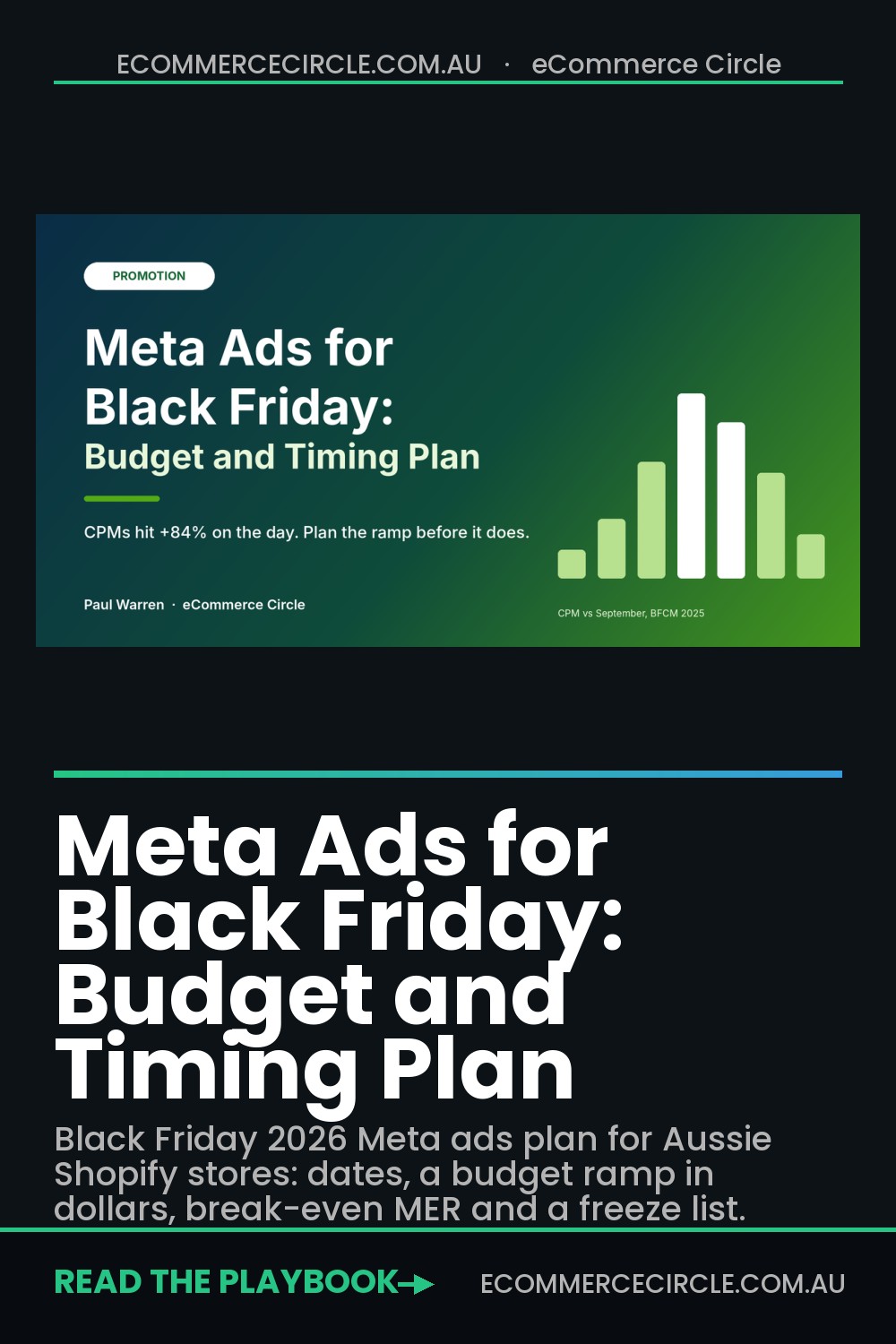
Most Aussie stores do the opposite. They run flat budgets until the week of the sale, panic-edit campaigns on Thursday night, then triple spend on Friday morning and wonder why the cost per purchase doubled. The auction was never going to wait for them. In 2025, the median brand in one large Meta dataset paid 84% more per thousand impressions on Black Friday than in September. If your plan assumes September prices, it is already wrong.
This is the budget and timing plan we build with eCommerce Circle members every year. It covers the calendar, the budget ramp in dollars, the break-even number that stops you overspending, and a freeze list for the week itself. If you want the whole-of-business view first, start with the Black Friday Australia 2026 dates and deadlines and the BFCM target maths, then come back here for the Meta side.
What Meta actually costs on Black Friday
Everyone knows ad costs rise in November. The useful question is when, and by how much. Lebesgue analysed the biggest Meta spenders on its platform (about $22.6M of spend from September to November 2025) and tracked median CPM against each brand’s September baseline. Their numbers are the clearest picture I have seen of how the auction behaves:
- 10 November: CPMs first clearly rise, up 13% on September.
- 20 November: up 27%.
- Thanksgiving (27 November 2025): up 53%.
- Black Friday itself: up 84%, with the middle half of brands paying 59% to 116% more.
- Cyber Monday: up 71%.
- The day after: 48%, then 20% by 3 December.
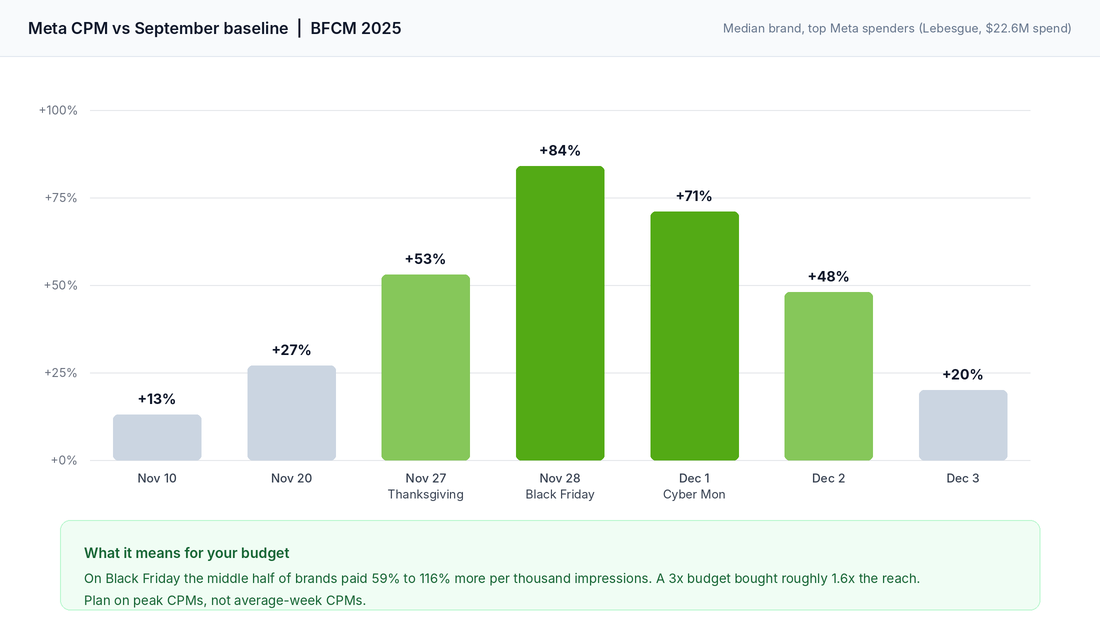
Two things matter for your plan. First, the cost spike is sharp and short. Costs sat near normal until mid-November, peaked on Black Friday, and were back to +20% within a week. Second, the rise started later in 2025 than in 2024. Lebesgue found the same brands were already 10% above September on 14 October in 2024, but did not get there until 10 November in 2025. Your calendar should not assume a fixed start date. Watch your own CPM in Ads Manager each week from late October.
Category matters too. In the same dataset, Black Friday week CPMs rose 116% for home and decor, 76% for electronics and sporting goods, 66% for fashion and footwear, and 42% for beauty, health and supplements. Lebesgue flags those groups as small samples, so treat them as directional, not as benchmarks. If you sell homewares, budget for the top of the range.
Triple Whale’s dataset of more than 33,000 Shopify shops tells a similar story from the cost side. In BFCM 2025, the median Meta CPM was $22.26 with a $34.06 CPA and a 2.26 ROAS. Those are US dollar figures and global stores, so use them as a sanity check, not a target. Your own September numbers are the baseline that counts. For context on what good looks like locally, see our Meta ads ROAS benchmarks for Australia.
The calendar: what to do in each window before 27 November
Darkroom, a performance agency that works with large Shopify brands, counts backwards from Black Friday and sets hard deadlines: structural changes about six weeks out, the offer about three weeks out, creative about two weeks out, and campaign setup about ten days out. I agree with the logic. Here is that frame with Australian dates for 2026.
| Window | Dates (2026) | What you do | What you do not do |
|---|---|---|---|
| Build and fix | Now to 1 Nov | Fix account structure, confirm tracking, run creative tests, collect email and SMS sign-ups | Start new channels. Structural changes should have stopped by 16 Oct |
| Offer lock | By Fri 6 Nov | Decide discounts, bundles, free gifts and shipping thresholds using your break-even MER | Change the offer after this date |
| Creative load | 2 to 13 Nov | Finish Black Friday versions of your top ads, plus 3 to 5 new concepts | Keep testing new angles after 13 Nov |
| Setup freeze | Tue 17 Nov | Campaigns, ad sets, audiences and budgets built and live | Rebuild campaigns or switch bid strategy |
| Warm-up ramp | 16 to 22 Nov | Early access and teaser ads, step budget up about 15% every 2 to 3 days | Jump budgets more than about 20% in one go |
| Peak run-in | 23 to 26 Nov | Hold at 1.5x, check pacing twice daily | Panic cut or panic scale |
| Black Friday to Cyber Monday | 27 to 30 Nov | Planned 2x to 3x days, last-chance creative, daily MER check | Touch targeting or creative inside live ad sets |
| Step-down | 1 to 7 Dec | Reduce in steps back to baseline, retarget buyers into the Christmas offer | Switch everything off on 1 Dec |
Click Frenzy deserves a flag. The 2025 Main Event ran Tuesday 11 to Friday 14 November, according to ShopBack’s guide, and I could not find confirmed 2026 dates at the time of writing. If you join it, treat it as a mini peak two weeks before Black Friday: it pulls your customers’ wallets forward and will push CPMs up on those days. Our Cyber Monday Australia plan covers the final day in detail.
Your break-even MER decides how hard you can push
Before you set a single budget, work out the number you need to hit. ROAS inside Meta is a fine day-to-day signal, but on Black Friday the number that keeps you honest is blended MER: total store revenue divided by total ad spend. Meta takes credit for sales that email, organic and direct would have made anyway, and that over-credit is biggest on the biggest day.
Break-even MER is your selling price divided by your contribution before ads. Take an example store selling a $120 product (ex GST) with $42 product cost, $9 shipping and packaging, and $5 in payment and platform fees. That leaves $64 before ads, so break-even MER is 120 ÷ 64 = 1.88x. Run a 20% discount and the price drops to $96, the costs stay the same, and contribution falls to $40. Break-even MER jumps to 96 ÷ 40 = 2.40x.
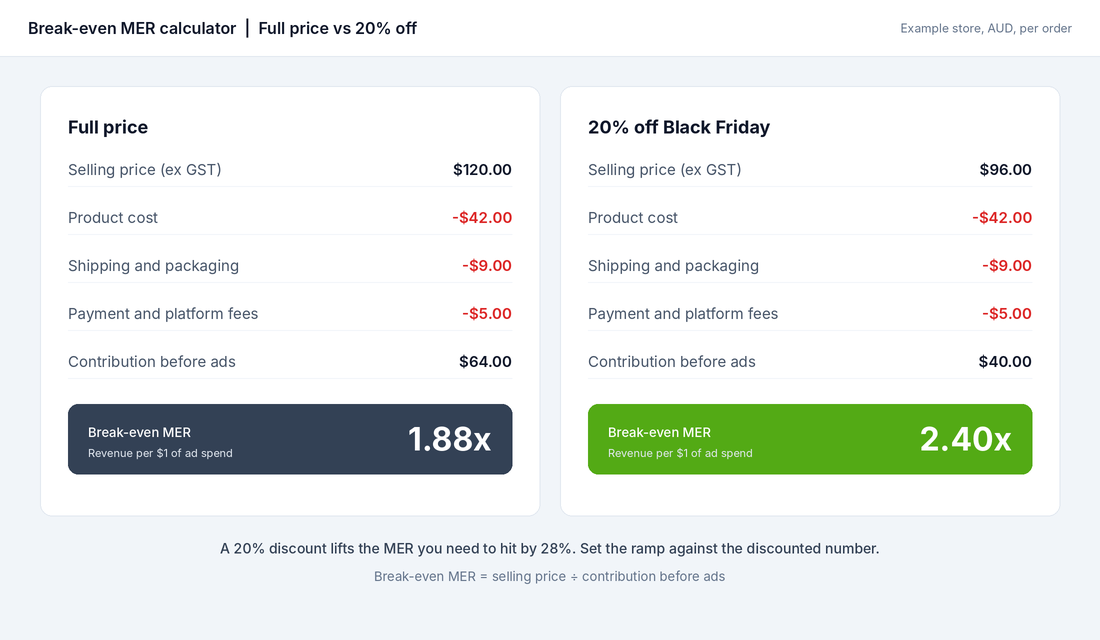
That 28% increase is where most Black Friday budgets go wrong. Founders look at a 3.0 ROAS on the big day and feel great, then find the contribution margin after returns and discounts was thin. The rule we use: only raise budget on days where the extra spend can still clear break-even MER at peak CPMs. If your break-even is 2.40x and CPMs are running 80% above normal, work out whether the conversion rate lift from the sale can cover that. It often can, and Lebesgue found Black Friday week conversion rate was up 48% on September, which is why Meta-reported ROAS in that dataset rose 19% even with the cost spike. But you want to see it in your own numbers, not assume it.
If you have not built your revenue target backwards into traffic and spend yet, do that first with the BFCM target maths and then layer this plan on top.
The budget ramp in dollars
Here is the ramp for a store spending $300 a day on Meta in October. Swap in your own baseline and the multipliers still hold. The reason for the steps is simple: Meta ad sets exit learning once they collect roughly 50 optimisation events in a rolling 7 days, and a budget change of about 20% or more can restart that count. Small steps keep the ad sets stable. The planned 2x to 3x days are an exception you accept on purpose.
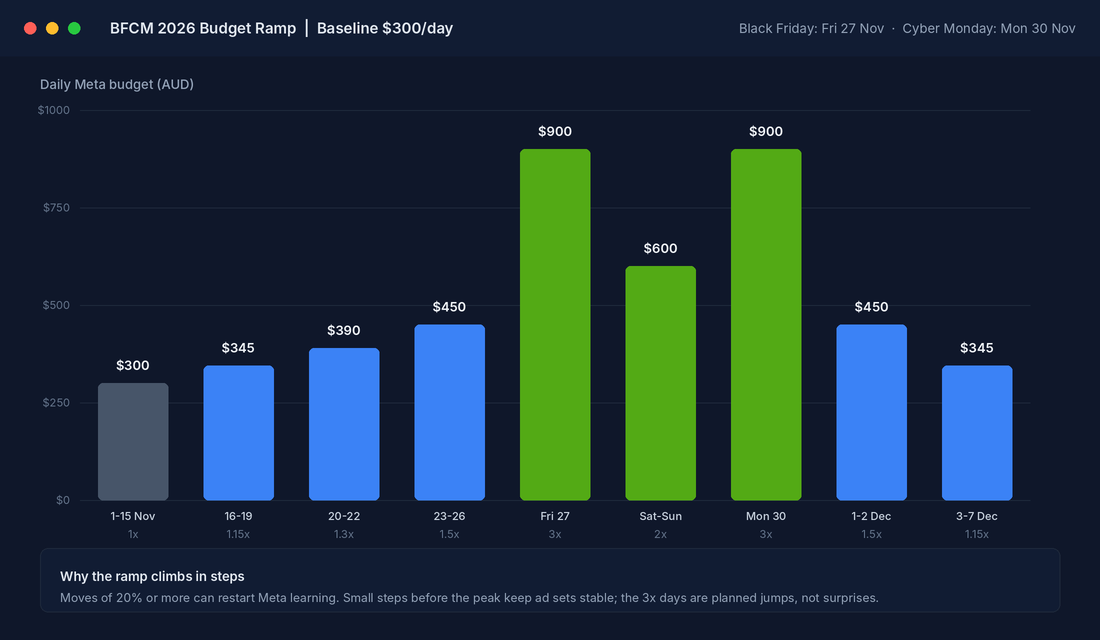
| Dates | Multiplier | Daily budget | Total for the window |
|---|---|---|---|
| 1 to 15 Nov | 1.0x | $300 | $4,500 |
| 16 to 19 Nov | 1.15x | $345 | $1,380 |
| 20 to 22 Nov | 1.3x | $390 | $1,170 |
| 23 to 26 Nov | 1.5x | $450 | $1,800 |
| Fri 27 Nov | 3.0x | $900 | $900 |
| Sat 28 to Sun 29 Nov | 2.0x | $600 | $1,200 |
| Mon 30 Nov | 3.0x | $900 | $900 |
| 1 to 2 Dec | 1.5x | $450 | $900 |
| 3 to 7 Dec | 1.15x | $345 | $1,725 |
That plan spends $14,475 over 37 days, with $5,700 landing in the ten days from 23 November to 2 December. If that feels like a lot for a store that normally spends $9,000 a month, remember that the ramp is conditional. Each step only happens if the previous days held your break-even MER.
Notice that tripling budget on Black Friday does not triple your impressions. With CPMs up 84% on the day, a 3x budget buys roughly 1.6x the reach. That is the gap between “I spent three times as much” and “I only got a bit more traffic”. Plan for it, and put your effort into conversion rate (offer clarity, page speed, shipping promise) rather than chasing impressions you cannot afford.
Our Meta ads budget guide covers how to set the baseline in the first place. If you are still working out what $300 a day should be, start there.
Learning phase: why setup freezes ten days out
The learning phase is the stretch where Meta is still working out who is likely to buy. An ad set needs about 50 optimisation events (for most stores, purchases) within 7 days to exit it, and the usual edits that restart the count are a budget change of roughly 20% or more, a new audience, new creative added to the ad set, or a change of optimisation event or bid strategy.
Here is the arithmetic that bites on a small account. If your target cost per purchase is $40, an ad set needs about $2,000 of spend in a week to collect 50 purchases (50 × $40). A store spending $300 a day, split across three ad sets, is nowhere near that per ad set. This is why the account structure matters so much before November. Fewer, bigger ad sets exit learning. Many small ones sit in limbo. If you are running more than two or three prospecting ad sets on a $300 daily budget, consolidate now. Our Meta ads account structure guide shows the three-campaign layout we use.
It also explains the setup freeze on 17 November. Anything you build after that date has not had time to exit learning before Friday. New campaigns launched on Thursday night run on guesswork on the most expensive day of the year. Build early, let them learn at modest spend, and then scale what is already stable.
Creative: more concepts, not more edits of the same ad
Budget gets you into the auction. Creative decides whether you win it. Nest Commerce analysed Meta data for more than 40 large ecommerce brands (over GBP 100 million in combined media spend) across the 2025 Black Friday and Cyber Monday weekend and reported in eCommerceNews Australia that the brands producing two to three times as many distinct creative assets grew revenue 38% year on year, on a 13% rise in ad spend. Their CPMs fell 16% and CPA fell 14%. It is aggregate data from one agency’s clients, so it is selection-biased toward well-resourced brands, but it matches what Meta’s Andromeda system is built to reward: many clearly different concepts, not ten colour variations of one video. We cover how that works in our Meta Andromeda guide.
For a lean Aussie store, that does not mean 40 new videos. It means this:
- Build 5 to 8 distinct concepts. Different hooks, different angles (gift, deal, problem-solution, social proof, founder story), different formats (UGC video, static, carousel).
- Make a Black Friday version of each winner. Same proven concept, new offer overlay and end card.
- Plan a mid-sale refresh. Hold two concepts back to swap in on Saturday, when fatigue starts to show in frequency and falling CTR.
- Test in October, not on the day. Anything that needs a week of data should be tested before the 13 November creative freeze.
Triple Whale’s data also points to placement. In BFCM 2025, Facebook and Instagram Reels had CPMs 30% to 40% lower than Feed in its dataset, so check that your top video concepts have a proper 9:16 version before the freeze.
Two brands, two lessons
Darkroom shared two Black Friday outcomes from brands they manage. They are agency case results, so treat them as examples of the approach, not typical outcomes.
- Sculpd (US fitness nutrition): monthly ad spend grew from about $30K to more than $1M by December, a 33x increase. The lesson is not the spend. It is that they raised budgets in stages and kept feeding the account new concepts as it scaled.
- Sauz (US sauce brand): paid media revenue grew 126% over BFCM, with Meta up 118%. The lesson is that Meta carried most of the growth when the offer, creative and budget plan were set well in advance.
Closer to home, Nutriment, a pet food brand, ran an alternative Black Friday campaign through Swanky Agency, promoting giving instead of discounting, and generated more than 25,000 donated meals for animal rescue charities. If your margins cannot survive 20% off, a cause-led or value-add offer can keep your ads out of the deepest discount noise. Our cause marketing guide shows how to set one up.
Tool: set up Meta automated rules as your safety net
You will not be watching Ads Manager at 2am. Meta’s built-in automated rules can watch for you. They are free and live inside Ads Manager. Here is a simple setup that alerts you rather than acting on its own, which is the safer choice on a peak day:
- Open Ads Manager and click Rules in the toolbar, then Create new rule and choose a custom rule.
- Under Apply rule to, pick All active ad sets (or your prospecting campaign only).
- Set the action to Send notification only.
- Add a condition: Cost per purchase is greater than your break-even CPA. If your break-even MER is 2.40x and your AOV is $96, your break-even CPA is about $40 ($96 ÷ 2.40).
- Add a second condition: Spent is greater than $150, so a rule does not fire on tiny samples.
- Set the time range to Today and the schedule to Continuously or hourly, and save.
- Repeat with a second rule: Frequency is greater than 3.5 over the last 3 days, to flag fatigue.
If you want hands-off protection, switch the action on the CPA rule to Turn off ad set, but only after 27 November once you know the cost is not a data blip. Pair it with a daily MER check from Shopify Analytics: total sales divided by total ad spend, at 9am, 1pm and 8pm.
The Black Friday week freeze list
This is the rulebook we give members. Print it, stick it next to the screen, and share it with whoever else has Ads Manager access.
- Do not edit targeting, optimisation events or bid strategy in live ad sets.
- Do not add new creative to ad sets that are exiting learning. Launch new ads in a new ad set instead.
- Do not raise or cut budget more than about 20% outside the planned days.
- Do check pacing at set times (morning, lunchtime, evening), not constantly.
- Do keep prospecting on unless your site or checkout is failing.
- Do pause an ad only if its CPA is well above break-even over a meaningful sample, not because it had a slow hour.
- Do confirm stock, shipping thresholds and the Australia Post cut-off messaging match your ads before Thursday night.
The compound effect: how the pieces work together
None of these moves is dramatic alone. A fixed account structure gets ad sets out of learning. A locked offer lets you set a realistic break-even MER. The MER sets the ceiling for your ramp. The ramp avoids resets. The creative pipeline keeps CPA from creeping as frequency rises. The safety-net rules stop a bad hour becoming a bad day. Stack them and Black Friday stops being a gamble and becomes a schedule you run.
The stores that get this right do not necessarily spend more than their competitors. They spend later, in bigger steps, on a tighter offer, with more distinct ads, and they stay out of the account when it is working. That is a calmer way to run the biggest week of the year, and it is repeatable.
Your Black Friday Meta ads checklist
- This week: pull your September CPM, CPA and blended MER as your baseline.
- By 1 November: consolidate prospecting ad sets so each can realistically exit learning.
- By 6 November: lock the offer and calculate break-even MER and CPA at the discounted price.
- By 13 November: finish 5 to 8 concepts, with Black Friday versions and a 9:16 cut of each.
- By 17 November: build and publish every campaign and ad set. Setup freezes.
- 16 to 26 November: follow the ramp, 15% steps, hold at 1.5x.
- 27 to 30 November: run the planned 3x, 2x and 3x days, check MER three times a day.
- 1 to 7 December: step down, retarget buyers, review contribution margin after the return window.
Inside eCommerce Circle, paid media planning is one of the core things we work through with every member heading into BFCM. If you want to see exactly where your store is being capped, take the free More Orders Scorecard. It takes two minutes and shows you which of the 10 P’s to fix first.